
Our enterprise infrastructure helps payment gateways and digital wallets process higher volumes safely and meet regulatory demands without linearly increasing compliance headcount.
31%
Reduction in fraud-related losses.
<150 ms
Transaction risk evaluation time.
70%
Improvement in compliance reporting efficiency.
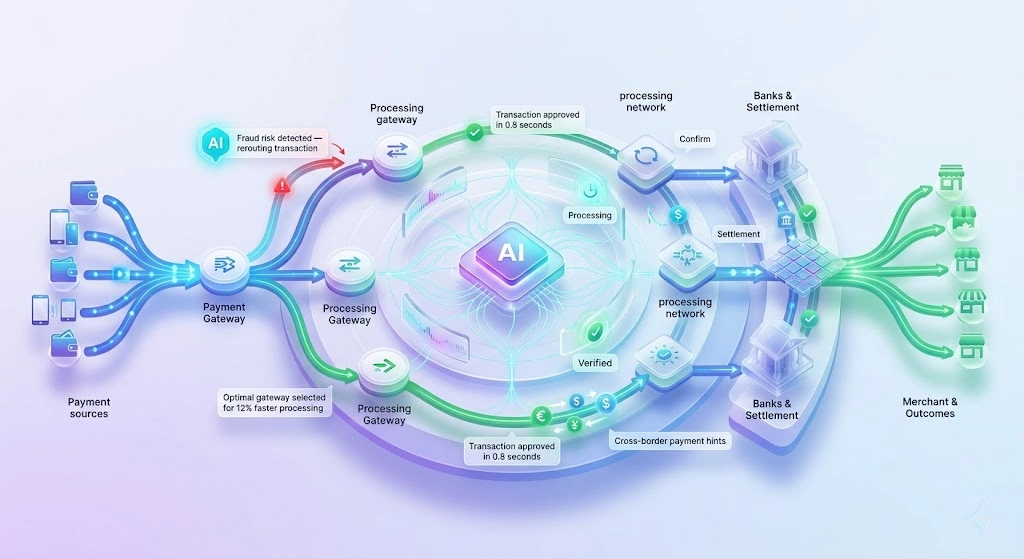
Our enterprise infrastructure helps payment gateways and digital wallets process higher volumes safely and meet regulatory demands without linearly increasing compliance headcount.
31%
Reduction in fraud-related losses.
<150 ms
Transaction risk evaluation time.
70%
Improvement in compliance reporting efficiency.
AI delivers the highest ROI in high-velocity, heavily regulated transaction environments. Here is how we apply it:

Deploy predictive models analyzing metadata in milliseconds, blocking emerging fraud vectors before funds settle.

Utilize Autonomous Agents to continuously screen transactions against global watchlists with minimal intervention.

Instantly extract and validate corporate registry and identity data to eliminate manual review bottlenecks.

Automate the gathering of transaction evidence and initial dispute resolution decisions, reducing administrative burden.

Use predictive analytics to dynamically route cross-border payments through cost-effective and reliable networks.
We build and deploy AI systems inside regulated financial environments where latency, PCI-DSS compliance, and system availability are non-negotiable.
Where AI Fits in the Payment Stack
AI enhances core payment gateways and ledgers through a structured, highly secure architecture
%201.webp)
Ingestion
Pull high-velocity transaction payloads, merchant data, and user behavior metrics from legacy databases.

Secure APIs
The low-latency middleware connecting payment switches and core infrastructure to AI scoring engines.

Model Layer
Localized predictive models ensuring sensitive payment data never leaves your secure, PCI-compliant cloud.

Human-in-the-Loop
AI handles real-time scoring and tier-1 reporting; high-value cases and AML investigations route to human officers.
Common Payment Automation Challenges
.webp)
AI analysis in an authorization flow must happen in milliseconds to prevent transaction timeouts and cart abandonment.

Customer financial data must remain in strictly isolated environments to maintain PCI-DSS and SOC2 compliance.

Overly aggressive models block legitimate buyers, directly impacting merchant revenue and platform trust.

Best Fit: Regulated payment gateways and processors needing a low-latency AI layer over existing switches.
Not a Fit: Basic fraud plugins or POCs without enterprise latency requirements.
Best Fit: Regulated payment gateways and processors needing a low-latency AI layer over existing switches.
Not a Fit: Basic fraud plugins or POCs without enterprise latency requirements.

Real-time transaction fraud scoring, automated AML reporting, chargeback evidence gathering, and merchant onboarding.
No. We engineer our secure APIs and predictive models for low-latency environments, ensuring risk scoring occurs in under 150 milliseconds.
Yes. Secure implementations utilize customized API middleware and localized models to ensure full data isolation and regulatory compliance.
Anomaly detection models identify deviations from standard transactional behavior, flagging emerging fraud vectors that traditional rules miss.
Our AI systems feature transparent logging. Every rule interpretation, flagged transaction, and risk score generates an audit trail for reporting.
.webp)
.webp)
.webp)

BuildNexTech empowers businesses with expert web development, app development, and cloud migration services.


.webp)
.webp)
