

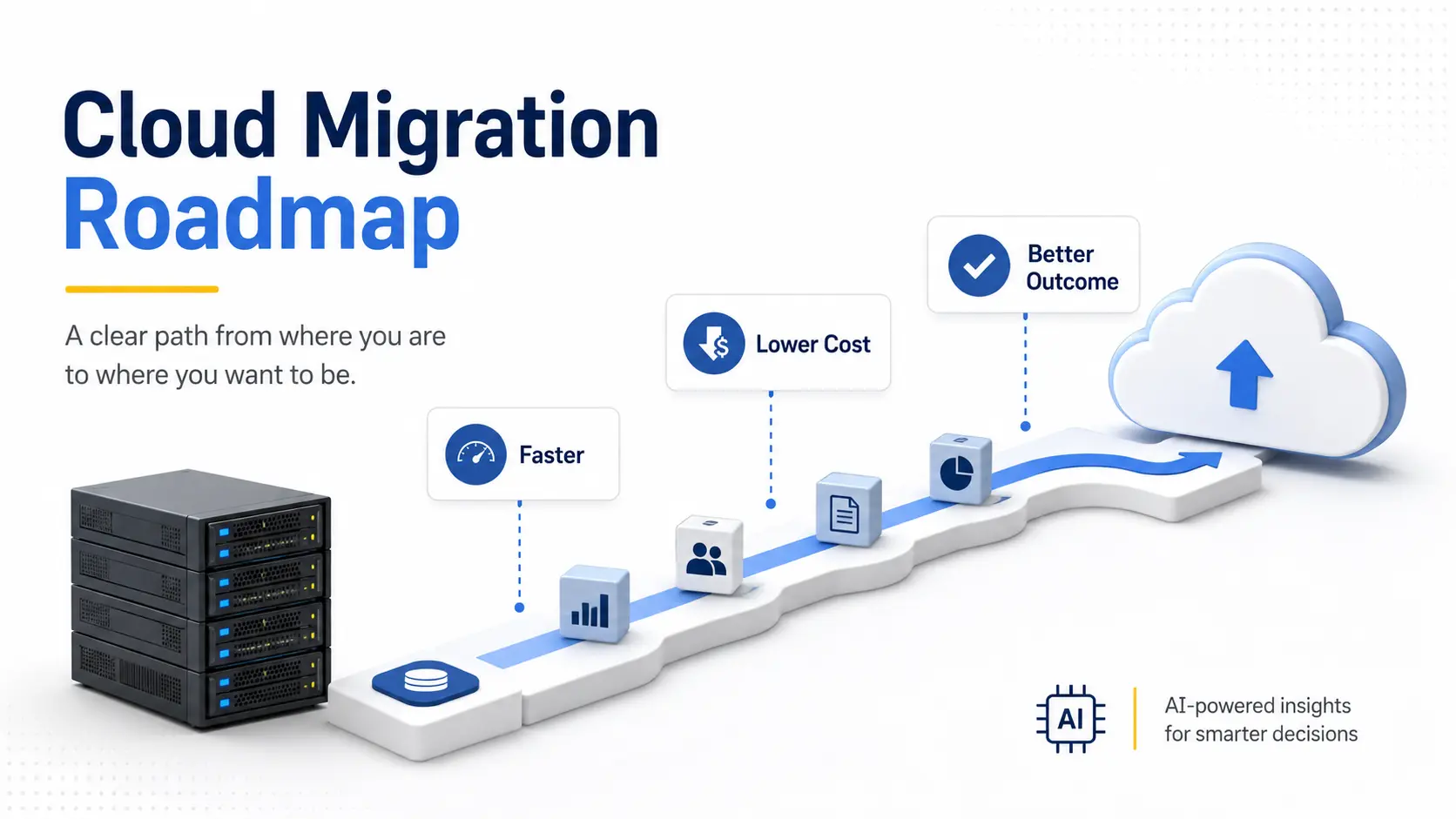
A U.S. logistics firm migrated 80% of its infrastructure to AWS over fourteen months. The cutover went technically clean. Six months later, their cloud bill was 31% higher than their on-prem costs, three critical integrations were misbehaving under load, and the team responsible had already moved on.
The cloud migration strategy was executed correctly. The migration had still failed.
That gap, between technical completion and actual business outcome, is where 62% of cloud migration projects end up, according to IDC. The cloud provider was not the problem. The planning was.
TLDR: Most cloud migrations stall or overspend because dependency mapping is manual, FinOps discipline starts too late, and landing zone architecture is treated as secondary. AI-powered workload assessment, IaC-governed landing zones, and agentic automation across the full migration lifecycle close all three gaps while reducing out-of-pocket costs and improving efficiency.
Across 150+ client engagements in fintech, healthcare, and retail, BuildNexTech has seen the same planning gaps surface regardless of cloud provider or team size.
Why Cloud Migration Projects Fail Before Cutover
A U.S. healthcare technology company came to BuildNexTech mid-migration, six months into a planned four-month timeline. With US healthcare spending on digital infrastructure accelerating, the pressure to move fast was real.
Their dependency maps, built manually in spreadsheets, had missed seven cross-service integrations. Two of those handled patient record synchronisation. They discovered this at the wave two cutover, not during planning.
The root cause of most failures is not technical complexity. Skills degradation on legacy systems, absent planning discipline, and the gradual erosion of institutional knowledge about undocumented integrations are far more consistent culprits. Across every engagement, the same three structural gaps emerge.
The Three Planning Gaps That Kill Migration ROI
These gaps appear regardless of team size or budget. Identifying them early is the difference between a migration that delivers ROI and one that simply moves the problem somewhere more expensive.
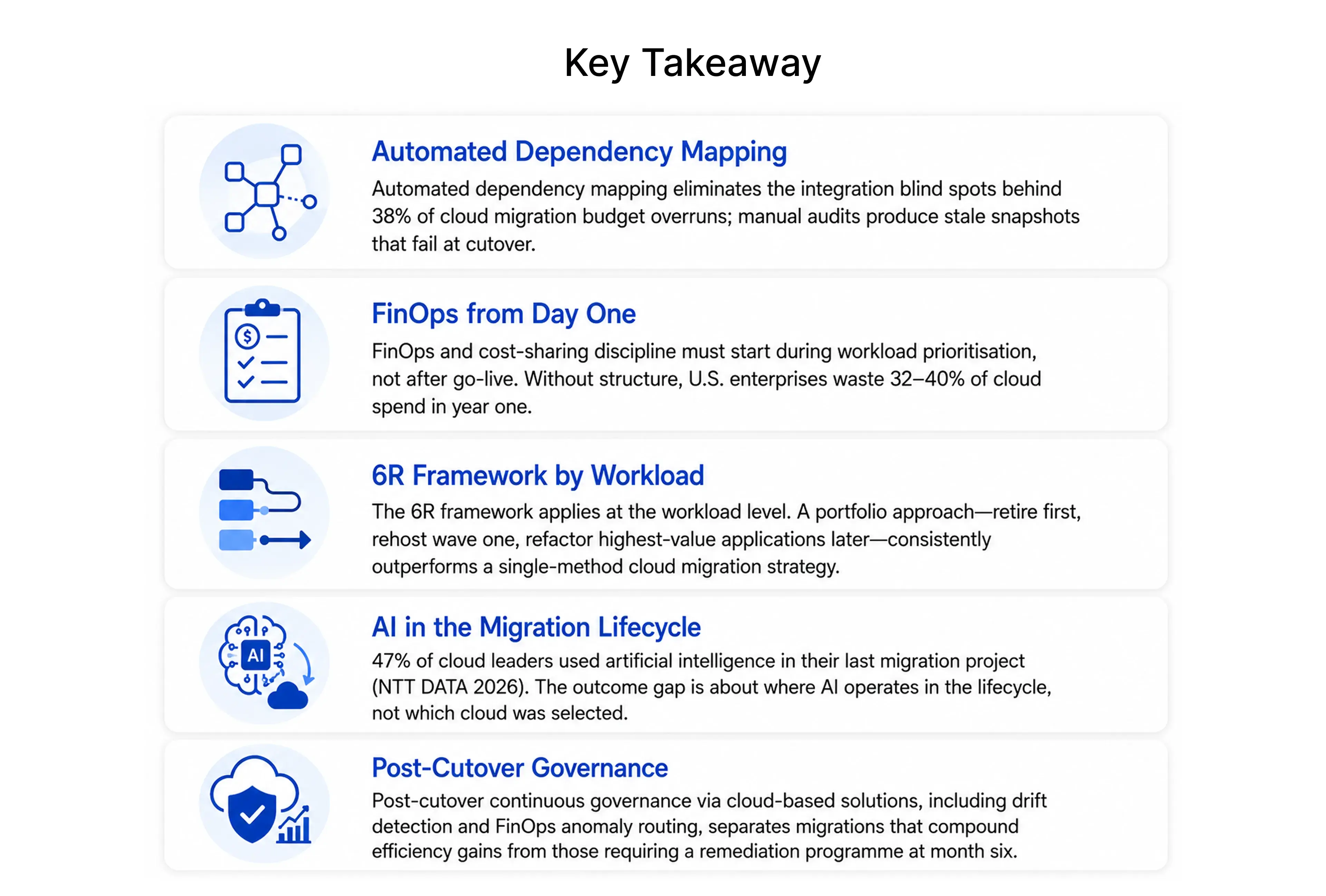
Gap 1: Manual dependency mapping: When teams audit legacy infrastructure by hand, they produce a snapshot accurate at audit time, not at cutover time. The integrations that get missed account for 38% of budget overruns: internal APIs added quietly, data pipelines built by engineers who have since left, shadow integrations that only surface under production load.
Gap 2: Absent FinOps discipline: Flexera's 2026 State of the Cloud Report found wasted cloud spend now represents 29% of total cloud spend. Organisations without structured cost-sharing governance and expense management waste 32-40% in year one. Right-sizing and cost checks must be embedded in IaC pipelines before the first workload moves, not after the first invoice arrives.
Gap 3: Landing zone as an afterthought: Retrofitting security controls, IAM policy, and compliance tagging after go-live costs three to five times more than embedding them from day one. Gartner found 99% of cloud security failures through 2025 originated from customer-side misconfiguration. Most were retrofits.
What Makes Cloud Migration Hard in Practice
Even well-planned migrations hit friction. These are the challenges that surface most consistently across enterprise programmes.
- Security misconfigurations: More than 60% of enterprise cloud incidents come from customer-side misconfigurations, not provider vulnerabilities. Controls embedded at landing zone design cost a fraction of what post-go-live remediation costs.
- Unplanned cost growth: Without expense management and price transparency built into the migration plan, cloud bills routinely exceed budgets. Organisations spend 14% more on migration than planned on average, and energy costs from over-provisioned environments compound the overrun.
- Skills gaps: By 2026, 65% of cloud-related outages are projected to trace back to inadequate migration expertise. Skills degradation on legacy systems means institutional knowledge is already incomplete by the time dependency audits begin.
- Legacy compatibility and reprocessing: Schema mismatches, broken APIs, and format incompatibilities require reprocessing work that was never budgeted. Finding these conflicts during readiness assessment keeps wave schedules intact. Finding them at cutover blows them.
.webp)
Building a Cloud Migration Planning Framework That Holds
Most teams skip straight to tooling selection before they have mapped their workloads. That is the wrong starting point.
A robust cloud migration plan runs four sequential phases. Each gates the next. Skipping one does not save time; it moves the cost to a later point where fixing it costs significantly more.
AI-driven data collection against live infrastructure collapses the readiness phase from three to four weeks of manual audit into two to three days.
Teams that treat cost governance as a cost-plus pricing model pay three to four times more in reprocessing and remediation costs post-go-live. Visual management of the dependency graph and energy costs visibility built into each wave approval prevents the over-provisioning that drives wasted spend above 29% of total cloud budgets.
Choosing the Right Migration Path for Each Workload
The 6R framework is a workload-level decision tool, not an organisational philosophy. Apply it per application during prioritisation, not once at programme level.
The best cloud migration strategy is a portfolio approach. Quick-win workloads move first; higher-risk systems follow a deliberate modernisation track; 10-25% of the portfolio gets retired before migration starts.
Which path fits your workload?
- Non-critical, needs to move fast? Rehost it.
- Benefits from managed services without code changes? Replatform.
- High-value ROI justifies the engineering investment? Refactor.
Our Take: Lift-and-shift is the right call for wave-one workloads when the goal is to prove the migration pipeline. Teams that refactor everything in wave one spend twice as long, introduce three times the risk, and rarely finish on schedule. Sequence for learning, then optimise.
.webp)
AI-Powered Automation Across the Migration Lifecycle
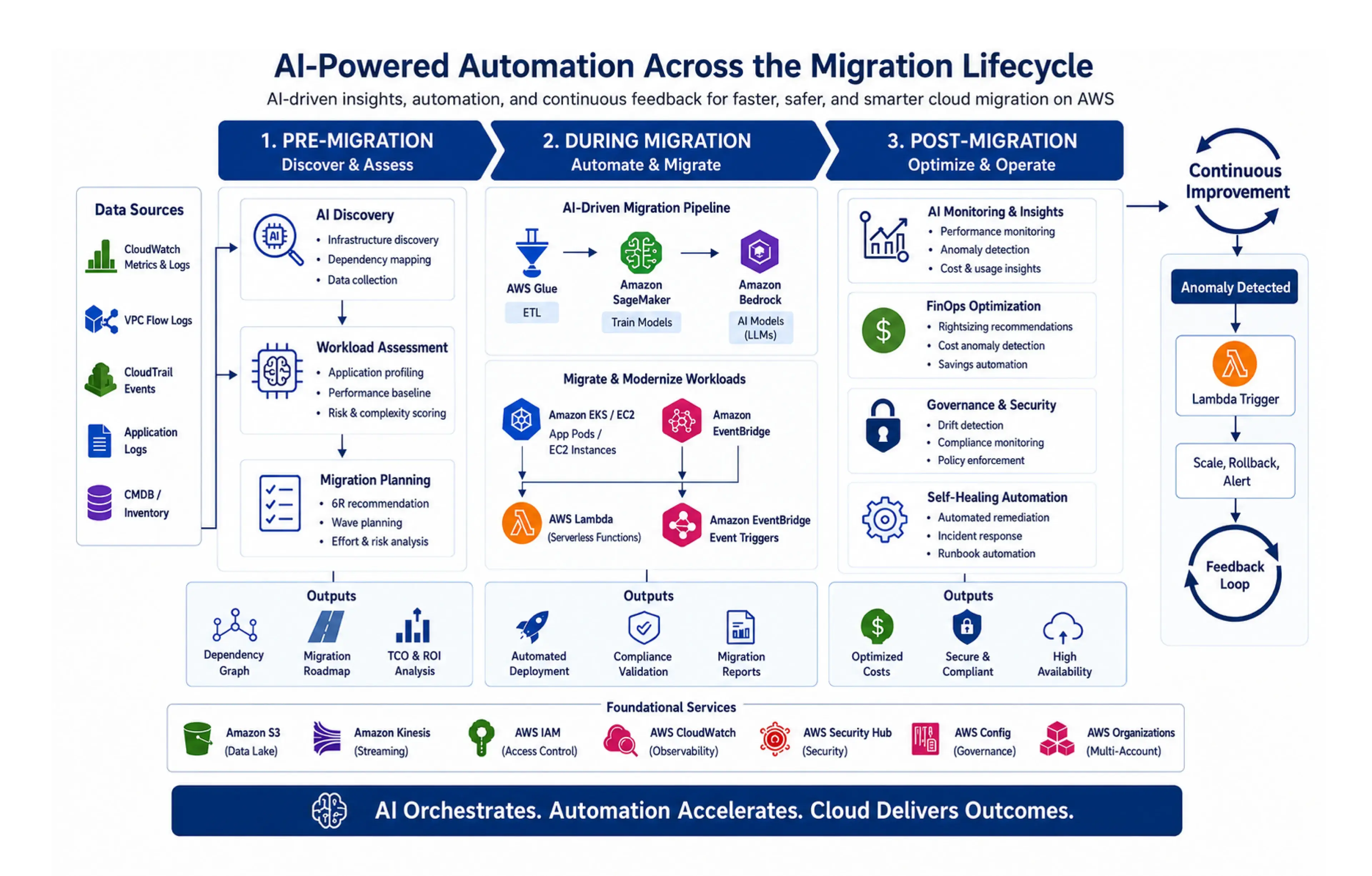
Artificial intelligence in cloud migration is not a label on a legacy discovery tool. It is autonomous agents running across dependency mapping, workload classification, IaC generation, and compliance policy validation across every phase.
NTT DATA's 2026 Cloud Report found that 47% of cloud leaders used AI in their most recent migration project versus 35% of all other organisations. The gap is not about access to AI tools. It is about where in the lifecycle those tools actually operate.
Here is how artificial intelligence changes each phase:
- Pre-migration: Automated dependency mapping and workload assessment collapse weeks of manual audit into hours, eliminating integration blind spots responsible for most budget overruns.
- During migration: Autonomous pipeline orchestration handles wave-checkpoint compliance validation and quality control without manual intervention, supporting continuous improvement across every wave.
- Post-cutover: FinOps anomaly detection surfaces cost spikes in real time and routes remediation as code changes rather than support tickets, improving ongoing efficiency.
Where AI and ML Remove Migration Risk
AI handles the phases where human effort is slowest and most error-prone. Machine learning adds a layer that gets sharper with every wave.
- Workload classification. ML analyses application behaviour, dependency patterns, and compliance requirements to assign the right 6R migration path per workload, removing subjectivity from prioritisation.
- Predictive right-sizing. Historical usage patterns are used to model the correct instance type and size before migration. This reduces energy costs and eliminates the over-provisioning responsible for wasted spend across most post-migration environments.
- Compliance validation. Policy checks run continuously across IaC definitions, flagging misconfigurations before they reach the target environment. Organisations using AI-driven security tooling average 30% faster project completion and 50% fewer post-migration security incidents.
- Anomaly detection. Post-cutover, performance, cost, and security signals are monitored in real time. Alerts route as code changes for review, not support tickets for manual triage.
The result: software quality control, cost governance, and security posture improve continuously across every wave rather than degrading between review cycles.
IaC is the migration control plane. Terraform, Pulumi, and OpenTofu ensure every software resource is codified, compliance enforced via OPA/Rego in CI pipelines, and post-cutover optimisation handled as a PR workflow.
Zero-downtime cutover architecture uses continuous replication until the final traffic flip, with automated rollback triggers and real-time observability via CloudWatch, Azure Monitor, or Dynatrace.
Multi-Cloud Governance: Where Most Migrations Lose Control
IAM logic is not portable across cloud providers. AWS IAM evaluates per API call; Azure Entra ID cascades through a management hierarchy; GCP IAM stacks roles with cumulative inheritance. Direct role mirroring creates security gaps that surface during audits or performance reviews, rarely before.
Policy-as-code resolves this. Define access intent in IaC, compile per cloud via Terraform or Pulumi, and enforce in CI automatically.
This keeps multi-cloud environments auditable under SOC 2 and FedRAMP, supports contract management and vendor contracts governance, and ensures CIDR planning happens before the first workload moves rather than after the first hybrid path failure.
How BuildNexTech Accelerates Cloud Migration from Assessment to Production
BuildNexTech's AI-native cloud migration services automate workload discovery, dependency mapping, IaC generation, compliance validation, and FinOps anomaly detection across AWS, Azure, and GCP.
A U.S. hospital system we worked with reduced administrative burden by 40% within the first quarter post-migration. A U.S. logistics fleet client achieved 40% downtime reduction through agentic monitoring from go-live. Both engagements included cost-sharing governance and price transparency dashboards built into the post-migration environment from day one.
Our AI services platform lets platform and DevOps teams deploy agentic workflows for migration discovery and validation without building custom software tooling from scratch. No model lock-in, with audit-ready compliance logging aligned to SOC 2 and NIST AI RMF controls.
What a BuildNexTech Migration Engagement Looks Like
- Day 1-3: Automated asset discovery generates the migration catalogue and dependency graph from live infrastructure, not from existing documentation.
- Day 4-7: Agentic workload classification assigns 6R migration paths based on complexity score, compliance tier, and business criticality. Review flows through PR workflow in GitHub or GitLab.
- Week 2: Migration wave sequencing is generated as an executable IaC plan. FinOps cost checks validate each wave against budget thresholds before approval gates open.
- Week 3 onward: Drift detection, compliance validation, and FinOps anomaly detection run continuously. The agentic layer routes remediation as code changes, not support tickets.
Key Takeaways
The Migration Is Not the Destination
Most cloud migration strategies are written to get workloads moved. Few are written to make the cloud environment more efficient, more governed, and cheaper every month after go-live.
The difference is not provider selection. AWS, Azure, and GCP all have the raw capability.
The difference is what runs on top after cutover: whether governance is automated or manual, whether FinOps anomalies surface in hours or at month-end, whether price transparency on cloud-based solutions is built in or bolted on.
Organisations that approach post-migration governance as a cost-plus pricing exercise, adding cost-sharing controls only when cost pressure forces it, consistently underperform those who instrument governance from day one. Energy costs on over-provisioned environments and the reprocessing overhead from failed integrations are what push cloud bills above on-prem baselines.
The organisations reaching the highest cloud maturity levels, just 14% of all enterprises per NTT DATA 2026, treated the cloud migration strategy as the first phase of an AI-native operating model built for continuous improvement.
Skills degradation on legacy systems, undocumented integrations, and absent cost governance are not one-time migration risks. They compound. That distinction, made early in planning, is worth far more than any provider discount negotiated at contract signature.
People Also Ask

What does a cloud migration strategy actually cover?
A cloud migration strategy covers cloud readiness assessment, workload discovery, dependency mapping, landing zone design, compliance controls, FinOps governance, and software expense management through post-cutover.
How long does a cloud migration take for a mid-to-large enterprise?
The median migration runs approximately eight months end-to-end. Simple workloads complete in four to six weeks; complex, regulated, multi-system environments routinely run twelve months or more.
What causes cloud migrations to go over budget?
Skipped readiness assessments, undiscovered legacy dependencies, absent FinOps discipline, and IAM misconfiguration are the four most consistent causes. Organisations running formal assessments report 2.4x higher success rates.
How does artificial intelligence change cloud migration execution?
AI handles automated dependency mapping pre-migration, autonomous pipeline orchestration during migration, and FinOps anomaly detection with continuous drift remediation post-cutover, making failures predictable during planning.
AWS, Azure, or Google Cloud: how do we choose?
The decision is workload-level, not organisational. AWS fits global-scale compute; Azure fits enterprise compliance; GCP fits AI/ML inference. Gartner projects 90% of enterprises will operate hybrid or multi-cloud by 2027.


.webp)
.webp)
.webp)

.webp)
.webp)