

.webp)
Hyperautomation is the coordinated use of AI, Robotic Process Automation (RPA), and Business Process Management (BPM) to identify, automate, and continuously improve end-to-end business processes. Unlike traditional automation that focuses on isolated tasks, hyperautomation connects intelligence (AI), execution (RPA), and orchestration (BPM) into a unified system that drives scalable business outcomes.
Why Businesses Need Hyperautomation Now
How Manual Processes Slow Growth and Increase Costs
Walk into most mid-sized operations, and you'll find the same problem wearing different clothes: a finance team manually keying invoice data into three different systems, a customer service rep toggling between tabs to resolve a single ticket, a supply chain manager reconciling spreadsheets that should have been automated years ago. These aren't edge cases-they're the default state of businesses that grew fast and stitched together IT systems along the way.
Manual processes aren’t just a minor operational nuisance; they erode growth opportunities and operational resilience at their core. Treating automation as optional guarantees rising operational debt that eventually blocks even basic scaling. From working in operations-heavy sectors, I see that the true costs aren’t always in the P&L-they're in slow order processing, inconsistent customer experience, and decisions made with outdated data. Hyperautomation isn't just valuable-it's becoming necessary for sustainable, competitive growth.
What Hyperautomation Actually Means in Practice
Hyperautomation isn't a product you buy. It's a strategy-one that combines AI, Robotic Process Automation, and Business Process Management into a coordinated system that can identify, automate, and continuously improve end-to-end business processes.
Gartner coined the term, but the urgent point is clear: hyperautomation requires using every available automation tool intelligently across an organization. This means process discovery, AI agents, intelligent document processing, and no-code platforms-coordinated for maximum impact. Not one tool fits all, but the right tool for each layer is non-negotiable for those who want to keep pace.
AI as the Intelligence Layer of Hyperautomation
How Intelligent Automation Enhances Decision-Making
Most automation fails not because the bots break, but because the decision logic underneath is too rigid. Rules-based systems handle known scenarios well. They fall apart the moment a vendor sends an invoice in an unexpected format, or a customer request doesn't fit a predefined category.
This is where machine learning and natural language processing change the game. AI brings adaptive decision-making to processes that used to require human judgment. Fraud detection in financial workflows, dynamic routing in customer service, risk prediction in supply chain management-these aren't theoretical use cases anymore. They're running in production at companies that made the shift from rule-following bots to genuinely intelligent automation.
In a bnxt.ai engagement with a mid-market lending company, a manual underwriting decision layer was replaced with a predictive modeling system. The change didn't eliminate humans-it elevated them. Underwriters stopped reviewing routine approvals and started focusing only on edge cases. Decision quality improved. Processing time dropped by 60%.
AI Use Cases in End-to-End Process Automation
The practical applications are broader than most teams' initial scope. Generative AI is being used to draft communications, summarize documents, and respond to natural language prompts from internal users. Intelligent document processing handles unstructured inputs-contracts, invoices, forms-that traditional automation couldn't touch. Digital twin technology lets organizations simulate process changes before rolling them out, which significantly reduces implementation risk.
Advanced analytics layered into workflow automation surfaces insights that used to require dedicated data teams. AI connectors now bridge systems that were never designed to talk to each other, enabling integration platform as a service (iPaaS) patterns that would have taken months to build just a few years ago.
RPA as the Execution Engine of Hyperautomation
What Is Robotic Process Automation (RPA)?
Picture a software layer that watches how your employees interact with applications-clicks, copy-paste, form fills, data transfers across IT systems-and then replicates that work automatically, at scale, without errors. That's RPA at its core.
What makes modern RPA more interesting than early screen-scraping tools is the spectrum of bot types available. Assisted bots work alongside humans in real time, prompting or completing steps during live interactions. Unassisted bots run independently on scheduled triggers or event-based logic. Cloud RPA extends this to cloud platforms without requiring on-premise infrastructure. The toolset has matured considerably-UiPath, Automation Anywhere, and Blue Prism have all moved well beyond basic UI automation into orchestrated enterprise workflows.
How RPA Eliminates Repetitive Business Tasks
The ROI case for RPA tends to be obvious quickly. Back-office tasks that involve moving data between systems, generating reports, reconciling records, or processing routine requests are where bots deliver the clearest wins. Order processing is a classic example-from receipt to fulfillment confirmation, most of the steps are deterministic and repeatable. RPA handles them without supervision.
Low-code/no-code tools have made RPA more accessible, too. Business teams can now configure automation workflows without deep technical knowledge, using low-code application platforms that abstract away the complexity. That said-I'll be direct here-RPA without good process design underneath just automates bad processes faster. That's where BPM comes in.
BPM as the Orchestration Layer of Hyperautomation
What Is Business Process Management (BPM)?
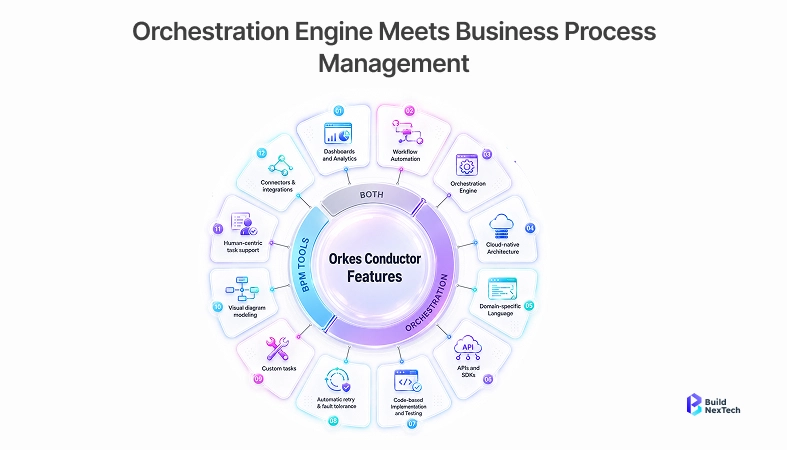
Before you automate anything, you have to understand what you're actually automating. BPM is the discipline-and the toolset-that makes that possible. It's how organizations map, analyze, execute, and continuously improve their workflows. Business process management software and intelligent BPM suites provide the structural layer that keeps automation aligned with actual business outcomes.
Without BPM, hyperautomation efforts tend to become collections of disconnected bots and AI models that each solve narrow problems but don't compound into real operational efficiency. With it, you get coherent process capabilities, clear ownership, and the ability to measure what's actually happening across systems.
How BPM Connects People, Systems, and Workflows
Good BPM platforms do more than document workflows. They orchestrate them-routing processes dynamically based on rules, workload, or AI-driven decisions. They provide user dashboards that give both frontline employees and managers visibility into process status. They incorporate business rules engines that can evaluate conditions and trigger actions without requiring code changes.
Process mining and task mining are increasingly central to this layer. Instead of mapping processes manually (which produces aspirational diagrams rather than reality), these tools analyze system logs and user behavior to show what's actually happening.In bnxt.ai's process discovery engagements, organizations that invest in process mapping before automation identify 30–40% more viable automation opportunities than those that skip this step-and they avoid automating broken workflows. In bnxt.ai's hyperautomation implementations, the most underestimated challenge is not RPA-it is process orchestration. Clients that align BPM before bot deployment typically achieve stable automation within 60–90 days, compared to 4–6 months when orchestration is retrofitted later.
Content automation and intelligent routing make BPM genuinely dynamic. Social, mobile, and cloud-focused businesses especially benefit here, since their processes often span multiple touchpoints and require real-time decision logic.
Hyperautomation Costs, ROI, and Business Impact
Expected ROI from Hyperautomation Initiatives
ROI varies significantly by process type and industry. Repetitive, high-volume tasks-claims processing, invoice management, compliance reporting-typically show payback within 6–12 months. More complex initiatives involving AI agents and full end-to-end business process transformation take 18–24 months to show peak ROI, but the ceiling is much higher.
A practical benchmark: Deloitte's global RPA survey found companies deploying automation at scale reported cost reductions of 20–35% in targeted business areas. When AI is integrated into decision-making processes, that figure increases.
The honest qualifier is that these numbers assume solid implementation-poor change management and weak process design will erode gains quickly.
How Hyperautomation Reduces Operational Costs
The cost savings come from multiple directions simultaneously. Fewer manual errors mean less rework. Faster processing means lower cycle times and better cash flow. Reduced dependency on headcount for routine tasks shifts labor toward higher-value work. App development timelines shorten when no-code automation handles integration tasks that used to require custom builds.
Operational costs tied to compliance are particularly responsive-automated audit trails, consistent data handling, and real-time risk prediction tools reduce both the cost and exposure of regulatory work. In supply chain management, the compounding effect of better data, faster decisions, and automated execution can meaningfully reduce carrying costs and vendor risk.
Choosing the Right Hyperautomation Strategy
Best Hyperautomation Tools and Platforms to Evaluate
The market is complex, and platform selection is often approached incorrectly. The most common mistake is leading with the vendor rather than assessing process maturity first. A more effective approach is to evaluate process readiness, then align platform capabilities to actual business requirements. That said, a few platforms deserve serious evaluation depending on your context.
UiPath leads for complex RPA with strong enterprise governance. Automation Anywhere is a strong contender for cloud-native deployments with good AI connectors. For BPM orchestration, Appian and Pega offer intelligent BPM suites with built-in process mining. Microsoft Power Platform is compelling for organizations already deep in the Microsoft ecosystem, especially for no-code automation use cases. Progress Corticon stands out specifically for business rules engine requirements, where decision logic is complex and needs to be managed independently of application code.
For AI capabilities, the honest evaluation should include what models underpin the intelligent automation-and whether the vendor has real integration depth or just marketing around generative AI. API integration quality matters enormously here.
Steps to Start Your Hyperautomation Journey
Start narrow, think wide. Pick two or three high-volume, low-exception processes and map them thoroughly using process discovery tools before writing a single automation. Establish baseline metrics-cycle time, error rate, cost per transaction-so ROI is measurable from day one.
Build a cross-functional team early. The most common failure mode I've seen is IT leading automation initiatives without operations buy-in, resulting in technically functional bots that no one uses. Digital transformation is a people problem as much as a technology one.
Then expand: use task mining to surface the next wave of opportunities, extend into AI-enhanced workflows for decision-heavy processes, and build the governance layer-user dashboards, audit trails, exception handling-that makes the system sustainable at scale.
Conclusion: Building the Future with Hyperautomation
Why AI, RPA, and BPM Are Stronger Together
Each pillar has limits alone. RPA without intelligence is brittle. AI without execution is theoretical. BPM without automation is documentation. Together, they form a system that can sense, decide, act, and improve-continuously, across the full width of business operations.
The organizations pulling ahead aren't choosing between these tools. They're integrating them into a coherent automation platform that spans from process discovery all the way through digital business transformation. Internet of Things sensors, cyber-physical systems, and Smart Industry initiatives are all extending this further-hyperautomation is becoming the operating system of Industry 4.0.
How to Begin Your Hyperautomation Transformation
If you're looking for where to start-or how to accelerate what you've already begun-the work is clearer than it looks. Identify your highest-cost manual processes. Map them with process mining. Automate execution with RPA. Apply AI where decisions are needed. Orchestrate everything with BPM.
Platforms like bnxt.ai are built specifically for teams at this inflection point-combining the intelligence, execution, and orchestration layers without requiring you to stitch together five separate vendor relationships. The technology is mature enough to deliver real results now. The question is whether your organization is ready to commit to the process discipline that makes it work.
People Also Ask

1. How much does AI automation cost to implement?
Costs range from $5,000 for basic RPA deployments to $500,000+ for enterprise hyperautomation programs-highly dependent on process complexity, vendor choice, and integration scope.
2. What processes should businesses automate first?
Start with high-volume, rule-based tasks with clear inputs and outputs-invoice processing, data entry, report generation, and compliance checks deliver the fastest, most measurable ROI
3. How long does AI automation take to show ROI?
Simple RPA deployments typically show ROI within 6–12 months; AI-enhanced automation programs usually reach full return within 18–24 months, depending on process complexity.
4. Can AI tools integrate with legacy systems?
Yes-modern automation platforms use API integration, screen scraping, and AI connectors to bridge legacy IT systems without requiring full replacement or re-architecture.
5. Which industries save the most with AI automation?
The industries that save the most with AI automation are financial services, healthcare, insurance, and manufacturing - as they operate high volumes of structured, repetitive processes where automation delivers maximum ROI.


.webp)
.webp)
.webp)

.webp)
.webp)