

Smart contract exploits rarely happen because attackers discover flaws in the Ethereum Virtual Machine (EVM) itself. More often, they stem from preventable mistakes in contract logic, access controls, or external interactions. Once deployed, these weaknesses can expose millions in digital assets and leave teams with limited remediation options.
For QA engineers, CTOs, and DevOps leads building on EVM-compatible chains, understanding EVM security architecture is essential to identifying risks early and strengthening smart contract security before vulnerabilities reach production.
Understanding EVM Security Architecture and How It Executes Smart Contracts
What the Ethereum Virtual Machine Is and How It Processes Contract Bytecode
The Ethereum Virtual Machine, commonly known as the EVM, is the smart contract runtime that executes code across Ethereum and other EVM chains. Developers write source code using Solidity, the most widely used smart contract programming language. The code is then compiled into bytecode that the EVM can execute.
Solidity is the language used to build smart contracts, while the EVM executes them consistently across thousands of nodes.
The EVM follows a deterministic execution model. Every node processes the same transaction and reaches the same result. This consistency is what enables decentralized applications to operate without centralized control.
However, the same feature that makes smart contracts trustworthy also introduces risk. Once code is deployed, vulnerabilities become part of the contract logic and can be exploited by anyone who interacts with it.
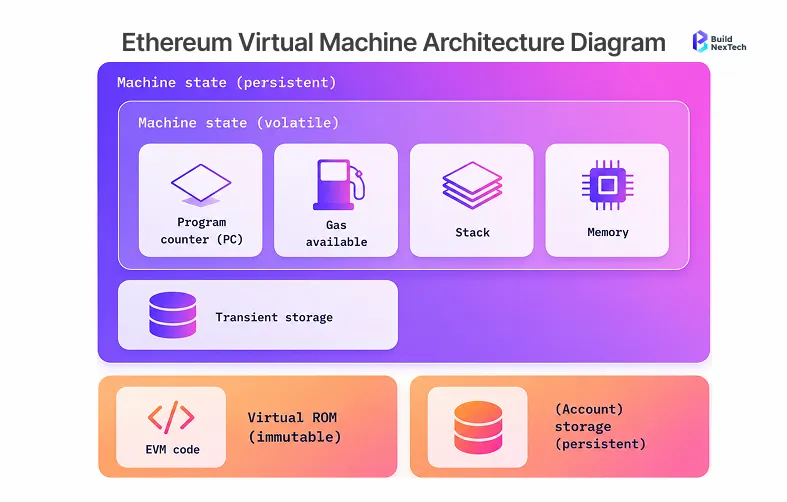
Core Components of EVM Security Architecture: Stack, Memory, Storage, and Trust Boundaries
EVM security architecture relies on several core execution components working together in a layered design.
Stack
- Temporary storage for calculations and opcode execution.
- Operates using a Last-In-First-Out mechanism.
- Limited size helps maintain predictable execution.
Memory
- Temporary data storage used during transaction execution.
- Cleared after each transaction.
- Less expensive than persistent storage.
Storage
- Permanent key-value storage attached to a contract.
- Holds balances, ownership information, and business logic data.
- Changes remain on-chain after execution.
Trust Boundaries
- Separate responsibilities between the protocol and developers.
- The EVM enforces gas limits and transaction validity.
- Developers must implement access controls, validation logic, and protection mechanisms.
Many blockchain security vulnerabilities arise when developers misunderstand these boundaries and assume the platform provides protections that must actually be implemented in code.
Why EVM Architecture Design Directly Determines Smart Contract Security Posture
Security decisions made during architecture design often determine whether a project remains secure after launch.
Unlike traditional applications, smart contracts cannot always be patched quickly. A poorly designed transfer function, privileged function, or external call can become a permanent attack vector after deployment.
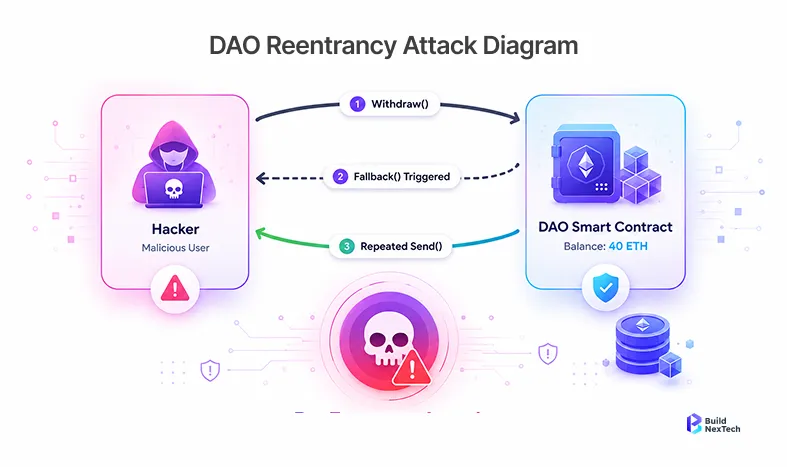
Consider a DeFi lending application. If developers allow external calls before updating account balances, attackers may exploit a reentrancy vulnerability and repeatedly withdraw funds before state changes are recorded.
This is why smart contract security begins long before testing and auditing. It starts with architecture decisions that define how contracts interact, how permissions are managed, and how sensitive operations are protected.
Organizations that prioritize blockchain cybersecurity during design typically experience fewer critical findings during smart contract auditing. At BuildNexTech, our blockchain security specialists consistently find that architecture-level decisions not just code determine where vulnerabilities appear in security reviews.
The EVM Attack Surface: Where Threats Begin
How the EVM Execution Environment Exposes Contracts to External Inputs and Interactions
Every public function deployed on an EVM blockchain is accessible to anyone capable of submitting a transaction. Attackers do not need privileged network access or special permissions to interact with contract logic.
This open execution model creates a unique attack surface that security teams must account for.
Common sources of risk include:
- Unvalidated user inputs that bypass business logic checks.
- Insecure external call handling that creates unexpected execution paths.
- Weak authorization controls that expose privileged functions.
- Improper state management that enables fund manipulation.
- Oracle dependencies that can be exploited through data manipulation.
The decentralized nature of blockchain deployment means security teams must assume every public-facing function will eventually be tested by attackers.
Entry Points, Contract Interfaces, and On-Chain Data as Primary Attack Vectors
Most contract vulnerabilities originate from a small number of attack vectors.
Public functions expose application logic directly to users. If validation is missing, attackers may trigger unintended behaviors.
Contract interfaces introduce another layer of risk. Poorly secured APIs between contracts can expose sensitive operations or bypass intended business rules.
On-chain data can also become a security concern. Variables such as timestamps, block information, and oracle feeds are frequently used in business logic. When developers treat these values as fully trustworthy, attackers may manipulate outcomes.
Examples include:
- Price oracle manipulation in DeFi protocols.
- Transaction ordering attacks.
These risks demonstrate why vulnerability detection must evaluate both code quality and business logic.
How Composability and Contract-to-Contract Calls Expand the EVM Attack Surface
Modern DeFi smart contracts often interact with multiple protocols during a single transaction. A single transaction can interact with multiple protocols simultaneously.
While this interoperability drives innovation, it also expands the attack surface.
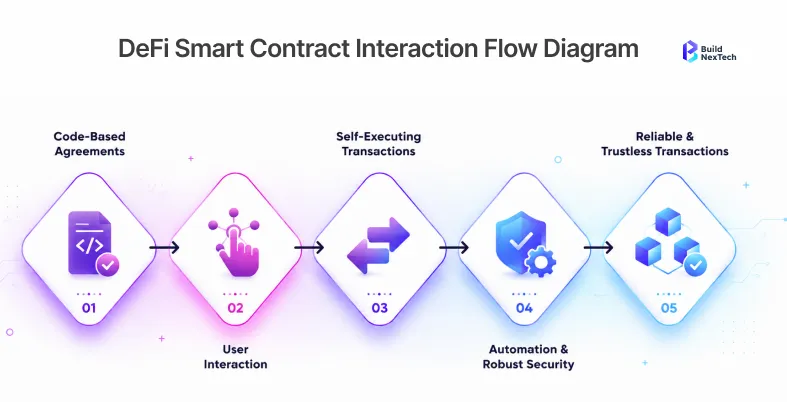
Every external call introduces new dependencies and potential risks. If an integrated protocol becomes compromised, connected contracts may inherit security issues.
Particular attention should be given to delegate call operations. Delegate call executes code from another contract while maintaining the caller's storage context. When used improperly, attackers can overwrite critical variables or bypass intended restrictions.
As EVM crypto ecosystems become more interconnected, security teams must evaluate not only their own contracts but also the security posture of every external dependency.
Common Smart Contract Vulnerabilities in EVM Architecture
Reentrancy Attacks and State Manipulation: The DAO Hack and How $60M Was Drained
In 2016, attackers exploited a reentrancy attack by repeatedly calling a withdrawal function before balances were updated. This allowed funds to be drained from the protocol multiple times within the same transaction. The exploit resulted in approximately $60 million being removed from the DAO treasury and ultimately led to Ethereum's hard fork. The contract performed an external call before updating its internal state.
To reduce reentrancy vulnerability risks, developers should:
- Update state before making external calls.
- Follow the checks-effects-interactions pattern.
- Use OpenZeppelin ReentrancyGuard when appropriate.
- Minimize unnecessary external interactions.
Despite years of awareness, reentrancy attacks continue to appear in audit reports and vulnerability categories tracked by the SWC Registry.
Access Control Flaws and Privilege Escalation: Lessons from the Parity Wallet Freeze
Not every exploit involves stealing funds directly. Sometimes a single mistake can permanently lock assets.
The Parity frozen wallet issue demonstrated the impact of weak access controls. In 2017, an unprotected initialization function allowed a user to gain ownership of a critical library contract. The user then triggered a self-destruct operation that rendered hundreds of wallets unusable.
More than $150 million worth of assets became inaccessible.
This incident highlights several important lessons:
- Every privileged function requires explicit authorization.
- Ownership transfer mechanisms must be carefully tested.
- Role-based control is safer than relying on implicit assumptions.
- Security auditors should review administrative workflows as thoroughly as financial logic.
Patterns such as Ownable and AccessControl help establish stronger permission models and reduce the likelihood of privilege escalation.
Integer Overflows, Underflows, and Arithmetic Logic Failures: The BeautyChain BEC Exploit
The BeautyChain BEC exploit is a well-known example. Attackers leveraged an Integer overflow condition that bypassed balance validation logic and enabled the creation of massive token quantities.
Before Solidity 0.8 introduced built-in arithmetic checks, developers had to manually prevent these issues through safe math libraries.
Although modern Solidity versions reduce exposure, legacy contracts remain vulnerable. Security teams should still review arithmetic operations carefully during smart contract audit and blockchain security audit processes.
Automated smart contract analysis tools also catch overflow conditions before deployment, making them a valuable layer in any audit workflow.
The key lesson is straightforward: even simple mathematical operations can become critical security risks when financial assets are involved.
The table below summarizes the three vulnerabilities covered above alongside two additional high-impact patterns that appear frequently in DeFi smart contracts and blockchain security audit reports.
Security Layers Within EVM Architecture
Transaction Validation, Gas Mechanisms, and How Execution Safeguards Limit Malicious Behavior
The Ethereum Virtual Machine includes several built-in protections that help maintain network integrity. Before execution begins, transaction validation verifies signatures, sender authenticity, and account balances. This prevents forged transactions from reaching the blockchain.
Gas mechanisms provide another important protection layer. Every operation consumes gas, making Denial of Service attacks significantly more expensive. Developers must still be cautious with loops and resource-intensive functions, as poorly optimized logic can create gas-related blockchain vulnerabilities.
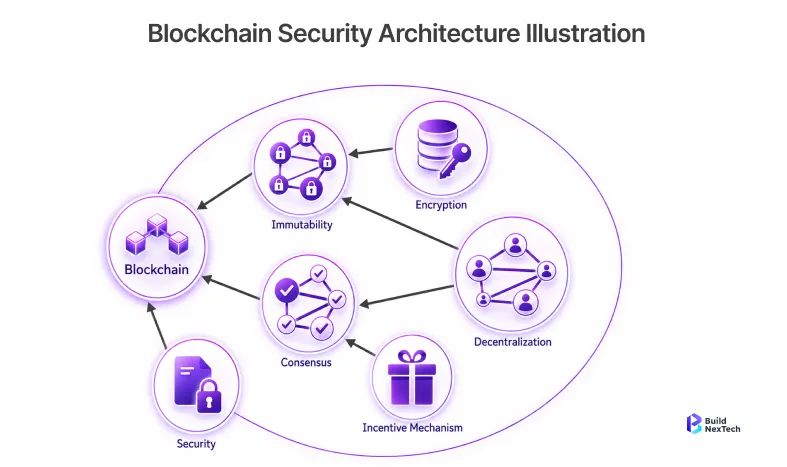
This distinction is important for security teams. The EVM can verify transaction integrity and limit resource abuse, but it cannot determine whether application logic is secure. As a result, many blockchain security vulnerabilities originate from contract design decisions rather than weaknesses in the underlying protocol.
Role-Based Access Control and Permission Management at the EVM Architecture Level
Access management is one of the most important aspects of smart contract security. Many high-profile exploits occurred because administrative functions lacked proper authorization checks.
A secure architecture typically includes:
- Ownable patterns for administrative actions
- Role-based control using OpenZeppelin AccessControl
- Multisig account approval for sensitive operations
- Restricted upgrade and governance permissions
Security auditors frequently identify weak access controls during a solidity audit because even a single exposed privileged function can compromise an entire protocol.
Protecting External Call Interactions and Preventing Reentrancy Exploits
External interactions remain one of the most common sources of contract vulnerabilities. Every external call introduces uncertainty because the receiving contract may execute arbitrary logic.
To reduce risk, developers should:
- Perform state updates before external calls.
- Avoid delegate call to untrusted contracts.
- Use static call for read-only operations.
- Apply runtime protection frameworks where appropriate.
Secure Smart Contract Development Best Practices for EVM Environments
Applying Solidity Secure Coding Standards and Defensive Design Patterns
Strong smart contract development begins with secure coding practices. The checks-effects-interactions model remains one of the most effective ways to reduce reentrancy vulnerability risks.
Another recommended pattern is pull-over-push payments, where users withdraw funds instead of receiving automatic transfers. This reduces dependence on external execution and improves reliability.
For teams focused on solidity development or building solidity smart contracts at scale, adopting secure coding standards early prevents costly redesigns later in the project lifecycle.
Designing Upgradeable Contracts Without Introducing New Attack Vectors
Proxy architectures allow Ethereum smart contracts to evolve after deployment. However, upgradeability introduces additional security considerations.
Secure upgradeable systems should include:
- Timelocked upgrades
- Multisig governance controls
- Storage compatibility validation
- Independent smart contract security audit reviews
Without these controls, attackers may target the upgrade mechanism itself rather than the business logic. Several high-profile incidents across the blockchain ecosystem have demonstrated that compromised upgrade permissions can be just as damaging as vulnerable code. Security teams should therefore treat upgrade governance as part of the protocol's attack surface.
Using Audited Libraries and Established Security Patterns
Building critical components from scratch often increases risk. Audited frameworks such as OpenZeppelin provide trusted implementations for access controls, token standards, pausability, and security utilities.
Using proven libraries offers several benefits:
- Reduced development effort
- Lower smart contract audit cost
- Faster security reviews
- Improved consistency across projects
BuildNexTech integrates OpenZeppelin standards as a baseline in every smart contract development engagement, ensuring clients begin from a vetted security foundation rather than building critical components from scratch.
Smart Contract Security Testing and Audit Strategies
Static Analysis Using Slither, MythX, and Echidna
Automated scanning is often the first stage of vulnerability detection. Modern smart contract audit tools help identify issues before code reaches production.
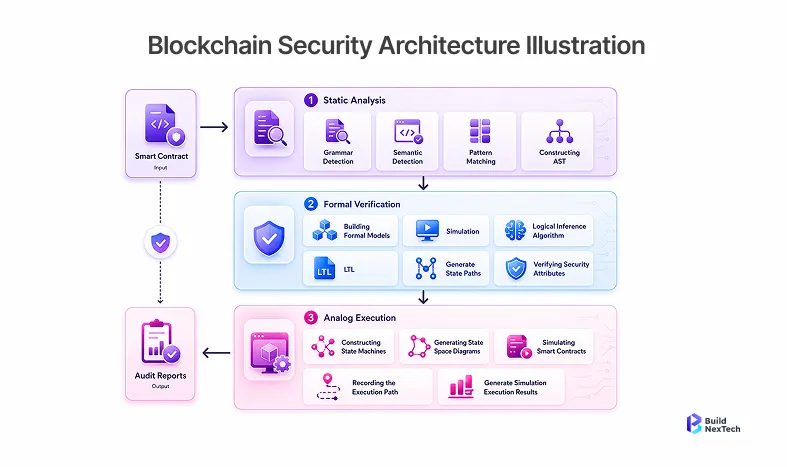
Popular tools include:
- Slither for AST-based code analysis
- MythX for symbolic execution testing
- Echidna for fuzzy testing and invariant validation
Integrating these tools into CI/CD pipelines creates a continuous vulnerability detection pipeline that supports secure blockchain deployment.
Manual Review and Adversarial Testing for Smart Contracts
Automation cannot identify every weakness.
Experienced security auditors review:
- Governance models
- Oracle dependencies
- Economic attack scenarios
- Privileged operations
Many organizations also participate in security contests and bug bounty platform programs to gain additional external validation before launch.
Formal Verification and Pre-Deployment Validation
Formal verification provides mathematical assurance that a contract behaves according to predefined specifications.
Solutions such as Certora Prover help validate critical logic and reduce the risk of unexpected execution outcomes. For high-value DeFi smart contracts, combining formal verification with smart contract auditing significantly improves confidence before production deployment.
Monitoring, Detection, and Incident Response for EVM-Based Applications
On-Chain Monitoring and Real-Time Threat Detection
Security does not end after deployment. Continuous attack detection helps teams identify suspicious behavior before losses escalate.
Platforms such as Forta and Tenderly enable:
- Real-time transaction monitoring
- Anomaly detection
- Governance activity tracking
- Exploit alerting
These capabilities provide valuable visibility into live protocol activity.
Emergency Controls and Exploit Containment Strategies
Every protocol handling digital assets should maintain an incident response plan.
Common protection mechanisms include:
- Pause functionality
- Emergency governance controls
- Multisig approval workflows
- Predefined containment procedures
Fast response times can significantly reduce the impact of an active exploit.
Post-Incident Analysis and Continuous Improvement
Following an incident, organizations should investigate root causes rather than focusing solely on recovery.
Effective reviews examine:
- Why vulnerability detection failed
- Whether monitoring systems generated alerts
- How security auditing processes can improve
Continuous improvement helps strengthen long-term blockchain cybersecurity maturity.
Emerging Security Challenges in the Evolving EVM Ecosystem
Cross-Chain Bridge Vulnerabilities and Lessons from the Ronin Hack
Cross-chain bridges remain one of the most targeted areas in web3 security.
The Ronin hack exposed how weak validator governance can create catastrophic single points of failure. It demonstrated how weak validator governance and centralized trust assumptions create catastrophic single points of failure. As interoperability grows, bridge security requires the same level of scrutiny as core protocol logic.
Independent blockchain security audit reviews should evaluate validator models, key management processes, and economic assumptions.
Layer 2 Security Considerations and Rollup Risks
Layer 2 architectures split into two dominant models, each with distinct security assumptions. Optimistic rollups (Arbitrum, Optimism) rely on fraud proofs — a challenge window during which invalid state transitions can be disputed. If no valid challenge is submitted, the state is accepted as final. ZK-rollups (zkSync, StarkNet) use cryptographic validity proofs instead, removing the challenge window but introducing proving-system correctness as a new risk surface. Both models introduce new trust assumptions that security teams must evaluate before deployment.
Deploying on Layer 2 IOTA EVM or other EVM-compatible environments requires auditing both the application contracts and the underlying L2 security model.
Preparing for Future DeFi Attack Vectors
Modern attackers increasingly combine technical exploits with economic manipulation techniques.
Flash loan attacks, governance exploits, and protocol composability risks continue to evolve. Defending against these threats requires a combination of secure architecture, smart contract security audit processes, monitoring, and ongoing testing.
Conclusion: Building Resilient EVM Security Architecture with BuildNexTech
Key Takeaways for Securing EVM-Based Smart Contracts
Successful smart contract security requires more than vulnerability scanning. It involves secure architecture design, disciplined solidity programming, comprehensive testing, and continuous monitoring throughout the development lifecycle.
How Proactive Security Architecture Reduces Risk
Combining secure coding practices, smart contract audit tools, formal verification, and real-time monitoring creates a strong defense against evolving threats.
Organizations that treat security as a continuous process rather than a pre-launch gate consistently reduce both exploit risk and remediation cost.
How BuildNexTech Supports Smart Contract Security
BuildNexTech helps organizations strengthen EVM security architecture through smart contract auditing, blockchain security services, vulnerability assessments, security testing, and deployment readiness reviews.
Whether launching new decentralized applications or securing existing Ethereum smart contracts, organizations that embed security across architecture design, development, testing, and auditing are significantly better positioned to reduce risk. In blockchain environments, preventing a vulnerability costs far less than remediating one after deployment. Teams that commit to proactive security can protect digital assets, maintain stakeholder trust, and scale confidently within the evolving ecosystem.
People Also Ask

What is the difference between a smart contract bug and a smart contract vulnerability?
A smart contract bug is an error in the contract's code that causes unintended behavior, such as incorrect calculations or failed transactions. A smart contract vulnerability is a security weakness that attackers can exploit to manipulate contract behavior, steal funds, or disrupt operations. While all vulnerabilities are bugs, not all bugs create security risks. Smart contract security audits focus on identifying vulnerabilities that could impact assets, users, or protocol integrity.
Can off-chain components like oracles and front-ends compromise EVM smart contract security?
Yes. Even when Ethereum smart contracts are secure, off-chain components can introduce significant risks. Compromised oracle feeds may provide inaccurate data that affects contract execution, while vulnerable front-end applications can trick users into approving malicious transactions. Effective EVM security architecture requires securing both on-chain smart contracts and supporting off-chain infrastructure to reduce overall attack exposure.
How does the immutability of smart contracts create unique security challenges compared to traditional software?
Unlike traditional applications, deployed smart contracts cannot be easily modified or patched after release. If a vulnerability exists in production code, fixing it may require complex upgrade mechanisms or contract migrations. This immutability makes secure smart contract development, thorough testing, and pre-deployment security audits essential for preventing costly blockchain security incidents.
What role do economic incentives and tokenomics play in smart contract attack design?
Many attacks target economic weaknesses rather than technical flaws. Poorly designed tokenomics, governance models, or reward mechanisms can create opportunities for flash loan attacks, market manipulation, and governance exploits. Secure EVM architecture should evaluate both code-level vulnerabilities and economic incentives to ensure protocols remain resilient against financially motivated attackers.
Is a smart contract audit enough, or does EVM security require ongoing measures beyond the audit?
A smart contract audit is an important security milestone, but it is not a guarantee of long-term protection. New attack techniques, protocol upgrades, and ecosystem changes can introduce additional risks over time. Strong EVM security requires continuous monitoring, periodic security assessments, vulnerability testing, incident response planning, and secure development practices throughout the contract lifecycle.


.webp)
.webp)
.webp)

.webp)
.webp)