

.webp)
Six weeks into a Django REST Framework implementation for a payments API, a company contacted us. Following the arrival of partner webhooks, hundreds of requests were waiting for downstream banks. They questioned if they had chosen the incorrect framework. They hadn't. No one on the team had recorded the workload, and they had chosen it without inquiring.
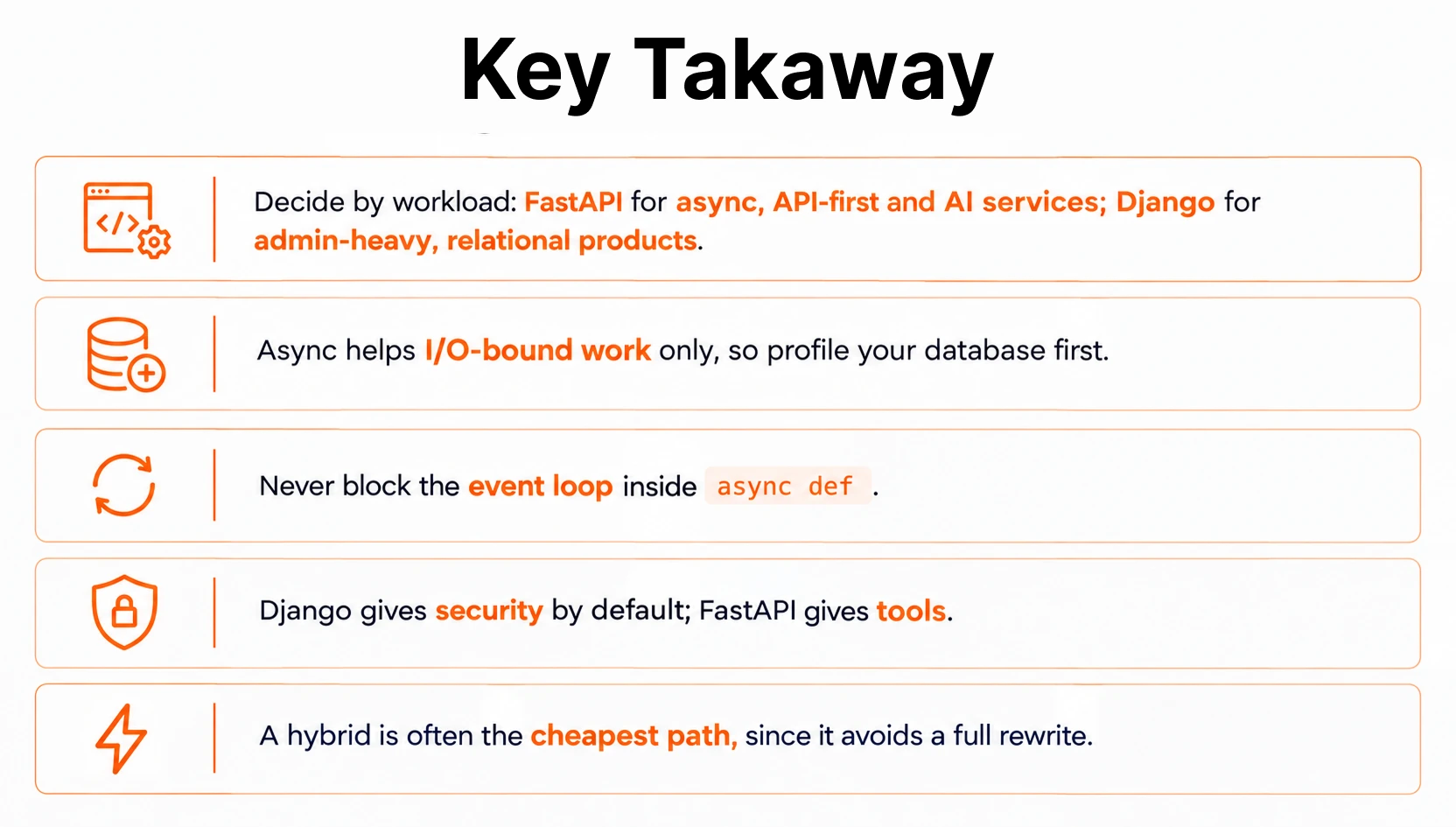
Choosing between Django and FastAPI is more about workload than choice, and a mistake might cost a quarter. At least 150 consumer interactions across more than 30 industries have shown this pattern. We arrive at a clear conclusion based on the workload: a hybrid is less costly, FastAPI is more effective on async and AI services, and Django is more successful on admin-heavy goods.
FastAPI for API Development
FastAPI is an API-first Python framework using Starlette for the web layer and Pydantic for the input/output validation. It ships lean and is simple to use for API-first development.
- No ORM, so add the SQLAlchemy ORM.
- No admin interface.
- No built-in auth.
Because of this, it is a popular choice for backend development that includes microservices, ML model serving, and AI-powered web apps. It is also a natural Python API choice among backend frameworks. Adoption is rising from 29 to 38%, according to the JetBrains Python Developers Survey, as big language models and machine learning frameworks like PyTorch enter operational services.
.webp)
Automatic FastAPI Documentation
FastAPI generates interactive API documentation from Python type hints and automatically creates an OpenAPI schema backed by JSON Schema. By default, it serves Swagger UI at /docs and ReDoc at /redoc. Django typically requires Django REST Framework (DRF) along with an additional package such as drf-spectacular for OpenAPI schema generation and interactive documentation. Frontend teams can then use the OpenAPI contract with tools that generate client code for JavaScript frameworks such as React.
Automatic Data Validation with FastAPI
FastAPI uses Python type hints and Pydantic models to validate incoming data, serialize responses, and generate the API schema from the same definitions.
Invalid input, such as a zero amount when a positive value is required, can be rejected with a 422 validation error before reaching the endpoint logic. The trade-off is the additional validation overhead from Pydantic in the request path, which is often worthwhile for reducing runtime data errors.
Django for API Development
Built on Django in three weeks, the dispatch tool for a logistics customer already included user roles, an admin panel, and migrations. Next to it was a FastAPI prototype with a login screen.
The most well-known full-stack Python web framework. Django Python projects receive this right away:
- The Django ORM, mapping database models to relational databases.
- The Django admin interface.
- Auth, sessions and permissions.
- Database migrations.
- A template language for server-rendered pages.
That bundle is why many projects double as a content management system. REST arrives through an extra layer, so for api development the question is what you get versus what you assemble.
.webp)
Django REST Framework Capabilities
Serializers, viewsets, routers, pagination, throttling, and a browsable API are all added by the Django REST Framework. Here, what does REST API design mean? JSON-returning resource-based HTTP endpoints. When combined, they cover the majority of CRUD-heavy REST APIs. FastAPI-style type hints within Django are provided by Django Ninja.
Where Django Falls Short for APIs
While Django is powerful and feature-rich, it can introduce additional complexity when building lightweight, high-performance APIs:
- A serializer, view and URL entry for every simple endpoint, which adds up across 40 endpoints.
- Incomplete async coverage in DRF.
- DRF provides a browsable API, but automatic OpenAPI/Swagger documentation requires additional tooling, such as drf-spectacular.
FastAPI vs Django at a Glance
Look at this table as a list of things you need to develop on your own. Every web framework for Python leaves something out.
FastAPI hands you speed and freedom, while Django hands you finished parts. Choose based on what you lack.
Python Async Performance Compared
Async is intended to support I/O-bound tasks, not CPU-bound activity. In Python, asyncio allows a single thread to manage several waiting jobs. On the other hand, FastAPI operates on ASGI under Uvicorn, which permits a worker to accept more requests while they are waiting, while traditional WSGI locks a worker. That is the essence of asynchronous processing and the difference between asgi and wsgi.
Although this is true for some workloads, the database rather than the framework itself will usually be the limiting issue. For this reason, it's critical to comprehend which particular workloads are faster with FastAPI. I can think of three data points:
- TechEmpower results favour FastAPI where requests wait on external calls.
- One agency test reported roughly 12,000 requests per second against Django's 8,500.
- In low-concurrency tests with a real database, Django has finished ahead.
How FastAPI Handles Async Requests
While everyone else is served by the event loop, this endpoint waits for an LLM call. The loop remains unrestricted.
import httpx
client = httpx.AsyncClient()
@app.get("/summary/{doc_id}")
async def summarise(doc_id: int):
    r = await client.post(LLM_URL, json={"doc": doc_id})
    return r.json()
In one project on the US logistics fleet, downtime was reduced by 30-50% by the AI predictive maintenance layer that was developed on top of telemetry waiting on downstream services. The pitfall is when you end up with a blocking call (e.g. requests.get or a synchronous database driver) inside an async def, which then freezes the loop for each user. Use a plain def route or an async client. Our enterprise application integration guide for Claude expands on the pattern. It could take 2-3 days to audit an existing service using FastAPI to block calls. For teams building AI-powered backends, BNXT.ai also provides AI development services covering AI integration, automation, and production deployment.
Django's Async Support Today
Django has closed much, not all, of the gap. Three points matter for API work:
- Async views and async ORM methods such as aget() and acreate().
- Synchronous middleware erodes the gains, as the Django docs warn.
- DRF still relies on a community package for async views.
API Security in FastAPI and Django
Django ships security defaults; FastAPI ships API security tools. Online attacks follow the OWASP API Security Top 10, so the gap is what you build versus what arrives enabled. Pin and patch dependencies in both, since Starlette has had advisories.
Django's Built-In Security Features
- CSRF protection, XSS escaping, clickjacking headers and secure cookies by default.
- ORM parameterization helps protect against SQL injection.
- Password hashing, validators and sessions out of the box.
- You still switch DEBUG off and set the HTTPS flags yourself.
FastAPI Authentication with OAuth2 and Argon2
Here is a FastAPI authentication example using the OAuth2 password flow with JWT bearer tokens. The current FastAPI tutorial uses PyJWT for JWT handling and pwdlib[argon2] with Argon2 for password hashing. Depends(oauth2_scheme) can be used to protect routes with bearer-token authentication.
Older tutorials often use passlib and python-jose. For new implementations, replace them with pwdlib[argon2] and PyJWT. In production, implement refresh tokens alongside short-lived access tokens.
import time
import jwt
from pwdlib import PasswordHash
from fastapi.security import OAuth2PasswordBearer
password_hash = PasswordHash.recommended()
oauth2_scheme = OAuth2PasswordBearer(tokenUrl="token")
def hash_password(password: str) -> str:
    return password_hash.hash(password)
def make_token(sub: str, key: str) -> str:
    return jwt.encode(
        {"sub": sub, "exp": time.time() + 1800},
        key,
        algorithm="HS256"
    )
Microservices vs Monolithic Architecture Fit
The issue is more about team size than it is about monolithic vs. microservices, and it is more about architecture choosing which framework to use rather than benchmarks. So what are software microservices? Instead, it's a tiny, self-deploying service with a single function. Microservices Architecture: What is it? creating a product that incorporates several of them.
The overhead of microservices development is too high, and microservices design patterns, including API gateways work only with multiple teams and parts scaling independently. We experience this same split in our web development team, industry-wise.
.webp)
Django in a Monolithic Architecture
Django works well for integrated applications where a centralized architecture simplifies development and management:
- A single codebase with a single ORM, admin and auth is suitable for an integrated product and a small team.
- The strain shows when one hot endpoint needs to scale on its own.
FastAPI in a Microservices Architecture
FastAPI is well suited to microservices where individual services need to scale independently and handle focused workloads:
- Small services with their own contracts scale and fail on their own.
- A hybrid pattern is often used: Django for the backend that has an abundance of administration, FastAPI for the services that are highly throughput or AI services, and authentication is shared via tokens.
Choosing Between FastAPI and Django: Which One Fits Your Workload?
Choose FastAPI for API-only, high-concurrency or AI-facing services, and Django for admin-heavy, relational products. Pick a hybrid when both needs exist.
Choose FastAPI when:
- You are building an API-only service or microservice.
- Requests mostly wait on I/O.
- You are serving AI or LLM backends. For larger AI workloads, LLM development services can help with model integration, RAG pipelines, deployment, and enterprise system integration.
Choose Django when:
- Non-engineers manage data through an admin.
- The data model is complex and relational.
- You need an MVP with auth and migrations built in.
Which one fits your team?
1. API-only and I/O heavy? FastAPI.
2. Need admin, relations and auth on day one? Django.
3. Both needs exist? Django for the core, FastAPI for the edge.
Our Take: For most new API and AI backends, start with FastAPI. Where non-engineers manage data, start with Django and add Django Ninja before reaching for a second framework.
How BNXT.ai Helps You Build Production-Ready Python APIs
BuildNexTech creates, develops, and implements production-grade Python APIs using Django or FastAPI. Teams bring us in for decisions like framework selection, security review, observability, and continuous integration and deployment (CI/CD) that are inexpensive once and expensive to reverse. These choices were made in the first week of an AI conversion system that increased lead conversion for a real estate platform with more than 180K leads per month.
The cost objection is fair. An engagement is cheaper than a rewrite. For software development outsourcing, large integrators such as Accenture or Infosys suit programme-scale rollouts; we suit teams that want senior engineers close to the code. Our case studies show the outcomes.
What a BNXT.ai API Implementation Looks Like
- Week 1: Discovery and architecture: workload assessment, data and traffic mapping, existing-system review, and framework evaluation.
- Week 2: Architecture decision and technical design: FastAPI, Django, or a hybrid approach, with API structure, authentication, data models, and integration requirements documented.
- Weeks 3-4: Core development: API endpoints, database integration, authentication, validation, business logic, and third-party integrations.
- Weeks 5-6: Testing and hardening: pytest-based automated testing, CI integration, API security testing, dependency updates, performance testing, error handling, and production hardening.
- Weeks 7-8: Deployment and observability: CI/CD pipelines, environment configuration, monitoring, dashboards, logging, alerts, and deployment validation.
- Ongoing: Maintenance and optimization: performance tuning, security updates, monitoring, scaling, and feature enhancements.
- At rollout: You retain control of the repository, CI/CD pipeline, documentation, runbooks, monitoring, and deployment infrastructure.
"FastAPI is faster than Django only for some workloads. Most of the time, your database is the bottleneck, not your framework."
Conclusion
There is no "winner" in the comparison between Django and FastAPI. Django has the right to work on full-stack, admin-heavy products, whereas FastAPI has the right to work on async, API-first, and AI workloads. When your workload is the most important factor, the first option is the best choice, followed by your team and architecture. Run them together and share authentication if you require both.
The audible decision is the framework. The security and delivery capabilities of a product determine whether or not it passes the test of its second year, and most teams discover which of these they overlook after launch, when making changes is most costly.
People Also Ask

Does FastAPI support WebSockets for real-time features?
FastAPI supports WebSocket endpoints through Starlette, making it suitable for chat applications, live dashboards, and streaming model output. Django can support the same real-time capabilities through Django Channels and an ASGI server.
How should I deploy FastAPI in production?
Run Uvicorn workers under Gunicorn inside containers, behind a reverse proxy or load balancer that terminates TLS. Add health checks and autoscaling so slow dependencies do not exhaust your workers.
Can FastAPI reuse the Django ORM and models?
Technically yes, by calling django.setup() before importing models, but it couples the services and complicates async use. Most standalone FastAPI services use SQLAlchemy and keep their own schema.
Which framework is easier for a beginner to learn?
FastAPI is quicker to start for a single API if you know type hints. Django takes longer because of its wider surface, but its conventions guide beginners towards sound structure.
How do I run background jobs in FastAPI or Django?
FastAPI's BackgroundTasks handles small post-response jobs. For retries, scheduling or heavy work, both frameworks pair well with Celery or a similar queue backed by Redis or RabbitMQ.


.webp)
.webp)
.webp)

.webp)
.webp)