

A founder I spoke with last quarter had two quotes for the same brief: one agency quoted $15,000, another quoted $180,000, both insisting they were building the same app. That gap is the normal state of mobile app development, and it rarely comes down to dishonesty; it comes down to scope and architecture decisions never written down before the quoting started.
It reminds me of something my manager used to joke about whenever a project estimate started looking suspiciously optimistic:
"Flutter isn’t just code and clutter,
It can save both time and butter.
But skip the planning, rush the map,
And budgets vanish in a snap."
At the time, it sounded like a throwaway rhyme. After working across 150+ client engagements spanning 30+ industries, it feels more like a rule of thumb. Teams pick Flutter for all the right reasons one codebase, one team, faster iteration across iOS and Android but often underestimate the discovery and planning work that ultimately determines the project's cost, timeline, and complexity.
This guide covers the Flutter mobile app development lifecycle, realistic 2026 costs by stage, and how to tell a capable development partner from one that is guessing alongside you.
Does Flutter Really Cost Less Than Native Development?
Usually, yes. A single Flutter codebase typically costs 30-40% less than maintaining separate native iOS and Android codebases, since one team replaces two and every feature gets built once instead of twice.
Worried a proper discovery phase eats into an already tight timeline? A two-week scoping sprint prevents the eight-week delay that shows up later when nobody agrees on the backend first. Teams that ship fastest spend slightly longer scoping and far less time firefighting mid-build.
The Flutter Mobile App Development Lifecycle, Stage by Stage
Flutter is Google's UI toolkit for building iOS, Android, web, and desktop apps from a single Dart codebase. The Flutter framework ships with Material Design 3 widgets by default, covering most user interface design out of the box.
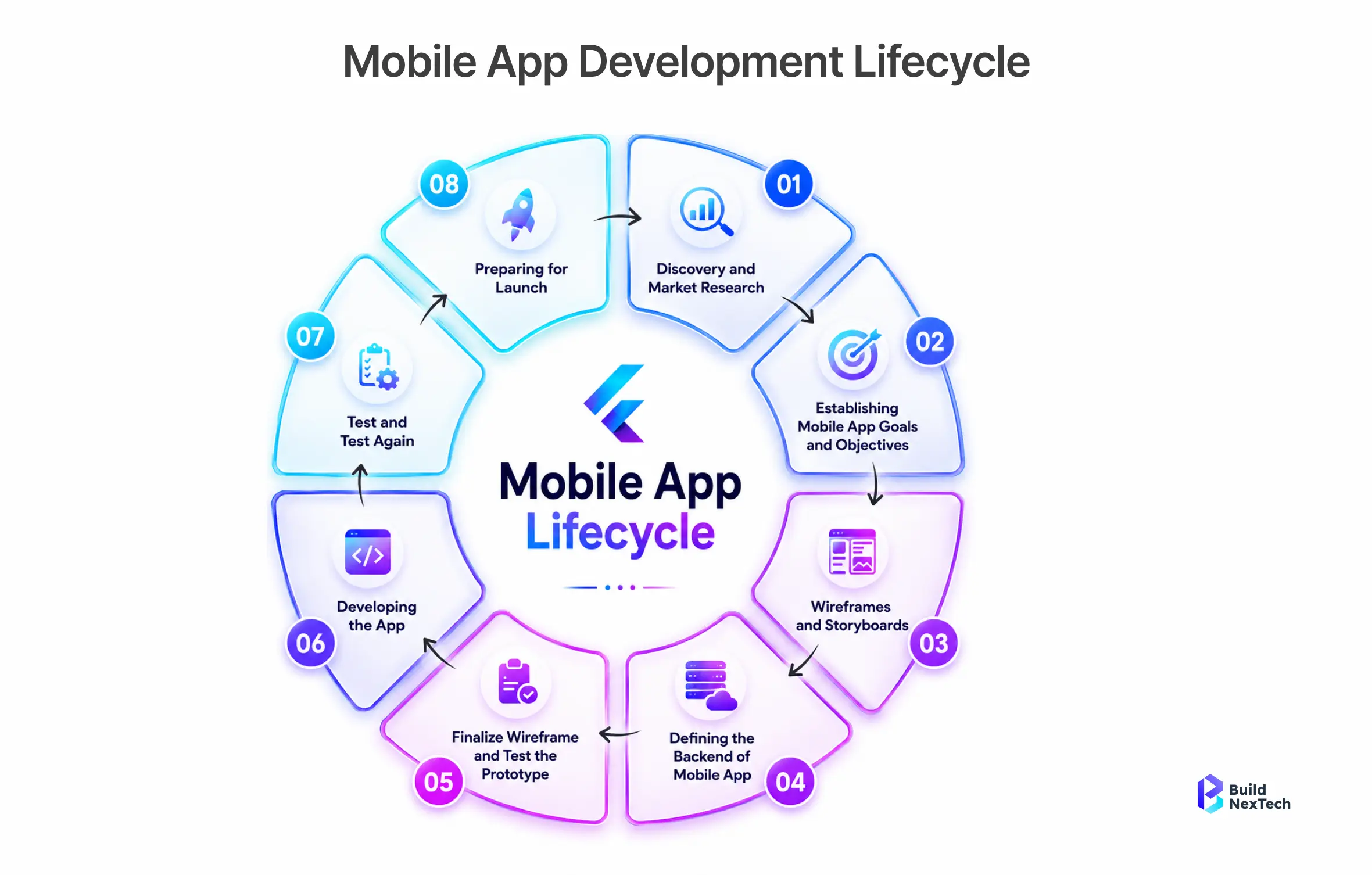
Six stages take an app through its full application lifecycle: discovery and planning, UI/UX design, development and architecture, QA and testing, deployment, and maintenance and support. Each stage forces a decision that the business signs off on, not just a task that developers tick off a list.
- Discovery and planning: scope, technical requirements, and competitor research, locked down before any Dart code gets written, the foundation for cross-platform development sits on.
- UI/UX design: wireframes through high-fidelity screens, user experience, and user interface design together, typically 10-20% of project cost. Material Design 3's accessibility features come close to free once you commit to the design system, and icon sets exported as a single SVG file scale cleanly across every device density.
- Development and architecture: widget tree structure, state management choice (BLoC, Riverpod, or Provider), and the Firebase-versus-custom-backend decision, made here rather than retrofitted later.
- QA and testing: unit, widget, and integration tests through Android Studio and Xcode simulators, since hot reload speeds up development but does not replace structured app testing strategies.
- Deployment: Apple App Store and Google Play submission, with Apple's review process being the more common source of slippage.
- Maintenance and support: OS updates, security patches, and new features, budgeted at roughly 15-20% of build cost annually.
Most Flutter projects do not fail because of the framework. They fail because nobody scoped the discovery phase properly. Jetpack Compose, paired with Android Jetpack Architecture Components, Flutter's native equivalent, is genuinely good but locks you to one platform, the entire reason teams targeting both iOS and Android default to Flutter instead.
Our Take: For most B2B and consumer apps that need to launch on iOS and Android without two separate engineering teams, Flutter is the right default. React Native wins when a team is already deep in JavaScript and wants to reuse web logic; native wins for graphics-heavy or deeply OS-integrated apps. We have built and maintained Flutter apps across fintech, healthcare, e-commerce, and logistics, and the single-codebase argument holds up once an app passes the prototype stage.
Worried that a proper architecture phase costs too much? Price a backend rewrite at month four instead, since architecture decisions are rarely reversible without cost once a Flutter app passes its first major version.
From Architecture Decisions to a Working Build
Every production Flutter app makes the same handful of architecture decisions, and getting them right early separates a maintainable codebase from one needing a rewrite by month six.
State management is the first fork. BLoC suits teams that want strict separation between business logic and UI, accepting more boilerplate for predictability at scale. Riverpod suits smaller to mid-sized teams wanting compile-time safety without BLoC's ceremony. Provider works for simple apps, but gets unwieldy once a screen depends on more than two or three data sources. Documenting that decision early keeps development predictable rather than an improvised, sprint-by-sprint process.
Backend is the second fork. Firebase gets an MVP into testers' hands within weeks, with managed authentication, a NoSQL database, push notifications, and hosting. A custom backend, often Node.js or a database like PostgreSQL behind a REST or GraphQL API, becomes the right call once the app needs complex business logic, multi-tenant data isolation, or compliance requirements that Firebase wasn't built for.
// Handles a user action and emits a new UI state
on<LoadUserProfile>((event, emit) async {
  emit(ProfileLoading());
  try {
    final profile = await profileRepository.fetch(event.userId);
    emit(ProfileLoaded(profile));
  } catch (e) {
    emit(ProfileError('Could not load profile'));
  }
});
This pattern pays off commercially: a five-engineer team onboards a sixth in days, not weeks, since state flow is explicit rather than scattered. It's why most teams bring in a Flutter mobile app development company rather than build in-house, and where AI-native features plug in cleanly. See more in our case studies.
How Long Does a Flutter App Take to Build?
Timelines mirror cost tiers: 4-6 weeks for a simple MVP, 8-14 weeks for mid-complexity, 6+ months for enterprise platforms, with the discovery phase length being the biggest swing factor in any range.
Region affects cost as much as complexity does. North American/Western European teams typically land at the top of the mid-complexity range, while vetted Eastern European or Indian teams come in 40-60% lower why outsourcing became the default for first-time Flutter buyers.
The "they won't understand our industry" objection doesn't hold up. We've shipped Flutter apps across fintech, healthcare, retail, edtech, and real estate patterns like secure data sync, role-based access, and payment handling repeat across industries more than founders expect. One US hospital system rolled out an AI virtual assistant in their patient-facing Flutter app and cut administrative burden by 40%, driven by workflow mapping rather than anything healthcare-specific in the code.
The Pitfall Most Flutter Teams Do Not See Coming
A retail client came to us with a Flutter app that had passed every functional test and still failed a pre-launch security review two weeks before a planned holiday release. The screens worked. The state management was clean. Nobody had implemented certificate pinning, and the app sent authentication tokens over a connection that would accept a forged certificate, leaving the door open to online attacks intercepting traffic between the app and the backend. That is not a rare gap; it is one of the most common findings across mobile codebases that otherwise look production-ready.
Is Flutter Secure Enough for Production Apps?
Yes, when security is built into architecture rather than treated as a separate security service or security solution bolted on after launch. Flutter itself is not the weak point; the implementation choices around it usually are.
The obvious pitfall people expect is picking the wrong state management library. The real pitfall, the one that costs more and gets caught later, is security. The OWASP Mobile Top 10 2024 lists the patterns that show up again and again in production apps:
- Improper credential mishandling, tokens or API keys stored in plaintext or hardcoded into the binary.
- Communication vulnerabilities, missing certificate pinning, or unencrypted traffic on supposedly secure endpoints.
- Data storage pitfalls, sensitive information cached locally without encryption.
- Binary protection weaknesses, no obfuscation, making reverse engineering straightforward.
- Insufficient input validation, a malformed data payload, or an unsanitised SQL command reaching the backend unchecked.
None of these are exotic; they show up when a team optimises for shipping a feature over security. Pairing the build with current cryptographic libraries closes most of this gap on its own. For apps handling payments or health data, HIPAA, PCI DSS, and SOC 2 expectations make this a compliance argument, not just a best-practice one.
Flutter vs React Native vs Native
The framework comparison gets asked before the harder question: who actually builds it. Here is the comparison most teams want first:
Which one fits your team?
- Need iOS and Android to live without doubling the engineering team? Flutter.
- Team is already fluent in React and wants to reuse web logic? React Native.
- Building something graphics-heavy or needing deep CarPlay or Bluetooth integration? Native.
Picking the framework is the easier half. Harder is who builds it: in-house, a specialized Flutter mobile app development company, or a large systems integrator. For standalone mobile products, a focused team usually moves faster since mobile is the whole engagement, not one workstream. For first-time buyers, outsourcing beats hiring in-house mainly because it skips the 2-4 month recruitment lag, not for cost. Vet on state management discipline, testing rigor, and whether maintenance is a real contract line.
Key Takeaways
- Discovery and planning, not framework choice, is what most reliably determines whether a Flutter build stays on budget.
- State management (BLoC, Riverpod, or Provider) and backend architecture should be locked down in week one, not patched in mid-build.
- Budget 15-20% of build cost annually for maintenance and support, and treat post-launch ROI, active users, crash-free sessions, and feature adoption as metrics to track, not an afterthought.
- Security gaps from the OWASP Mobile Top 10, certificate pinning, and data storage in particular, are more common in "finished" apps than most teams expect.
- Outsourcing to a vetted mobile app development company typically beats in-house hiring for a first Flutter build, mainly because of recruitment timelines rather than cost.
A chance to BuildNexTech to Build Your first Flutter App.
If you're weighing quotes, frameworks, or build-vs-buy decisions for your first Flutter app, that's exactly where we come in. BuildNexTech has shipped production Flutter apps across fintech, healthcare, retail, edtech, and real estate, and we document architecture decisions upfront so you're not improvising scope sprint by sprint.
Whether you need a lean MVP in 4-6 weeks or a full enterprise build with AI-native features layered in, our team handles state management, backend architecture, and integration planning as a single coherent engagement, not a patchwork of assumptions.
Conclusion
The lifecycle determines your timeline. Complexity tier and team location determine your cost. Vendor vetting determines whether either number holds up once development starts. Mobile app development built on Flutter still rewards the same discipline good software always has: scope before you estimate, decide architecture before you build, and treat security as a phase rather than a checkbox at the end.
What is changing is what gets built on top of that foundation. Apps shipping in 2026 increasingly need an AI feature on the roadmap, a recommendation engine, an in-app assistant, and an automated workflow, and that requirement changes the architecture conversation before a single screen gets designed, the same way building production-ready AI agent workflows changes the backend conversation. Teams that pair the release with business intelligence software for adoption tracking spot retention problems months before users start complaining. Plan for that from discovery onward, and you will spend far less fixing it later than teams who bolt it on after launch.
People Also Ask

How much does Flutter app development cost in 2026?
Simple MVPs typically run $15,000-$35,000, mid-complexity apps $40,000-$90,000, and complex or enterprise builds $90,000-$180,000 or more. Complexity tier and team location are the two biggest levers that range.
Is Flutter better than React Native?
Neither wins outright; the better question is which fits the team. Flutter usually wins on performance and UI consistency, React Native wins when a team is already deep in JavaScript and React.
Is Flutter good enough for enterprise apps?
Yes. BMW, Google Pay, and Nubank all run Flutter in production, and enterprise readiness depends more on backend architecture and security practices than on the framework itself.
What's the difference between hiring a freelancer and a mobile app development company?
Freelancers fit small, well-defined scopes with a fixed budget. A mobile app development company brings testing discipline, project management, maintenance, and support that reduce risk on anything beyond a narrow MVP.
What is a runtime environment in Flutter, and why does it matter?
A runtime environment is the layer that executes your compiled code on the device, and Flutter's Dart code compiles to native ARM machine code via the Impeller engine rather than interpreting at runtime. That is part of why Flutter apps perform close to native instead of running through a JavaScript bridge.


.webp)
.webp)
.webp)

.webp)
.webp)