

By 2026, organisations that pair hyperautomation with redesigned processes will reduce operational costs by 30%, according to Gartner. Most enterprise teams are not there yet not because automation is unavailable, but because they are automating tasks rather than outcomes. This guide explains how hyperautomation differs from RPA, how to model ROI, and how to build a business case your board will approve.
Hyperautomation takes AI, machine learning, RPA, and low-code digital automation platforms and uses them to automate processes - not tasks. According to Gartner's 2024 Technology Trends report, by 2026, organisations using hyperautomation with reimagined processes will lower operational costs by 30%.
.webp)
What is Hyperautomation vs. Traditional Automation? A Complete Breakdown
Hyperautomation is the business-led, disciplined approach to finding, assessing, and automating the greatest number of business processes - using AI, RPA, BPM, and integration platforms - and automation tools to do so. Hyperautomation, unlike traditional automation, which focuses on individual tasks, builds a network of smart agents that work across systems, processes, and data.
Business process automation tools run rules-based processes. Hyperautomation has a learning, adaptable, and improving capability, using artificial intelligence (AI) process automation to support unstructured data such as emails, documents, and voice that legacy systems cannot manage.
Traditional Automation vs. Hyperautomation: A Direct Comparison
This knowledge enables businesses to decide where to focus their investments in AI business process automation and where traditional tools remain useful.
Table 1: Traditional Automation vs. Hyperautomation - Feature Comparison
Digital process automation is fundamental to the shift from traditional to digital. Those who don't, risk getting left behind as others adopt enterprise workflow management.
Why Traditional RPA Has a Ceiling
Legacy RPA streamlined finance, HR and customer service processes. But its shortcomings are now clear. RPA bots don't adapt to changing UIs, don't understand complex inputs, and lack the ability to orchestrate complex workflows with human intervention.
- Bots need to be continually updated when apps are updated.
- Lack of inherent support for unstructured data.
- No built-in support for AI or real-time decision-making.
- Becomes limited in scalable processes.
- Lacks the ability to learn and detect process anomalies.
These limitations are driving enterprises to adopt AI and process automation platforms that offer process mining, natural language processing, and smart document processing.
Real-World Hyperautomation Use Cases Driving Measurable ROI
Financial Services: How Hyperautomation Cuts Loan Origination Time by 60%
The current loan application process is manual document processing, credit scoring, compliance and approval - in weeks. Hyperautomation speeds this up with AI document automation, machine learning (ML) credit scoring and automation.
- The system automatically classifies and extracts data from incoming loan documents using AI.
- Machine learning models score credit bureau data in real time.
- Compliance rules are validated automatically against current regulatory rulesets.
- Agents are notified of exceptions with suggested resolution actions.
The McKinsey 2023 State of AI report, AI process automation for financial institutions loans has reduced processing times by 50-70%. Tools like bnxt.ai allow financial institutions to orchestrate these workflows without code. In bnxt.ai's hyperautomation deployments with mid-market financial services teams, accounts payable pilots processing 4,000–6,000 invoices monthly consistently show payback within 60–90 days, primarily through cost-per-invoice reduction from $12 to $3–4.
Supply Chain: Automating Purchase Orders End-to-End with AI
Dealing with large volumes of transactions, connecting multiple systems, and making decisions in a time-critical environment make supply chain operations a prime use case for digital process automation. PO automation is a great place for enterprise teams to start.
- Vendor invoices are automatically matched to the PO and shipping documents.
- Real-time anomaly detection detects price or delivery issues.
- Procurement staff use low-code automation tools to set up workflows.
- Predictive analytics automates stock re-order levels based on real-time demand.
According to the World Economic Forum's Future of Jobs 2023 report, intelligent automation in the supply chain can cut processing costs by as much as 40%. It's possible on a large scale with secure enterprise workflow management systems that integrate ERP, WMS, and supplier portals.
Healthcare: Scaling Prior Authorization Without Adding Headcount
Prior authorization is the most labour-intensive administrative process in health care. Health care providers fill out and file claims, wait for payer action, resolve denials, and re-submit (typically by hand). Hyperautomation eliminates much of the manual effort.
- EHR data is automatically extracted and compared to payer guidelines.
- AI-driven business process automation pre-scores the likelihood of being authorized.
- Claims denial processes flag claims with appeal prompts.
- Documentation for compliance is recorded and stored automatically.
The CAQH index 2023 demonstrates that the healthcare industry can save more than USD 450 million a year through prior authorization automation. This scale without staff growth is possible with enterprise content management workflow platforms.
Table 2: Hyperautomation ROI by Industry Vertical
Hyperautomation Costs, ROI Framework, and What Most Guides Miss
What Does Hyperautomation Actually Cost to Implement?
Guides typically talk about the benefits of hyperautomation but don't talk about the costs. Costs depend on the scale, tech stack, and readiness of your organisation.
- Basic low-code automation software: USD 15,000-50,000 annually (SMBs).
- Mid-market digital process automation: USD 100,000-500,000 per year.
- Large-scale deployments with AI and process mining: USD 500,000 - more than USD 2 million.
- Change management and training: 20-30% of implementation cost.
- Annual maintenance and bot management: 15-20% of initial deployment cost.
These numbers are consistent with broader market growth Gartner's low-code development technologies market reached USD 26.9 billion in 2023, growing at nearly 20% year-on-year. A low-code process automation platform speeds up and simplifies implementation and reduces the need for developers.
Where ROI Actually Comes From (With Sample Calculations)
Redesigning processes before automating is key to hyperautomation ROI. Here's a simple model enterprise teams can use.
- Hours saved: (Monthly hours saved x FTE hourly rate) x 12 months.
- Error reduction: (Error rate reduction % x cost per error) x volume.
- Speed to outcome: (Time reduction % x margin) x volume.
- Avoidance of noncompliance costs: (Risk of penalty x reduction in noncompliance).
A mid-sized organisation that automates accounts payable - 5000 invoices per month for USD 12 each with a cost per invoice of USD 12 - saves USD 480,000 a year by reducing the cost to USD 4 through a low-code digital automation system. It's an easy payback for a CFO to calculate.
Hidden Factors That Kill Hyperautomation ROI
Technology is not usually the reason why many initiatives do not work well, it is the underestimation of non-technical risks. These risks are the cause of most failed AI and process automation.
- Process debt: Garbage in, garbage out.
- Shadow IT: Automation is not integrated, data is not consistent.
- Poor data quality: AI makes poor decisions with poor data.
- Resistance: If not designed by end users, they don't like the bots.
- Governance issues: Orphaned bot is a dead bot.
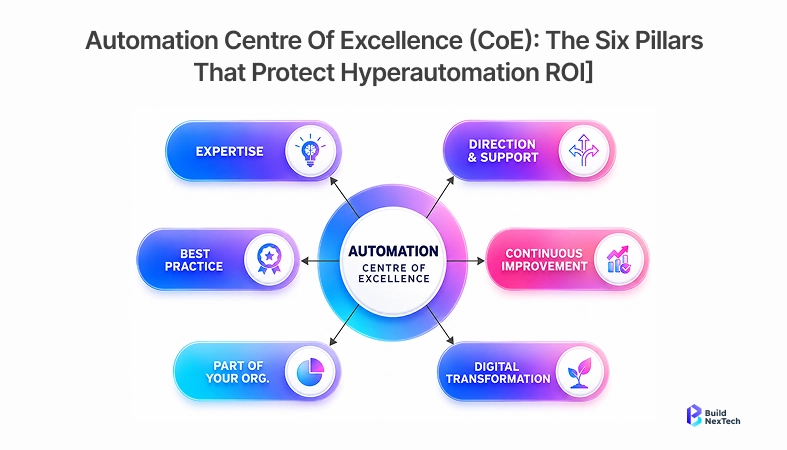
Pre-deployment governance, including a Center of Excellence, is needed to protect the return on investment.
Hyperautomation Benefits vs. Risks: The Unfiltered View
Tangible Benefits That Show Up on the P&L
The best hyperautomation business cases are financial. These are direct-line items on income statements and operational KPI reports.
- 30-50% decrease in the cost of running high-volume transactional processes
- 3-10 times faster processing than manual processes
- Up to 90% fewer errors in structured data processing tasks
- Linear growth in efficiency - manage spikes in volume without extra staff
- Enhanced compliance with audit trails automatically created
Companies that adopt low-code workflow automation products such as bnxt.ai see signs of ROI in 60-90 days (based on planned pilot projects).
Table 3: Hyperautomation Benefits vs. Risks Summary
Real Risks That Deserve Serious Weight
The risk of technology is significant, but the risk of the business is higher. Purely technical approaches to hyperautomation underperform.
- Vendor lock-in: Excessive dependence on proprietary systems constrains options
- Security risk: Automated processes interacting with sensitive systems increase risk
- Dependency: Lack of technical AI expertise makes maintenance and optimisation difficult
- Process invisibility: No monitoring means problems are not detected until they occur
Avoiding these risks requires careful system design, security audits, and training - all of which should be factored into the initial business case.
When Should You Implement Hyperautomation? Key Readiness Signals
Hyperautomation Readiness Conditions: When Is the Right Time to Move Forward?
Organisations aren't always ready for hyperautomation. Some readiness factors need to be in place (or made to be in place) to ensure returns on deployments. This is particularly true of mid-market firms in India and Southeast Asia, considering the use of digital process automation software for the first time.
- You have high volume, repeatable processes with defined decision rules.
- Legacy data systems support digital data inputs and outputs.
- Management is committed to automation, not cost reduction.
- An initial process is identified where a 60-90 day ROI can be shown.
Organisations that approach hyperautomation in stages, with one well-documented process with high impact, outperform those that try to roll it out across the enterprise.
How to Build a Hyperautomation Business Case Your Board Will Approve (Step-by-Step)
The Hyperautomation Business Case Framework That Gets Board Approval
A business case to the board is a financial and operational case based on process results, not a technology case. Take this step-by-step approach to create one that passes CFO muster.
- Step 1 - Select a process: volume, errors, and cost per transaction.
- Step 2 - Establish the baseline: 90 days of run rate data to establish a baseline.
- Step 3 - Project automation changes: cost, cycle time, error rates.
- Step 4 - Estimate total cost of ownership: cost of the automation platform, implementation, training, and maintenance.
- Step 5 - Show the payback period: time to ROI in the conservative and base case.
Tools such as bnxt.ai include ROI and implementation plans designed to build a compelling case for action.
The table below summarises the five-step business case framework, mapping each action to its expected output for board presentation.
Table 4: Hyperautomation Business Case Framework at a Glance
How to Start Your Hyperautomation Implementation
Hyperautomation has moved from emerging technology to operational baseline in financial services, healthcare, and supply chain. Enterprises that have not yet moved beyond task-level RPA are now facing measurable competitive gaps in processing speed, error rates, and cost per transaction. The question is no longer whether to adopt hyperautomation it is where to begin.
Your First Implementation Step: One Process, One Pilot
Hyperautomation is not the future - it's the reality of competitive companies today. In financial services, healthcare, and supply chain, the ROI for business process automation with AI is proven, the platforms are commercial, and the digital process automation market is growing.
Whether you are a startup looking to implement low-code automation for the first time or an enterprise looking to upgrade your business process automation software to the latest tech stack, your journey begins with the right process, the baseline, the ROI model, and a successful pilot.
People Also Ask

1. What is the typical ROI timeline for hyperautomation compared to traditional RPA?
The typical ROI timeline for hyperautomation is 3–6 months, compared to 6–12 months for traditional RPA, because hyperautomation eliminates error-handling overhead and compresses process cycle times — delivering faster payback at enterprise scale.
2. Which business processes are the best candidates for hyperautomation?
The best ROI for hyperautomation comes from automating processes with large volumes, rule-based decisions, and structured data - such as invoice processing, loan processing, prior authorization, and order management.
3. What is the difference between hyperautomation and AI-driven automation?
Hyperautomation integrates various technologies (AI, RPA, BPM, integration platforms) while AI-driven automation focuses specifically on using machine learning models for intelligent decision-making in a step of a process.
4. What are the biggest mistakes organizations make when implementing hyperautomation?
The biggest mistakes organisations make when implementing hyperautomation are automating legacy processes without redesigning them first, underinvesting in change management, allowing poor data quality to persist, and failing to establish governance through a Center of Excellence (CoE).
5. How should we structure a hyperautomation Center of Excellence (CoE)?
A hyperautomation CoE should be cross-functional (IT, operations, compliance, finance) with process owners, bot creation and governance, performance monitoring, and improvement.


.webp)
.webp)
.webp)

.webp)
.webp)