

Spotify has become the world's most influential music-streaming service. It delivers seamless listening through the Spotify app, Spotify Player, Spotify Webplayer, Spotify Premium, and tools like Spotify for Artists and Spotify for Podcasters. Listeners expect instant Personalisation, smooth audio quality, fast recommendations, and deeply relevant content across music, podcasts, and audiobooks.
Spotify combines machine learning, artificial intelligence, natural language processing, generative AI, large-scale data systems, audio analytics, and global content delivery to achieve this. Features like Spotify personalised Playlists, Discover Weekly, Spotify Wrapped, Spotify Charts, and ai generated Spotify playlists are all powered by this advanced architecture.
This blog breaks down exactly how Spotify’s Personalisation engine and audio streaming systems work together to create one of the most adaptive and intelligent audio experiences online.
Introduction
Spotify operates at a massive scale, processing billions of daily events across global listeners to deliver real-time Personalisation and high-quality audio streaming services. Spotify's core Personalisation and streaming stack combines machine learning models, natural language processing pipelines, microservices architecture, cloud systems like Amazon Web Services and Google Cloud Platform, distributed storage, and real-time feedback loops. These power experiences include Spotify Premium recommendations to Web Spotify playback.
Inside Spotify’s Personalisation Engine
The Echo Nest was developed into the recommendation intelligence of Spotify. Today it has machine learning algorithms, generative AI, collaborative filtering, raw audio analysis and large-scale distributed data pipelines. It keeps learning with the interaction of the user, audio information, cultural changes, and global trends - helping to provide personalised playlists, suggestive engines, ranking of content and predictive mixes to both the free and Premium subscribers.
The use of ML, User behaviour and Real-Time Signals by Spotify.
Spotify combines machine learning with real-time user behaviour in order to provide hyper-personalised listening experiences at scale. It optimises the suggestions to each individual listener by examining continuous signals, such as skips, repeats, searches, and context.
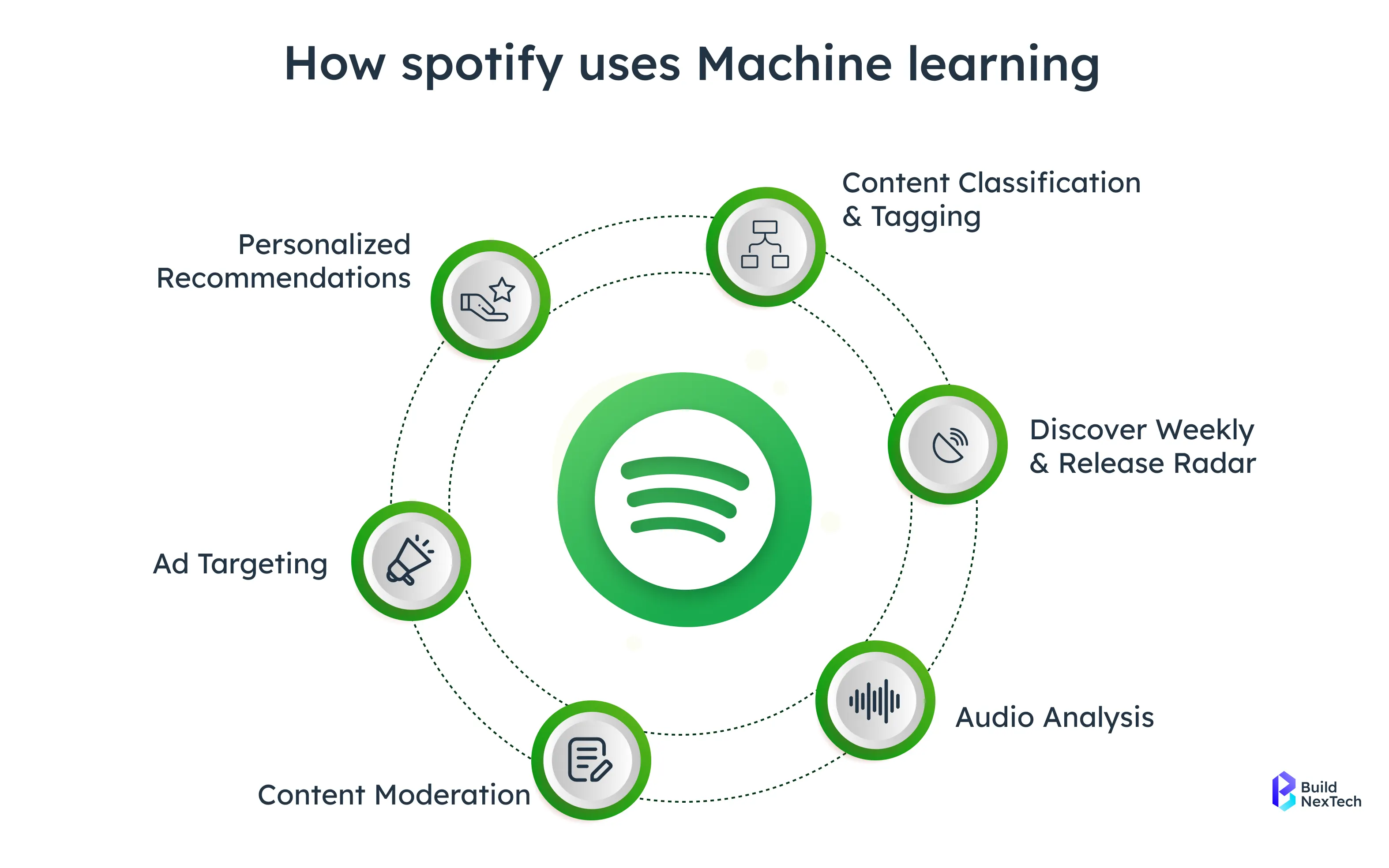
Spotify analyzes massive, multi-dimensional data streams. It updates recommendations instantly.
- Track skips, repeats, saves, and search queries – Signal what users like or reject, refining real-time predictions.
- Listening duration, time-of-day habits, and device usage – Reveal when, how long, and where users engage the most.
- Playlist creation, follows, shares, and browsing patterns – Indicate deeper musical interests and evolving user behaviour patterns.
- Acoustic features extracted from raw audio – Allow ML models to read tempo, mood, and intensity from audio signals.
- Global and regional listening trends – Inform cultural patterns that shape worldwide recommendation accuracy.
Spotify uses advanced AI techniques to understand both users and content:
- Natural Language Processing (NLP) - Processing the lyrics, descriptions, articles and cultural discussions.
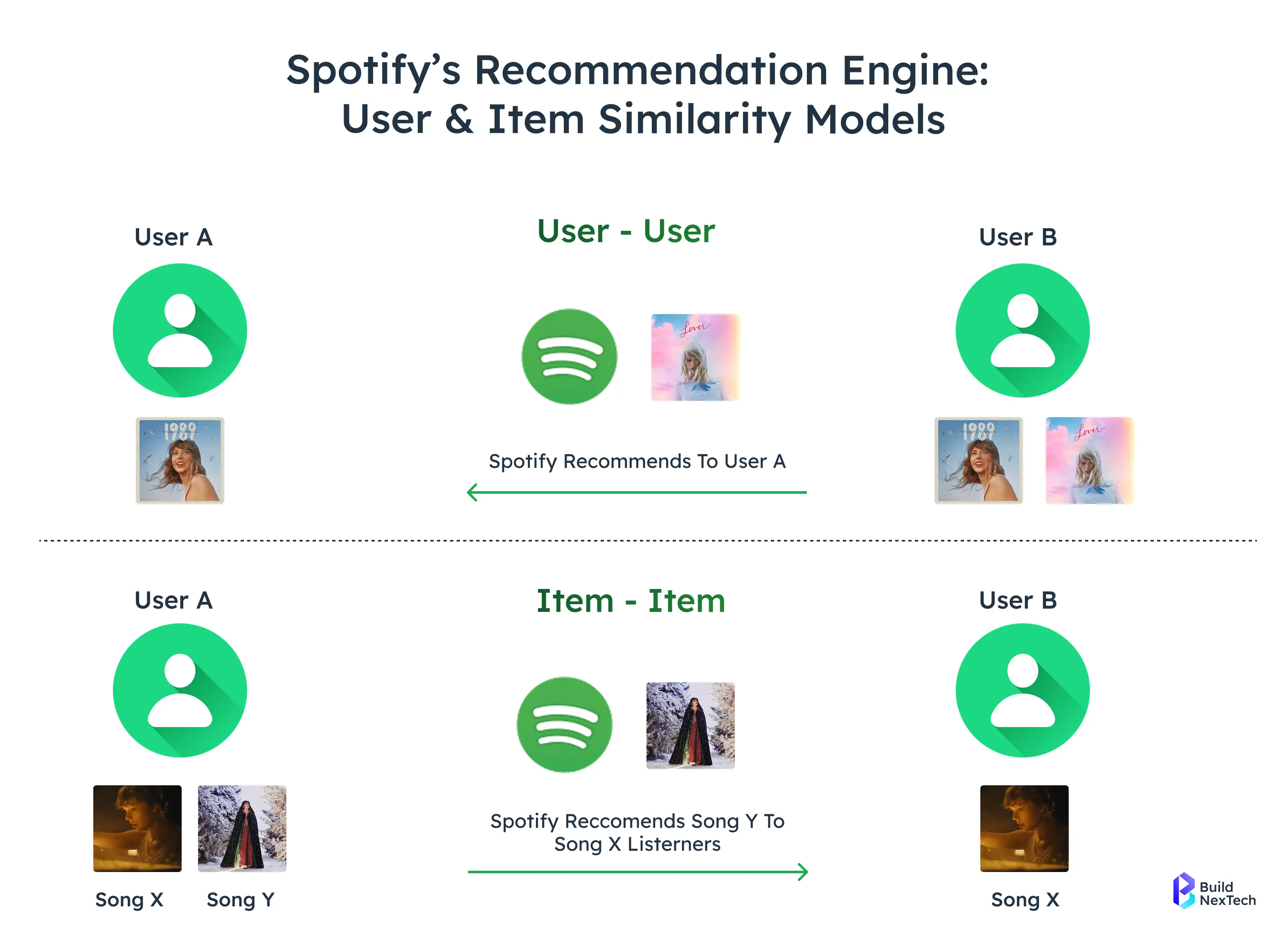
- Collaborative filtering - Matches listeners based on their similarity profile of taste to make a joint discovery
- Convolutional Neural Networks (CNNs) - Process audio information to identify timbre, genre and emotion
- Hybrid recommendation systems - Integrate user tastes, metadata and listening behaviour .
- Machine learning algorithms - Anticipate what the users will like to see next based on historical and real-time indications.
The infrastructure that Personalisation is based upon is a robust real-time infrastructure:
- Streaming pipelines based on events - Relocate billions of events of listeners in real time to provide blazing-fast updates.
- Apache Kafka - Processes high throughput and low latency streaming data.
- Apache Cassandra - Archives user and audio information to be accessed instantly.
- Directed acyclic graph (DAGs) of data processing - Directed acyclic graphs and coordinate complex ML processes and content ranking.
- A/B tests - Determine which playslists, artwork or layout are more valuable to user and more engaging.
- Feedback loops - Continuous improvement of quality of recommendation with each user action.
- Monitoring algorithmic bias - Provides fairness and transparency through recommendations.
This ecosystem powers signature Spotify features:
- Discover Weekly – Generates personal mixes using ML + collaborative filtering.
- Release Radar – personalises updates from followed artists and genres.
- Daily Mixes – Blend familiar favorites with new recommendations.
- Personal radio stations – Stream nonstop personalised queues.
- Spotify Wrapped – Summarises annual listening with advanced data storytelling.
- Activity-based playlists – Adapt to workouts, studying, commuting, or relaxation.
- AI Recommendation tools & Digital Mixtape formats – Generate fresh listening experiences on demand.
AI DJ & Dynamic Recommendation System
Spotify’s AI DJ uses real-time preference modeling, deep learning, and NLP commentary to create adaptive, radio-style listening experiences. It integrates with the Spotify API and personalisesx music, podcasts, and Spotify audiobooks, ensuring dynamic playlists and instant responses to mood, skips, and context.
Spotify’s AI DJ is one of the most advanced applications of Generative AI in audio streaming:
- NLP-generated voice commentary – Creates realistic DJ-style narration and insights.
- Real-time preference modeling – Reacts instantly to skips, likes, and listening momentum.
- Deep learning predictions – Forecast user mood and listening intent.
- User taste profiles – Drive highly personalised song sequencing.
- Music-aware transitions – Blend tracks smoothly using audio feature analysis.
- AI Playlist Builder – Auto-creates playlists using AI-powered content selection.
The AI DJ acts as a Digital Mixtape, continuously updating based on behaviour — powering experiences like DJ AI Spotify, Spotify AI, and future Spotify AI bot systems.
How Spotify Ensures Smooth, Fast Audio Streaming
Spotify’s powerful Personalisation would mean little without flawless, low-latency playback. The streaming layer uses AWS architecture, Google Cloud, private data centers, cloud setup strategies, and microservices built using Spring Framework to deliver instant playback across the globe.
Adaptive Bitrate, Audio optimisation & Low-Latency Delivery
Spotify ensures smooth playback by using adaptive bitrate streaming that automatically adjusts audio quality based on network conditions. Advanced audio optimisation techniques keep sound clear while reducing buffering. Low-latency delivery pipelines ensure tracks start instantly, even during rapid skips or playlist changes.
Spotify uses advanced streaming technologies to optimize performance:
- Adaptive Bitrate Streaming (ABR) – Adjusts audio quality automatically based on network strength.
- Distributed Content Delivery Networks (CDNs) – Deliver songs from the closest edge server.
- Edge caching – Stores popular tracks locally for faster access.
- Microservices architecture – Ensures resilient backend performance for Spotify players.
- Low-latency streaming protocols – Minimize buffering for real-time playback.
- Efficient codecs like Ogg Vorbis & AAC – Maintain high audio quality with minimal bandwidth.
- Real-time streaming DAGs – Manage dependencies for consistent, glitch-free playback.
These optimisation s support audio streaming, audio live streaming, recording streaming audio, and ensure competitive performance in comparisons like Spotify vs Apple Music.
Personalisation + Streaming: The Combined Experience
Spotify’s unique power comes from merging real-time Personalisation with seamless streaming into one intelligent, adaptive system. Spotify uses advanced machine learning expertise and innovations shaped by top ML engineering agencies. It delivers perfectly timed recommendations and maintains uninterrupted, high-quality playback. This creates a listening experience that feels instant, intuitive, and deeply personal.
Real-Time Playlist Updates & Context-Aware Suggestions
Spotify updates playlists in real time by analyzing mood, habits, and listening context—reshaping queues, mixes, and discovery paths instantly. These dynamic suggestions enhance the value of every Spotify subscription, while features like the Spotify AI DJ further personalize recommendations based on live user interactions.
Spotify creates dynamic audio journeys by updating recommendations while users listen:
- Mood-based playlist updates – Shift selections based on emotional patterns.
- Context-aware mixes – Adapt recommendations for work, fitness, commuting, or focus sessions.
- personalised queue reshaping – Rearranges upcoming tracks using real-time behaviour .
- Podcast + music hybrids – Blend formats for richer content experiences.
- Discovery paths via Spotify Charts & Spotify for Creators – Encourage artist exploration.
These experiences rely on:
- Real-time feedback loops – Improve accuracy with each user action.
- A/B tests – Validate optimal playlist combinations.
- behaviour clustering – Group similar listeners for deeper Personalisation.
- Dynamic recommendation engines – Update music choices instantly.
- User preference mapping – Translate behaviour into precise taste signals.
- Customer experience optimisation – Enhance satisfaction and reduce friction.
- Customer loyalty improvements – Strengthen long-term engagement without creating filter bubbles.
The Future of Spotify’s Listening Experience
Spotify is creating a next-generation audio ecosystem. It uses deep learning, Google DeepMind research, and advances in machine learning reliability, privacy, and contextual intelligence. As Spotify evolves, it relies on cloud migration and optimisation services. It also uses scalable backend development and advanced performance optimisation services. These support its global, real-time Personalisation engine.
Next-Gen Hyper-personalised Audio
Spotify’s future innovations may include:
- Emotion-aware playlists – Adjust music based on mood, vocal tone, or emotional cues.
- AI-narrated audiobook companions – Our ML engineering agency builds intelligent narration layers that adapt dynamically across audiobooks, creating richer and more immersive listening experiences.
- Predictive wellness soundscapes – Generate personalised ambient audio for wellness routines.
- Creator-led personalised content – Allow artists to craft hyper-personalised experiences via Spotify for Artists.
- Evolving Digital Mixtapes – Use Generative AI to reshape playlists in real time.
- Real-time generative transitions – Seamlessly blend tracks with AI-powered transitions.
- AI-driven podcast storytelling – Build interactive and adaptive narrative experiences.
Conclusion
Spotify leads global streaming by combining advanced machine learning algorithms, AI integration services, and expertise from top ML engineering agencies to deliver precise, real-time predictions. Its ecosystem uses powerful ML models that drive hyper-accurate audience insights, NLP systems that decode lyrics and acoustic patterns, and deep audio analysis that interprets mood, genre, and cultural signals with exceptional accuracy.
To support these intelligence layers, Spotify runs event-driven data pipelines that process millions of user interactions instantly, enabling true real-time personalisation at massive scale. Collaborative filtering, hybrid recommendation systems, and generative AI experiences—like the Spotify AI DJ—work together to match every user with the right content and create dynamic, immersive listening sessions. These models continuously refine themselves using behavioural signals across Spotify Music, Podcasts, and Audiobooks.
Underneath all of this sits a highly scalable cloud architecture powered by AWS, ensuring global performance, low latency, and reliable adaptive streaming no matter the device or network. This blend of ML, AI, and cloud engineering powers features such as Discover Weekly, personalised playlists, Spotify Wrapped, and the platform’s advanced AI recommendation engines. Together, these systems create a streaming experience that becomes smarter, faster, and more personalised with every user interaction—cementing Spotify’s position as the leader in real-time, AI-driven audio streaming.
People Also Ask

What does Spotify do with user privacy as it provides them with personal recommendations?
Spotify secures user information by encrypting data, anonymizing, and by controlling access. It uses aggregated patterns as its ML models do not depend on identifiable information. The platform meets the GDPR, CCPA, and international privacy regulations to make the provision of Personalisation a secure operation.
How does Spotify scale its recommendation engine worldwide using technologies?
Apache Kafka, Apache Cassandra and event-driven data pipelines are the distributed systems used by Spotify to scale on-the-fly. It provides real time suggestions to millions of people in the world with AWS-powered infrastructure and DAG-based orchestration.
What does Spotify do to maintain low data consumption when streaming of music?
Spotify operates with adaptive bitrate streaming, which helps to alter the quality of the audio depending on the network conditions. Reducing the file size is done by using efficient codecs such as Ogg Vorbis and AAC, and minimizing redundancy between data transfers is done by CDN edge caching.
How can machine learning be utilized to enhance the playlists suggestions at Spotify?
Machine learning interprets the behaviour of the user, audio characteristics, and cultural cues to know what the listeners would like. Dynamically updating playlists based on models such as collaborative filtering and CNN audio analysis are more accurate in producing recommendations.
What does Spotify do to identify and differentiate bot or fake streaming?
Spotify identifies bots with the help of the anomaly detector algorithm, pattern analysis, and monitoring devices/IP. Suspicious behaviour is automatically identified, fair metrics and genuine streaming action.


.webp)
.webp)
.webp)

.webp)
.webp)