

Building production-ready agentic AI systems with Claude and LangChain requires five core components: a reasoning model, an orchestration framework, memory management, retrieval pipelines, and observability tooling. Claude provides reliable long-context reasoning, while LangChain and LangGraph manage workflows, tool execution, memory, and multi-agent orchestration at scale.
What Are Agentic AI Systems and Why Are They Important in 2026?
Most LLM applications are of the following format: prompt, response, end. This will enable them to summarize or answer questions. It takes apart the moment you need to back up your task, need to retrieve from some external data, or need to undo a bad choice in the middle of a task. Agentic AI systems are designed to enable a Large Language Model to think about a goal, determine actions, invoke AI testing tools or APIs, evaluate outputs, and iterate until a goal is achieved.
Three things came together to make it mainstream for long tasks in 2026:
- Claude's long context window and reasoning make it easy to keep the state of the agent and recover from any errors that occur within a task without losing the context of the task.
- Modern orchestration frameworks made it practical to build, monitor, and scale AI agent workflows without creating orchestration infrastructure from scratch.
- Enterprise adoption accelerated in 2026 as companies began deploying agentic AI systems in real production environments. Klarna publicly reported that its AI assistant handled nearly two-thirds of customer service conversations, demonstrating how large-scale AI agent workflows can automate support operations efficiently.
Traditional generative AI focuses on producing a single output, while agentic AI systems are designed to complete entire tasks through planning, reasoning, memory, and tool execution.
Why Claude and LangChain Are the Go-To Stack for Building AI Agents in 2026
To build production AI agents, two things need to happen: a reliable model that can reason in a long, complex task, and a framework that routes, connects, and orchestrates the reasoning without interfering. Being on both sides, Claude and LangChain appear again and again in serious agentic AI system deployments for 2026.
Claude Agent Architecture Diagram: LLM, Tools, Memory, and Orchestration Explained

Claude is used for most enterprise deployments because it is the balance of reasoning depth and cost. An opus suit is for complex tasks that involve multiple steps; Haiku is for light workflows that are fast and sensitive.
Why Claude Is the Strongest Reasoning Engine for Multi-Step AI Agents
This also means that all workflows can be contained in the 200K context window of Claude, eliminating the need for RAG retrieval overheads. It does so by guaranteeing uniformity across the schemas of tools invoked from various nodes of LangGraph, and thus doesn't hallucinate API responses from other production agentic AI systems.
LangChain Architecture Diagram: How Chains, Nodes, and Edges Power Agent Workflows

LangChain is a graph-based agent logic, where nodes are functions,s and the edges are the logic that determines how the data is routed. Documents are fed into a RAG pipeline, embedded in a vector database, fed into LangGraph for orchestration, then split across multiple sub-agents running in parallel, then enter a quality check node before finally being output. Claude is directly connected to this flow via ChatAnthropic.
How LangChain Cuts Agent Development Time Without Sacrificing Control
You don't need to manually implement retry logic, memory management, or tool routing when using LangChain. ConversationBufferMemory and EntityMemory are out-of-the-box attached to any chain. All nodes executed and tools called are logged into LangSmith, allowing you to observe what the agent does when it executes some of the wrong nodes in production.
Core Components of a Production AI Agent
The essential parts of a production AI agent are explained. All production AI agents share the same bottom layer, regardless of the framework, which is the following:
- Memory: A place for context
- Tools: A way to interact with the world
- RAG: A way to access external knowledge
- Evaluation: A way to check if it is working
These four are the keys that will make the difference between a demo agent and a production agent.
Memory and Context Management
Production agents must have memory that lasts beyond a single session – in-process storage snaps quickly with actual traffic.
- For small, local workflows, in which context does not become overly large, the ConversationBufferMemory keeps all conversation messages.
- Named entities (such as users, tasks, records, etc.) are tracked throughout longer multi-step sessions in EntityMemory without losing track
- Efficiently capping memory use per session, and isolation between concurrent users in production using external backing databases, either PostgreSQL or Redis.
Retrieval-Augmented Generation (RAG)
Retrieval-Augmented Generation (RAG) is a method that boosts AI agents' capabilities by enabling them to access data from an external source to help their LLM reasoning. The agent can search documents, databases, APIs, or vector stores for info, rather than just training data, and then draw on this stored information to draw a response. This decreases hallucinations and increases factual accuracy.
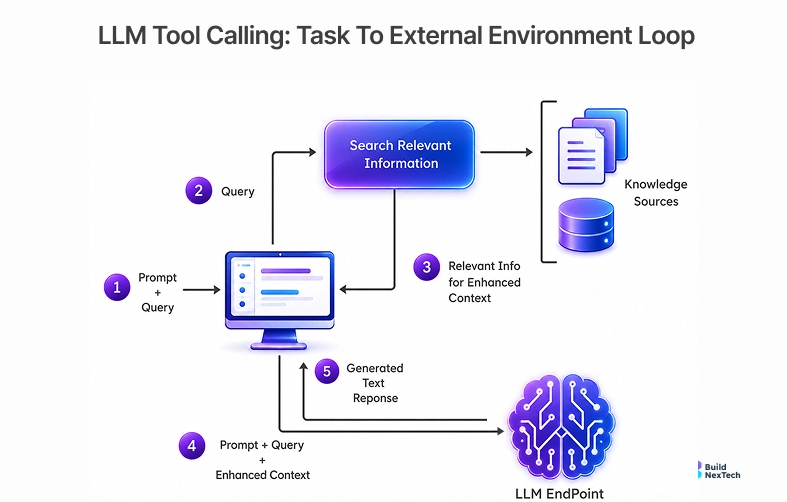
The user's query is then converted to embeddings, matched against the vector store, and a handful of relevant context is added to the prompt for Claude. From retrieval pipelines to chunking to orchestration, LangChain gets it, and Claude's 200,000 context window enables longer context for more powerful long-context reasoning in enterprise-level AI agent systems.
Tool Calling and External Integrations

Claude receives a task, calls a tool, collects external information, and gives a grounded answer, without a human doing anything in the loop.
Production agentic AI systems have components for:
- Data layer: SQLAlchemy ORM for database writes, Pinecone / Weaviate for vector search, FAISS for local retrieval.
- Systems HubSpot CRM, Stripe payments, Gmail email workflows, and ERP enterprise data.
- External services: REST APIs, OAuth providers, Airbyte (data orchestration), real-time context servers: mcp.
- Web and search Web Search and live pages scraping during the workflow with SerperDevTool and FireCrawl, respectively.
Evaluating and Optimizing Agent Performance
In BNXT.ai's agentic AI deployments, one of the most common production failures is insufficient evaluation coverage. Teams that built a 50-case golden dataset before the first production deployment consistently saw 60–70% fewer post-launch agent failures compared to teams that relied on manual spot-checking. This significantly improved multi-step workflow reliability and production stability.
Three layers must exist in all production eval setups:
- Trace level: LangSmith records every call to each LangGraph node, every call to each tool, and every token used. Here is where you can see where the agent went wrong and why absolutely critical to identify the multi-step reasoning mistake before reaching the user.
- Task level: Has the task been achieved? How many steps did it take you to make? Perform a typical test set before every deployment. This captures behaviors of AI agents that unit tests are completely unaware of.
- Cost level: usage of tokens over the course of each workflow step. Correctly working agents that are running 40-step loops with 10 could simply be quietly breaking budgets, particularly in the case of parallel workflows across multiple Kubernetes clusters.
Creating Agentic AI Workflows with Claude and LangChain
This section will focus on building agentic AI workflow automation with Claude and LangChain. Knowing about components is one thing; getting them to work as an agent is another. We discuss the same setup, the workflow structure, and the pattern for implementing production agentic AI systems with Claude and LangChain.
Setting Up Claude and LangChain for Agent Development
Better to get the environment right before writing any agent logic in order to save time debugging later.
Install dependencies:
pip install langchain langchain-anthropic langgraph langsmith
pip install pinecone-client weaviate-client faiss-cpu
Initialize Claude via ChatAnthropic:
Always verify the latest Claude model identifiers directly from Anthropic documentation before production deployment.
from langchain_anthropic import ChatAnthropic
llm = ChatAnthropic(
    model="claude-sonnet-4-20250514",
    anthropic_api_key="your-api-key",
    max_tokens=4096
)
Set your LangSmith environment variables in the beginning debugging multi-step workflows will be much easier when you have your LangSmith environment variables set up.
Building AI Agent Workflows with LangChain
Each node is a Python function. No implicit chaining, only explicit. This allows complex multi-agent workflows to be read and tested.
from langgraph. graph import StateGraph
from typing import TypedDict

class AgentState(TypedDict):
    messages: list
    tool_output: str

graph = StateGraph(AgentState)
graph.add_node("reason", reasoning_node)
graph.add_node("act", tool_node)
graph.add_node("review", review_check_node)
graph.add_edge("reason", "act")
graph.add_edge("act", "review")
Implementing Memory, Tools, and RAG Pipelines
Once the graph structure is defined, add memory, tools, and RAG to the appropriate nodes.
Memory:
from langchain. memory import ConversationBufferMemory
memory = ConversationBufferMemory(
    return_messages=True,
    memory_key="chat_history"
)
RAG pipeline:
from langchain_community.vectorstores import FAISS
from langchain_anthropic import ChatAnthropic

retriever = FAISS.load_local("index").as_retriever(
    search_kwargs={"k": 5}
)
Tool binding:
In most production RAG pipelines of LangChain agent systems, memory is scoped per session, retrieval is done with vector stores such as FAISS or Pinecone, and retrieval is limited to a single-purpose tool bound to Claude. Integrating Generative AI with CRMs and ERPs on a large scale.
from langchain_core.tools import tool

@tool
def search_knowledge_base(query: str) -> str:
    """ Search internal knowledge base for relevant context."""
    return retriever.invoke(query)

llm_with_tools = llm.bind_tools([search_knowledge_base])
Advanced Agentic AI Design Patterns Beyond LangChain Defaults
Basic LangChain chains execute simple workflows. There are no ready-to-use patterns for production agentic AI systems that involve multi-step reasoning, parallel agent collaboration, and self-correction.
ReAct Agents for Multi-Step Reasoning
The ReAct pattern involves reasoning and acting within the same loop: Claude reasons, acts, observes the result, and continues iterating until the task is completed. This allows agents to avoid taking on the wrong path at the outset and following it through.

In LangGraph, it can be run as follows:
- Reason node → Claude determines its next action
- Act node → tool fires against REST API, vector database, or external service
- Observe node → Output returns to Claude as tool output
- Loop or exit → Claude determines to continue or exit the last answer
ReAct agents perform better than a single pass LLM call on tasks that require varying levels of complexity, such as research workflows, Customer Support Email Agents, and multi-source data lookups.
Multi-Agent Architectures
Single agents reach a ceiling on task complexity.
Multi-agent systems divide tasks among specialised agents, each operating in a separate domain, in parallel, and consolidating their results at a supervisor agent node.
In general, the following patterns are observed in production:
- Supervisor + worker orchestration layer takes tasks to specialist agents through LangGraph edges
- CrewAI / AutoGen Multi-agent purpose-built frameworks for collaborating and communicating between agents
- Independent agents, which then execute independently, query various knowledge bases concurrently, thereby significantly decreasing the workflow time
While very similar, Google ADK and the OpenAI Agents SDK provide less explicit control of node routing for more complex multi-agent workflows than LangGraph.
Deploying Agentic AI Systems to Production
Local development and production are two engineering issues.
FastAPI and Docker Deployment
- Expose LangGraph workflows via FastAPI async API routes
- Use Docker to containerise, and pass in Anthropic API key and LangSmith tokens as environment variables
- Directly connect Next.js or Vercel AI SDK frontends with these API routes
- Always set timeouts & retry limits at FastAPI layer, never in node logic
Scaling AI Agents in Production
- Kubernetes is horizontally scalable every pod executes a separate agent, each with a session-local memory
- Sharing memory between pods and preventing state loss in the middle of the workflow
- Rate limiting protection between Claude and the LLM provider at the API level
- LangSmith notifies about token spikes prevents runaway LangGraph loops from budgeting over
Conclusion: Ship Reliable Agentic AI Systems Faster with BNXT.ai
When building production-grade AI agents with Claude and LangChain, you need to get the memory, RAG pipelines, tool integrations, and deployment patterns right from the get-go not after-the-fact.
Whether you're developing a LangGraph-based system, integrating with Claude, deploying the model with FastAPI, or managing with LangSmith observability, BNXT.ai empowers your engineering teams to deploy reliable AI agent systems faster than ever.
The patterns throughout this guide provide a repeatable base for use in various scenarios, from automating customer support processes to creating multi-agent systems for industries like healthcare or finance, to integrating Generative AI with CRMs and ERPs on a large scale.
People Also Ask

What is the difference between an agentic AI system and a standard LLM pipeline?
An agentic AI system goes beyond a standard LLM pipeline by planning tasks, using tools, retrieving external data, storing memory, and making decisions across multi-step workflows. Agentic AI systems are designed for automation, orchestration, and task completion rather than simple content generation.
How does Claude's long context window improve multi-step agent reasoning?
Claude’s large context window allows AI agents to retain instructions, retrieved documents, conversation history, and tool outputs within a single workflow. This improves multi-step reasoning, reduces context loss, and minimizes repeated retrieval calls. In production AI agent systems, it helps maintain workflow continuity, improves response accuracy, and supports long-running enterprise automation tasks.
How do you prevent infinite loops and timeouts in production AI agents?
Production AI agents prevent infinite loops using iteration limits, timeout controls, fallback conditions, and task validation checkpoints. LangGraph and LangChain workflows commonly include retry caps, execution guards, and human approval nodes for critical actions. Monitoring tool usage and adding observability with LangSmith also helps detect stuck workflows before they impact production systems
Can Claude and LangChain agents run asynchronous parallel workflows at scale?
Yes. LangChain and LangGraph support asynchronous execution, parallel tool calling, and multi-agent orchestration at scale. Claude-powered AI agents can process independent tasks simultaneously, improving workflow speed and reducing latency. Production deployments often combine async processing with FastAPI, Redis queues, and container orchestration platforms like Kubernetes for scalable AI agent infrastructure.
How do you version control, monitor, and roll back AI agent configurations in production?
Production AI agents use Git-based version control for prompts, workflows, tool schemas, and configuration files. Monitoring platforms like LangSmith track executions, latency, failures, and tool calls in real time. Rollbacks are handled through container versioning, CI/CD pipelines, and infrastructure snapshots, ensuring stable recovery when new AI agent updates introduce unexpected behavior.


.webp)
.webp)
.webp)

.webp)
.webp)