

.webp)
Choose Flutter when your app demands highly customised UI and long-term scalability. Choose React Native when your team is already deep in JavaScript and needs faster ecosystem integration. The best cross-platform app development company depends on your product goals, technical complexity, and post-launch growth plans.
Here's a scenario that plays out more often than anyone in the industry likes to admit. A founder does their homework - checks reviews, takes sales calls, compares quotes. They go with the agency that seemed most responsive and came in at a reasonable price. Six months later, they're staring at a half-finished app, a depleted budget, and a Slack channel that's been quiet for weeks.
Real example: A mid-sized retail brand hired an offshore team in 2023 at roughly 40% below market rate to build their loyalty app. The team shipped on time - but with no automated tests, no documentation, and a back-end architecture that couldn't scale past 5,000 concurrent users. Fixing it cost 1.4× the original build price and pushed their peak-season launch back by eleven weeks.
It doesn't have to go that way. Whether you're a founder building your first app, a product manager at a growing SaaS company, or a business owner moving into mobile, the decision you make here shapes everything that follows - timelines, budget, user experience, and your ability to grow the product after launch.
What follows is a practical, no-fluff framework for evaluating development partners - the questions that actually matter, the cost realities nobody puts in a proposal, and the warning signs that are easy to miss when you're excited about a new product.
Cross Platform App Development Company Selection Guide (What Actually Matters)
Most people start their search by Googling 'best cross-platform app development company,' scrolling through Clutch listings, and shortlisting whoever has the most five-star reviews. That's fine as a starting point - but it's a terrible way to make the final call. The teams that consistently ship great products care far more about fit than they do about their star rating.
Business Goals vs Technical Fit: Why Both Matter
A technically brilliant team can still destroy a project if they don't understand the business behind it. Before you look at a single portfolio, get clear on what success actually means for your app - not just the features you want to build, but the user problem you're solving and the numbers that will prove it's solved. That clarity is what separates a product conversation from a spec conversation, and it's how proper agency selection starts.
- Do they ask about your business goals in the first meeting, or do they jump straight to tech stack?
- Have they built apps in your vertical - fintech, health, e-commerce, logistics?
- Can they explain how their cross-platform mobile app development approach fits your specific growth stage?
- Do they push back when your requirements have gaps or hidden technical risks?
- Do they understand AI-ready app development, and can they design your product to support AI integrations down the line?
Technical skill without business context is like a GPS with no destination. The best cross-platform app developers work like product partners - they ask the uncomfortable questions early so they can build the right thing, not just build things well.
Portfolio, Case Studies & Real Product Experience
A slick website and a gallery of mockups don't tell you much. What you're actually looking for are case studies that go deeper than screenshots - ones that explain the problem, the constraints, what decisions were made and why, and what the outcome looked like six months after launch. User retention metrics and post-launch growth figures matter here far more than the number of apps in the portfolio.
- Look for apps that are live and downloadable in the App Store or Google Play - not just polished renders
- Ask about specific technical challenges they solved - auth systems, offline sync, cloud integration
- Request references from past clients, particularly ones with a similar scope and business model to yours
- Ask whether their past work shows documented user retention metrics and app revenue growth post-launch
- Ask how they approach design validation - do they test UX flows with real users before a single line of code is written?
BNXT.ai client outcome: A fintech client reduced release cycles from six weeks to ten days after migrating from two separate native teams to a unified Flutter codebase. That same team cut post-launch maintenance cost by 38% in year one - because a single shared codebase means one place to fix, not two.
BNXT.ai keeps a transparent portfolio of live production apps with documented outcomes, including post-launch growth data. That level of accountability is a good signal - it means the team is used to being measured on results, not just delivery.
Delivery Models and Engagement Types: Choosing What Fits You
An early-stage startup stress-testing an MVP needs something completely different from an enterprise team building their fourth internal tool. Getting the engagement structure right before the contract is signed saves a lot of friction - and it's one of the clearest signals of whether an agency actually understands how products are built in the real world.
Here's a quick decision framework before you speak to anyone:
- Fixed-scope projects: best for well-defined MVPs with stable, agreed requirements
- Dedicated mobile app developers: right when you need sustained development capacity over time
- Hybrid models: your strategic direction, their execution - good for teams that want involvement without running the day-to-day
- Offshore app development company setups can deliver real cost efficiency when the process is tight and communication is structured
The right model keeps a project moving without creating unnecessary dependencies. When you ask an agency which engagement model they'd recommend for your situation - and they actually give you a considered answer rather than defaulting to whatever suits their pipeline - that's a good sign.
Complete Checklist to Evaluate a Mobile App Development Company
Once you have a shortlist, you need a structured way to compare it. This is the checklist we'd run through when evaluating a custom mobile app development company - the questions that go deeper than features and pricing.
Before getting into the checklist, a few terms worth knowing. An MVP (Minimum Viable Product) is the smallest version of an app that delivers enough value to test your core idea with real users - without building every planned feature first. Design validation is the practice of testing UX prototypes and flows with real users before engineering begins, catching wrong assumptions before they become expensive code. A cloud-native architecture means your app infrastructure is built to scale horizontally on cloud platforms from day one, rather than being retrofitted later.
Mobile App Development Services Scope: End-to-End vs Partial
Some agencies handle design and front-end work, then hand the backend to a third party you've never met. Others offer full-cycle mobile app development services - discovery, UX flows, development, QA, deployment, and post-launch support - under one roof. Knowing exactly what's in scope prevents the expensive surprises that show up mid-project, and it keeps your cost considerations grounded from the start.
- Discovery and scoping: do they help define what you're building, or do they just execute a spec you hand them?
- UI/UX design and UX flows: is design validation done with real users, or is it assumed to be correct?
- Backend and API development: can they own the server-side too, including cloud integration?
- QA, performance testing, and testing and feedback loops: are there dedicated QA engineers, or does testing happen between developer tasks?
- Deployment and app store submission: do they see it through to go-live, or hand off before the finish line?
When one team owns the whole product, accountability is total. There's no third-party to point at when something breaks, and that changes the quality of decisions made throughout the build.
.webp)
Flutter vs React Native Expertise in Real Projects
Any serious development partner should have real production experience with both Flutter and React Native, and should be able to give you a clear, honest view of when each one makes sense. Teams that push one framework regardless of what you're building are either cutting corners on training, or optimising for their own workflow rather than yours. The framework choice has a direct impact on long-term scalability and the cost efficiency of future updates.
The table below compares Flutter and React Native across seven dimensions - use it to walk into any vendor conversation informed about the tradeoffs:
- Flutter app development shines for pixel-perfect UIs, high-performance animations, and products where visual consistency across platforms is non-negotiable
- React Native app development fits well when your team already works in JavaScript and you need faster access to a wide library ecosystem
- Ask to see real production apps in both frameworks - not demos, not sample projects
- A good flutter development company or react native development company knows the tradeoffs from direct experience, not from reading documentation
A competent development partner will have shipped production apps on both frameworks and will be able to show you the tradeoffs from real project experience - not from a comparison blog post or a sales deck. That's the bar to hold any team to.
Code Ownership, Security & Scalability: The Non-Negotiables
More businesses than you'd expect reach the end of a project and discover they don't fully own what was built, or that the codebase is completely undocumented. Before anything is signed, get explicit answers on IP assignment, code ownership transfer, and how the architecture is designed for long-term scalability. If you're in healthcare, fintech, or any regulated space, security certifications aren't optional.
- Full IP and code ownership must transfer to you at the end of the project - put it in the contract, not in a conversation
- Ask specifically about security certifications (ISO 27001, SOC 2 Type II) and how they handle data encryption and API security
- Review how they approach performance testing, code reviews, and documentation - these are the things that determine whether the next developer can work with what they've built
- Is the app designed for cloud integration and 10× user growth without needing a full rewrite?
- Can they set up remote monitoring so you can track app health and performance after launch?
Any team worth hiring will welcome these questions. Defensiveness about code ownership or vagueness on security certifications is the kind of signal that should end a conversation, not slow it down.
Communication, Process & Transparency: What Day-to-Day Looks Like
Good developers working inside a broken communication process will still produce a broken result. Most project failures aren't technical - they're coordination failures that compound quietly until a deadline arrives. Agile methods - where work moves in short, structured sprints with working software delivered incrementally - exist specifically to surface those problems early, through regular testing and feedback cycles, before they become expensive.
- How often will you get updates - weekly sprint reviews? Written async reports?
- What project management tools do they use (Jira, Linear, Notion) and do you have real visibility, not just summary emails?
- Who is your actual point of contact, and what's their availability window relative to your time zone?
- How do they bring testing and feedback from stakeholders into the development cycle?
- What's the process when scope changes, timelines slip, or something hits an unexpected technical wall?
The best app developers treat communication like any other deliverable - it's part of the job, not a favour. Teams that proactively surface problems instead of waiting to be asked are the ones that keep projects on track when things get complicated.
Mobile App Development Cost Breakdown (What You Will Actually Pay)
Let's address the number everyone dances around. App development costs range from $10,000 to well over $500,000 - and that gap is real, not a rounding error. Agencies tend to quote the lower end to get into a conversation, then adjust upward once the project is running. Knowing what actually drives cost is the best way to protect yourself from that dynamic.
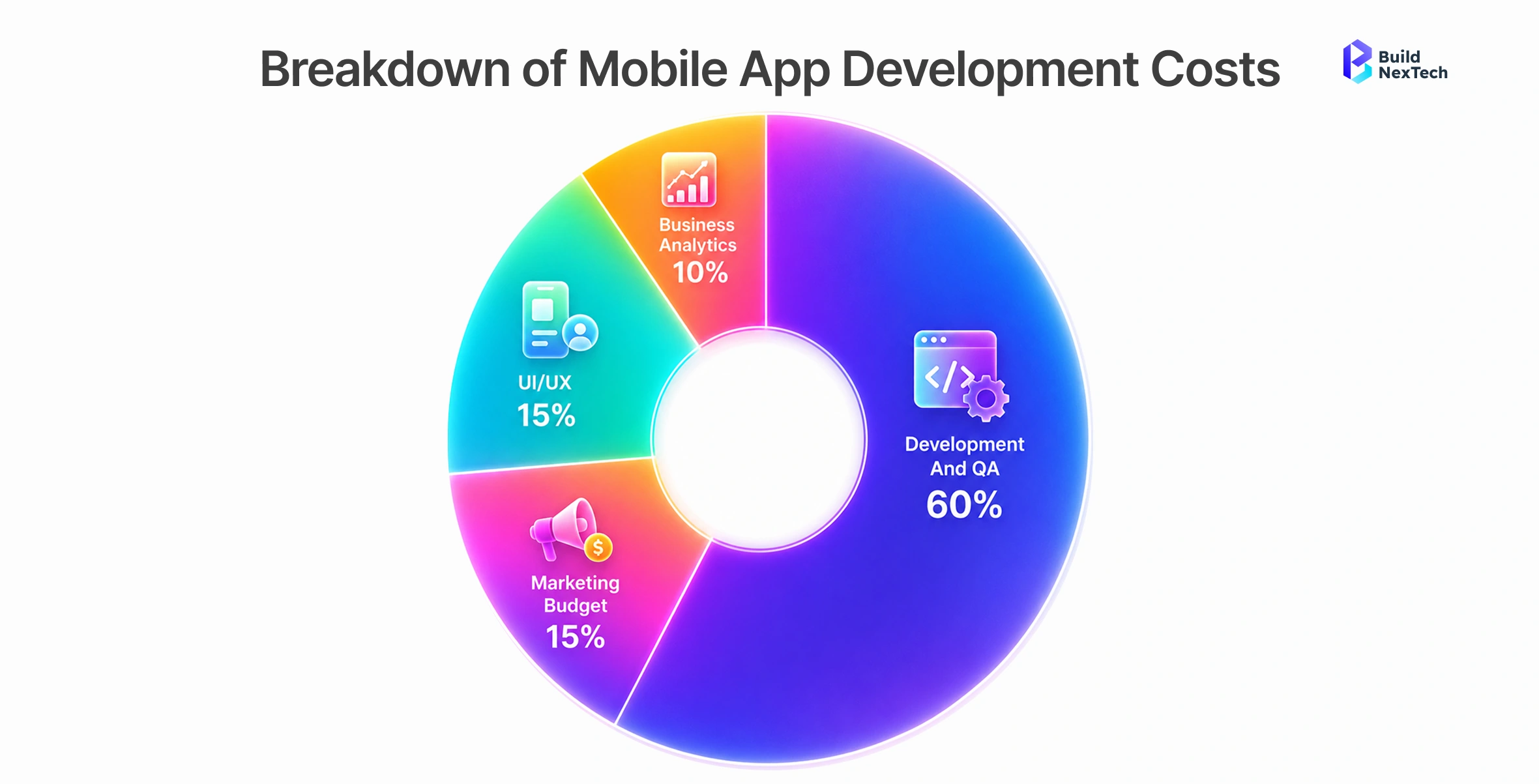
Key Cost Drivers in Cross Platform App Development
No two apps cost the same, but the same variables drive the price almost every time. Understanding these cost considerations before any negotiation means you can scope projects accurately and have far more productive conversations with any development partner you're evaluating.
- Feature complexity: authentication flows, payment systems, real-time data, and offline sync all carry significant time costs that are easy to underestimate
- Third-party integrations: connecting to CRMs, ERPs, payment gateways, or analytics tools multiplies scope in ways that don't show up in a rough estimate
- Design requirements: custom UX flows and highly branded UI take 2–3× longer than standard components (based on internal BNXT.ai benchmarks across 60+ client engagements)
- Backend and cloud integration: does the app need a new API built from scratch, or is there an existing backend it can connect to?
- Team location and seniority: senior engineers in the US cost $120–$200/hr, Western Europe $80–$140/hr, and South/Southeast Asia $25–$65/hr (Clutch.co Global Developer Rate Report 2024)
- AI-powered mobile apps carry an additional cost premium if they require on-device ML models or real-time AI inference pipelines
A proper discovery phase before development starts is one of the most cost-effective investments you can make. It surfaces the ambiguities when they're cheap to address - not mid-sprint when changing direction costs real time and money.
Flutter vs React Native Cost Comparison: Real Differences
Both Flutter and React Native give you a single codebase for iOS and Android - which is significantly cheaper than building two separate native apps. Flutter delivers roughly 85–90% code reuse across platforms; React Native sits at 75–85%, per their respective official documentation. That shared codebase is the real cost efficiency story here, and it's the main reason cross-platform development has become the default choice for most new mobile products.
- Flutter app development services have a smaller talent pool overall, which can push senior engineer rates higher when demand peaks
- React Native mobile app development benefits from a massive JavaScript developer community - more candidates, more hiring flexibility, more open-source tooling
- Flutter's compiled nature typically produces faster runtime performance, which can reduce the need for expensive backend optimisations later
- React Native's JavaScript bridge can introduce performance overhead in complex apps, and addressing that sometimes means writing native modules - which adds scope and cost
- For most standard business apps, the total cost delta between Flutter and React Native is under 10%
Framework choice matters less than framework depth. The best Flutter developer will almost always outperform an average React Native developer, and vice versa. Hire for expertise first, framework second.
Hidden Costs Businesses Commonly Miss in App Projects
The quoted development price is a starting point, not a finish line. These cost considerations almost never appear in the initial proposal, but they land in your budget one way or another once the app is live. Getting ahead of them changes how you structure your total budget - not just the build.
- App store fees: $99/year for the Apple Developer Program, $25 one-time for Google Play
- Cloud infrastructure and cloud integration: hosting, CDN, databases, and storage all scale with your user base - costs grow with success
- Post-launch bug fixes: every production app has them, and plenty of contracts don't include any warranty period after delivery
- OS update compatibility: both Apple and Google ship major annual updates that can break existing apps without any changes on your end
- Remote monitoring and performance testing tools: essential for catching problems in production before users hit them
- Third-party subscriptions: push notifications, analytics, payment processors, maps - these add up to a real monthly recurring number
A development partner worth working with will walk you through the full cost of ownership - not just the build - before any contract is signed. If the conversation starts and ends with the initial quote, add those ongoing cost considerations yourself.
Pricing Models: Fixed, Hourly, and Dedicated Team Options
How you pay shapes how your partner behaves. A team on a fixed-price contract has different incentives than a team billing by the hour, and understanding that dynamic helps you choose the structure that aligns with how your project is actually going to run. Milestone-based payment - where each instalment releases only after a defined phase is completed and approved - is increasingly popular because it aligns financial releases with verified delivery, protecting both sides from the usual points of friction.
BNXT.ai works across all five models and helps clients choose based on where their project actually is - not which pricing structure earns the most upfront.
Red Flags When Hiring App Developers
Knowing what a good partner looks like is only half of it. You also need to spot the warning signs before they become expensive lessons. These patterns appear across a lot of failed projects - they're not rare, and they're not always obvious in a sales conversation.
Unrealistic Low Pricing & Fake Commitments: Watch Out
When an agency comes in 40% below everyone else, that number has to come from somewhere. Usually it's junior engineers being substituted for seniors, QA being treated as optional, or a pricing model designed to get you through the door before the upsells start. Freelance developers can sometimes hit similar rates, but they rarely bring the process rigour, security certifications, or bench depth that a properly structured product requires.
- A very low quote without a detailed discovery phase means the scope hasn't been thought through - or it's been deliberately under-specified
- Timelines like '3 to 4 months' with no milestone breakdown or milestone-based payment structure aren't plans, they're placeholders
- Guarantees made before requirements are fully defined are a sales tactic, not a commitment
- An agency that can't walk you through how they arrived at a cost estimate probably hasn't done the work to arrive at one
Cheap upfront almost always means expensive later. The cost of rebuilding a poorly-built app consistently exceeds the cost of doing it right the first time - often by a significant margin.
No Dedicated Mobile App Developers or Team Clarity
'We have a team of 50 developers' is a meaningless statement until you know which of those 50 will actually work on your project. The bench model is common: agencies win the work in the proposal stage, then assign whoever's available when it's time to start. You end up with a team you've never met, working on a product you've spent months thinking about.
- Ask to be introduced to the actual developers who will work on your project - before anything is signed
- Get explicit clarity on whether the team composition changes mid-project and what the handover process looks like if it does
- Understand the seniority mix - most projects need at least one senior developer who owns architectural decisions from day one
- If they can't name who's on your team in the sales conversation, there's a good chance they don't know yet
The strongest development relationships are with named people you've spoken to, whose backgrounds you've reviewed. Anonymous resources assigned post-contract are how projects lose institutional knowledge at the worst possible moments.
Lack of Post-Launch Support & Maintenance: A Common Pitfall
Going live is day one, not the finish line. Real users behave differently from test accounts. iOS and Android updates land without warning and break integrations. User retention metrics start moving in the wrong direction when performance issues go unaddressed for too long. If the agency treats launch as the end of the project, you're dealing with all of that without the people who built the thing.
- Get specific about what post-launch support is included and exactly how long it runs
- Ask what their SLA looks like for critical bugs - hours or business days?
- Will they set up remote monitoring to track app health and performance in production, or is that on you?
- What's the process for OS compatibility updates when Apple or Google ships a major release?
- Does ongoing maintenance need a new contract, or is it already part of the engagement?
BNXT.ai treats post-launch as a structured phase, not an informal courtesy. Every project includes a dedicated stabilisation period and retainer-based maintenance options - so there's always support available when user retention metrics matter most.
No Clear Process or Ownership Terms: Non-Negotiable Basics
A defined process isn't bureaucracy - it's the scaffolding that keeps complex work from collapsing under its own weight. An agency that can't describe how they work is telling you they're figuring it out as they go. Agile methods, documented ownership terms, and structured testing and feedback cycles aren't extras - they're the baseline for any team building something that matters.
- There should be a documented development methodology - Scrum, Kanban, or a clearly explained hybrid
- IP ownership must be explicit in the contract, not inferred from a handshake
- NDAs should be offered automatically, not only when you ask
- Project kick-off, milestone reviews, and client sign-off processes should all be defined before work begins
If an agency can't describe their process in a sales conversation, they aren't going to develop one once your project starts. Process isn't something teams adopt under pressure - it's something they either have or they don't.
Conclusion: Why Choose BNXT as Your Cross Platform App Development Company
You now have a real framework for making this decision - not just a list of questions, but a way of thinking about what separates the partners who ship great products from the vendors who just ship. If you're looking for a team that clears every bar in this guide, here's the case for BNXT.ai.
Full-Cycle Mobile App Development Services at Every Stage
BNXT.ai handles every phase of the product lifecycle - from early discovery and UX flow design through development, QA, launch, and ongoing maintenance. There are no handoffs to third-party vendors, no gaps in accountability, and no need to piece together a separate team for each function. One team owns the full journey, from design validation to post-launch growth.
- Product discovery and roadmap planning built into every engagement from day one
- In-house design with UX flow prototyping and design validation before engineering begins
- Dedicated QA, performance testing, and structured testing and feedback loops in every sprint
- Post-launch stabilisation period with remote monitoring included in every project scope
End-to-end ownership means one team is accountable for the whole outcome - and that changes everything about how a project gets managed.
_1.webp)
Expert Flutter & React Native Development Teams with Real Track Records
The engineering team at BNXT.ai includes senior Flutter specialists and React Native engineers who have shipped production apps across healthcare, fintech, retail, and logistics. These aren't developers who learned the frameworks on tutorial projects - they've dealt with the edge cases, the performance bottlenecks, the cloud integration challenges, and the platform quirks that only surface in real-world production environments.
BNXT.ai client outcome: A healthcare logistics client saw a 42% improvement in daily active user retention after BNXT.ai redesigned their React Native app's UX flow and added real-time shipment tracking via cloud integration. Post-launch remote monitoring caught and resolved three critical performance issues within 48 hours of go-live.
- Senior Flutter and React Native engineers available as dedicated developers or on a project basis
- A live app portfolio across both frameworks, with post-launch growth data and user retention metrics available on request
- AI-ready app development capabilities including ML Kit, TensorFlow Lite, and OpenAI API integrations
- Framework recommendations that are driven by your product requirements and long-term scalability goals - not internal preference
Whether you're looking to hire Flutter developers for a new build or hire React Native developers to extend an existing product, BNXT.ai gives you access to specialists who've already navigated the hard problems.
Transparent Process with Dedicated Developers You Actually Know
At BNXT.ai, the team you meet during the sales process is the team that works on your project. Developers are introduced at kick-off. You have direct access - not just polished summaries from a project manager. Agile methods run every sprint. Milestone-based payment structures give you clear checkpoints where you review what's been built and approve the next phase before it begins.
- Named developers assigned to your project from day one - no bench-model surprises after signing
- Direct Slack or Teams access to your engineering team - communication without gatekeepers
- Weekly sprint reviews with working software to demo, not slide decks with RAG statuses
- Milestone-based payment tied to verified deliverables at each defined project phase
Transparency isn't something BNXT.ai offers as a differentiator - it's just how they operate. No surprises, no hidden cost models, no team you've never met.
Scalable Solutions Built for Long-Term Product Growth
Every app BNXT.ai builds is designed for where the business is going, not just where it is today. Architecture decisions, cloud integration design, and API structures are all built for long-term scalability - so growth doesn't eventually require a full rewrite. The goal is always an app that generates real app revenue and delivers measurable post-launch growth over time, not just at launch.
- Cloud-native architectures built for horizontal scaling from day one
- Remote monitoring and performance testing built into every post-launch support structure
- AI-ready app development foundations - designed so AI-powered features can be added later without rebuilding core architecture
- Ongoing retainer options to support product evolution, move user retention metrics in the right direction, and accelerate app revenue growth
The difference between a good app and a great one usually isn't the feature list - it's the foundation underneath it. BNXT.ai builds foundations that last.
People Also Ask

1)How much does a cross-platform mobile app cost?
A basic cross-platform app typically costs $25,000–$80,000. Mid-complexity apps with custom UX flows and backend integrations usually fall between $80,000 and $200,000. Enterprise-grade or AI-powered apps can exceed $300,000
2)How do I know if an app development company is good?
Look for live apps you can download and review, not just portfolio screenshots. Ask for client references you can actually call.
3)How long does it take to build a mobile app?
MVPs typically take 3–4 months. Standard business apps with cloud integration, custom UX flows, and design validation usually take 5–8 months.
4)Will I get updates after the app is launched?
That depends entirely on what's in the contract - which is why you should confirm it before anything is signed. BNXT.ai includes a post-launch stabilisation period with remote monitoring and performance testing built in
5)Can I change my app idea during development?
Yes - but mid-project changes have real cost and timeline consequences. Good teams handle changes through a formal change request process that assesses impact before the work starts.


.webp)
.webp)
.webp)

.webp)
.webp)