

Run Kubernetes in production without a real security plan, and someone will eventually spend their weekend digging through logs. It happens. Teams ship to unsecured clusters frequently - RBAC settings never touched since setup, images scanned clean by a broken scanner that never ran anyway.
The Kubernetes Security Problem (Why DevSecOps Is Required)
Most Kubernetes breaches aren't sophisticated. Exposed API servers. Service accounts with too much access. Unsigned images. Not zero-day exploits. Just configuration mistakes that shouldn't have happened in the first place.
Traditional security infrastructure wasn't designed for this. Firewalls don't understand pod networking. Security reviews happen weekly, but your CI/CD pipeline pushes multiple times daily. That gap is the problem.
Expanding Attack Surface in Kubernetes
The Kubernetes API server runs the control plane. Compromise that, and you don't need to target individual workloads at all. Add multi-cluster setups, hybrid cloud, and teams that can't see what's actually running where, and the attack surface becomes nearly impossible to reason about.
It happens quietly. Nobody sends a message when a new node gets added with different kernel settings. Permissions get added during crunch periods and never get removed. The environment drifts. So does your security posture.
Real-World Impact of Misconfigurations
The issue of container security is even reflected in CVEs. As per the Sysdig 2024 Cloud-Native Security and Usage Report, crypto mining is still the most common threat seen in exposed Kubernetes environments. This type of threat tends to go unnoticed until the bill comes due for the sudden cloud expense hike. However, compliance violations tend to be less exciting but much more predictable: GDPR, SOC 2 failures, customer alerts.
The Gap: Where Traditional Security Fails
Perimeter security assumes you have a perimeter. Kubernetes doesn't have one, especially not in multi-cloud. Code flows through CI/CD continuously, but traditional security is a gate at the end - sometimes days after code was written, often skipped entirely when deadlines get tight.
DevSecOps embeds security throughout the pipeline. Not as a final checkpoint. As part of every step.
DevSecOps Architecture for Kubernetes Security
DevSecOps isn't a product. It's a way of organising how teams build and release code. Getting it to work takes time. It requires buy-in from people who don't initially understand why their deployment process suddenly has extra steps.
End-to-End DevSecOps Security Flow
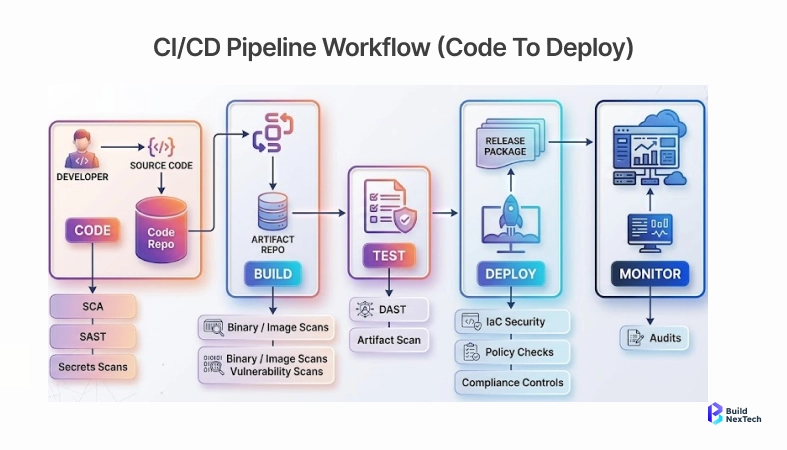
Security happens at each stage. Most organisations have pieces of this. The gap between ideal and reality is usually substantial. Image scanning exists. Runtime Kubernetes monitoring is on the roadmap somewhere. Code-level scanning was discussed in a meeting six months ago.
Shift-left means catching problems earlier when they're cheaper to fix. Vulnerabilities that arise during development are almost free. According to a study done by IBM Systems Sciences Institute, the cost incurred to correct defects increases tenfold when going from one phase to another, starting from development to testing then finally to production.
Key Security Layers in Kubernetes
The layers that actually matter:
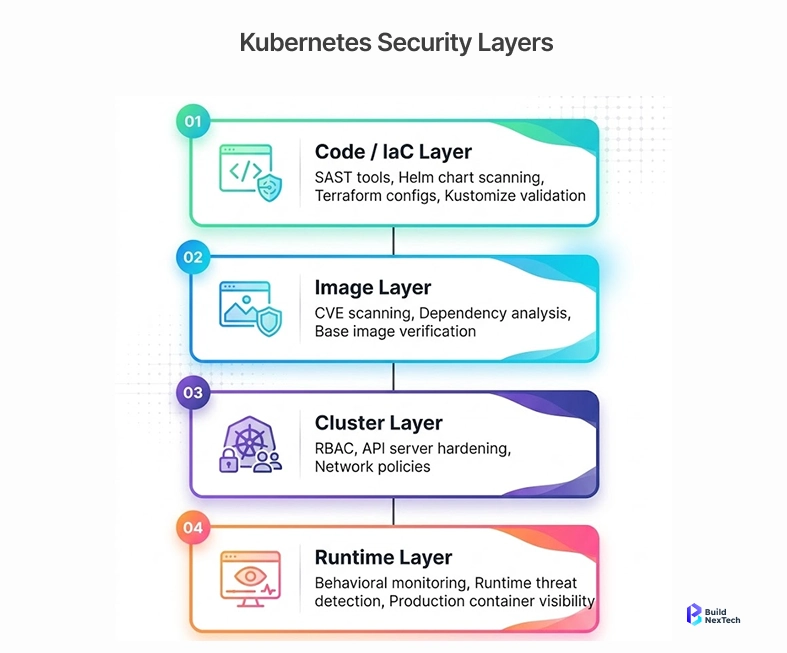
Code / IaC layer - SAST tools that scan Helm charts, Terraform configs, Kustomize files. Catches misconfigurations before they hit a cluster.
Image layer - CVE scanning, dependency analysis, base image verification. Most teams start here. Necessary but not the whole story.
Cluster layer - RBAC, API server hardening, network policies. Set up once at the beginning and then often forgotten.
Runtime layer - Behavioural monitoring of actual containers running in production. This is where most teams fall furthest behind.
Each catches different threats. Runtime monitoring finds attacks that static scanning misses. Code scanning catches issues before images are built. Treating one layer as a replacement for another is a recurring mistake.
Shared Responsibility Model
Developers own code and Helm charts. DevOps manages the pipeline. Security owns policies and audit logs. It works in theory. In smaller organisations where people wear multiple hats, the boundaries blur quickly.
Policy-as-code helps. Responsibilities get encoded in version-controlled, reviewable rules instead of living in someone's head.
Securing the Build & CI/CD Pipeline
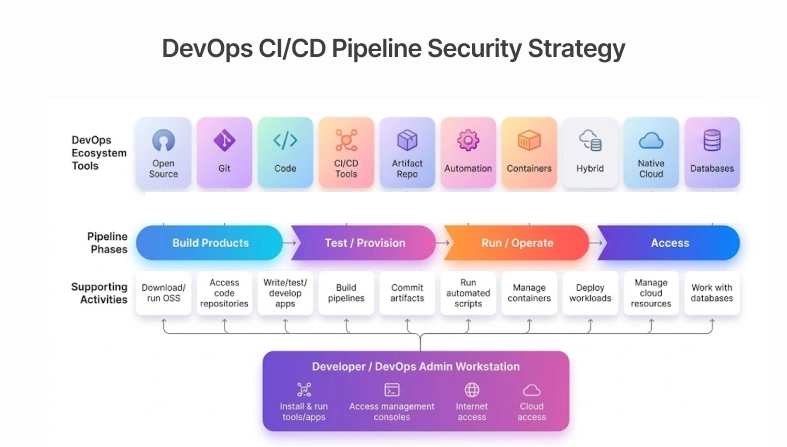
The pipeline is where you get the most leverage. A vulnerability caught there costs a fraction of what you pay after deployment. This is why shift-left security actually works.
Shift-Left Security in Kubernetes
Checkov scans Terraform, Helm, and Kubernetes manifests for misconfigurations. It's fast enough to run on every pull request without bottlenecking developers. Snyk catches vulnerable dependencies before images are built - when fixing them is cheap.
Kustomize files often slip through without being scanned. Not intentional. Just an oversight that compounds as more configuration lives in overlays.
Image Security & Supply Chain Protection
Every base image is a trust decision. "Official" images from Docker Hub still have vulnerabilities. Trivy Scan is the most common choice for scanning - it's fast, open source, and integrates cleanly into most CI/CD setups. Make sure your scan includes everything: base images and all packages, not just your application code.
Image signing matters for supply chains. Cosign handles signing and is becoming a standard expectation in mature pipelines. SBOMs (software bills of materials) are worth generating at build time. Compliance and procurement teams are pushing them from "nice to have" toward "required."
Image immutability gets overlooked, but it shouldn't. If a container image can be modified after deployment, everything you did during the build phase is weaker than it appears.
CI/CD Security Gates
Admission controllers enforce policies and block deployments that don't meet them. The trick is tuning them correctly. Too strict, and engineers start adding exceptions just to get work shipped - worse than no gate at all because now it exists, but nobody respects it.
Keep checks integrated into Git workflows. The check runs where developers already work. If it requires separate dashboards and logins, people will find ways around it.
Kubernetes Deployment Security (Cluster-Level Controls)
Kubernetes defaults aren't production-secure. By design. Kubernetes is a general-purpose infrastructure. Flexibility is the priority. The burden of hardening falls on operators, and there's more work than most people realise.
Access Control & API Security
RBAC is the right model for least-privilege access. The initial setup is usually fine. The problem is drift. Permissions get added to meet a deadline. Service accounts accumulate access that was granted for reasons that no longer exist. Without regular audits, RBAC becomes permissive almost on its own.
The Kubernetes API server shouldn't be publicly accessible. This seems obvious when you say it out loud. It still shows up in security audits regularly.
Secrets & Configuration Security
Credentials in plaintext in Kubernetes manifests are a recurring problem. It's also completely avoidable. Teams put API keys in version control. Then they discover them three months later. Vault integrates well with Kubernetes Secrets - the setup work is real, but it's a one-time cost. Encrypting etcd at rest should be the baseline.
Network Segmentation & Traffic Control
By default, pods communicate freely with each other. Many production clusters run this way longer than security teams realise. It doesn't announce itself.
Zero-trust networking - every connection explicitly verified, nothing assumed safe - is the goal. Getting there means defining Network Policies, using Calico Cloud or Cilium for enforcement, and grouping external endpoints with NetworkSets. It's real work. But an environment where lateral movement meets no resistance is a genuinely bad place to be.
Runtime Security & Threat Detection
Static analysis finds known issues. Runtime security finds what's actually happening. They're not interchangeable. This is an important distinction.
Runtime Threat Detection
Falco Kubernetes detects privilege escalations, new process creations, and suspicious file writes and alerts on these anomalies. Such alerts are only counted if they reach a destination where action will be taken. An alert sent to a Slack channel that nobody checks is no different than not sending an alert at all.
Kubernetes Audit & Event Monitoring
Kubernetes audit logs capture everything the API server does. Without centralised forwarding, the data exists but goes unused. By default, Kubernetes audit logs retain data for 30 days or less, which is not enough for SOC 2, where the requirement for log retention is at least 90 days, or PCI-DSS, which requires a minimum retention period of one year. A SIEM makes detection rules actionable. Rules targeting actual Kubernetes attack patterns beat generic Kubernetes alerting that produces noise.
Kubernetes Observability for Security Signal Correlation
Prometheus collects metrics. Grafana displays them. The hard part is correlation. In microservices, single signals look like noise. A spike in latency means nothing. A failed request means nothing. Only when logs, metrics, and traces are analysed together do actual patterns emerge.
Deploying tools and calling it done is the classic mistake. The real value is in the correlation.
Policy Enforcement & Compliance at Scale
Manual configuration review breaks down quickly. Once you've got more than a handful of clusters, it's either automated or it's unreliable. There's no middle ground.
Policy-as-Code for Kubernetes
OPA enforces custom rules through admission controllers. Kyverno does the same thing, but using native Kubernetes YAML - lower barrier to entry, popular with teams already deep in Kubernetes. Both work.
Consistency matters more than which tool you pick. Inconsistent policies across clusters, version gaps, exceptions that never get cleaned up - that's worse than imperfect policies applied uniformly everywhere.
Continuous Compliance Monitoring
CIS Kubernetes Benchmarks define what "baseline secure" looks like. Kube-bench validates against them on live clusters. Run these checks in your CI/CD pipeline, and catch configuration drift before it becomes a formal audit finding. Configuration drift is an issue that requires only one hour to detect in a CI/CD pipeline, but it would require weeks to fix if discovered during SOC 2 audits. Configuration drift detection in SOC 2 takes several weeks to fix and could affect the audit outcomes.
Standards like SOC 2 and PCI-DSS are moving away from point-in-time audits toward continuous validation. Automated compliance checking gets you there without needing to prepare for an audit every cycle.
Zero Trust Security Model
Zero trust means every request gets verified. No implicit trust because something originated "inside the network." Istio enforces mutual TLS between services automatically.
It's a significant shift. Internal traffic gets the same scrutiny as external. After an initial compromise, this limits how far an attacker moves. The difference between "attacker has a foothold" and "attacker can move freely" often determines whether you contain the incident or it becomes a breach.
DevSecOps Toolchain for Kubernetes Security
No single tool solves everything. A working security toolchain gets assembled across multiple categories. Usually built incrementally, not all at once.
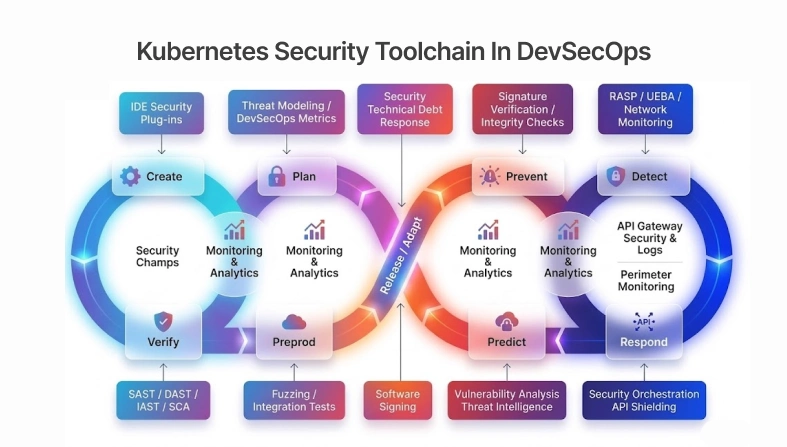
Code & IaC Security Tools
Checkov scans IaC across Terraform, Helm, and Kubernetes manifests. Snyk catches vulnerable dependencies during development. Both support custom policies. Running both on every pull request is the goal - not everyone gets there immediately, but that's the direction.
Container & Supply Chain Security
Trivy is typically the first choice: it's fast, open source, and widely adopted. As needs get more sophisticated, Clair or Anchore gets added. Cosign handles image signing. SBOMs get generated at build time for transparency.
Image immutability deserves more attention than it gets. Enforce it at the cluster level, and you eliminate an entire category of runtime tampering risk.
Runtime & Monitoring Tools
Falco for runtime threat detection. Prometheus and Grafana for monitoring and alerting. Zentara extends Kubernetes observability for security operations.
Common failure: Tools get deployed, dashboards look good, alert routing becomes an afterthought. Operational discipline around what happens when an alert fires matters as much as the tools themselves.
Policy & Governance Tools
OPA integrates directly with Kubernetes admission control. Kyverno writes policies in YAML. Argo CD and Flux enforce GitOps with built-in security controls. Governance tools get deprioritised consistently - until an audit or incident suddenly makes them urgent. An OPA cluster that is inconsistent from an environmental standpoint will be approved internally but flagged by vendors for its security review. Vendor questionnaires usually uncover the worst configuration in your set, rather than the best one.
Scaling Kubernetes Security with DevSecOps
Scaling security is an automation problem. Human review can't keep up with production Kubernetes. Not because people aren't capable, but because the volume is simply too high for manual processes.
Automating Security Across Environments
Standardised security pipelines apply consistent controls across all clusters. The value isn't just efficiency - it's predictability. Inconsistently applied security is unpredictable during incidents, when assumptions like "this cluster follows standard policy" turn out wrong.
Automation reduces configuration errors that compound in large environments. GitOps tools enforce secure patterns at scale without per-deployment manual review.
Drift Detection & Auto-Remediation
Configuration drift is quiet and persistent. Clusters diverge from the desired state for mundane reasons: patches applied inconsistently, emergency changes outside the normal process, temporary exceptions that become permanent. Automated detection compares the live state against the desired state and triggers remediation.
Detection Window Size Always Determines Incident Scope at BNXT: Four Hours Is Containable, but Three Weeks Is Not. Misconfiguration of four hours that goes unreported can be contained, while three weeks is a much larger problem.
Security for Multi-Cloud & Hybrid Kubernetes
Consistent policy across cloud providers requires tooling that spans environments. Documentation doesn't scale past a certain point. Centralised visibility across clusters is required. RBAC, network policies, secrets management - standardise them across the fleet instead of deciding per-environment.
How a DevSecOps-First Approach Improves Kubernetes Security Outcomes
BNXT treats Kubernetes security as an engineering problem. The kind that requires understanding how clusters actually behave in production.
During Kubernetes hardening activities, role-based access control (RBAC) drift and overprivileged service accounts have repeatedly surfaced as the most critical issues in clusters that operate beyond the six-month mark. This trend correlates with audit results obtained through the CIS benchmark, where access control misconfiguration was found to be among the leading causes of failed tests.
For SOC 2, PCI-DSS, and similar compliance frameworks, they use OPA and Kyverno with automated CIS Kubernetes benchmark validation. Structured to pass audits without a separate preparation effort.
For teams using BNXT for Kubernetes security hardening, they transition from being in audit-preparation mode to continuous compliance, where audit-proofing is merely a consequence of the pipeline itself, rather than a separate process.
Conclusion: Building Secure Kubernetes with DevSecOps
Kubernetes security doesn't have an endpoint. CVEs surface continuously. Teams change. Requirements shift. DevSecOps works because it makes security continuous - woven into delivery instead of bolted on at the end.
Teams that get this right don't necessarily have more resources. They have better automation, clearer ownership, and controls that function without constant manual intervention. Compliance posture comes as a byproduct of being continuously automatically validated against CIS Benchmarks, the audit evidence that is used to replicate through manual compliance. That's better than treating compliance as the goal.
People Also Ask

What is Kubernetes security?
Kubernetes security refers to the controls that protect clusters, workloads, and infrastructure across build, deploy, and runtime stages.
How does RBAC enhance Kubernetes security?
RBAC enforces least-privilege access. When credentials get compromised - and they will - scoped permissions limit what an attacker can do. The ongoing problem is drift. Permissions accumulate without cleanup. RBAC that was tight at setup becomes permissive over time.
What are the best tools for Kubernetes security?
By layer, Kubernetes security best tools include: Trivy for image scanning; runtime threat detection with Falco; OPA or Kyverno for policy enforcement, Checkov and Snyk for code scanning and IaC, and Kube-bench for CIS Benchmark validation.
How to automate security in DevSecOps pipelines?
CI/CD gates block insecure builds without per-build manual review. Admission controllers enforce policies at deployment. Continuous compliance checks run on schedule. Automate everything that doesn't require human judgment. Reserve human review for actual decisions.
What is zero trust in Kubernetes?
Every request gets verified regardless of origin. No implicit trust from being "inside the network." Istio enforces mutual TLS automatically. Internal traffic is treated like external. After an initial compromise, this substantially limits lateral movement. Implementation is real work, but it's the only approach that actually constrains attacker movement.


.webp)
.webp)
.webp)

.webp)
.webp)