

YouTube isn’t just the world’s largest video-sharing platform—it’s a digital heartbeat connecting billions of people every single month. From life-changing tutorials to global events watched in real time, YouTube streams billions of hours of human stories, creativity, culture, and knowledge across every corner of the planet.
Behind this easy experience is an amazing engineering achievement. It combines next-generation content delivery networks (CDNs), very precise chunk-based streaming, smart adaptive bitrate streaming (ABR), distributed caching systems, and Google's huge cloud and network infrastructure.
Key Topics Covered in This Blog:
- How YouTube handles millions of simultaneous video requests across the globe.
- How its CDN architecture and global caching systems ensure fast and reliable delivery.
- How chunk-based streaming improves startup time, seeking, and stability.
- How Adaptive Bitrate Streaming (ABR) maintains smooth playback even on weak networks.
- How Google’s cloud infrastructure, data centers, and private backbone power global video delivery.
- How YouTube keeps playback stable during network congestion and unpredictable bandwidth.
- How the platform delivers consistent quality for all content types-from small creators to global live events.
If you’ve ever wondered how a platform of this magnitude continues to run flawlessly at a global scale, this is your journey into the technology, the innovation, and the engineering brilliance that make YouTube one of the most resilient and impactful digital ecosystems in the world.
Understanding YouTube’s Massive Streaming Scale
With more than 2 billion monthly users and petabytes of video uploaded daily, YouTube must maintain a delivery ecosystem capable of handling massive concurrency-sometimes millions of streams per second. Its engineering priorities revolve around:
- High-quality video streaming
- Consistent video playback on any device type
- Resilience across unpredictable network conditions
- Efficient data centers, network infrastructure, and CDN caching
Why YouTube Requires a Specialized Global Delivery Architecture
When a new music video goes viral and 50 million people hit play in the same hour, a normal server would collapse—like everyone trying to squeeze through a single doorway at once. YouTube prevents this overload by using a planet-scale delivery system with CDN edge servers, distributed caches, regional storage clusters, and tightly integrated GCP services supported by a broad ecosystem of GCP partners to ensure global reliability and massive scalability.
Instead of viewers pulling the video from one central server, local nodes deliver it nearby—similar to having thousands of mini-theaters worldwide. But this level of demand can’t be handled by a traditional website relying only on basic browser caching or simple web caching. YouTube needs an infrastructure designed explicitly for massive video distribution, including:
- A global content delivery network (CDN) optimized for large video files
- Distributed data caching and content caching mechanisms
- Ultra-fast DNS caching for rapid routing
- A custom, scalable video processing pipeline
- Intelligent distributed caching strategies
- High-capacity network infrastructure powered by Google’s private backbone
Together, these systems eliminate bottlenecks, reduce latency, and ensure smooth, high-quality playback—even during massive global events, viral surges, or live sports streams.
The Infrastructure Behind YouTube’s Planet-Scale Video Delivery
YouTube is powered by Google’s global cloud infrastructure, data center infrastructure, and private undersea cables forming one of the fastest networks on Earth. It tightly integrates:
- Storage systems like the Google File System
- Object Storage for video segments
- Distributed File Systems Stores video chunks across multiple servers to ensure fast access, reliability, and scalability for global streaming.
- Compute clusters for video transcoding and replication
- Load balancers for routing traffic
- IT infrastructure and network infrastructure optimized for high throughput
Google’s Global Data Centers, Private Backbone & Distributed Storage
YouTube relies on a network of globally distributed Google data centers to store, process, and deliver video content at scale. These data centers are interconnected through Google’s private backbone, ensuring ultra-high bandwidth and low-latency communication between regions.
Key components include:
- High-performance video transcoding clusters – Convert uploaded videos into multiple formats, resolutions, and bitrates for global accessibility.
- Massive Object Storage – Optimized for billions of video segments, enabling quick retrieval for users worldwide.
- Distributed File Systems – Store video chunks across multiple servers to provide reliability, redundancy, and fast access.
- Redundant data center infrastructure – Ensures resilience and uninterrupted service even during failures or maintenance.
- Global private backbone – Connects data centers with ultra-high-speed links, reducing latency and network congestion.
- Google Cloud Infrastructure as a Service – Powers compute and storage operations, supporting massive scale video delivery.
- AI infrastructure – Facilitates real-time video analysis, recommendation algorithms, and adaptive streaming optimization.
This architecture ensures YouTube can deliver videos efficiently, reliably, and at high quality to users anywhere in the world, making the platform resilient to traffic spikes and network disruptions.
How Compute + Replication Manage Trillions of Video Chunks
When a video is uploaded:
- It enters YouTube’s video processing pipeline
- It is transcoded into multiple video formats, frame rates, and video resolutions
- Each output becomes a set of video segments (chunks)
- Chunks are stored across Distributed File Systems
- Replicas are placed strategically using data caching and distributed caching
By dividing videos into thousands of tiny chunks, YouTube enables:
- Faster startup times
- Lower bandwidth costs
- Better resilience when node failures occur
- Compatibility with HTTP networks, HLS (HTTP Live Streaming), DASH (Dynamic Adaptive Streaming over HTTP), and Smooth Streaming
Content Delivery Mechanisms That Power YouTube
YouTube’s delivery stack goes far beyond standard content delivery network services.
Instead of relying solely on traditional CDNs, YouTube uses a deeply customized global delivery architecture that includes its own edge caches (YouTube Edge Nodes), AI-driven traffic routing, region-aware load balancing, and real-time quality optimization.
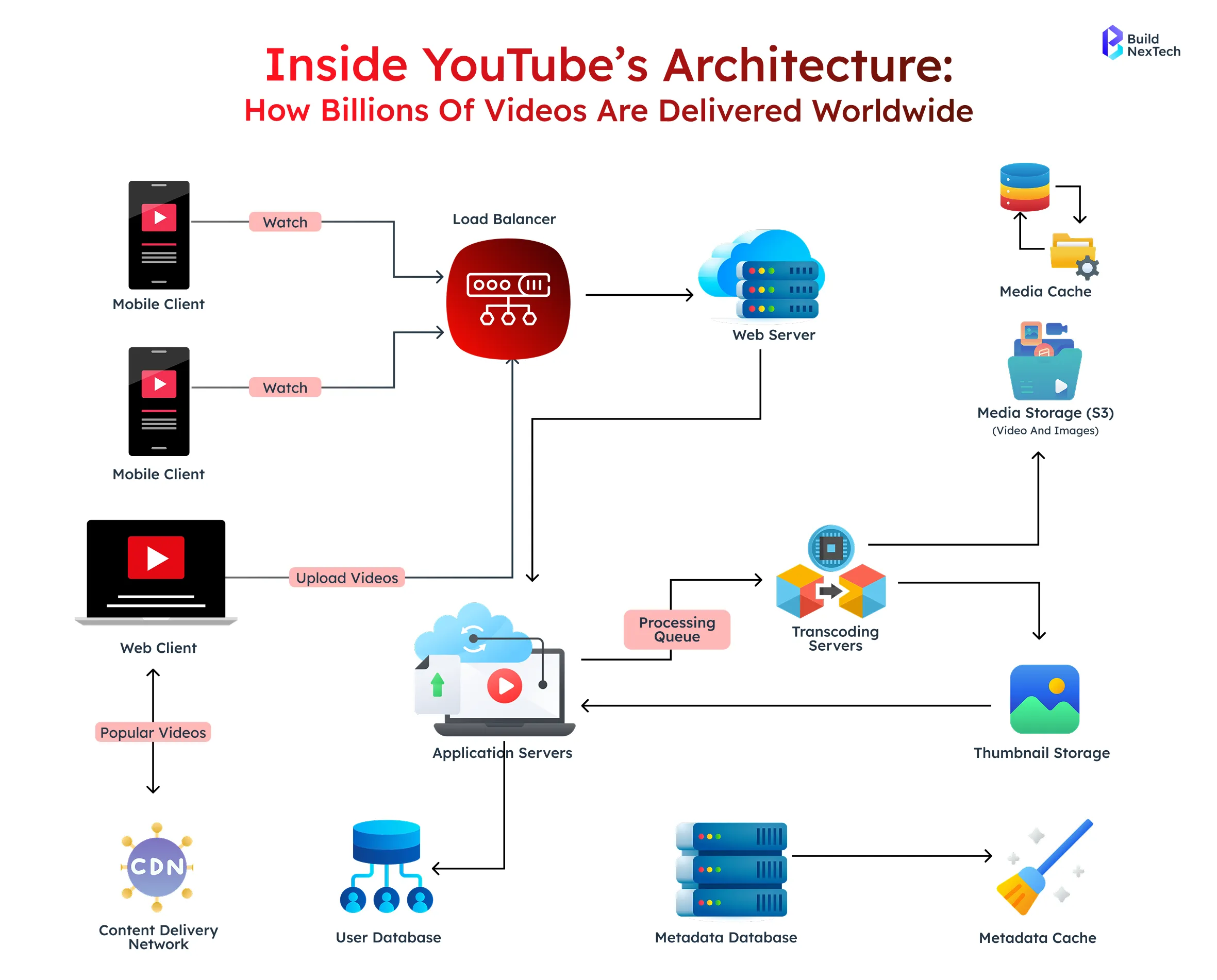
YouTube’s Private CDN, Edge Caching & Intelligent Routing (QUIC/BBR)
To deliver billions of hours of video globally with minimal buffering and latency, YouTube uses a highly customized private content delivery network (CDN), often called Google Global Cache (GGC). This network ensures videos are delivered quickly and reliably, even during traffic surges or network congestion.
Key components and their purpose:
- Thousands of CDN servers embedded inside ISPs – Store popular videos close to users, reducing the distance data must travel and improving playback speed.
- Deep edge caching for popular videos – Keeps frequently requested videos readily available at local nodes, preventing repeated long-haul fetches from central servers.
- Content delivery network cache tuned for video workloads – Optimizes storage and retrieval of large video files for smooth streaming at scale.
- CDN caching to reduce backhaul usage – Limits repeated requests to origin servers, saving bandwidth and reducing latency.
- Intelligent routing using QUIC – Low-latency transport protocol that accelerates connection setup and reduces interruptions during playback.
- BBR congestion control algorithm – Dynamically adapts video delivery rate to network conditions, minimizing buffering during congestion.
Why it matters:
- Closer servers to viewers – Faster video start times and fewer interruptions.
- Reduced buffering and latency – Ensures seamless playback during peak traffic or on slower networks.
- Less dependency on external networks – More control over performance and reliability.
- Enhanced security – Private CDN reduces exposure to public network attacks and enhances content protection.
YouTube’s private CDN, combined with edge caching and intelligent routing, allows the platform to deliver millions of simultaneous streams efficiently, even under unpredictable network conditions.
Chunk-Based Streaming and High-Efficiency Buffer Management
YouTube breaks videos into 2–6 second chunks, allowing the player to fetch only what’s needed in real time. This keeps playback smooth, reduces wasted bandwidth, and lets YouTube quickly switch quality levels during network fluctuations.
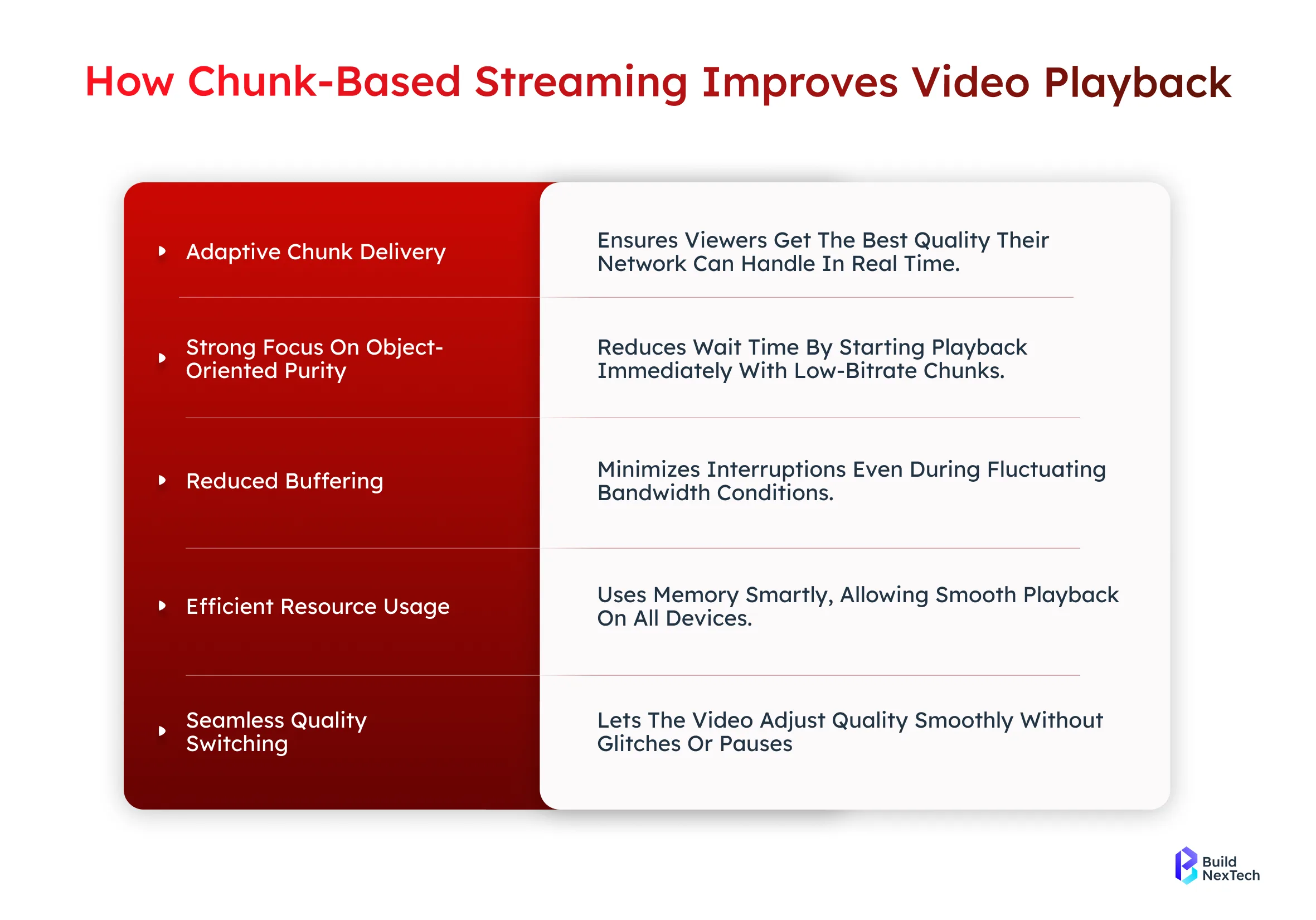
Chunking enables:
- More accurate bandwidth adaptation
- Fast seek operations
- Seamless switching between bitrates
YouTube’s buffer management system prefetches segments depending on:
- User device capability
- Network conditions
- Historical viewing patterns
- Content popularity
This improves startup time and minimizes stalls.
How ABR (Adaptive Bitrate Streaming) Enables Smooth Playback
Adaptive Bitrate streaming Adaptive Bitrate Streaming (ABR) is a technology that provides the seamless playback of a video by dynamically altering the quality of the video, depending on the current network bandwidth and capability of the device used. It reduces buffering and maximizes bandwidth and the viewing experience on any device as optimally as possible.
Multi-Bitrate Encoding, Network Adaptation and Real-Time Quality Switching.
Youtube converts any uploaded video into a rich variety of formats, developing various bitrates, encoding ladder, and codec profiles, frame rates and video resolutions. This will see to it that all viewers, no matter which device or connection they have, receive the best possible version of the video.
All the significant quality levels such as:
144p, 240p, 360p, 480p, 720p, 1080p, 1440p, 4K and further (depending on the supported devices).
The YouTube player is in the process of analyzing the important factors, including: to deliver the perfect quality at the perfect time, it analyzes the following factors:
- Internet speed-The speed of data that could be transferred between your device and the internet.
- Network throughput -The amount of data that has been transferable successfully in a second.
- Available bandwidth -The capacity the network can serve at a specific time.
- Device capability -The quality of your device to decode, render and play videos without troubles.
- Screen resolution- this is the number of pixels in your display that defines your ability to see.
- Live network conditions- the live network stability, network congestion, or signal strength.
Considering all these signals, the YouTube smartly chooses the best stream, immediately and dynamically, to have a seamless playback, a minimum buffering time, and maximum possible quality that your connection is capable of.
The Reducing Buffering and Network Congestion by ABR.
Adaptive Bitrate streaming (ABR) reduces buffering and it always checks your current network speed and automatically adjusts the video quality to the most appropriate one. When the connection becomes weak (e.g. because of congestion, Wi-Fi dropouts, mobile inconsistency, etc.) ABR automatically switches to a lower bitrate to maintain the smooth playback. As the bandwidth is enhanced it upgrades the quality once again without disrupting the stream.This dynamic adjustment ensures continuous, stable viewing even under unpredictable network conditions.
ABR reacts in real time to the tiniest shifts in your connection—whether it’s:
- Sudden WiFi fluctuations
- Unexpected mobile network drops
- Heavy ISP congestion slowing down your route
To stay ahead of these unpredictable changes, YouTube relies on advanced ABR intelligence such as:
- Context-Aware Encoding that tailors quality to content type
- Per-Title Encoding for optimal compression on every video
- Optimized Bitrate Ladders that reduce unnecessary data usage
- Smart media player heuristics that predict and prevent playback issues
The result is a viewing experience that feels almost effortless:
- Buffering nearly disappears
- Videos start instantly
- Quality stays consistently high, even when your network doesn’t
User Experience Optimization Across Devices & Networks
YouTube is engineered to deliver a seamless, high-quality experience across every type of device. Its intelligent video player adapts instantly to device capability, supported streaming protocols, and available network bandwidth to select the ideal bit rate, video codecs, and ABR level for smooth playback.
Behind the scenes, YouTube uses advanced video compression, optimized frames per second, and precise manifest file delivery through globally distributed origin servers. Together, these systems ensure that all video uploads play consistently well—providing an exceptional quality of experience no matter the device, connection, or environment.
Mobile Optimizations, Low-Bandwidth Modes & Smart Prefetching
YouTube’s mobile optimizations include:
- Low-data mode with aggressive caching strategies
- Dynamic prefetching of the next few video chunks
- Network-aware application caching
- Browser caching for UI, static assets, and small metadata
- Device-specific encoding playback profiles

These optimizations help deliver smooth streaming even on networks with limited bandwidth.
Future of YouTube’s Video Delivery
YouTube is constantly evolving its video delivery with predictive caching, AI-driven bitrate selection, and low-latency streaming. These innovations, similar to the breakthroughs led by custom software development teams and modern AI development companies - ensure faster, smoother playback and a superior viewing experience as global demand and device diversity continue to grow.
Predictive Caching, AI-Driven Bitrate Selection & Low-Latency Streaming
YouTube is continuously evolving its delivery system to handle growing global demand and device diversity. Future enhancements include:
- Predictive Caching – Machine learning will anticipate trending videos and pre-position content at edge servers, reducing startup times and preventing congestion during peak demand.
- AI-Driven Bitrate Selection – Advanced algorithms used by an AI development company dynamically choose the optimal bitrate for each viewer, ensuring smooth playback while minimizing bandwidth usage.
- Expansion of Edge Computing Nodes – More computing resources closer to users will enable faster processing of video requests and lower latency for interactive and live content.
- Low-Latency Streaming – Optimized delivery pipelines will reduce the delay between video upload and playback, improving experiences for live events, gaming streams, and interactive formats.
- Enhanced Digital Rights Management (DRM) – Stronger, more efficient DRM will protect content globally without affecting playback speed or quality.
- Improved Cloud-Based Delivery Mechanisms – Leveraging global cloud infrastructure, YouTube will enhance content replication, routing, and delivery efficiency for faster and more reliable streams.
These innovations will allow YouTube to serve massive audiences more efficiently, maintain high-quality playback, and stay ahead of evolving user expectations.
Conclusion - How YouTube Continues to Scale Global Video Delivery
YouTube delivers billions of hours of video every month through a purpose-built global CDN, supported by advanced caching, redis caching, distributed caching, and intelligent data caching. Combined with chunk-based streaming, this ensures faster startup, smoother seeking, and reduced load on backend infrastructure.
Much of YouTube’s performance comes from its highly optimized adaptive bitrate streaming (ABR) engine, powered by global cloud infrastructure, distributed data centers, and Google’s private backbone. Smart routing with QUIC and BBR protocols helps avoid network bottlenecks, reduce latency, and maintain stable playback even under fluctuating network conditions.
AI further enhances YouTube’s delivery by optimizing caching, video encoding, bitrate selection, and predicting content placement. These innovations make YouTube a scalable, reliable, and high-performance platform capable of providing high-quality playback to users worldwide.
People Also Ask

What does YouTube do with copyright and fingerprinting of content on such a big scope?
YouTube operates a system called Content ID, which is automated and it searches uploaded video files in a large database of copyrighted content. It is capable of blocking, monetizing or tracking real-time even billions of uploads.
What are the technologies that YouTube employs to suggest videos to billions of users every day?
YouTube uses AI and machine learning algorithms to identify watch history, engagement patterns, and content metadata to provide personalized recommendations to a specific user.
What does YouTube do to guarantee play-back across various devices and platforms?
YouTube can dynamically adjust quality (through adaptive bitrate streaming (ABR), codec optimization and device-aware encoding) to play any video smoothly across all locations.
How does the encoding pipeline of Youtube help to lower storage expenses?
Multi-bitrate and per-title encoding of videos on YouTube allows compressing videos effectively in various formats and resolutions, and consuming less storage capacity, but still providing a high quality of playback across various devices.
How does YouTube measure video quality (QoE) and detect playback issues in real time?
YouTube monitors real-time metrics like buffering events, startup times, bitrate switches, and playback failures to assess Quality of Experience (QoE) and trigger corrective actions instantly.


.webp)
.webp)
.webp)

.webp)
.webp)