


Outsourcing web app development means hiring an external agency, offshore team, or freelance squad to design, build, and deliver a custom web application. It helps businesses reduce hiring delays, expand engineering capacity, and launch faster. Success depends on defining scope clearly, choosing the right vendor, controlling code ownership, setting milestones, and planning handoff before development begins.
.webp)
Why Most Outsourced Web App Projects Fail Before the First Commit
Where outsourced projects actually break - and it's not where you think.
Most post-mortems on failed software development outsourcing engagements blame "communication issues" or "vendor underperformance." Both are symptoms. The root cause is almost always a Scope of Work that was too thin to quote against accurately, handed to a team that built to their own assumptions. Those assumptions diverge from yours in the first sprint and compound over twelve. By the time the gap surfaces in a demo, rebuilding costs more than starting over.
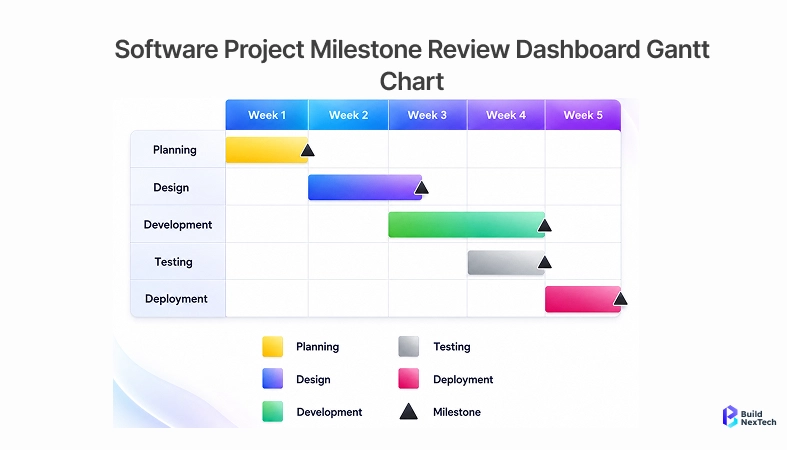
Governance is the second failure point. Projects without milestone-based reviews and repo access established from day one leave one window into progress: a status update email from the vendor. When the first milestone slips, there's nothing to audit.
From what I've seen across web app development outsourcing engagements, misalignment on what "done" means accounts for more project restarts than technical failures - and it typically surfaces within the first four to six weeks, once the first milestone review exposes a gap that was embedded in the brief from day one. Fix the brief before you fix the vendor.
When outsourcing is the right call - and when it isn't
Web development outsourcing makes sense when you need to ship a defined scope faster than an in-house department can be staffed; when your core team lacks a specific technology stack; when the build is time-boxed with stable requirements; or when you're validating a Minimum Viable Product before committing to headcount. Talent shortages in specialist areas - full-stack web developers, mobile app developers, UI/UX designers - make the case stronger when the skill gap is the constraint, not budget.
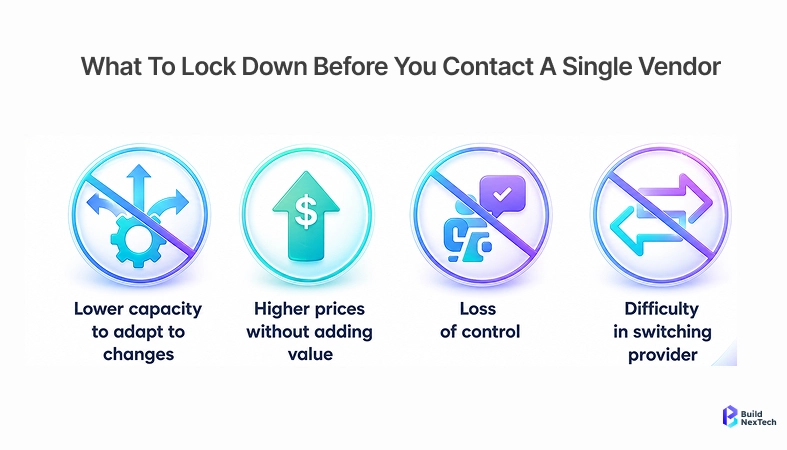
The model creates liability when requirements are genuinely undefined or the product roadmap will shift weekly. The most common mistake non-technical founders make is outsourcing product thinking alongside execution. The result is a vendor who becomes de facto product owner with no accountability for outcomes - only for shipping tickets.
Scope, stack, and success metrics - the three non-negotiables before vendor contact
A vendor can't quote accurately against a paragraph description. You need a documented Scope of Work that covers what you're building, what technology stack it will run on, and what acceptance criteria define success. Technical specifications - user flows, feature set, explicit out-of-scope boundaries - replace the paragraph brief. Stack constraints matter practically: an existing Node.js backend pairs naturally with React; a divergent stack adds integration overhead your team inherits long after handoff.
Acceptance criteria must be testable and owned by you, not the vendor. When vendors quote against undocumented criteria, they quote against their own interpretation. That gap is where budget overruns live - not in development.
Technical ownership and IP control - repo access, code rights, and vendor lock-in risk
Two things belong in every contract before you sign: explicit IP assignment, and repo access under your organisation from day one. IP assignment language should state that all work product transfers to the client upon delivery or payment milestone, whichever is earlier. A non-disclosure agreement covering proprietary business logic and user data shared during the engagement is equally non-negotiable.
At the infrastructure layer, check whether the vendor manages hosting and DNS without credential transfer. If they do, you carry an operational dependency that survives contract termination. For engagements handling sensitive user data or secure payment processing, ISO 27001 certification or equivalent security protocols is a reasonable baseline requirement - not a nice-to-have.
Choosing the right engagement model - fixed price, time and materials, or dedicated team
Fixed price works for fully defined builds - internal tools, defined MVP builds, or projects where requirements are genuinely stable. Time and materials fits exploratory products where requirements evolve through testing. Dedicated team suits sustained engineering capacity across multiple sprints, operating inside your Scrum framework and release cadence. Many Agile teams also rely on a CSM to guide Scrum practices and improve collaboration.
The error is choosing the model based on vendor preference. A vendor pushing fixed price on a vague brief is mispricing risk, not offering certainty - and you'll fund the gap through change requests. When evaluating custom web app development companies, the model recommendation should follow from your brief, not precede it.
How to Find and Vet a Custom Web App Development Company
Where to find a web application development company worth shortlisting
Clutch and GoodFirms surface verified reviews filterable by tech stack, project size, and IT industry vertical. GitHub profiles and public repos show how a team codes - not how they present in a sales deck. For complex builds with real-time functionality, third-party integrations, or compliance requirements, referrals from operators who have shipped comparable products carry more signal than any listing. The global IT outsourcing market is projected to reach $588.38 billion in 2025, which means the volume of vendors has grown faster than quality indicators - shortlisting discipline matters more, not less (Statista, 2025: https://www.statista.com/outlook/tmo/it-services/it-outsourcing/worldwide).
Decide early whether nearshore web development outsourcing or offshore web development outsourcing fits your budget and operational style. Nearshore vendors tend to offer cultural compatibility and time zone overlap. Offshore developer rates lower the cost ceiling, but offshore teams require stronger process infrastructure on your side to compensate. Either can work - the variable is your internal capacity to manage the engagement, not the geography.
Narrow to three or four firms before sending an RFP.
Six questions every vendor interview must answer
Ask every shortlisted vendor the same questions: Which part of this build carries the highest technical risk? How are scope additions logged and priced mid-engagement? Do you have dedicated quality assurance engineers, and what does your QA process include - automated tests, User Acceptance Testing, or both? What does a sprint review look like and who attends? If the engagement ends early, what does handoff include? Can you provide a reference from a project of comparable complexity?
The answers surface process maturity faster than any proposal. A vendor who can't describe their QA process hasn't built one. How a vendor handles pushback in the interview is a reliable signal for how they handle it at milestone three.
What a credible vendor proposal actually contains
A proposal worth signing includes a phased milestone plan with defined deliverables and review gates; explicit IP assignment; confirmed repo access under your organisation; a communication protocol covering sprint cadence and escalation paths; and a clear scope boundary. A flat quote against a paragraph brief is a bid on the vendor's interpretation of your project.
In bnxt.ai's web development engagements, projects where the vendor challenged the brief before quoting completed with 40–60% fewer change requests and delivered against original scope in over 85% of cases - versus engagements where scope gaps surfaced mid-sprint.
Costs, ROI, and What the Budget Gap Actually Means
Why can two vendors quote 5x apart for the same brief
Why two vendors can quote 5x apart for the same brief
A $20,000 quote and a $100,000 quote against the same brief aren't pricing the same product. The lower figure scopes to the happy path: minimal error handling, no meaningful test automation, no documentation, hosting the vendor controls. The higher figure prices in what production software actually requires - load testing, security protocols, staging environments, handoff documentation, post-launch support. Offshore developer rates vary significantly by region: according to Accelerance's 2024 Global Software Outsourcing Rates & Trends Guide, blended rates average $18–$25 per hour in South Asia, $25–$50 per hour in Central and Eastern Europe, and $35–$65 per hour in Latin America - a spread that explains much of the sticker shock when comparing multi-vendor quotes (Accelerance, 2024: https://www.accelerance.com/2024-global-software-outsourcing-rates-and-trends-guide).
Before comparing quotes, confirm both vendors quoted against the same documented Scope of Work. Different documents produce a meaningless comparison.
How to model a realistic payback timeline before you sign
A simple model: identify the operational cost the app replaces or revenue it enables, then divide total cost of outsourced app development - build plus first-year maintenance estimate - by that monthly figure. For internal tools replacing manual workflows, the metric is hours saved per week at fully-loaded cost per hour. A $60,000 build eliminating 20 hours of manual processing at $75 per hour loaded cost pays back in under nine months - consistent with Forrester Research findings that process automation implementations in mid-market operations typically achieve payback within 6 to 12 months (Forrester Research, 2022: https://www.forrester.com/research/).
Model this before you sign. If the case doesn't hold, re-examine whether a full custom build is the right move - or whether workflow automation or low-code tooling closes the gap faster and at lower cost.
Running the Engagement - From Kickoff to Delivery
Setting up communication, access, and milestone cadence
The kickoff meeting is the last point where expectations are cheap to correct. Use it to confirm sprint length and review cadence; designate one project manager and decision-maker on your side, not a committee; agree how scope additions are logged and priced; and define what constitutes milestone completion. Establish repo access before development starts - not at handoff.
Project management tools - Linear, Jira, Notion - matter less than consistent use. Pick one. Weekly async updates and biweekly sprint reviews are a functional minimum for any distributed engagement of meaningful complexity.
How to protect output quality across time zones without micromanaging
Quality protection in remote team development is a systems problem. Automated test coverage thresholds baked into the contract - minimum branch and integration coverage - consistently outperform manual review cadence. Code review gates before merge, staging deployment before demo, and pre-agreed definition-of-done criteria shift quality accountability to the process. Agile outsourcing teams that operate inside a structured sprint framework with clear review gates produce more predictable output than those managed through ad hoc check-ins.
When It Goes Wrong - Recovery Patterns That Work
The three failure modes that end outsourced projects
Three patterns account for most failed builds in the outsourcing market. Scope drift without documented change control: small additions feel free until the delivered web application shares only a feature name with the original spec. Key-person dependency: one app developer holds critical context with no documentation trail and leaves mid-engagement. Payment-milestone misalignment: front-loaded payment inverts incentives once the vendor has been paid beyond what they've delivered, accumulating technical debt that outlasts the engagement. All three are contract problems before they're vendor problems.
When to escalate, renegotiate, or cut the engagement
A clean exit means full codebase in your repo; credentials transferred for all infrastructure and third-party services; documentation covering environment setup, deployment process, and known issues; and a two-week overlap where the vendor answers questions from your incoming team. These terms should be negotiated as carefully as the build scope itself - standard vendor contracts almost always draft them in the vendor's favour.
The same handoff standards apply if you're running a parallel mobile app development track. Platform-specific, same principles.
What a clean contract exit and handoff looks like
A clean exit means full codebase in your repo; credentials transferred for all infrastructure and third-party services; documentation covering environment setup, deployment process, and known issues; and a two-week overlap where the vendor answers questions from your incoming team. These terms should be negotiated as carefully as the build scope itself - standard vendor contracts almost always draft them in the vendor's favour.
The same handoff standards apply if you're running a parallel mobile app development track. Platform-specific, same principles.
Conclusion: Building the Right Outsourcing System, Not Just the Right App
What separates a one-time build from a scalable outsourcing system
Teams that document vendor selection criteria, engagement structure, contract terms, and handoff requirements from their first product development outsourcing engagement run the next one faster and with less overhead. Companies that treat each build as a one-off restart from scratch - re-learning vendor evaluation, re-negotiating the same clauses, experiencing the same failure modes.
A scalable software development outsourcing system is a playbook: standard scope template, vendor evaluation criteria, contract clauses, milestone review format. Worth building the moment you know you'll be shipping more than one application over the next three years.
bnxt.ai's AI and web development services work with founding teams and engineering leads to structure engagements that deliver clean, maintainable codebases - with handoff documentation built into the engagement design, not retrofitted at exit.
People Also Ask

1. How much does it cost to outsource web app development?
Cost of outsourced app development typically ranges from $15,000 for a basic Minimum Viable Product to $250,000 or more for a full-featured enterprise web application - depending on feature complexity, technology stack, team location, and engagement model. Total cost of ownership is the more useful framing: build cost plus first-year maintenance plus opportunity cost of delays. Model payback against operational savings or revenue enabled before committing to a ceiling.
2. What is the best engagement model when hiring web app developers - fixed price, time and materials, or dedicated team?
The best engagement model for hiring web app developers depends on how stable your scope is. Fixed price suits fully defined builds with minimal expected changes. Time and materials fits exploratory builds where requirements will evolve through testing. Dedicated team works when you need sustained engineering capacity across multiple sprints within an Agile methodology. Match model to project type - a vendor pushing fixed price on an undefined brief is mispricing risk, not offering certainty.
3. How do I find and vet a reliable custom web application development company?
Finding and vetting a reliable custom web application development company starts with Clutch or GoodFirms filtered by tech stack and project size, followed by referrals from operators who have shipped comparable products. During vendor interviews, ask specifically about QA process, sprint review format, early-exit handoff terms, and the highest technical risk in your brief. Proposals that don't push back on ambiguity before quoting signal weak process discipline.
4. Agency, freelancer, or offshore team: which outsourcing model fits your project and budget?
Agencies offer structured delivery and team redundancy - better for complex builds where key-person dependency is a risk. Freelancers suit narrow, well-defined scopes with close oversight. Offshore web development outsourcing offers cost efficiency and scale but requires stronger process infrastructure from your side. Match model to complexity and your internal capacity to manage the engagement.
5. How long does it typically take to outsource and deliver a custom web app end-to-end?
Outsourcing and delivering a custom web app typically takes 8 to 14 weeks for a simple application - login, core workflow, basic integrations - from a vendor working from a defined spec. Mid-complexity products with third-party integrations, role-based access, and multi-environment deployment run 16 to 24 weeks. Enterprise-grade applications extend beyond six months. The app development lifecycle clock starts at spec approval - scoping and negotiation add two to six weeks before a line of code is written.


.webp)
.webp)
.webp)

.webp)
.webp)