

One changed line in a system prompt broke a fintech client's support assistant in production over a single weekend. The line told it to "be more concise", and concise turned out to mean dropping the repayment date from loan summaries. By Monday, support tickets had doubled, and nobody could say which outputs had broken or why.
That is the weekend prompt evaluation exists to prevent. Most prompt engineering still runs on gut feel, and regressions surface only after users complain. Across 150+ client engagements in 30+ industries, the model is rarely the problem; the missing test process is. This guide builds that process in four parts: A golden dataset, a scoring rubric, automated scoring, and error analysis.
Why Prompt Testing Needs a Pipeline, Not Spot Checks
Prompt testing by spot check fails because five to ten outputs cannot reveal drift across thousands of requests. Treat prompts like code, and three problems appear:
- The whack-a-mole effect: Fixing one edge case often breaks three others.
- Vibe-based scoring: Human reviewers tire, disagree, and cannot score hundreds of variants.
- Silent model upgrades: Provider updates shift outputs even when your prompt does not change.
Building a Golden Dataset for Prompt Evaluation
A golden dataset is the evaluation suite for your prompts: Curated inputs paired with ideal outputs. Each row holds three things:
- Input: A real or realistic user request.
- Reference answer: What a correct response contains.
- Tags: Intent, language, or customer tier.
Start small. Fifteen to twenty well-chosen cases teach more than five hundred scraped ones.
Sourcing Ground Truth from Production Data
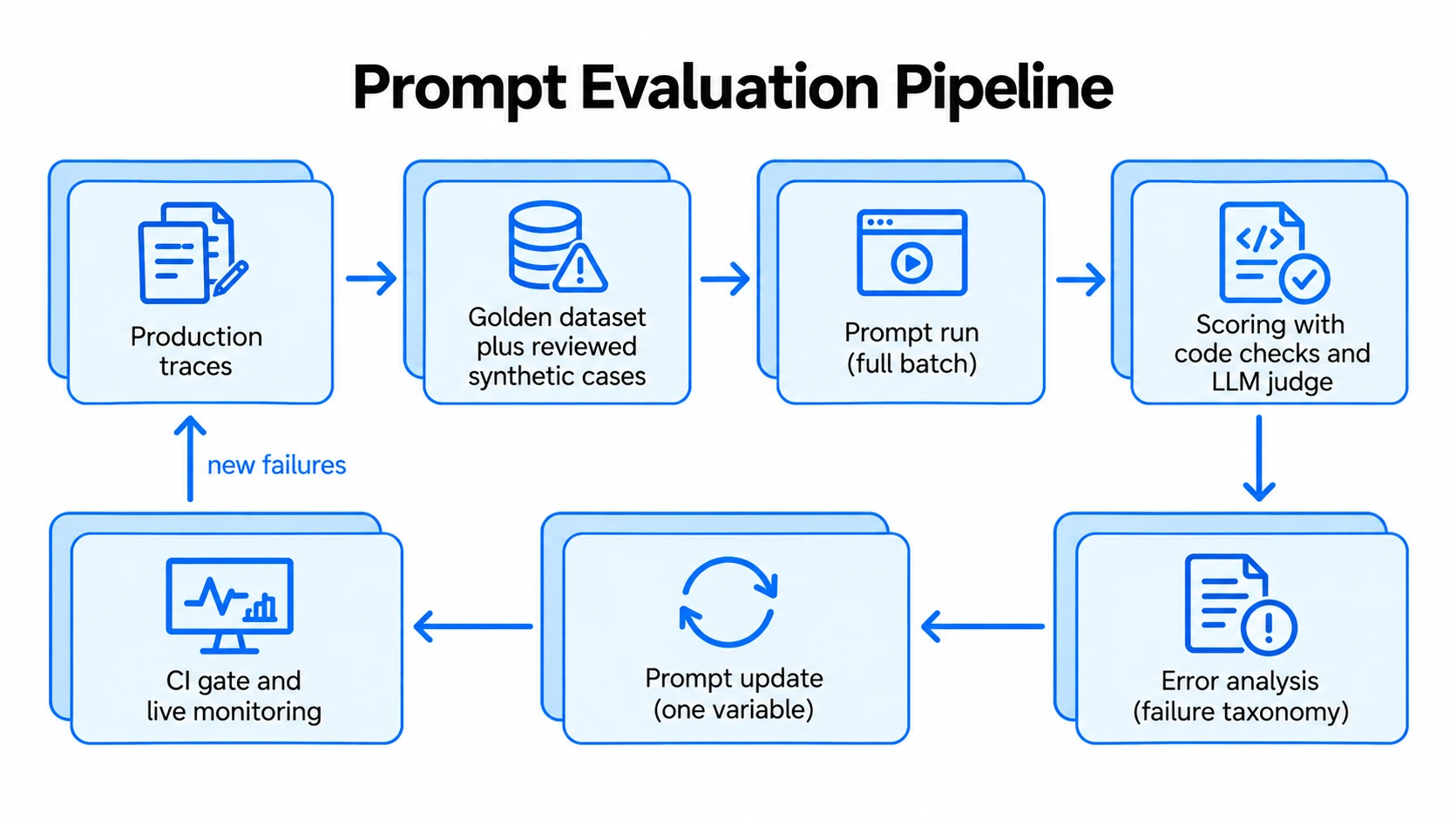
The best source of ground truth is production traces: Logged inputs, outputs, and retrieved context. LLM observability tools such as Langfuse and Arize Phoenix capture these, but raw logs need three passes first:
- Anonymisation: Strip personal data, API keys, and secrets with regex or a masking model.
- Clustering and stratification: Group logs by intent and sample five to ten per cluster.
- Hard case harvesting: Prioritise thumbs-down ratings and immediately rephrased questions.
Then a domain expert (support lead, underwriter, clinician) writes the reference answer. That is regression testing for prompts: Every captured failure must pass on every future change.
Filling Coverage Gaps with Synthetic Data Generation
Synthetic data generation uses a stronger LLM to write inputs production has not produced yet. Two techniques cover most gaps:
- Adversarial generation: A hostile-user persona probing guardrails with injections.
- Semantic diversity: One intent, rephrased in ten styles and lengths.
Here is the warning most tutorials skip. Every synthetic case needs human review, because generated reference answers can be confidently wrong.
A 100% pass rate on your prompt tests is not good news. It means your dataset is not hard enough to tell you anything.
Designing a Scoring Rubric That Scores Consistently
A scoring rubric turns "is this good?" into criteria two reviewers would apply identically. Vague scales produce noise. Concrete ones produce signal.
Binary pass/fail criteria are the right default, and a tightly anchored three-point scale is as far as you should stretch. Reviewers agree on them faster, automated scorers apply them without drift, and nobody hides behind a 3.
Choosing LLM Evaluation Metrics for Your Use Case
LLM evaluation metrics should follow the task, not a vendor dashboard. Pick the quality metrics tied to business value:
- Factual correctness: Model accuracy on verifiable facts, vital for medical, legal, and financial assistants.
- Groundedness: Every claim backed by retrieved documents; for retrieval-augmented generation (RAG), Ragas calls this faithfulness.
- Relevance and completeness: The actual question answered, without padding.
- Safety and alignment: Jailbreaks and toxic content blocked.
- Structural adherence: Output matches the required JSON schema.
Our guide to vector databases for enterprise GenAI applications covers the retrieval half of RAG evaluation. Code checks beat an LLM judge for mechanical rules, running in milliseconds at zero cost. Send only survivors to the judge; a 50-case run costs a few dollars, far less than one escalated incident.
Applying the Rubric with LLM-as-a-Judge
LLM-as-a-judge means a second model scores outputs against your rubric, and it works only under rigid constraints. Its prompt template needs five inputs:
- The original question.
- The model output.
- The reference answer or retrieved context.
- An anchored rubric.
- A reasoning field, filled before the verdict.
Use a different, stronger model than the generator. In "Judging LLM-as-a-Judge with MT-Bench and Chatbot Arena", Zheng et al. found strong judges such as GPT-4 matched human preferences over 80% of the time, about the rate human experts agree (arXiv).
That holds only after calibration: Label 30 to 50 outputs by hand, compare the judge, and adjust the rubric. Calibration also tests the judge's conceptual understanding of your domain. The same discipline applies to AI agent evaluation, covered in our post on production-ready AI agent workflows.
Running Error Analysis on Failed Outputs
A healthcare client came to us with eleven automated evaluators and an assistant that still embarrassed them weekly. None checked the failure that mattered most: Quoting the wrong clinic's opening hours.
They had designed evals on a whiteboard, not from traces. Error analysis fixes that by showing which evals to write. Hamel Husain reports that 60 to 80% of development time on successful AI products goes to error analysis and evaluation (Hamel Husain). The goal is to find systematic errors, not one-off oddities.
Grouping Failures into an Error Taxonomy
Useful categories come from reading traces, not brainstorming. The method has two passes:
- Open coding: Read 50 to 100 failed traces and write a free-form note on each, such as "ignored the date range".
- Axial coding: Cluster those notes into five or six named categories.
Four categories appear in almost every engagement. Your names may differ:
- Retrieval failures: Irrelevant, missing, or truncated documents.
- Constraint violations: Chatty text instead of the required JSON.
- Tone or style drift: Answers turned verbose, informal, or robotic.
- Instruction over-correction: A prompt so fenced against one error that it refuses valid requests.
Count the categories. The tallest bar is your next evaluator. Plot categories against tags as an error heatmap to see where failures cluster, such as constraint violations in billing questions. Two rules keep the failure taxonomy honest:
- Log only the first upstream failure per trace.
- Stop once new traces reveal no new categories.
Adding Hallucination Detection to the Pipeline
Hallucination detection flags any claim unsupported by the reference answer or retrieved context. Two lightweight checks catch most cases:
- Natural language inference (NLI): A small cross-encoder labels each claim as entailed, contradicted, or neutral.
- Self-consistency: Sample three times at temperature 0.7 and flag outputs whose core facts diverge.
A concrete case: A cloud operations assistant told a customer to deploy into a region code the provider has never offered. Once that trace entered the golden dataset with a region-name check, it could never ship again.
Turning Eval Results into Prompt Optimization
Prompt optimisation is an iterative loop that works only when you change one variable at a time. The same rule makes prompt engineering techniques comparable. Work through it in four steps:
- Isolate one failure group: Fix a single taxonomy slice, such as JSON failures.
- Turn loose instructions into priority rules: Replace "be brief and return JSON" with one constraint banning markdown and pleasantries.
- Add reason-backed few-shot examples: Two to five worked edge cases, each explained.
- Run a delta check: Hold model parameters (temperature, max tokens) constant, trigger a full batch run, and compare the two prompt versions row by row.
Read regressed rows even when the average improves. A prompt can lift the mean from 82% to 88% while breaking an account-closure case, and that case alone should block release.
Under 30 cases, one flipped case shifts the score three or more points. Prompt management in PromptLayer or Langfuse links each eval experiment to its exact prompt. Our guide to integrating the Claude API into enterprise applications shows prompt versioning in code.
Running Prompt Evaluation Inside Your LLMOps Workflow
Prompt evaluation belongs inside your LLMOps workflow, in the same CI/CD pipeline that tests your code. LangSmith, Braintrust, and Promptfoo support this flow:
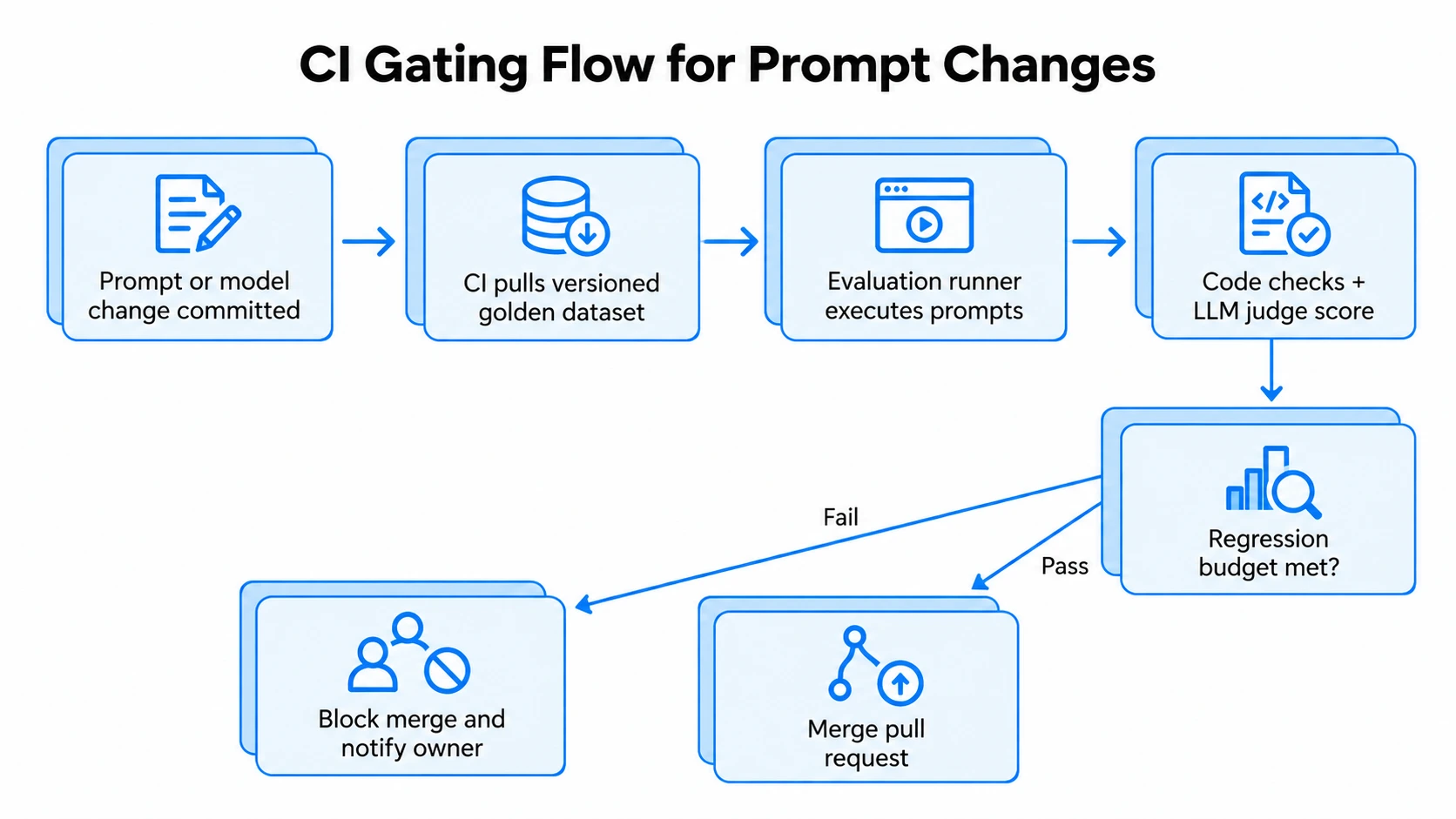
Treat this as LLM testing. A working setup has four parts:
- Versioned prompts: Every prompt template in Git or a registry, with semantic versions such as v1.2.0.
- Trigger: Every pull request touching a prompt, model version, or retrieval setting.
- Evaluation runner: A script with API access to the generator and judge, or a custom API endpoint.
- Regression budget: Block the merge if a must-pass case fails, a safety violation appears, or two cases regress.
Pre-release tests are half the job, so schedule batch workflows that score 1 to 5% of live traffic. That LLM monitoring catches silent drift, and our AI services team treats LLM observability as part of the same loop. An ai qa function usually owns this sampling.
How strict the budget should be has no clean answer. Too tight and engineers game the dataset; too loose and the gate becomes decoration. The four components fit together like this:
How BuildNexTech Helps You Build a Prompt Evaluation Pipeline
BuildNexTech's AI testing services keep dataset management, rubric scoring, LLM-as-a-judge and failure tagging in one place. Failures flow from traces into the dataset in one step.
Worried your domain is too specialised? That is why rubrics get written with your experts, not for them. Across our custom AI development work, including agentic AI that auto-resolved 64% of IT tickets for a 400-location US retail chain, every build started from the client's definition of correct.
Our AI agent development services wire these evals into every agent. Teams pick this over scripts or generic AI integration consulting for:
- AI-native architecture.
- A low-code agent builder.
- Enterprise-grade observability.
- No model lock-in.
The rollout takes two weeks. It runs in three stages:
- Day 1 to 3: Discovery and dataset seeding.
- Day 4 to 7: Rubric design and judge calibration.
- Week 2 onwards: CI gating and live-traffic monitoring.
Conclusion
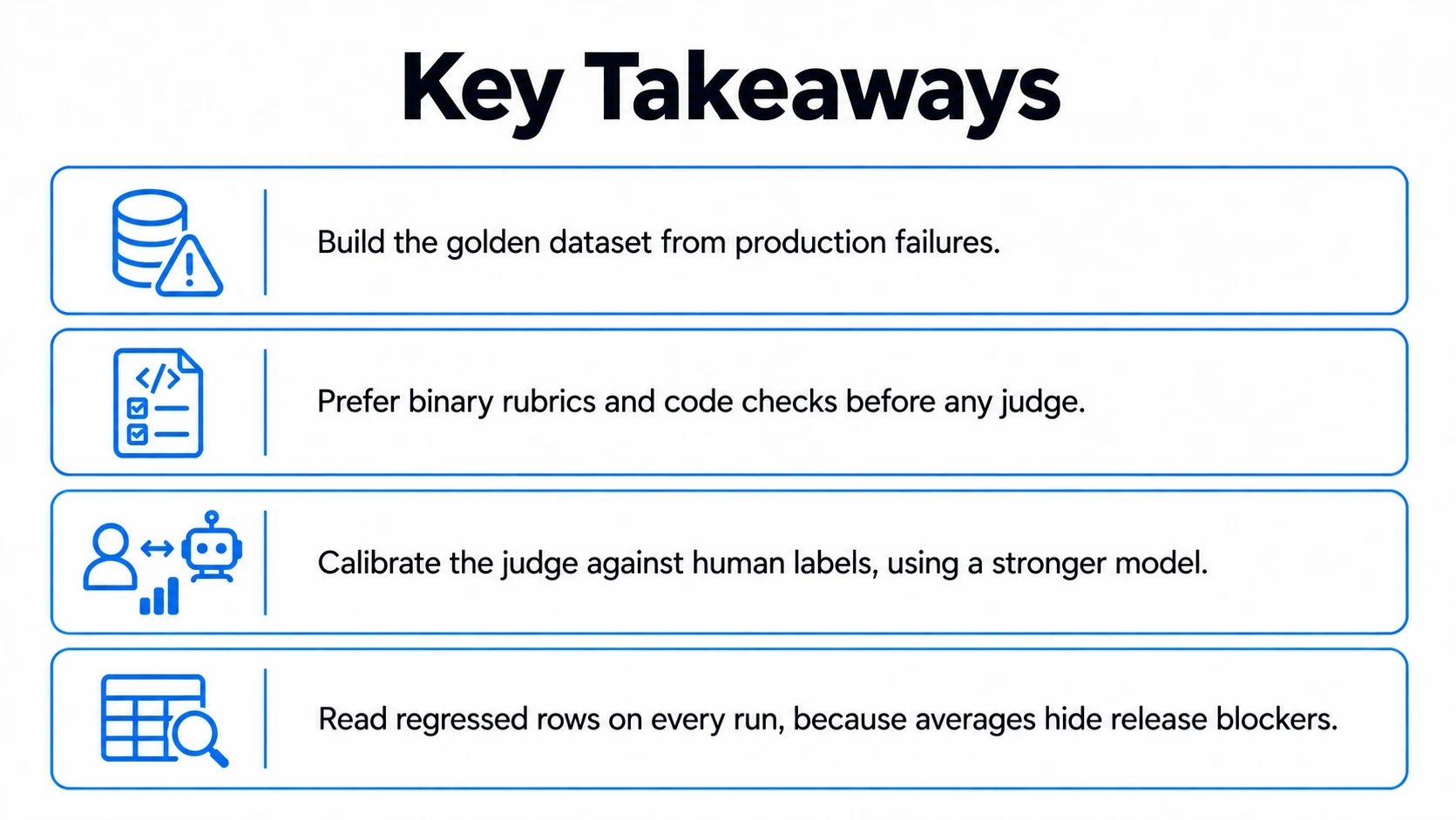
Prompt evaluation is not a testing chore bolted onto an AI feature. It is how a team earns the right to change that feature quickly. Build the dataset from real failures, score it with concrete rubrics and a calibrated judge, and let error analysis decide what you test next.
The harder question is not technical. When the product changes next quarter, who owns the rubric, and who decides which failures block a release? Most teams we meet have not decided, and that gap costs more than any tooling choice.
People Also Ask

What is prompt engineering, and where does evaluation fit in?
Prompt engineering is the practice of writing instructions that steer a model's output. Prompt engineering examples include role prompts, few-shot examples, and output schemas; evaluation proves which ones actually work.
Context engineering vs prompt engineering: What is the difference?
Prompt engineering shapes the instructions; context engineering shapes everything else the model sees, such as retrieved documents, memory, and tool results. Both change outputs, so both need evaluation.
What is an AI hallucination, and why do models produce them?
An AI hallucination is a confident output that is false or unsupported. Models produce them because they predict plausible text, not verified facts, particularly when retrieval returns weak context.
How is prompt evaluation different from an LLM benchmark?
An LLM benchmark handles generic model evaluation on tasks such as MMLU or MT-Bench. Prompt evaluation tests your application, prompts, and data, so a benchmark score guarantees nothing in production.
What does generative AI in software testing actually cover?
Generative AI in software testing covers both using AI to write tests and testing AI features. The second needs rubrics and pass-rate thresholds, because outputs vary between runs.