

.webp)
The corporate sector is swiftly advancing towards hyper-automated infrastructure, where the principles of DevOps automation and continuous deployment characterize the success of contemporary engineering. If your organization aims for agile, scalable, and sustainable infrastructure, GitOps is not merely an option—it is a strategic necessity.
By adopting declarative infrastructure management, GitOps facilitates quicker deployments, enhanced governance, and a sustainable competitive advantage through automation. However, is your team prepared?
Let’s walk through a practical evaluation to help you decide.
What Is GitOps —and Why It Matters Today
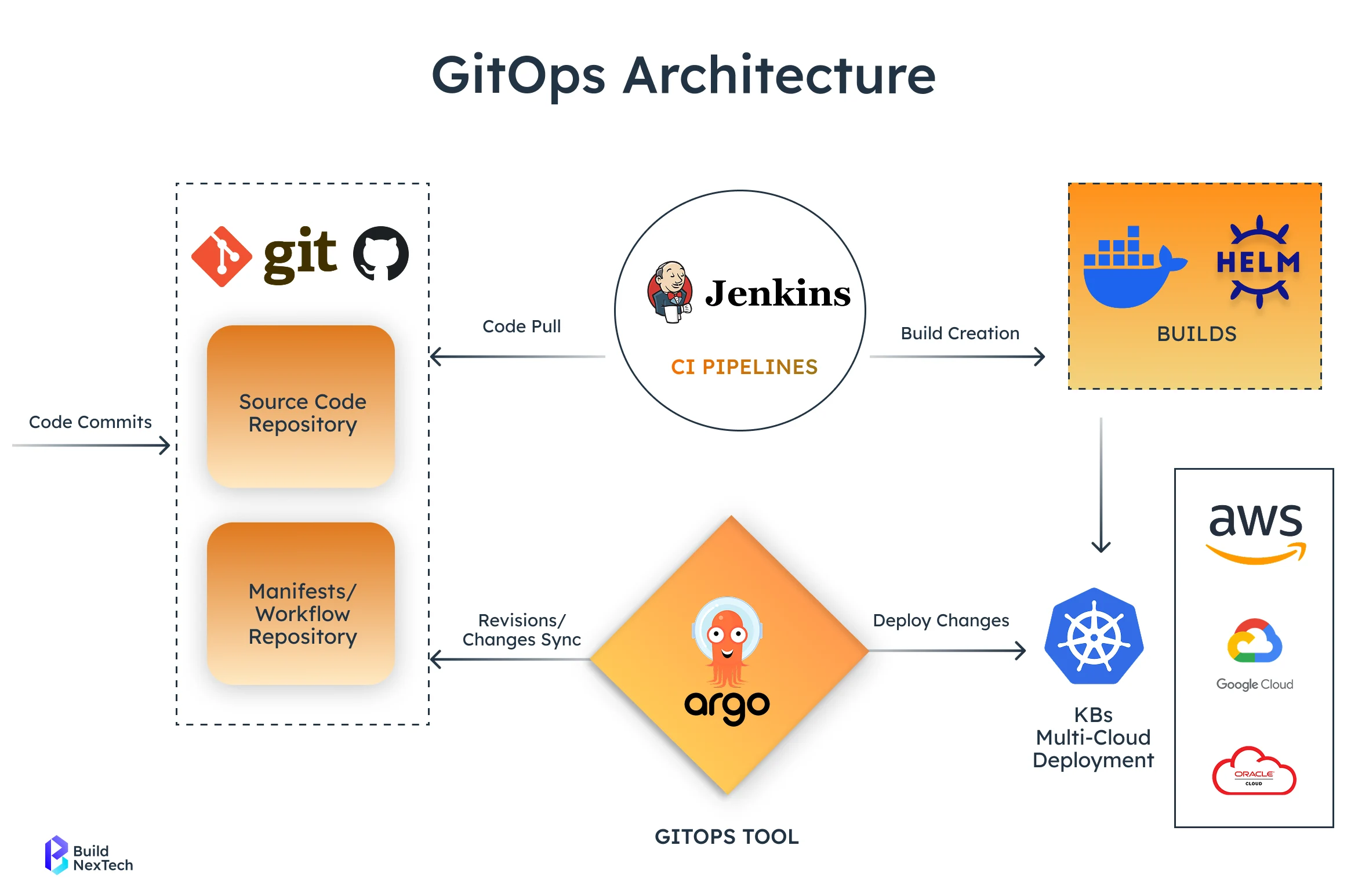
GitOps flips traditional infrastructure management on its head. Instead of manual interventions, it treats your Git repository as the single source of truth for both application code and infrastructure. Every change—whether to a microservice or a Kubernetes manifest—is version-controlled, reviewed, and automatically reconciled.
This approach enables:
- Automated deployment through tools like Argo CD
- Drift detection that ensures actual system state always matches the desired state in configuration repositories
- Full audit trail for compliance, incident review, and stakeholder transparency
In high-stakes sectors like finance or e-commerce, where rapid software delivery and continuous deployment are non-negotiable, GitOps with Argo CD slashes deployment time from hours to seconds—especially when using trunk-based Git branching and branch protection rules.
Core Benefits of GitOps in Practice
- Automated Deployment & Consistency
- With Argo CD's deployment, any merge to the trunk branch triggers an automated sync. This declarative GitOps Kubernetes model ensures every environment—from dev to prod—mirrors the desired state in Git. Advanced strategies like blue-green deployments and canary releases are natively supported, reducing risk during application delivery.
- Quality & Reliability Boost
- Using Infrastructure as Code (IaC) in human-readable formats, teams eliminate manual errors. Source code reviews apply equally to app logic and infrastructure, enforcing security, resilience, and coding standards checks at every stage. Configuration maps and Terraform module registry patterns help standardize environments across teams.
- Strategic Team Empowerment
- Infrastructure-oriented teams and Platform Engineers shift from firefighting to innovation. Freed from repetitive tasks, they focus on cloud native architecture, API endpoint design, and optimising Container orchestration systems—driving real business value
Is Your Infrastructure Ready for GitOps?
Before jumping in, assess your current state. GitOps adoption demands maturity in automation, Git practices, and Kubernetes.
Evaluate Your Current Practices
Ask these questions:
- How often do you deploy? (Daily? Weekly?)
- How much of your pipeline is manual?
- Are version control and trunk-based development consistently used?
- Do you use private Git repositories (or even free private Git repositories) for configuration repositories?
Teams using trunk-based Git branching and avoiding long-lived environmental branches are better positioned for declarative configuration success.
Identify Critical Gaps
Common readiness gaps include:
- Automation deficits in deployment validation
- Weak observability for drift detection
- Limited Kubernetes maturity (e.g., on AWS EKS or Azure Arc)
Without strong CI/CD pipeline foundations, GitOps can amplify chaos—not solve it.
💡 What is CI/CD? Continuous Integration and Continuous Delivery automates code integration, testing, and deployment. CI/CD tools like Argo CD and Flux GitOps power modern DevOps development services.
How GitOps Transforms CI/CD
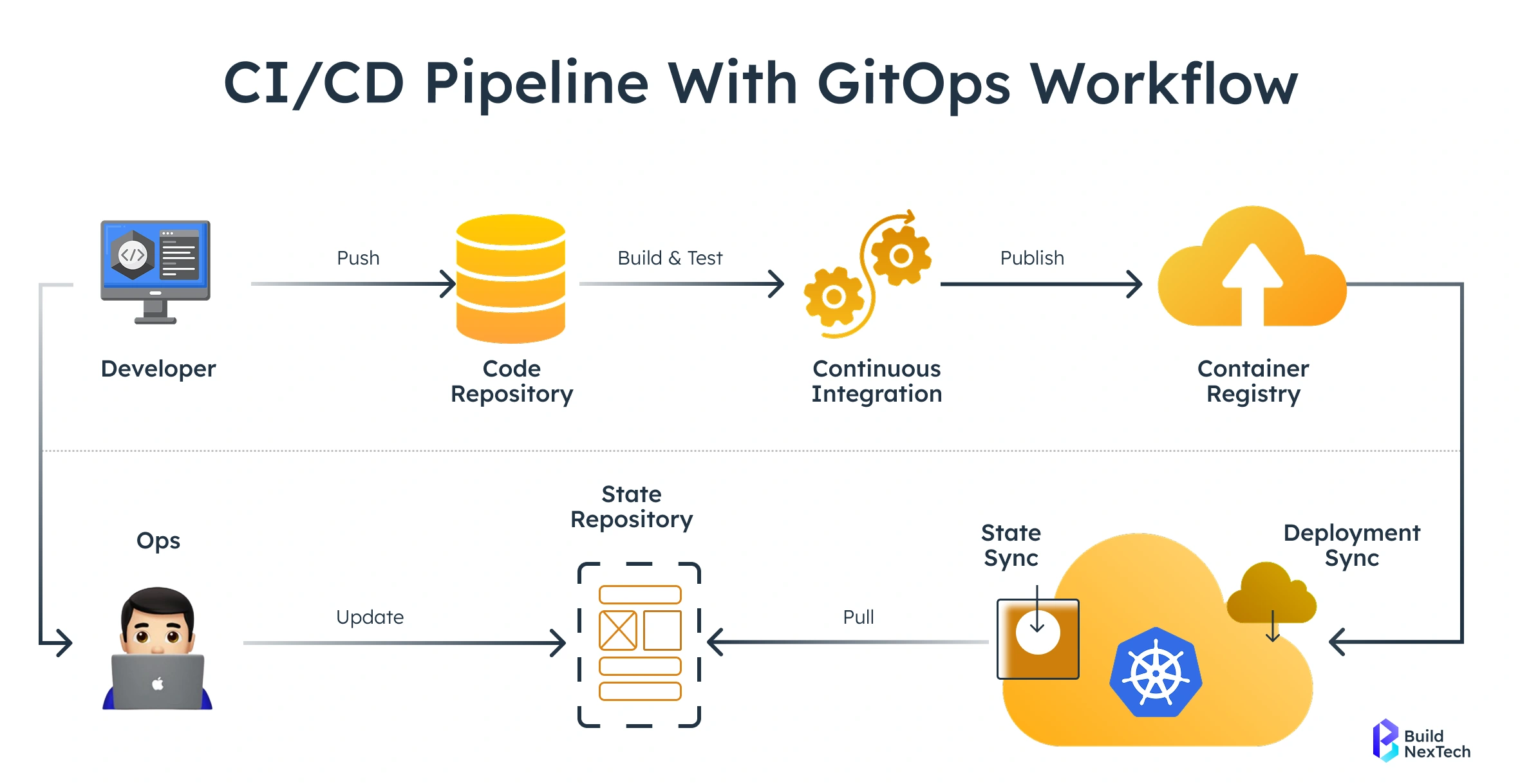
Traditional CI/CD process relies on imperative commands. GitOps replaces that with declarative state management: “This is how the system should look.”
Argo CD Kubernetes integration turns Git into your deployment engine:
- Changes in configuration repositories → automatic sync to cluster
- Mismatches trigger continuous synchronization
- Failed deployments auto-rollback using semver policy and image tagging
This model aligns with DORA metrics , helping teams achieve elite performance: daily deployments, <1-hour recovery, and <15% failure rates.
Key Workflow Shifts with GitOps
1. Single Source of Truth
All environments derive from the same Git repository, reducing configuration drift and merge conflicts across environmental branches.
2. Code Review & Branch Protection
Branch protection rules enforce peer reviews before merging YAML files—critical for DevOps security tools and compliance. Every pull request must pass security, resilience, and coding standards checks.
3. Drift Detection as Standard
GitOps infrastructure constantly compares live system state to Git. Unauthorised changes? Reverted instantly. This ensures infrastructure consistency across Container orchestration systems.
Organisations participating in the DevOps Enterprise Forum have reported improvements in reliability ranging from 40% to 60% within six months following the adoption of GitOps with Kubernetes.
The DevOps Enterprise identifies trunk-based development as a crucial factor that facilitates swift software delivery.
Choosing Your GitOps Platform: Argo CD vs. Flux
Two leading tools dominate the space—each suited to different needs.
Argo CD: Enterprise-Grade GitOps
Argo CD is the gold standard for Kubernetes GitOps:
- Native support for blue-green deployments and canary releases
- Multi-cluster management acrossAWS EKS, Azure, and on-prem
- Deep integration with private Git repositories and configuration repositories
- Real-time drift detection and sync with full audit trail
Flux GitOps: Lightweight & Kubernetes-Native
Flux GitOps offers simplicity:
- Minimal resource footprint
- Strong support for trunk-based development
- Tight integration with image registries and human-readable formats
Best for cloud native teams prioritising speed.
Platform Selection Checklist
When comparing Argo GitOps vs. Flux GitOps, evaluate:
- Multi-cluster capabilities
- Secrets management integration (e.g., Vault, AWS Secrets Manager)
- Support for governance frameworks like Open Policy Agent
- Compatibility with your IaC software and Terraform module registry
- Reconciliation tools speed and reliability
Remember: GitOps is not tied to one tool it’s a methodology.
Ultimately, the right choice depends on your team’s scale, complexity, and operational maturity—but either way, you’re embracing a GitOps future built on consistency, automation, and trust.
Your GitOps Adoption Roadmap (4–12 Months)
A successful GitOps rollout isn’t a flip-of-a-switch event—it’s a phased journey that aligns people, processes, and technology. The goal is to build confidence gradually, minimize risk, and create reusable patterns that scale across teams. Rushing leads to failed syncs, broken branch protection rules, and team frustration. A thoughtful roadmap ensures you gain the full benefits of declarative configuration, system state consistency, and automated incident review.
Phase 1: Pilot (Months 1–3) — Build Foundations with Low Risk
Start small to validate your GitOps approach without disrupting critical workloads.
- Target: Deploy 1–2 non-critical or internal-facing applications (e.g., dev tools, staging environments).
- Git Hygiene: Enforce branch protection rules, require pull requests for all changes, and automate code reviews for YAML manifests.
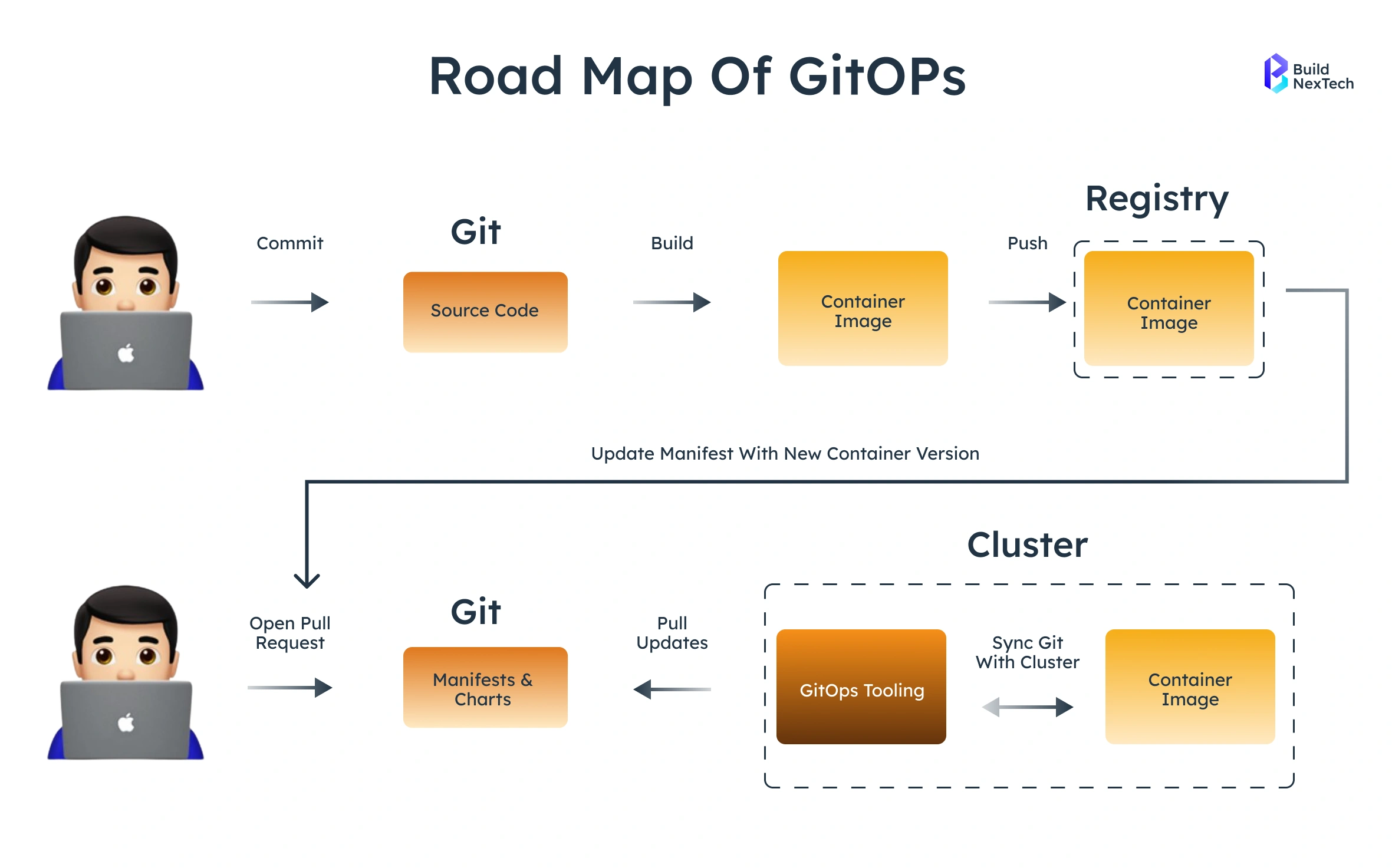
- Tooling Integration: Connect Argo CD to your existing CI/CD pipeline (e.g., GitHub Actions, Jenkins, or GitLab CI) so that merges to the main branch automatically trigger syncs to your Kubernetes cluster.
- Goal: Prove that declarative deployments work reliably in your environment and gain team confidence.
Phase 2: Scale (Months 4–8) — Standardize and Expand
With lessons from the pilot, begin migrating business-critical services and establishing organizational patterns.
- Infrastructure as Code (IaC): Convert core services to declarative configurations using YAML, Helm charts, or Kustomize. Store all manifests in version-controlled configuration repositories.
- Consistency: Adopt standardized config maps, naming conventions, and human-readable formats to reduce cognitive load and improve collaboration.
- Team Enablement: Train Platform Engineers and DevOps teams on Git workflows, Kubernetes troubleshooting, and GitOps troubleshooting (e.g., sync failures, drift resolution).
- Goal: Achieve consistent, auditable deployments across multiple services while reducing manual intervention.
Phase 3: Optimize (Months 9–12) — Mature and Govern at Scale
Shift focus from implementation to performance, security, and enterprise readiness.
- Measure Outcomes: Track DORA metrics—deployment frequency, change failure rate, and Mean Time to Recovery (MTTR)—to quantify GitOps impact.
- Policy & Security: Strengthen governance using Open Policy Agent (OPA) or Kyverno to enforce compliance (e.g., “no privileged containers”) directly in Git.
- Multi-Cluster Expansion: Extend GitOps to production-grade environments across AWS EKS, Azure Kubernetes Service (AKS), and on-prem clusters using Argo CD’s multi-cluster features.
- Goal: Operate a self-healing, policy-driven infrastructure that scales securely across teams and cloud environments.
New Roles & Required Skills
GitOps reshapes team responsibilities:
Upskill your team through Kubernetes certification programs and hands-on Argo CD deployment labs.
Measuring GitOps Success
Track these KPIs:
- Deployment frequency: Target daily (enabled by trunk-based Git branching)
- Change failure rate: Aim for <15% via source code reviews
- Mean Time to Recovery (MTTR): Under 1 hour
- Infrastructure consistency: Verified via drift detection in configuration repositories
Most enterprises see 40–60% improvement in software delivery performance within 6 months. The audit trail from Argo CD also streamlines incident review processes.
Final Verdict: Is GitOps Right for You?
GitOps is more than a deployment pattern—it’s a philosophy that aligns infrastructure with the principles of modern software engineering. By anchoring your entire system in version-controlled configuration repositories, you gain predictability, resilience, and the ability to scale application delivery without proportional increases in operational risk.
Whether you’re running AWS EKS, managing on-prem clusters, or building a hybrid cloud, GitOps provides a unified model that works across environments. The transition demands investment in tooling, training, and cultural change, but the payoff is clear: infrastructure that self-heals, teams that innovate instead of troubleshoot, and a foundation built for the future.
In a world where the DevOps Enterprise increasingly treats infrastructure as code, GitOps isn’t just an option—it’s the standard for excellence. Embracing it means your organization is ready to compete, adapt, and lead.
People Also Ask

How long does GitOps implementation take?
Pilots take 2–4 months; full adoption typically 6–12 months. Teams using trunk-based development and Argo CD adopt faster. Plan for Git training and phased app migrations.
What are the main GitOps adoption challenges?
Common issues: Kubernetes/Git skill gaps, secrets management risks, and team resistance. Mitigate with targeted training, branch protection rules, and proper drift detection setup.
Can GitOps work with non-Kubernetes infrastructure?
Yes—while ideal for Kubernetes, GitOps principles apply broadly. Many teams use hybrid models: GitOps for cloud-native workloads, traditional methods for legacy systems.
How do I manage secrets securely in GitOps?
Never store secrets in Git. Use external tools like Vault or AWS Secrets Manager, sealed secrets, or runtime injection. Layer in policy-as-code (e.g., OPA) for added security.
What metrics indicate GitOps success?
Track deployment frequency, change failure rate (<15%), and MTTR (<1 hour). Use drift detection to confirm infrastructure consistency. Most teams see 40–60% delivery improvements within 6 months


.webp)
.webp)
.webp)

.webp)
.webp)