

A mid-sized agency came to us after losing a retainer over a single stale ranking report. Their account lead walked into a renewal call holding data that was four days old, and the client had already spotted the same drop on a live dashboard days earlier. Nothing in the report could win the meeting back.
That gap, between a ranking moving and someone knowing about it, is exactly what good seo keyword tracking software is meant to close. Across 150+ client engagements, we have watched teams pick a rank tracker software on feature count alone, then discover eighteen months later that update frequency mattered more than the demo dashboard. This search engine optimization guide tests what holds up in 2026.
Why Keyword Tracking Matters More in 2026
A logistics client of ours ran on weekly exports until an algorithm update cost them page-one positions on 40 keywords in a week, and nobody noticed until sales asked why inbound went quiet. Static checks made sense when results held still for months:
- AI Overviews (AI summaries) correlate with a 58% drop in click-through rate for position-one pages, per December 2025 Ahrefs research, nearly double April 2025's figure.
- Authoritas research cited by DevriX found AI Overview rankings swing roughly 70% over two to three months, above the 49 to 55% baseline for organic results.
- Fresh algorithm updates produce sharper keyword and ranking fluctuations than two years back.
Rankings that used to guarantee organic traffic no longer do, which is why continuous monitoring replaced "check my rank."
What to Look for in an SEO Keyword Tracking Tool
The best rank tracker is rarely the one with the most features on paper. Core metrics every keyword research tool and SEO platform reports:
- Search volume, keyword difficulty: How often a term is searched and how hard it is to rank.
- Difficulty scores, Traffic Potential: The realistic upside behind a keyword worth chasing.
- Long-tail keywords: Lower-competition variants that most rank tracker software still tracks well.
- Domain authority, Page Authority: Trust scores from tools like Moz Keyword Explorer.
- Ranking URLs, intent data: Which page ranks, and why the searcher typed it.
- Keyword Generator, Google Keyword Planner, Google Ads: Raw sources for keyword suggestions.
- Keyword Insights, SEO PowerSuite: Alternative platforms for topic clustering and desktop audits.
- All-in-one SEO platform: Where rank tracker software often lives bundled in.
Daily vs Real-Time Rank Updates
A 48-hour lag between a ranking move and awareness of it can cost real click volume in a competitive niche.
- Real-time tracking exists on most platforms but usually sits behind a premium tier.
- A daily vs. weekly rank updates comparison should factor into pricing before you assume it is included.
- Fast-moving, competitive niches benefit most from real-time; stable niches can often stay on daily checks.
- Checking daily vs weekly rank updates against your niche's keyword fluctuations avoids paying for speed you do not need.
SERP Feature & Local Rank Tracking
Ranking third means little if a featured snippet, a local pack, and an AI Overview sit above it. A serp tracker or serp keyword tracker worth paying for logs SERP snippets and local rank tracker data alongside position.
- ZIP code, location targeting, local targeting: Pinning a check to the exact area a client competes in.
- Geo databases, device settings, mobile tracking: Simulating a real searcher's device and local search results.
- Pixel Tracking, Pixel Depth, Pixel Visibility: How far down a page a listing sits, not just ordinal rank.
Free tools miss AI Overview visibility almost entirely.
Reporting, GA4/GSC Integration & Dashboards
A tracker outside your analytics stack creates friction:
- Google Search Console and Google Analytics for the traffic side of the picture.
- Google Data Studio and API access for a proper client reporting dashboard.
- Ranking timelines and Visibility Scores that roll historic movement into a client-friendly skim.
- Raw Google search data, pulled directly rather than estimated.
A good seo reporting tool and local SEO tracking setup should live in one dashboard, not scattered across two or three.
Our Take: Most teams overweight keyword volume and underweight update frequency and SERP feature coverage. A tool tracking 500 keywords with daily updates and AI Overview visibility tells you more than one tracking 5,000 keywords weekly.
Free vs Paid Keyword Rank Trackers: What You Actually Get
Free tools like Google Search Console, MozBar, and Ubersuggest cover the basics well enough for a blogger or early-stage team validating a handful of terms, typically with weekly updates and no competitor visibility. Paid platforms such as SE Ranking, Ahrefs, and Semrush earn their subscription once tracking data has to support a client report or a revenue decision, adding daily updates, competitor depth, and automated reporting nobody has to assemble by hand.
Best SEO Keyword Tracking Software, Tested
Each pick below is a genuine best SEO rank tracking software candidate, with SEO guaranteed results for specific team profiles rather than a generic ranked list. Differences between an all-in-one SEO platform and a specialist tool show up fast once compared side by side.
Best for Agencies: SE Ranking
SE Ranking covers daily tracking, white-label reports, and client seat management at a price that holds up for agencies under 30 accounts.
- Bundled site audit and technical website audit modules, useful for packaging deliverables into one subscription.
- A competitor gap analysis module surfacing competitor insights and a full competitor keyword gap view other tools bury three clicks deep.
- Past 30 clients, per-project pricing works against you, and deeper research tools on higher tiers matter more.
- This makes SE Ranking the best rank tracker for growing agencies still building out a client roster.
Best for Accuracy: AccuRanker
AccuRanker's on-demand updates suit high-volume, programmatic keyword sets where a daily batch update is already too slow.
- Its speed comes from SERP scraping and clickstream data feeds rather than a shared crawl schedule.
- Rank tracking accuracy claims across the industry are largely self-reported, not independently audited.
- AccuRanker's speed advantage is one of the few that holds up across independent reviews rather than vendor marketing.
- That makes it the best seo rank tracking software pick for teams that cannot wait on a daily crawl.
Best All-in-One Suite: Semrush / Ahrefs
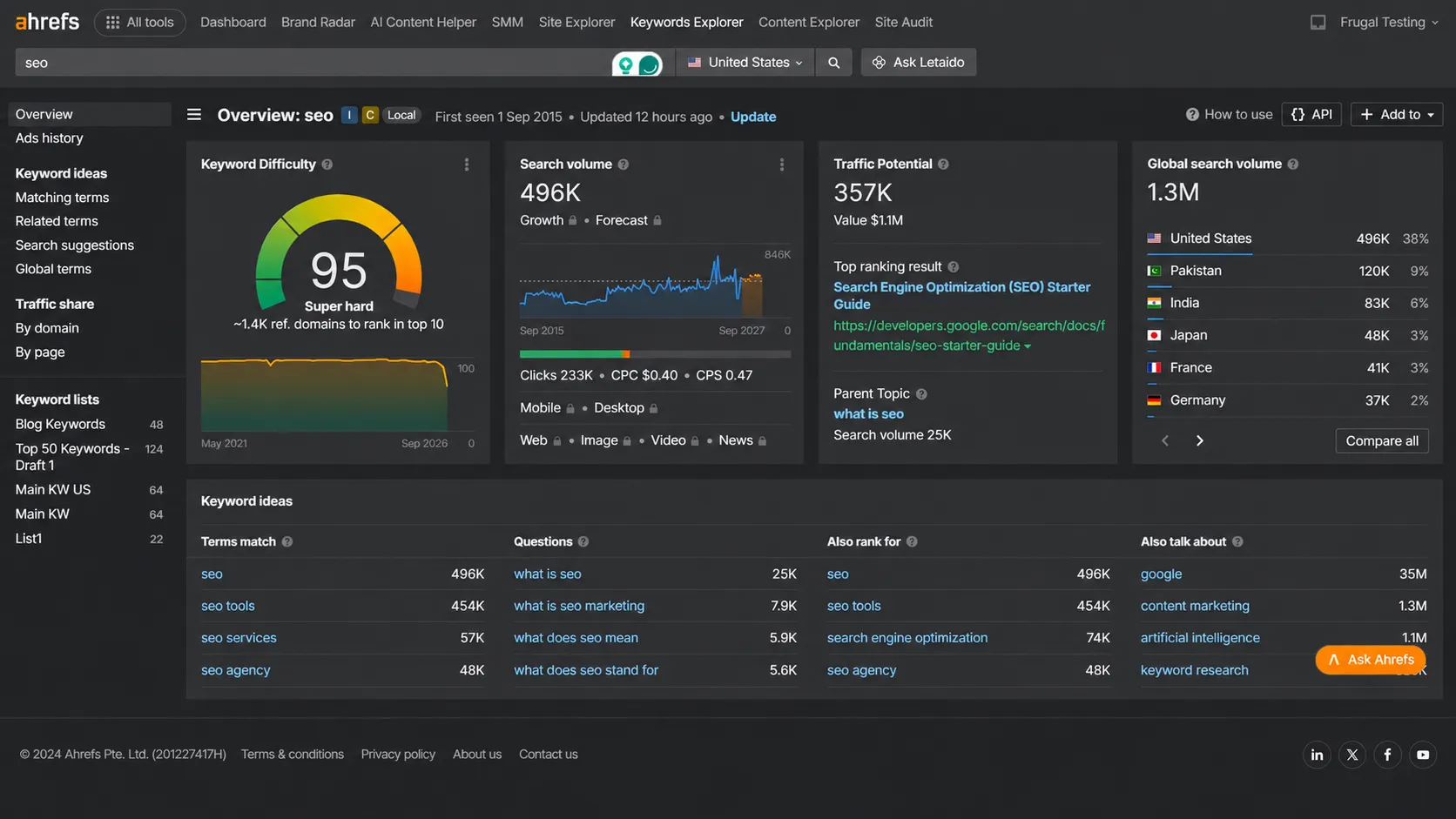
Semrush and Ahrefs bundle keyword research, backlinks, and rank tracking into two of the best-known all-in-one SEO platforms.
- Content Editor tools that grade draft copy against ranking pages in real time.
- Domain authority and Page Authority scoring, alongside alternatives like Moz Keyword Explorer.
- Rivals worth comparing: SEO PowerSuite, Keyword Insights, plus free baselines from Google Keyword Planner and Google Ads.
- A healthcare client we worked with consolidated four point tools into one Semrush subscription, cutting reporting time from two days to four hours.
Best for AI Search & LLM Visibility Tracking
This is the newest, least mature category: AI Visibility Tracking tools measuring AI search visibility, brand presence inside AI-generated answers rather than blue-link positions.
- Share of SERP, Share of Mind: How much of a page or AI answer mentions your brand.
- Entity Authority: Whether Large Language Models and AI Engines like Google Gemini trust your brand as a source.
- Generative Engine Optimization and AI predictions: Shaping content for how AI Engines summarise and cite it.
- Search visibility now extends past Google too, into voice search optimization, social platform keyword data, and influencer marketing reach.
White-Label Rank Tracking & Reporting for Agencies
A seo white label setup means branded PDF reports, client dashboards on your own domain, and seat management: The real difference between a genuine white label seo service and a CSV with a logo pasted over someone else's header.
- SE Ranking and most mid-tier platforms offer genuine white label seo reports as a paid add-on, not a default.
- A white label seo audit tool with custom domains sits a full pricing tier above the base plan.
- Below roughly 10 to 15 clients, the premium rarely pays for itself against manual rebranding.
- Past that count, a white label seo company still running reports by hand loses more billable hours than the white label seo software upgrade costs.
How BNXT.ai Helps You Write Blogs That Are SEO Friendly
None of the platforms above turn keyword signals into a published post by themselves. Our Blog Engine is one of several content planning tools built as an autonomous AI agent pipeline for workflow automation, taking a post from research to publish in around 70 minutes- work a six-role content team once spread across days, now handled by 1 to 2 people.
The Strategy layer handles content planning and topic clustering into topic clusters and content clusters, while Content Generation drafts outlines, FAQ content, and CTAs. Optimization runs SEO scoring, content depth analysis, and GEO tuning, cutting cost per blog by roughly 90 percent.
The Blog Engine's Five-Layer Pipeline
- Research: Automated topic discovery, SERP analysis, and keyword research at machine speed.
- Strategy: Topic selection, content planning, and topic clustering into content clusters.
- Content generation: Outlines, meta tags, FAQ content, and CTAs drafted fast.
- Optimization: SEO scoring, GEO and AEO tuning, content depth analysis, and humanization checks.
- Automation: AI agents handle scraping, competitor monitoring, and workflow automation continuously.
Conclusion
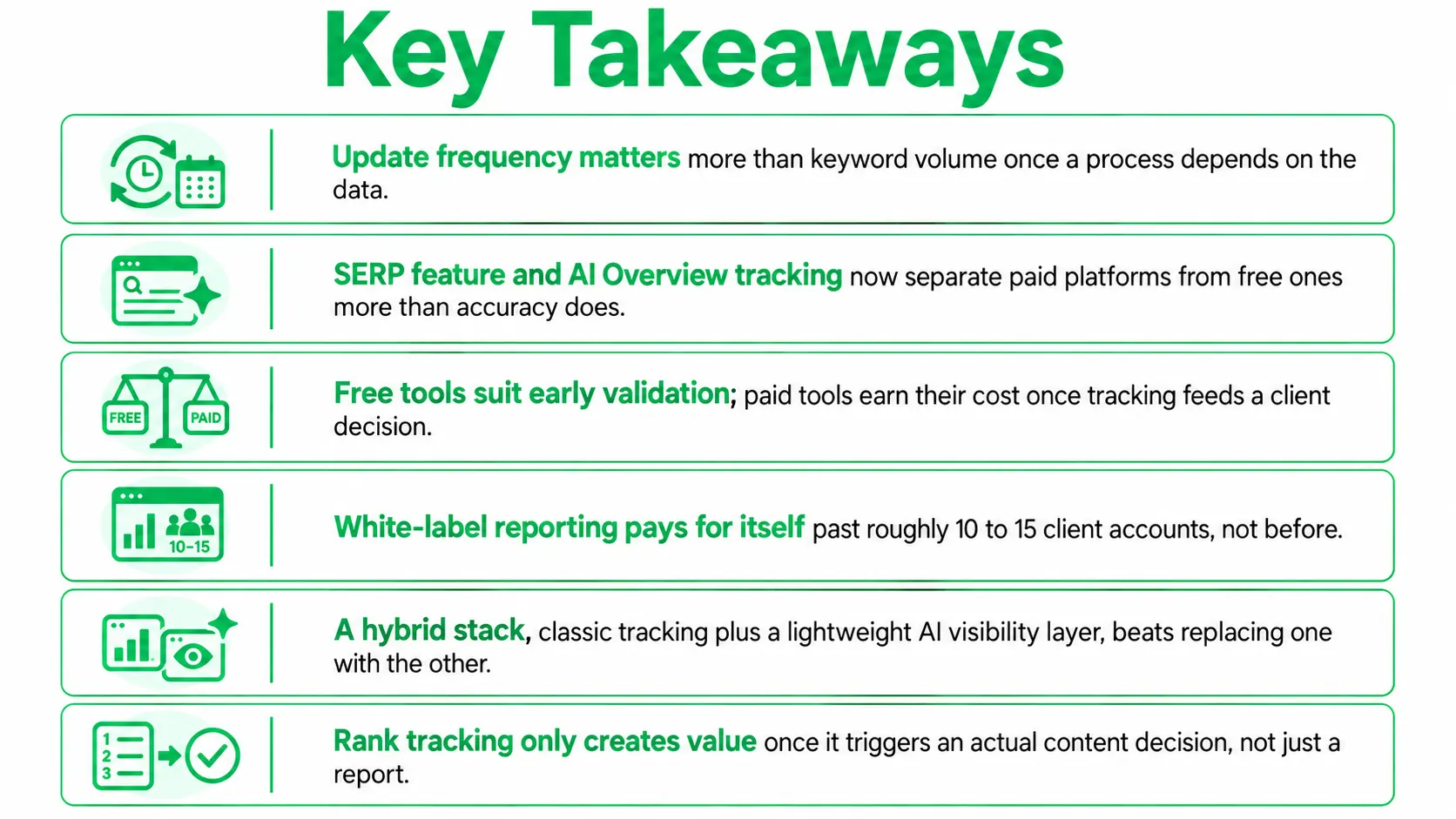
Three things decide whether a keyword tracking software earns its price: Accuracy you can act on daily, integrations that fit your existing stack, and white-label depth that matches your client count. Seo keyword tracking software has become table stakes for exactly that reason.
Most comparison pages stop at the feature table and leave you to work out what happens next. The tool decides how fast you see a problem surface; what you do with that signal decides whether your next client call goes well.
People Also Ask

How often should you audit a tracked keyword list?
Review it every quarter at minimum, and after a major product, service, or site change, since search intent shifts faster than most teams update their tracked terms and keyword rank checklists.
Can keyword tracking software monitor competitor rankings too?
Most paid platforms let you add competitor domains alongside your own, showing where rivals outrank you, though depth in that competitor gap analysis varies by tool and pricing tier.
How many keywords should a small business start tracking?
Start with 50 to 100 high-intent terms tied to revenue pages, then expand gradually as budget and reporting maturity grow, rather than tracking everything a competitor ranks for on day one.
What happens to historical ranking data when you switch platforms?
Most platforms let you export historical data as a CSV, but daily history rarely transfers cleanly between providers, so budget for a visible gap in your ranking timelines during migration.
Do rank trackers work the same way for e-commerce product pages?
Largely yes, though product pages benefit from added shopping and image-pack tracking, since visual SERP snippets influence e-commerce click-through more than standard organic listings do.


.webp)
.webp)
.webp)

.webp)
.webp)