

Introduction
Artificial intelligence (AI) has rapidly evolved from a futuristic concept into a business necessity across industries. Whether it’s automation, predictive analytics, machine learning, or natural language processing, companies today rely on AI-driven capabilities to streamline workflow, boost productivity, and enhance customer experience. Yet for many organizations—especially those still maturing in digital transformation—building AI systems in-house is expensive, complex, and resource-heavy.
This is where AI as a Service (AIaaS) comes in. AIaaS allows businesses to outsource AI development, deployment, and maintenance to specialized partners who offer ready-to-integrate AI tools, APIs, SDKs, and cloud-based plug-and-play AI capabilities. With rising demands for Generative AI, LLMs, computer vision, and conversational interfaces, outsourcing AI integration is becoming the smartest way for businesses to scale without massive upfront investment.
This blog explores the benefits of outsourcing AI integration through AIaaS partners, how to choose the right provider, challenges to be aware of, and future trends that will shape the AIaaS landscape.
Understanding AIaaS and Its Benefits
What is AIaaS?
AI as a Service (AIaaS)—also referred to as Artificial Intelligence-as-a-Service—is a cloud-based delivery model where businesses can access AI tools and infrastructure on demand. Instead of developing AI logic, building data pipelines, or hiring large teams of AI developers, companies leverage pre-trained solutions offered by cloud providers.
Popular AIaaS platforms include:
- Google Cloud AI & Dialogflow
- Amazon SageMaker and broader AWS AI capabilities
- Microsoft Azure AI and Cognitive Services
- OpenAI APIs and assistants
- IBM Watson
- Oracle AI Services
- ServiceNow AI and AIOps
- SAS Viya
- Platforms like Biz4Group, Algoscale, and RapidMiner
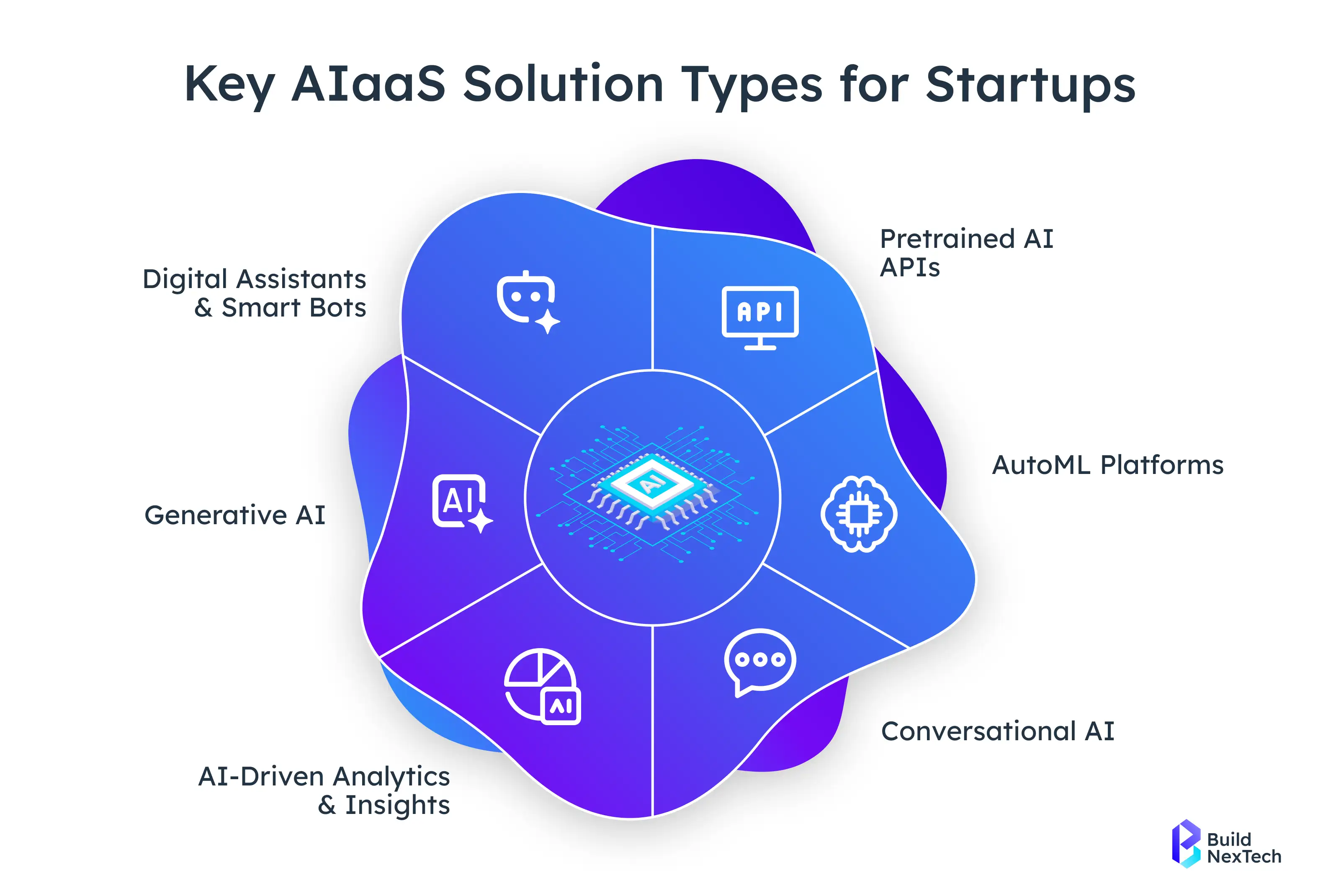
These cloud platforms provide everything from visual AI systems, predictive analysis, Fraud Detection, AI Diagnostics, customer segmentation, virtual assistants, content moderation, Lip-sync AI, appointment scheduling, to enterprise-grade workflow automation. Whether you need recommendation engines like Netflix, Supply Chain Optimization, AIoT systems using IoT sensors, or industry 4.0 modernization—AIaaS providers make it possible.
Key Benefits of AIaaS
Cost-effectiveness:
Building an in-house AI infrastructure requires major investment in GPUs, compute clusters, data storage, and specialized talent such as ML engineers and data scientists. It also involves continuous efforts to maintain data privacy, security, and compliance frameworks like GDPR and HIPAA. With AIaaS, companies eliminate these heavy overheads and instead pay only for the services they use. Providers take care of data preprocessing, data labelling, model development, optimization, and ongoing support.
Scalability:
AIaaS platforms are built to scale on demand. Businesses can instantly increase workload capacity, deploy AI models across different regions, and integrate AI via APIs and SDKs without infrastructural constraints. As data volumes and operations grow, AIaaS ensures seamless model expansion across cloud, IoT, and edge environments.
Faster Time-to-Value:
AIaaS enables companies to launch AI initiatives quickly without long development cycles. Pre-built models, automated ML pipelines, and ready-to-use AI services reduce the time needed to experiment, deploy, and generate business outcomes. This accelerates innovation and shortens the path from idea to production.
Access to Advanced Technologies:
AIaaS providers offer access to state-of-the-art tools, pretrained models, vector databases, MLOps pipelines, LLM APIs, and real-time analytics platforms. Even small and mid-sized businesses can leverage cutting-edge AI capabilities without needing to build them internally.
Reduced Operational Risk:
Managing AI architecture in-house comes with risks such as unexpected system failures, security vulnerabilities, and performance issues. AIaaS providers handle infrastructure monitoring, uptime guarantees, incident response, patching, and continuous optimization—substantially lowering operational risk for the business.
Expert Support & Continuous Upgrades:
AIaaS platforms come with built-in support from AI specialists who monitor models, update algorithms, and apply performance tuning. Providers also roll out regular updates, ensuring businesses always work with the latest advancements in AI, security, and compliance.
Better Resource Allocation:
By outsourcing AI infrastructure and model management, internal teams can focus on core business functions—product development, customer experience, sales, and innovation—rather than managing complex ML workloads. This leads to improved productivity and strategic clarity.
The Importance of Outsourcing AI Integration
Outsourcing AI integration to an AI-as-a-Service (AIaaS) partner provides companies with specialized expertise, faster deployment, and reduced risks. Instead of building a full in-house AI team—which requires years of hiring and infrastructure—businesses can leverage the advanced capabilities of external AI experts.
1. Access to Specialized Expertise
AIaaS partners provide access to highly trained professionals such as:
- Data Scientists – Experts in data cleaning, analysis, and modeling
- Machine Learning Engineers – Build, train, and deploy ML models
- Deep Learning Specialists – Work on complex neural networks
- AI Data Scientists – Combine domain knowledge with AI skills
- AIOps & Cognitive Computing Experts – Handle automation, monitoring, NLP, and LLMs (Large Language Models)
These teams work daily on AI challenges and bring experience from multiple industries.
They typically develop advanced solutions for:
- Predictive maintenance
- Inventory forecasting
- Customer engagement platforms
- Healthcare outcome prediction
- Fraud detection
- Recommendation systems
- Sentiment analysis
- Automated document processing
Result: Companies get world-class AI without the cost and struggle of building an internal AI department.
2. Faster Time-to-Market
Outsourcing significantly speeds up AI deployment. Research shows companies can reduce implementation time by up to 30% by using AIaaS partners.
This is because these partners already have:
- Pre-trained models (for NLP, classification, vision, forecasting)
- Pre-built data pipelines
- Ready-made AI APIs
- Reusable architecture diagrams & design patterns
- Proven coding templates and best practices
- Cloud-based, plug-and-play AI components
This allows companies to launch AI-powered applications much faster.
Examples of products launched quickly with AI outsourcing:
- Customer service automation tools
- Automated ticket labeling
- Smart order tracking systems
- Payment refund classification bots
- AI-powered staffing and hiring platforms
- Customer service chatbots
- Recommendation engines
- Lead scoring models
Result: Instead of spending months developing from scratch, businesses can launch production-ready AI tools within weeks.
Choosing the Right AIaaS Partner
Evaluating Provider Credentials
When selecting an AIaaS provider, evaluating E-E-A-T (Experience, Expertise, Authoritativeness, Trustworthiness) is critical. Key factors include:
- Quality of AI Platform
- Strength of security measures
- Compliance with GDPR, HIPAA, and Gouvernance, risque et conformité
- Access to advanced data processing pipelines
- Availability of APIs, SDKs, and documentation
- Proven customer experience and expérience client enhancements
- Reliability of cloud-based services such as Azure, Amazon, Google Cloud
You should also consider alignment with your tech stack—especially if your systems rely on Microservices, enterprise systems, AI APIs, or AIoT integrations.
Case Studies of Successful AI Outsourcing
1. Netflix – Recommendation Engines
Netflix uses AIaaS components across Amazon, Google Cloud, and proprietary ML models to power one of the world’s most advanced recommendation engines, improving user retention through personalized content.
2. Salesforce Einstein – CRM Enhancement
Businesses outsource CRM intelligence to Salesforce Einstein to boost customer engagement, automate interactions, and deliver interactions personnalisées.
3. Healthcare AI Diagnostics
Hospitals outsource diagnostics and visual AI systems to Microsoft Azure AI, IBM Watson, and H2O.ai to enhance Healthcare Outcomes using computer vision, voice recognition, and predictive models.
4. Retail Supply Chains
Global retail brands use Google Cloud AI and AWS Sagemaker for Supply Chains and inventory control forecasting, significantly reducing operational costs.
Challenges in Outsourcing AI Integration
- High cost of data breaches
- According to Unity-Connect, the average cost of a data breach in 2024 was US$ 4.88 million. unity-connect.com
- These costs are especially relevant when sensitive data is shared with external AI/outsourcing partners. unity-connect.com
- According to Unity-Connect, the average cost of a data breach in 2024 was US$ 4.88 million. unity-connect.com
- Regulatory risk (GDPR / compliance)
- AI outsourcing involves sharing data with third parties, increasing the need for strict compliance with data protection laws like GDPR or HIPAA. Amplework Software Pvt. Ltd.+1
- According to a management-paper review, between 2018–2023, GDPR fines amounted to €2.9 billion, emphasizing how costly non-compliance can be. managementpaper.net
- AI outsourcing involves sharing data with third parties, increasing the need for strict compliance with data protection laws like GDPR or HIPAA. Amplework Software Pvt. Ltd.+1
- Security-readiness gap
- In a survey by SailPoint (353 IT professionals), 96% saw AI agents as a growing security threat. TechRadar
- Only 54% of those professionals had full visibility into the data their AI agents could access, which is a big concern for data governance. TechRadar
- Further, 80% of companies reported unintended actions by AI agents: unauthorized access (39%), sharing inappropriate data (33%), downloading sensitive content (32%). TechRadar
- Alarmingly, 23% said their AI agents were “tricked” into revealing credentials. TechRadar
- In a survey by SailPoint (353 IT professionals), 96% saw AI agents as a growing security threat. TechRadar
- Lack of governance frameworks
- Only 7% of organizations have fully embedded governance frameworks for AI, even though 93% are using AI in some capacity. IT Pro
- Only 8% have integrated AI governance into their software development life cycles. IT Pro
- Just 4% reported that their data & infrastructure environments are fully prepared to support AI at scale. IT Pro
- Audit trails, version control, registries for AI models are often manual or missing. IT Pro
- Only 7% of organizations have fully embedded governance frameworks for AI, even though 93% are using AI in some capacity. IT Pro
- Real-world data exposure risk
- According to a Concentric AI 2025 report, Microsoft Copilot accessed nearly 3 million sensitive records per organization during the first half of 2025. TechRadar
- In that, 57% of shared files (on average) contained confidential info. In sectors like healthcare / finance, this number rose to 70%. TechRadar
- Also, around 400,000 records on average were shared with personal accounts, many of which included confidential data. TechRadar
- According to a Concentric AI 2025 report, Microsoft Copilot accessed nearly 3 million sensitive records per organization during the first half of 2025. TechRadar
Future Trends in AIaaS and Outsourcing (Expanded Explanation)
1. The Rise of No-Code AI Platforms
No-code AI platforms make it possible for people without programming or data science skills to build AI solutions. Tools such as Google Cloud Vertex AI, Azure ML Studio, RapidMiner, and H2O.ai provide drag-and-drop interfaces, templates, and automated workflows.
These platforms allow non-engineers to quickly create:
- Predictive models
(e.g., predicting demand, customer churn, or sales trends) - Sentiment analysis workflows
(analyzing customer feedback or social media posts) - Conversational interfaces
(building chatbots without writing code) - Automated analytics dashboards
(auto-generating insights from business data) - Workflow visualizations
(mapping and automating internal processes) - Customer support automation
(AI-based ticket routing, classification, response suggestions)
Because these tools reduce the need for in-house AI expertise, many companies are outsourcing their AI needs to external partners who specialize in setting up and managing these no-code solutions. This speeds up adoption and reduces implementation costs.
2. The Shift Towards AI Ethics and Responsibility
As AI becomes more integrated into everyday business decisions, companies are expected to follow strict ethical and regulatory guidelines. This includes ensuring:
- Fairness
AI systems must not disadvantage specific groups. - Bias prevention
Models should be trained on balanced, representative data. - Transparency
Businesses should understand how AI is making decisions. - Responsible usage of large language models
Ensuring outputs are safe, factual, and appropriate. - Compliance with global regulations
Such as GDPR, HIPAA, and upcoming AI regulatory frameworks.
AIaaS partners play a crucial role by offering:
- Ethical data usage policies
- APIs and cognitive services built with compliance in mind
- Audit-ready outputs
(important for industries like healthcare, finance, government) - Explainable AI tools
that show why a model produced a particular result
Major providers like OpenAI, Microsoft, Google Cloud, and Amazon are continuously improving their AI governance frameworks to help businesses adopt AI that is safe, reliable, and compliant.
Conclusion
Outsourcing AI integration through AIaaS providers is becoming the smartest way for businesses to scale. With access to advanced artificial intelligence, deep learning, predictive analytics, and automation, companies can rapidly modernize their business operations, enhance customer service, and build intelligent workflows without heavy internal investment.
AIaaS empowers organizations to leverage world-class AI capabilities—from Data Analytics to Generative AI, visual AI systems, Fraud Detection, AIOps, and AI Diagnostics—all through flexible cloud-based services. As cloud platforms evolve and no-code solutions grow, outsourcing AI will become even more accessible, secure, and essential.
Now is the time for businesses to evaluate their current AI maturity, explore AIaaS partners, and take strategic steps toward integrating AI-as-a-Service into their digital transformation strategy. Adopting this smarter approach will not only accelerate innovation but also ensure long-term scalability and competitive advantage in an increasingly AI-driven world.
People Also Ask

1. Why outsource AI integration to AIaaS partners?
It reduces cost, speeds up deployment, and gives access to ready-made models and expert teams without building everything in-house.
2. Is it safe to share company data with AIaaS providers?
Yes—if the partner offers strong security: encryption, zero-trust access, compliance (GDPR/HIPAA), and clear data-handling agreements.
3. What AI solutions can be outsourced?
Chatbots, computer vision, analytics, automation, recommendation engines, fraud detection, and generative AI integrations.
4. How fast can outsourced AI projects show results?
Pilot projects take 2–6 weeks, and full integrations typically deliver measurable ROI within 3–9 months.
5. What should we look for in a good AIaaS partner?
Check their security, cloud compatibility, industry experience, scalability, pricing model, and quality of support/documentation.


.webp)
.webp)
.webp)

.webp)
.webp)