

Three web development service providers. Identical decks. Similar pricing. Your engineering lead says the only way to tell them apart is to let one break something in production. Across 150+ client engagements, BuildNexTech has seen this pattern: organisations that ran engineering-led evaluations shipped faster and spent less on post-launch remediation. Those who skipped the technical checks paid for it later.
The problem is that most evaluation frameworks were designed by procurement, not engineers. The checks that predict whether a web app development engagement will succeed - CI/CD pipeline at handoff, maintainable codebase at 18 months, application security testing actually run - appear on almost no standard RFP.
Why Standard Vendor Evaluation Fails Engineering Teams
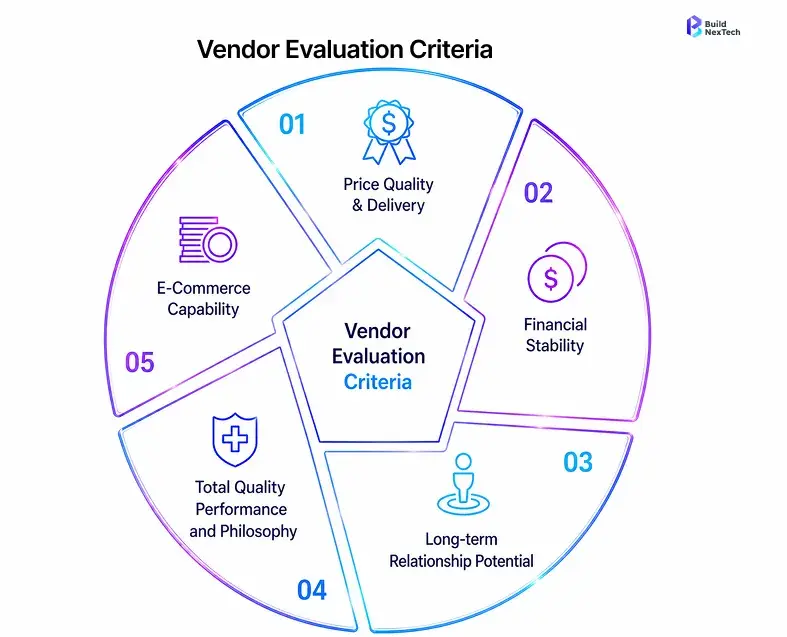
A portfolio is a marketing artefact. The gap between how a web development agency presents its work and what the codebase actually looks like at delivery is where most engagement failures begin. Continuous Integration discipline, test coverage floors, and CI Service configuration are far stronger signals of engineering maturity than any case study slide.
According to Gartner's 2025 Software Engineering Trends forecast, 90% of enterprise developers will use AI code assistants by 2028. Any vendor evaluation that does not ask whether AI Agents, AI-assisted engineering, and production monitoring are embedded in the delivery workflow - not just 'we use Cursor Pro sometimes' - is measuring vendors against a 2022 standard. Software developer productivity benchmarks have shifted. Vendors investing in AI R&D and contributing to open-source repositories signal genuine engineering depth.
What Does a Solid CI/CD Pipeline Look Like from a Vendor?
Continuous Integration is not a checkbox. It is a delivery posture. A CI Service genuinely embedded in a vendor's workflow means automated test gates on every commit, containerised build environments, feature branches deploying to isolated test environments, and rollback capability tested before it is needed. Self-testing code - where the automated build fails fast on any regression - is the minimum standard.
Kent Beck and Paul Hammant established the foundational principles of Continuous Integration: commit to the mainline frequently, keep the build green, and fix failures immediately. What has changed is the tooling expectation.
The Five CI/CD Questions to Ask Before Signing
An evaluation harness for a vendor's CI/CD maturity in 2025 should cover these five checks:
- Mean time to deploy on a green build: Above 20 minutes on a standard web app signals pipeline inefficiency.
- Feature branches and merge conflicts: Ask how they handle parallel development. Teams without a clear branching strategy turn feature branches into integration hell at scale.
- Automated test coverage floor: No floor means coverage drifts. Ask for a specific percentage. A regression suite that catches issues before production is not optional.
- Build scripts and dependency network: Brittle build scripts and an unaudited dependency network are the two most common sources of silent pipeline failures. Diff debugging after a failed deployment reveals whether a team actually runs Continuous Deployment or just describes it.
- Post-incident reports: Ask to see one. Canary Releases and blue-green deployment strategies signal a vendor that has thought seriously about production risk.
How CI/CD Debt Compounds After Handoff
A retail chain, BuildNexTech, worked with an inherited web application from a previous agency with zero automated build infrastructure. Eleven weeks of instrumenting and implementing CI/CD passed before a single new feature was released safely. The original vendor had delivered working software. Not a delivery system.
Stack Validation and Application Security Testing
Your team is about to inherit a web app development codebase. The frontend is React. The backend is Python. The README says 'runs fine locally.' Nobody has run a static application security testing scan. Nobody checked whether the version control history contains secrets. Nobody validated whether the dependency network carries known CVEs. This is the starting condition of roughly half the legacy modernisation engagements BuildNexTech engineers take on.
Stack validation and application security testing are not separate concerns. A credible web development agency treats security as a build gate, not a pre-launch sprint.
The Four Stack Layers to Validate Before a Contract
- Language and framework version currency: Python 3.11+ and React 18+ carry security patches; older versions do not. Vendors on deprecated versions are accumulating technical debt on your behalf.
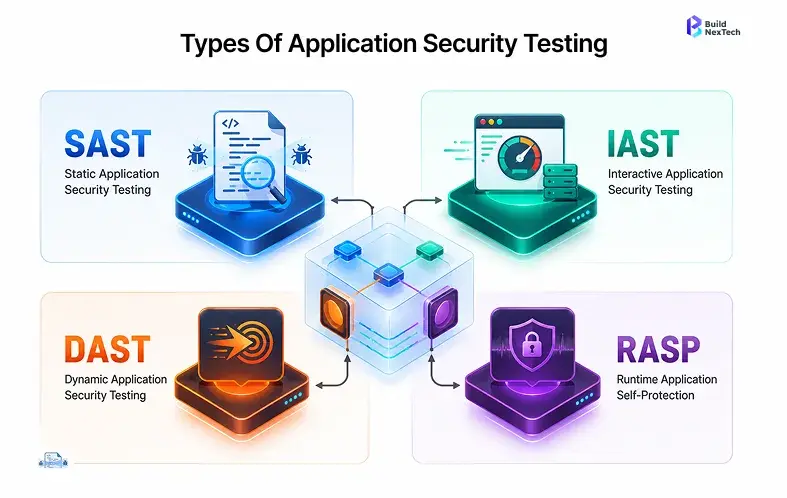
- SAST on every PR merge: Static application security testing tools - Semgrep, CodeQL - scan source code before runtime. Ask for a SAST scan result from a recent project. Mature vendors point to specific lines of code flagged and remediated, not just a passing badge.
- DAST before every major release: Dynamic application security testing (OWASP ZAP, Burp Suite) tests a running application. Teams practising Pair Programming during security-sensitive modules catch a different class of issue than solo reviewers - and it shows in DAST results.
- API design standards: The OWASP API Security Top 10 is the evaluation framework. OpenAPI documentation, JWT with refresh token rotation, and rate limiting defaults are baseline deliverables. Ask whether the vendor runs A/B testing on API response performance before finalising endpoints. Database Migration Scripts should be version-controlled and reversible; unversioned schema changes are where breakdowns in safeguards most commonly occur.
Our Take: Most web development services contracts specify 'testing' - which gets interpreted as functional QA. SAST and DAST require different tooling. If the statement of work does not name them explicitly, assume they are not included.
Real-World Application: Healthcare, Retail, and Fintech
A US hospital system, BuildNexTech, had a previous vendor deliver a patient intake web application. Functional. No HIPAA-compliant API design. No SAST evidence. Electronic Health Records integration that had never been through a security review. The rebuild was completed in 14 weeks, compared to 22 weeks for the original build. The cost difference was not in the new build - it was in the remediation required to make the original usable for a Digital Health context.
Why the Cost Objection Gets the Maths Wrong
The objection that surfaces here is cost. The cost of a post-launch penetration test finding a critical vulnerability consistently exceeds the cost of choosing a vendor that includes security by default. AI capabilities in modern AI Agents and agent development pipelines have also raised the baseline: production monitoring, automated evals, test cases from LLM graders, human evaluation, and human raters for nuanced decisions - these are standard in 2025, not premium add-ons. Customer support integrations, multi-turn evaluations for conversational features, and A/B testing frameworks all need to be accounted for in the delivery scope. Vendors doing genuine AI R&D will have grounded opinions on each. Those simply tracking AI R&D trends will not.
Four Pitfalls That Surface After Signing
A fintech startup came to BuildNexTech seven months into a custom web application development engagement. The application worked. There was no test suite. Every release was a manual deployment. Merge conflicts were resolved by whoever raised their voice loudest. This is not a technology failure - it is what happens when pre-engagement checks were never run.
The Pitfall Most Teams Only Discover Under Pressure
The four pitfalls engineers consistently underestimate:
- CI/CD debt compounds invisibly. A codebase without an automated build pipeline does not feel painful until release pressure hits. Automated deployment - where a green build triggers a release without manual steps - is the goal. Feature flags and Canary Releases require that the pipeline infrastructure exist first.
- 'We use React' is not an architecture answer. Ask about Core Web Vitals budgets, test-driven development discipline, and component architecture strategy. Anecdotal reports of 'we've always done it this way' for architecture decisions are a warning sign, not a confidence signal.
- Security testing on the services page is not security testing in the build pipeline. Regression tests and a regression suite that catches vulnerabilities before production - not after - separate vendors who practise security from vendors who describe it. Benchmark scores from an automated eval are evidence; a slide deck is not.
- The counterintuitive one: Vendors with the strongest portfolios often have the weakest process documentation. Visual output quality and delivery infrastructure quality are not correlated.
According to the DEV Community's 2025 AI in Development survey, 91% of developers now use AI to generate code. Web development companies that have not embedded model capabilities and AI capabilities into their SDLC - through automated evals and production monitoring with clear success criteria - are running on a 2022 delivery model.
Choosing the Right Web Development Services Partner
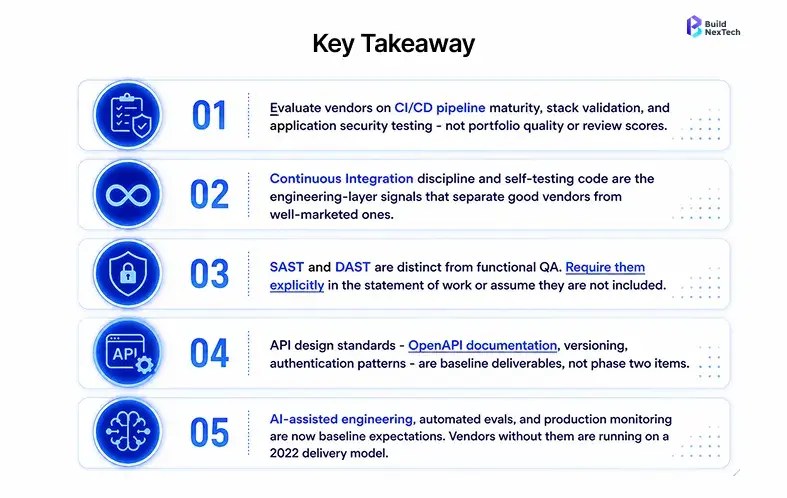
The web development services providers who consistently deliver maintainable, secure, production-ready applications are not the ones with the most impressive portfolios. They are the ones whose engineers answer specific questions about their CI/CD pipeline, SAST tooling, API design principles, and post-handoff documentation standard without pausing to check a slide deck.
Custom web application development engagements fail in predictable ways: no Continuous Delivery infrastructure at handoff, API design without versioning, and security review that happens after the product is live. None of these are surprises. They are the direct consequence of pre-engagement checks that were never run. Whether you are hiring a web development agency for the first time or replacing one that underdelivered, are you running the engineering checks before signing, or after shipping?
People Also Ask

What should engineering teams evaluate when comparing web development service vendors?
Evaluate five layers: stack version, currency and dependency hygiene, CI/CD pipeline maturity, SAST and DAST delivery posture, API design standards, and post-handoff maintainability. Portfolio quality and review scores are not predictive of any of these.
What is the difference between SAST and DAST in web app development?
SAST scans source code before the application runs, catching vulnerabilities on every PR merge. DAST simulates attacks against a running application and runs before every major release. Both are required; neither replaces the other.
How do I know if a web development agency has real CI/CD maturity vs. just claiming it?
Ask for their mean time to deploy on a green build, their test coverage floor, and a post-incident report from a recent project. If they cannot produce the last one in 24 hours, the pipeline exists on paper, not in practice.
What compliance standards should a web development services provider meet for US enterprise clients?
SOC 2 Type II for general enterprise applications, HIPAA for anything touching health records, and CCPA for consumer-facing applications. The NIST Secure Software Development Framework is the underlying standard - any vendor that cannot reference it for a US enterprise engagement is not enterprise-ready.
How much do web development services typically cost for a custom web application?
Clutch's 2025 benchmarks put the average engagement at around $66,500 for a mid-scope project, with US-based teams billing $100–$149 per hour. CI/CD infrastructure and security testing should be included by default, not billed as separate line items.


.webp)
.webp)
.webp)

.webp)
.webp)