

A company came to us with a prompt that had grown to 1,000 words. It reviewed customer contracts through large language models and passed every internal test. Then real files arrived, full of scans, missing pages, and odd formats. Clauses went unchecked, and nobody could tell which part of the prompt had failed or why. The team soon stopped trusting it.
That is a workflow problem, not a prompting problem, and generative AI makes starting easy and trusting hard. So, what is prompt chaining? It splits one task into connected LLM calls, passes structured data between them, and checks every step. Across 150+ client engagements at BuildNexTech, it is the first pattern we reach for. Below, we show how to build one.
What Is Prompt Chaining?
Prompt chaining is a workflow pattern where one task becomes a sequence of LLM calls, with each output feeding the next. It is a design decision, not a prompt trick. Anthropic's Building Effective Agents describes it as LLM calls with programmatic gates between them.
The prompt chain AI teams run in production has four parts:
- Subtask prompts: One objective each.
- Structured handoffs: Typed data between steps.
- Gates: A check on every output.
- An orchestrator: Code or a platform that runs the sequence.
Remove one, and you have a chat habit, not an LLM pipeline. It is multi-stage prompting with engineering around it, one level above basic prompt engineering. Gartner expects task-specific AI agents in 40% of enterprise apps by 2026.
Why Single Prompts Fail on Complex Tasks
Instruction overload is the usual cause. It shows up three ways:
- Constraints compete, and the AI model quietly drops some.
- A failure cannot be traced to one instruction.
- Natural language processing jobs such as extraction and drafting pull against each other.
Task decomposition fixes all three. A first chain can be two steps and an afternoon.
Prompt Chaining vs Chain of Thought Prompting
Chain-of-thought prompting reasons inside one call, while prompt chaining spans several calls with code between them.
How Prompt Chaining Works Step by Step
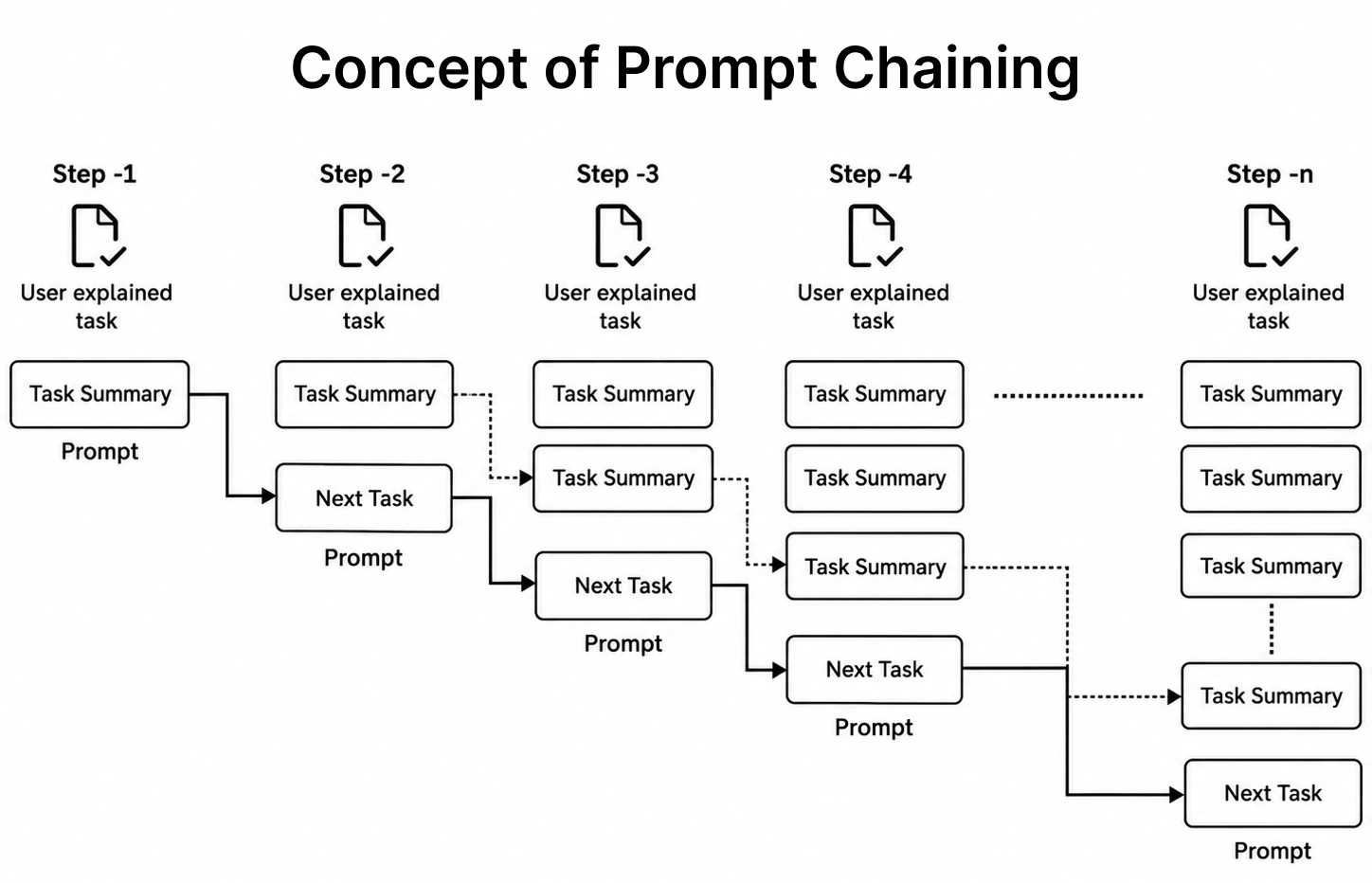
A working chain repeats one loop per subtask: prompt, capture, validate, hand off.
- Decompose the goal: Break a large objective into single-focus subtasks. If a human would switch documents or context, add a step.
- Design the first prompt: Write a clear, bounded instruction for the first subtask and send it to the model.
- Capture the intermediate output: Receive the response as structured output, such as JSON format that matches a JSON schema.
- Validate or clean: Run a validation gate, such as a Pydantic schema check, that filters, reformats, or rejects the output before it moves downstream.
- Feed the output into the next prompt: Pass the previous result in as direct input, such as "Using this content brief, draft the first section."
- Repeat and iterate: Keep linking prompts until the deliverable is ready.
Tooling comes second, so pick the automation approach that fits your team. Workflow automation tools fall into four groups:
- No-code: Workflow automation software such as Zapier and Microsoft Power Automate suits simple flows.
- Code-first: LangChain and LangGraph suit teams that need branching.
- Orchestration platforms: AWS Step Functions handles retries and state at scale.
- Event-driven architecture: An API Gateway request or queue message starts each run.
Four Ways to Chain Prompts
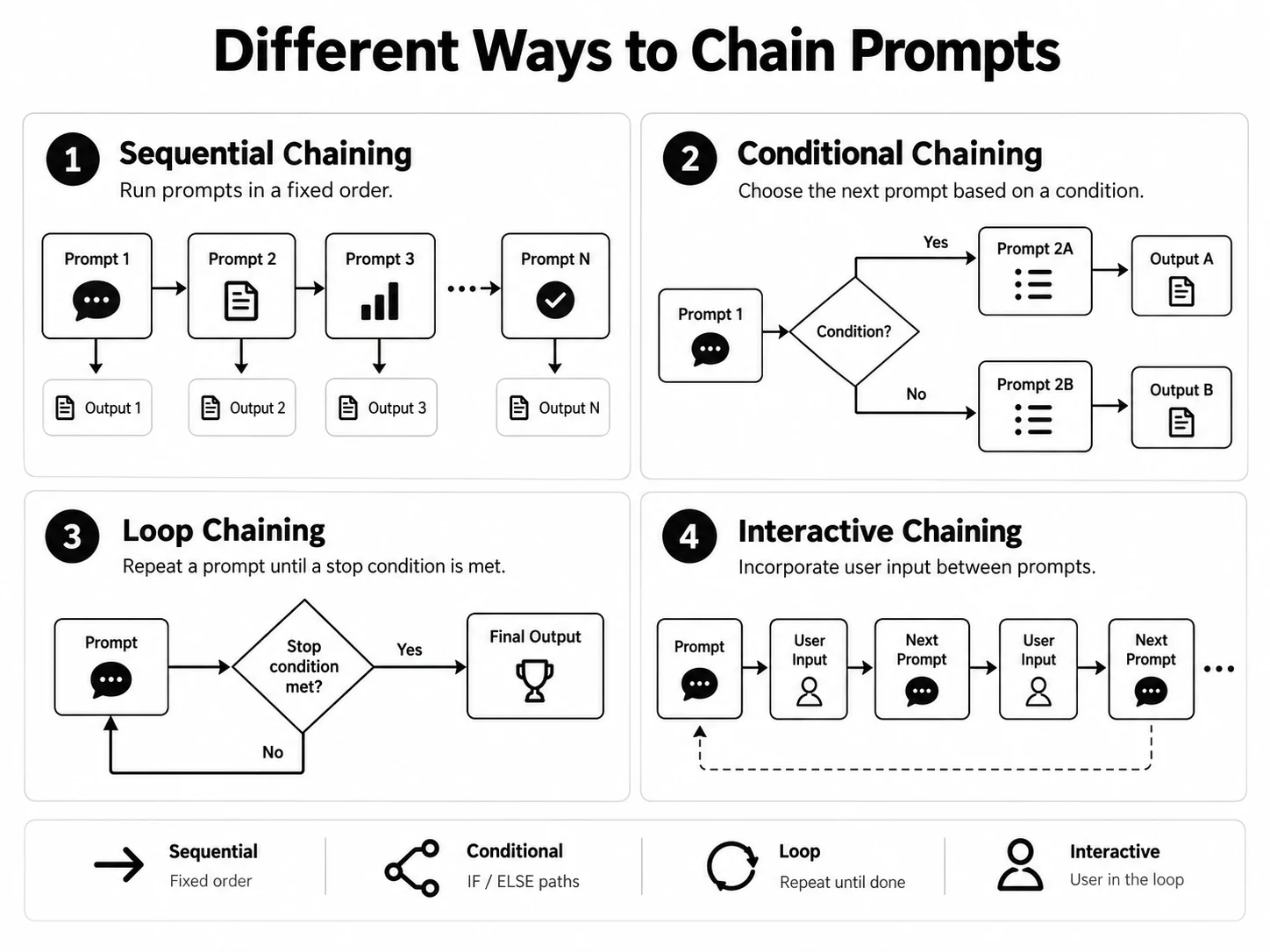
Most chains take one of four shapes:
- Sequential chaining: Each prompt feeds the next in fixed order, such as research, summary, draft, then SEO review.
- Conditional chaining: A gate picks the next prompt from the last result, so positive sentiment triggers a marketing message and negative triggers fixes.
- Loop chaining: A prompt repeats until its output clears a bar, such as generating, testing, and fixing code until tests pass.
- Interactive chaining: A person reviews each output, and their feedback becomes the input for a revision prompt.
From Prompt Chains to Agentic Workflows
An agentic workflow, also called an AI agent workflow, wraps an LLM in a control loop of planning, acting, observing, reflecting, and iterating. In a chain, you define the path. In an agent, the model chooses it.
The loop most teams meet first is ReAct: Reason, call a tool, observe, reflect, repeat. It gives an agent three abilities a chain lacks:
- Tool integration: Database queries, external API calls, code interpreters. The Model Context Protocol standardises how an agent reaches them.
- Adaptability: Changing course and handling missing data mid-run.
- Self-correction: Judging its own output and looping back.
Anthropic treats these as one spectrum: Chaining sits at the fixed end, and each later pattern hands the model more control. Most production systems mix two or three, which is where Multi-Model Orchestration begins: A small model routes, a larger one reasons.
Governance matters more than autonomy, so frameworks such as Mastra expose decision nodes for logging and human checkpoints. Our guides on agentic workflows and multi-agent orchestration go further.
Which one fits your team?
1. Steps known in advance? Prompt chain.
2. Later steps depend on earlier findings? Chain with conditional branches.
3. Subtasks impossible to predict? Agentic workflow.
Our Take: Start with a chain, every time. Most production workflows are predictable enough that an agent adds cost and variance, not value.
Prompt Chaining Examples for Real AI Workflows: Code Generation and Security Auditing
Step 1: Generate the code
Input:
Write a Python function using sqlite3 that fetches a user profile by user_id.

Output A:
def get_profile(user_id):
    query = "SELECT * FROM users WHERE id = " + user_id
    return db.execute(query).fetchone()
The draft works, but string concatenation invites SQL injection.
Step 2: Audit for flaws
Input:
Review this function for SQL injection and hardcoded credentials. List each flaw as JSON.

{Output A}

Output B:
{"flaws": [{"issue": "SQL injection", "line": 2, "fix": "Use parameterised queries"}]}
JSON gives the next step a precise list, and a validation gate can reject a malformed audit.
Step 3: Fix and refactor
Input:
Rewrite the function to fix the flaws below. Return only production-ready code.

Code: {Output A}
Flaws: {Output B}

Final output:
def get_profile(user_id):
    query = "SELECT * FROM users WHERE id = ?"
    return db.execute(query, (user_id,)).fetchone()
The same loop fits lead qualification and medical question answering, anywhere AI assistance needs a checkpoint, and it grows into AI agent examples once you add tools. Setup time: One to two days for a gated two-step chain; about two weeks for a traced production chain.
Common Prompt Chaining Mistakes
A logistics chain misreads a shipment weight in step one. Every later step trusts it. The quote is wrong by a factor of ten, and nothing throws an error.
That is cascading errors: One early hallucination compounds, so early steps need the strictest gates. Three more mistakes recur:
- Over-chaining. Every sequential call adds latency and cost. Fix: Run independent steps in parallel and use prompt caching for repeated context.
- Missing visibility. Debugging agentic systems, or plain chains, is guesswork without logs. Fix: Record each step's input, output, and gate result, so the broken step is findable in minutes.
- Format-only gates. Valid JSON can still be wrong. Fix: Add one semantic check, such as comparing a number against its source.
Key Takeaways
- Add a step whenever a human would switch documents or context.
- Hand off schema-valid JSON, enforced by function calling, so the next prompt never guesses.
- Gate every risky step with a capped retry and a human fallback, strictest at the start.
- Parallelise independent steps and route simple ones to smaller models.
- Log each step's input, output, and gate result so failures point to one step.
- Use a chain for predictable steps, and an agent only for subtasks you cannot script.
Conclusion
Prompt chaining is an engineering habit: Split the work, pass structured outputs, and gate every risky step. Teams that adopt it stop arguing about prompt wording and start measuring cost per run, failure rate, and time to resolution across their AI systems.
A single large prompt hides its failures, whereas a chain surfaces them one step at a time, where they are cheap to fix, long before customers notice. So which of your current prompts is secretly four tasks in one, and what would finding out in production cost you?
People Also Ask

What are AI agents, and what does agentic AI mean?
AI agents are LLM-driven programs that pursue a goal by choosing actions and calling tools themselves. Agentic AI refers to systems built from agents that plan, act, and adapt
What is prompt engineering?
Prompt engineering is the practice of designing and refining instructions, examples, and context so a language model returns accurate, consistently formatted output for a specific task.
What is workflow automation, and how do AI workflow automation tools differ?
Workflow automation uses software to run repeatable business processes without manual effort. AI workflow automation tools add language models so that steps can handle unstructured input instead of only fixed rules.
What are multi-agent systems?
Multi-agent systems use several specialised agents, each with its own role and tools, coordinated by an orchestrator or by one another to complete a larger task.
How to build AI agents without starting from scratch?
Define one narrow goal, choose a framework or low-code agent builder, connect tools through standard protocols, add guardrails and tracing, then test on real cases before widening the agent's scope.