

Ruby on Rails (or simply Rails) is a very powerful framework built using the Ruby programming language. Rails is an open source framework used by many teams to create dynamic database-driven web applications with a clear, organised, structured, and elegant design.
Rails follows the Model View Controller (MVC) pattern, which divides an application into 3 parts (the Models, the Views, the Controllers), making it easier to maintain and expand. Rails is also based on several different principles, including Convention over Configuration and Don't Repeat Yourself (DRY). DRY helps developers avoid writing too much repeating code, thus improving the productivity and efficiency of developers.
Rails was created in 2004 and has since become a dominant player in the web development community, with many users across companies of all sizes (including Shopify, GitHub, and Basecamp). Rails has been widely adopted due to its ability to scale and its dependability.
Key Takeaways
- Understand the power of MVC architecture, Active Record ORM, and DRY principles for efficient development.
- Discover how gems libraries, and Rails best practices speed up MVP and custom web app development.
- See why partnering with a Ruby on Rails development company ensures high performance and long-term growth.
- Compare Rails with other frameworks in terms of scalability, security, and developer productivity.
- Explore how Rails supports dynamic backend development, API layers, and competitive full-stack web applications.
The Growth of Ruby on Rails in the Development Community
Ruby on Rails has experienced immense growth in popularity due to both its intuitive user interface and the sheer amount of contributors and support that the Rails community provides. There are thousands of contributors who support this open-source framework by continually adding:
- Reusable Libraries and Gems
- Tools for debugging, testing, and tuning performance
- Tutorials and Documentation
- Authentication, Payment, Background Job, and File Upload Plugins
The Ruby on Rails ecosystem is vibrant and dynamic. As a result, developers will have quick access to helpful resources. The availability of these resources helps increase both developer productivity and satisfaction.
Companies such as Shopify, GitHub, Basecamp, and Twitter (among others) have displayed that Ruby on Rails scales effectively. These companies are able to demonstrate the performance and longevity of Ruby on Rails in a real-world environment. Today, there are still many technology companies that consider Ruby on Rails to be the best solution for developing competitive web applications and digital products.
The community around Ruby on Rails provides support through best practices for:
- Behaviour-driven development and Test Driven Development.
- Frequent updates, patches for security, and bug fixes
- Knowledge sharing through meetups, events, and communities, both online and offline.
With this kind of collaborative support, both experienced developers and those new to Ruby on Rails can continue growing their skills and producing high-quality applications.
Why Ruby on Rails Is a Smart Choice for Web App Development
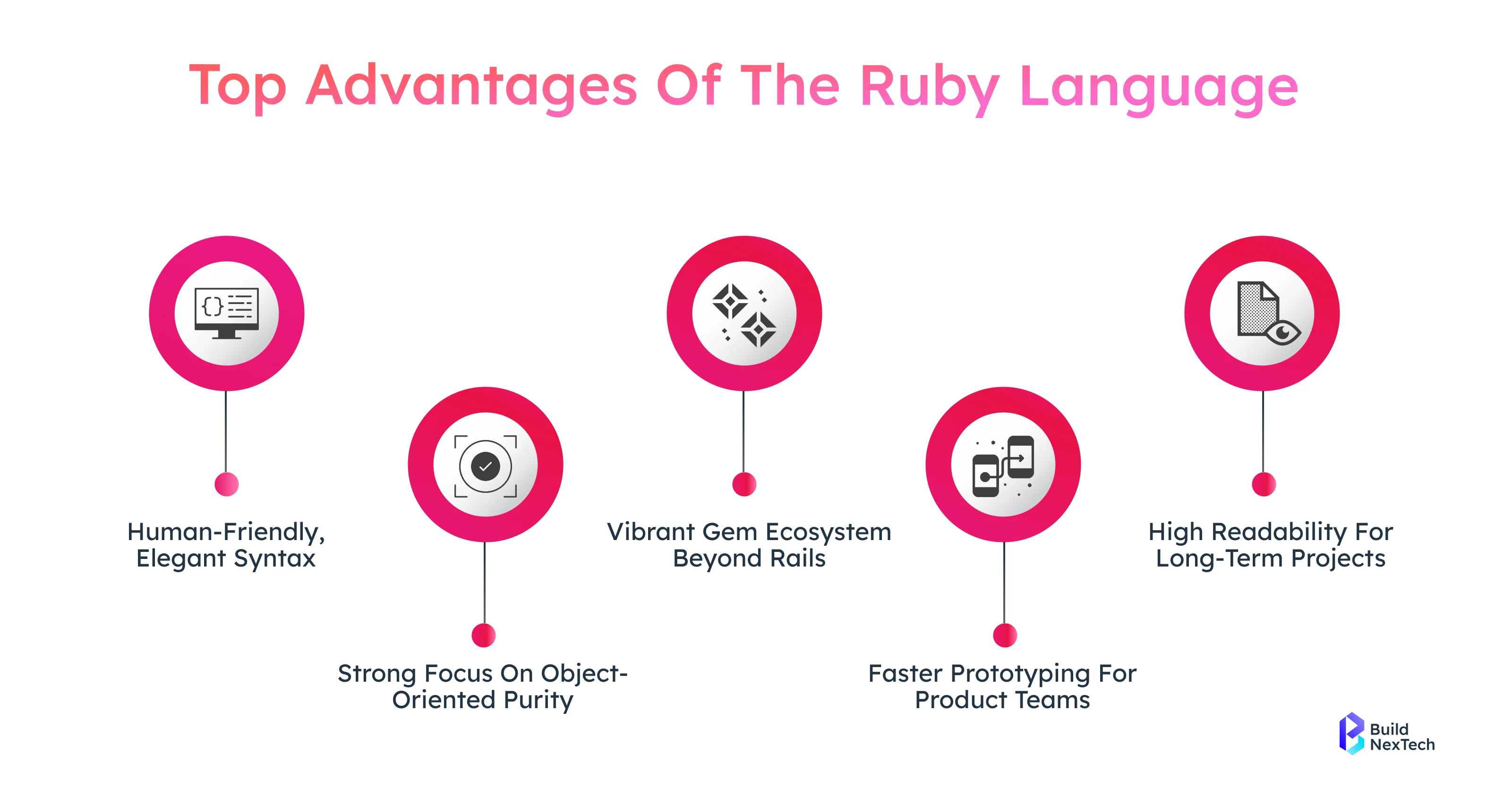
Ruby on Rails is a great solution for startups and enterprise-level businesses alike when looking to get their product to market faster, deliver high-quality, scalable digital products, and reduce complexity when delivering their projects. Ruby on Rails provides a strong, organized framework that allows developers to focus on building robust applications, reducing the overall time it takes to build a new application from scratch.
The Rails Framework has an extensive library of pre-built components, as well as a strong tradition of scaling applications quickly and effectively. With the Rails Framework’s ability to offer robust functionality and the ability to scale rapidly, Rails is a popular choice for developing innovative new products, increasing the quality of products, and getting them into the hands of customers sooner.
Faster Development Cycles and Reduced Time-to-Market
One major feature of Rails is that it can significantly reduce the amount of time needed for development. Rails includes many built-in features as well as conventions to help developers build features quickly, including:
- Rails Generators
- Scaffolding for models, views, and controllers
- Pre-configured project structure
- Automated code generation templates
By utilizing a Convention Over Configuration approach, teams are able to eliminate the need to make multiple decisions, which would typically slow down the development process. In addition, Rails provides a large library of Gems with many components and tools to make common tasks easier.
Examples include:
- Automatic testing support for test-driven development
- API-only Rails applications
- Pre-defined structure for background processing, Active Record, and routing.
Overall, Rails is a great choice for developing MVPs and for adding new features and scaling them after release.
Robust Ecosystem and Libraries for Cost-Effective Solutions
Ruby on Rails provides thousands of gems, which are reusable packages that help speed up the development of features. Instead of needing to build the major functions from scratch, Rails developers can use proven solutions that have been tested through time.
The most commonly used gems include:
- Devise, which provides authentication features for web applications
- Stripe and PayPal gems, which enable payment processing integration
- CarrierWave and ActiveStorage, which support uploading files, images, and other media
- Background job processors like Sidekiq, Delayed Job, and Resque for handling asynchronous tasks
Using gems provides developers and businesses with:
- Reduced development costs
- A shorter time to implement
- Reduced risks of security vulnerability
- More consistent performance
The combination of these factors makes Rails a financially wise choice for business owners, whether building a minimum viable product (MVP) or scaling to an enterprise-level infrastructure.
Key Features of Ruby on Rails That Make It Ideal for Web Apps
Ruby on Rails includes a powerful set of features that allow it to handle both small and enterprise-grade applications. Below are essential features that demonstrate why Rails is a popular full-stack web development framework.
MVC Architecture: The Foundation of Rails
Rails is built around the MVC (Model-View-Controller) pattern, which divides responsibilities into clear components:
- Model:
- Handles business logic
- Communicates with the database
- Manages validation and persistence
- View:
- Renders UI elements
- Presents information to users
- Supports dynamic content and templating
- Controller:
- Connects user requests with the application logic
- Interacts with models
- Chooses the appropriate view for rendering
This structure improves:
- Code readability
- Project maintainability
- Long-term scalability
- Separation of concerns
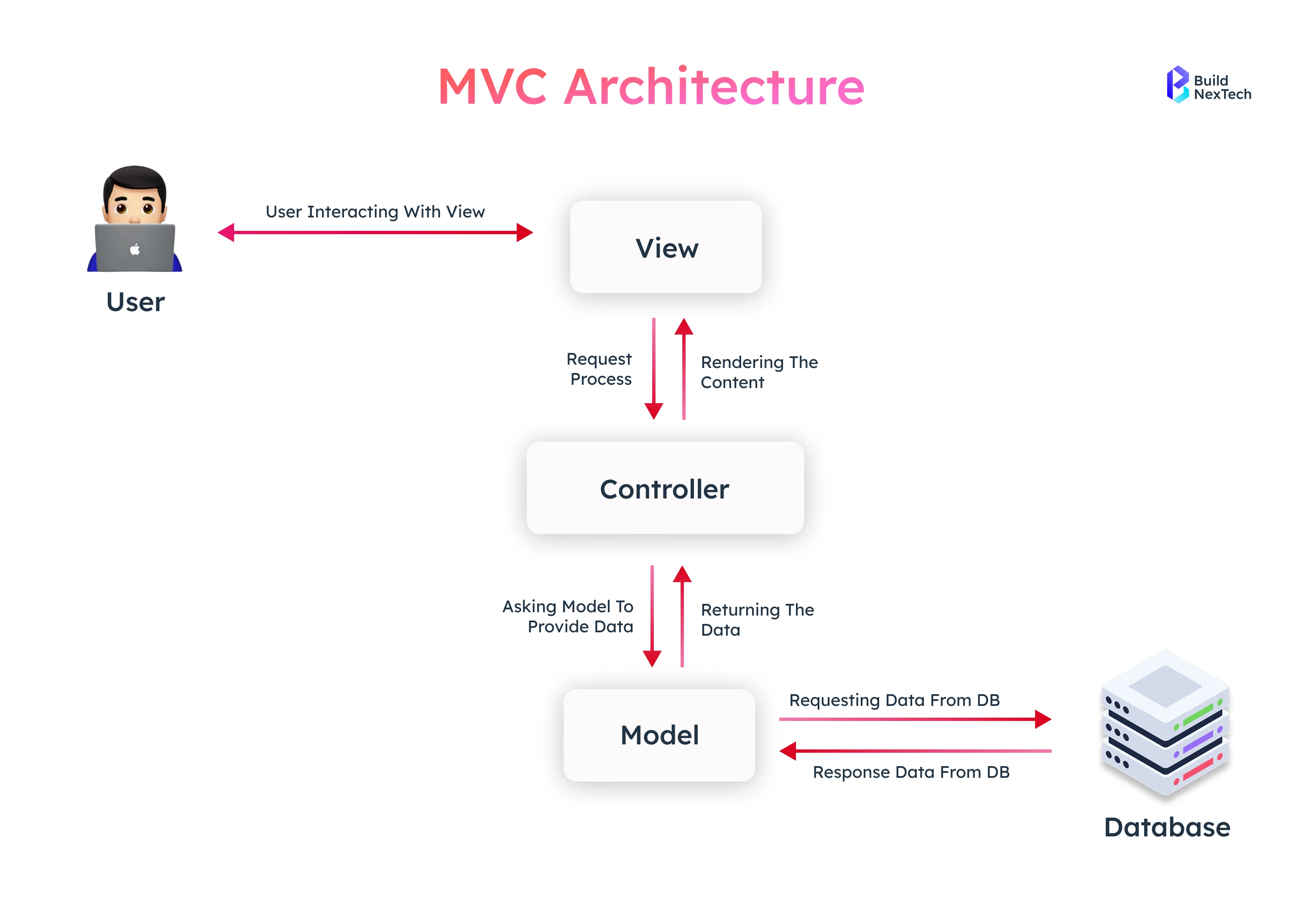
The MVC architecture is fundamental when building scalable web applications that must grow with user demand.
Object-Relational Mapping (ORM) in Ruby on Rails
Rails uses Active Record, an intuitive Object Relational Mapping (ORM) layer that enables developers to work with databases using Ruby objects instead of manual SQL.
Key benefits include:
- Automatic database migrations for evolving data structures
- Active Record associations (one-to-many, many-to-many, has-many-through, and more)
- Simplified CRUD operations
- Reduced complexity when managing database logic
- Cleaner codebases and fewer bugs
Active Record lets Ruby objects work smoothly with database tables. This lowers the learning curve and speeds up development.
Why Partner With a Ruby on Rails Development Company
When you partner with an experienced web developers to build your application, you can be assured that it will be built efficiently following Ruby on Rails best practices. Many of these development companies focus exclusively on Ruby on Rails, providing full-stack Web development services. They utilize best practices in the industry to produce high-performance web applications.
- By partnering with professionals, you can expect:
- Clean and maintainable code
- Robust architectural structure and seamless performance.
- Enterprise-grade security.
- Faster delivery time, cycles, and reliable, longer-term support.
Access to Experienced Rails Developers and Best Practices
A qualified Ruby on Rails development company provides access to seasoned Ruby on Rails developers who follow modern engineering standards, such as:
- Test-Driven Development (TDD)
- Behavior-Driven Development (BDD)
- SOLID principles
- Object-oriented design
- Don’t Repeat Yourself (DRY) practices
- Efficient use of bounded contexts for complex domain logic
Best practices are:
- Identify performance bottlenecks
- Optimize Active Record queries
- Improve scalability and performance optimization
- Build systems that handle high-traffic workloads
- Prevent security breaches by applying secure coding conventions
With deep experience in Ruby programming language, MVC, ORM, and custom web app development, seasoned Rails developers ensure your application is stable, future-ready, and aligned with your business goals.
Built-in Testing Tools for High-Quality Code
Rails stands out because of its strong focus on quality and automated testing. Tools like RSpec, MiniTest, and built-in test suites help ensure that every piece of code behaves as expected.
Benefits include:
- Early detection of bugs
- Reduced regression issues
- Faster and safer feature deployment
- Better long-term maintainability
Whether you're building an MVP or scaling an enterprise application, test-driven development helps teams deliver a reliable product with confidence.
Scalability and High Performance for Complex Applications
A well-optimized Ruby on Rails backend can handle complex business logic, support APIs, and scale seamlessly with your growing user base.
Techniques that enhance performance include:
- Caching strategies: page caching, fragment caching, action caching
- Background jobs and asynchronous processing with Sidekiq, Resque, or Delayed Job
- Efficient Active Record queries
- Load balancing and multi-server deployments
- Optimized API layer for high-traffic applications
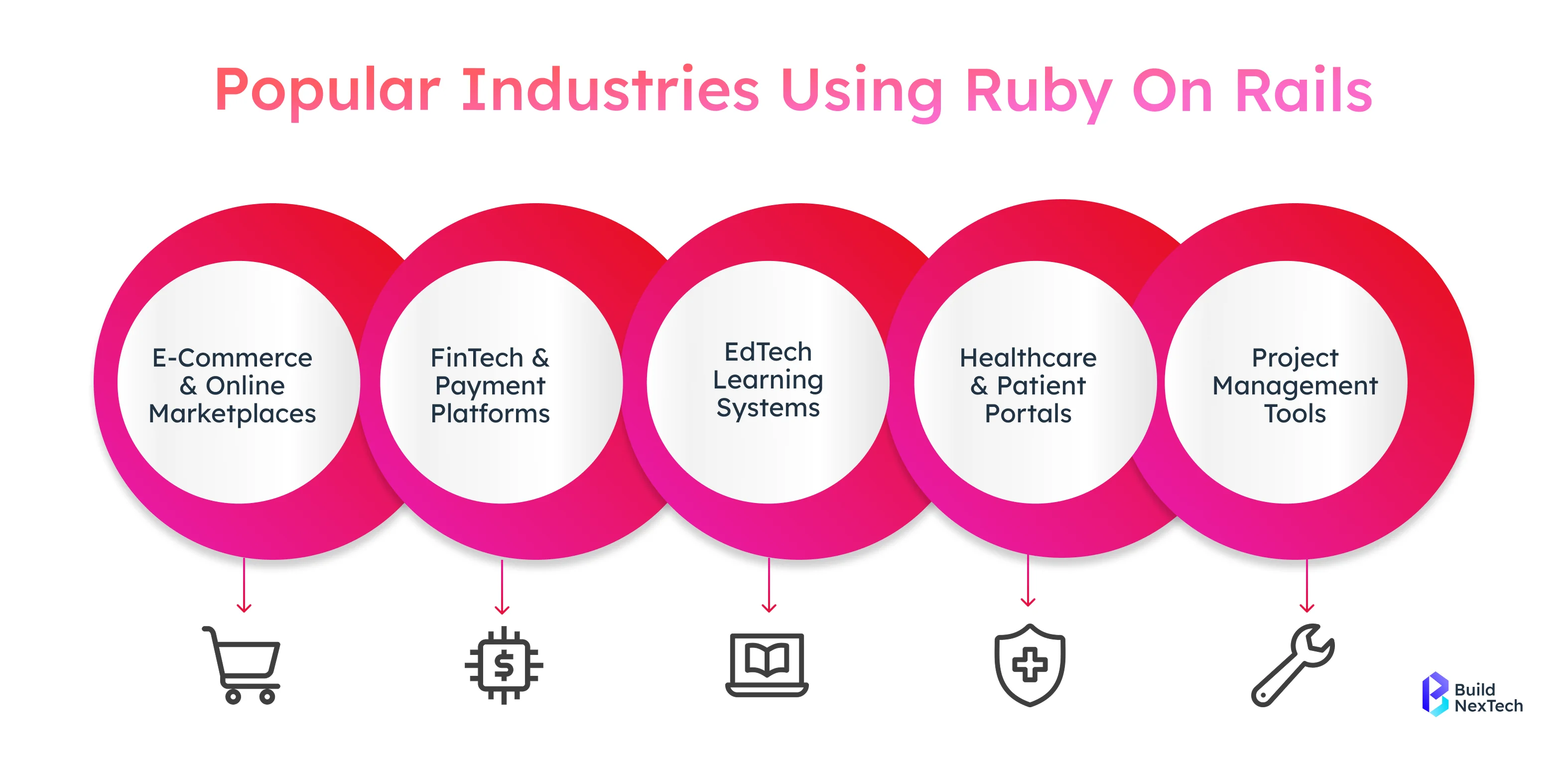
These capabilities prove why industries like SaaS, e-commerce, health tech, and FinTech rely on Rails for long-term scalability.
Ruby on Rails vs. Other Development Frameworks
Rails competes strongly with other major full-stack frameworks. Here’s a simplified comparison:
Rails offers developer happiness, stability, and fast development. This makes it attractive for business owners who launch new products or update old systems.
How to Choose the Right Ruby on Rails Development Company
Selecting the right partner ensures your project’s long-term success. A reliable agency knows how to build scalable, secure, and high-performing Rails applications. They use modern methods like API development, API-only Rails, strategic domain modeling, and clean architecture.
Key Factors to Consider When Hiring a Rails Development Team
When reviewing potential Rails partners, evaluate the following:
- Experience and expertise
- Look for proven experience in Ruby on Rails web development and backend web development.
- Prefer companies experienced in competitive web applications, MVPs, and cloud service architecture.
- Development process
- Choose a company that uses:
- Agile methodology
- CI/CD pipelines
- Automated testing (TDD and BDD)
- Strong code review processes
- Choose a company that uses:
Conclusion: Why Ruby on Rails Delivers Exceptional Value for Web Applications
Ruby on Rails offers excellent versatility and security, with extensive support from both developers and the development community. The integration of developer-friendly conventions, quick development cycles, scalability capabilities, and robust security makes Ruby on Rails the ideal technology platform for developing minimum viable products (MVPs), large-scale enterprise solutions, and long-term digital product platforms.
Ruby on Rails is built using the Ruby programming language, the Model-View-Controller (MVC) design, and Active Record Object-Relational Mapping (ORM). In addition to the many features provided by the community, Ruby on Rails has also seen considerable success across many industries.
As a result, Ruby on Rails allows businesses to build secure, dynamic, and scalable web-based applications with great efficiency. When partnering with an experienced Ruby on Rails development company, companies will benefit from the expertise and best practices of this particular technology platform, as well as ongoing maintenance and enhancements.
At Buildnextech, we deliver trusted software development services, expert mobile app development, scalable web development services, tailored custom software development, and innovative AI development services for businesses worldwide.
People Also Ask

Why should I choose Ruby on Rails for my web application?
Ruby on Rails offers rapid development, clean code, and built-in best practices that reduce development time and cost. It’s ideal for scalable, secure, and high-performance web applications.
What types of web apps can be built using Ruby on Rails?
Rails is perfect for marketplaces, SaaS platforms, e-commerce sites, social networks, and workflow automation tools. Its flexibility allows businesses to build anything from MVPs to full-scale enterprise applications.
How does MVC architecture improve development?
MVC separates Model, View, and Controller, keeping code organized and allowing teams to work efficiently. It also reduces duplication and makes maintenance easier.
Why is Rails ideal for MVP development?
Rails’ scaffolding, generators, and gem ecosystem speed up development, making MVPs quick to build. Startups can launch products faster and iterate based on user feedback.
Can a Ruby on Rails app handle high-traffic enterprise workloads?
Yes, with caching, background jobs, and optimized database design, Rails supports large-scale, high-traffic apps. Many enterprises like Shopify and GitHub rely on Rails for millions of users.


.webp)
.webp)
.webp)

.webp)
.webp)