
Our enterprise AIOps infrastructure helps hybrid-cloud environments, MSPs, and SaaS platforms scale system reliability and incident response without increasing SRE headcount.
72%
Reduction in redundant monitoring alerts.
68%
Decrease in Mean Time to Recovery (MTTR).
54%
Elimination of infrastructure outages.
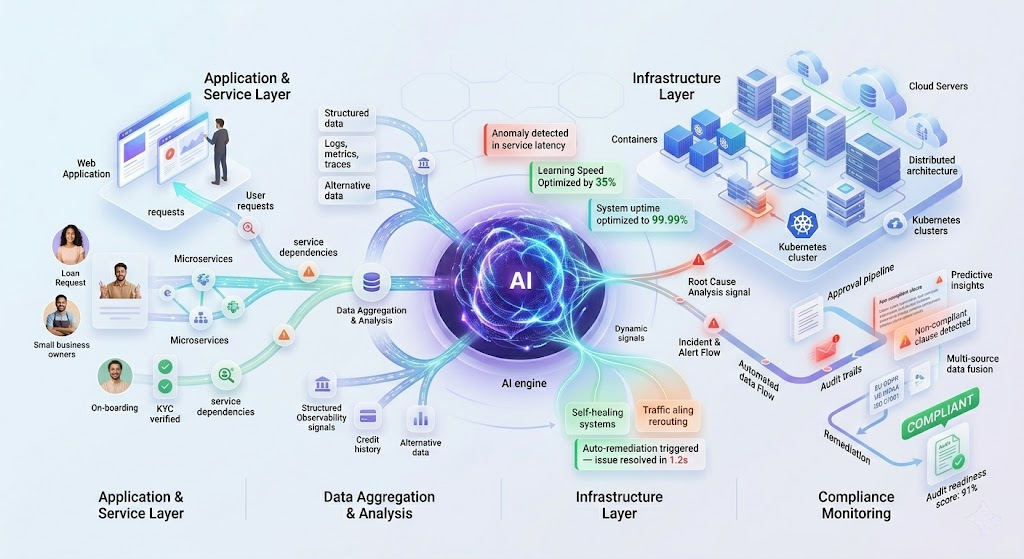
Our enterprise AIOps infrastructure helps hybrid-cloud environments, MSPs, and SaaS platforms scale system reliability and incident response without increasing SRE headcount.
72%
Reduction in redundant monitoring alerts.
68%
Decrease in Mean Time to Recovery (MTTR).
54%
Elimination of infrastructure outages.
AI delivers the highest ROI in data-heavy, high-velocity infrastructure environments. Here is how we apply it

Deploy intelligent filtering algorithms to aggregate redundant monitoring alerts and eliminate alert fatigue.

Analyze historical telemetry and metrics to predict server degradation before an outage impacts end-users.

Utilize localized AI models to correlate cross-system anomalies and instantly surface the probable root cause.

Automatically classify and route incoming IT tickets to the correct engineering teams based on payload context.

Execute automated, secure runbooks for known tier-1 issues (like restarting stalled services) prior to human escalation.
We build and deploy AI systems inside complex IT environments where system uptime, data privacy, and strict change-management compliance are non-negotiable.
Where AI Fits in the IT Operations Stack
AI enhances core IT Service Management (ITSM) and observability platforms through a structured, highly secure architecture:
%201.webp)
Ingestion
Pull streams of unstructured logs and metrics from legacy servers and modern cloud providers (AWS, GCP, Azure).

Secure APIs
Reliable middleware connecting modern AIOps engines to your existing ITSM tools (ServiceNow) and monitoring stacks.

Model Layer
Localized predictive models ensuring internal infrastructure topologies never leave your isolated, compliant environment.

Human-in-the-Loop
AI handles alert correlation and tier-1 remediation; complex architectural changes always route to human SREs.
Common IT Operations Automation Challenges
.webp)
Connecting AI to siloed legacy monitoring tools and modern cloud telemetry requires custom integration middleware.
Engineering teams need a phased approach, starting with read-only recommendations before moving to automated remediation.

System logs contain sensitive data. Public AI models cannot be used to parse internal network configurations or vulnerability scans.

Best Fit: Enterprise IT departments or MSPs managing high alert volumes needing an intelligent correlation layer.
Not a Fit: Basic ping-monitoring tools, generic helpdesk portals, or unsecured POCs.
Best Fit: Enterprise IT departments or MSPs managing high alert volumes needing an intelligent correlation layer.
Not a Fit: Basic ping-monitoring tools, generic helpdesk portals, or unsecured POCs.

Monitoring alert correlation, false-positive filtering, automated ticket routing, and predictive capacity planning.
Yes. Secure implementations utilize isolated, private models and strict access controls to ensure network topologies remain confidential.
No. Through a Human-in-the-Loop (HITL) architecture, AI handles alert noise so your engineers can focus on strategic infrastructure improvements.
The model is trained on your historical incident data, learning to identify the signatures of transient spikes versus genuine service-impacting anomalies.
Yes. Custom API middleware acts as a secure bridge, allowing our AIOps layer to ingest data and update tickets directly in your ITSM platform.
.webp)
.webp)
.webp)

BuildNexTech empowers businesses with expert web development, app development, and cloud migration services.


.webp)
.webp)
