
Our enterprise infrastructure helps freight forwarders, 3PLs, and delivery fleets scale supply chain visibility and optimize routing without linearly increasing operational headcount.
20%
Acceleration in dispatch cycle generation.
29%
Improvement in on-time deliveries.
50%
Reduction in cloud infrastructure costs.
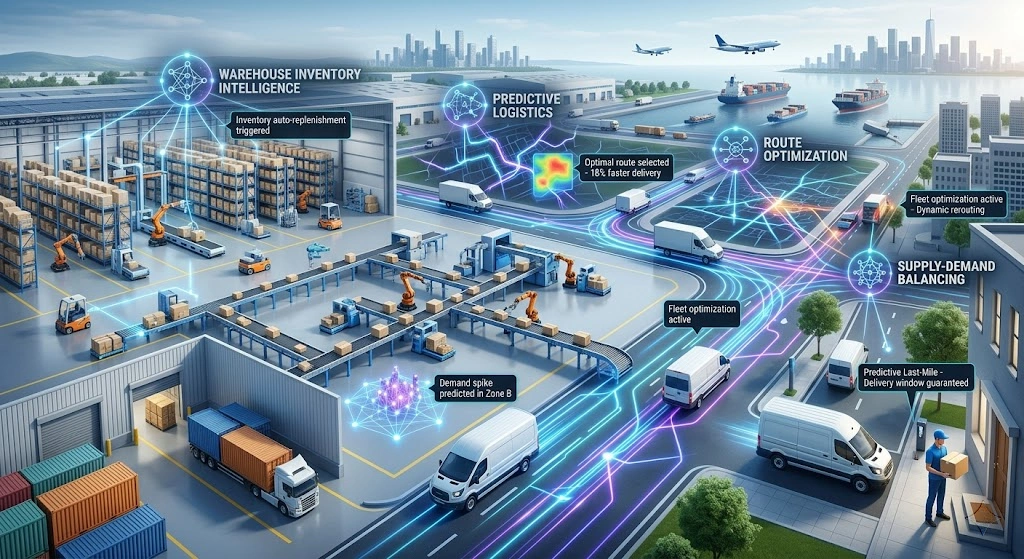
Our enterprise infrastructure helps freight forwarders, 3PLs, and delivery fleets scale supply chain visibility and optimize routing without linearly increasing operational headcount.
20%
Acceleration in dispatch cycle generation.
29%
Improvement in on-time deliveries.
50%
Reduction in cloud infrastructure costs.
AI delivers the highest ROI in data-heavy, time-sensitive supply chain processes. Here is how we apply it

Intelligent engines automatically coordinate between warehouses and drivers, reducing manual coordination by 60%.

Custom mobile apps with IoT telemetry provide sub-second visibility, improving operational efficiency by 35%.

Computer vision models extract data from Bills of Lading directly into your ERP, reducing manual entry errors by 50%.

Migrate legacy databases to scalable infrastructure (like Amazon RDS) to deliver 99.95% uptime and faster queries.

AI models analyze historical sales and market signals to predict stockouts and optimize warehouse capacity.
We build and deploy intelligent systems inside complex supply chains where data latency, cloud scalability, and operational reliability are non-negotiable.
Where AI Fits in the Logistics Stack
AI enhances your supply chain through a highly secure, high-throughput architecture
%201.webp)
Ingestion
Pull real-time telemetry data from fleet GPS, ELDs, and unstructured data from legacy WMS.

Secure APIs
The high speed cloud bridge connecting your Transportation Management System (TMS) to our AI engines

Model Layer
Custom routing algorithms and Agentic AI dedicated specifically to your fleet parameters and rules.

Human-in-the-Loop
AI handles continuous monitoring and generates routes; dispatchers retain override control for critical shipments.
Common Logistics Automation Challenges
.webp)
Connecting modern AI to disconnected carrier portals and legacy ERPs requires robust custom middleware.

Logistics AI APIs must process thousands of simultaneous GPS pings and status updates without failing.

Automation must be cleanly integrated into mobile apps and workflows to ensure high driver adoption rates.

Best Fit: High-volume 3PLs or supply chains needing an intelligent integration layer over existing TMS/WMS to scale visibility.
Not a Fit: Basic off-the-shelf GPS trackers or non-production POCs.
Best Fit: High-volume 3PLs or supply chains needing an intelligent integration layer over existing TMS/WMS to scale visibility.
Not a Fit: Basic off-the-shelf GPS trackers or non-production POCs.

Route optimization, freight document extraction (BoL/Invoices), predictive inventory forecasting, and real-time fleet tracking.
Yes. We build secure API middleware that extracts data from legacy systems, enabling modern predictive analytics without a full infrastructure overhaul.
It can, but we recommend a Human-in-the-Loop (HITL) approach. AI detects delays and generates alternative routes for dispatchers to approve.
Initial implementations like cloud migrations or automated tracking apps take 8–12 weeks; deep Agentic AI workflow engines require phased testing.
Legacy on-premise servers cannot process AI datasets fast enough. Migrating workloads to platforms like Amazon RDS unlocks real-time forecasting.
.webp)
.webp)
.webp)

BuildNexTech empowers businesses with expert web development, app development, and cloud migration services.


.webp)
.webp)
