

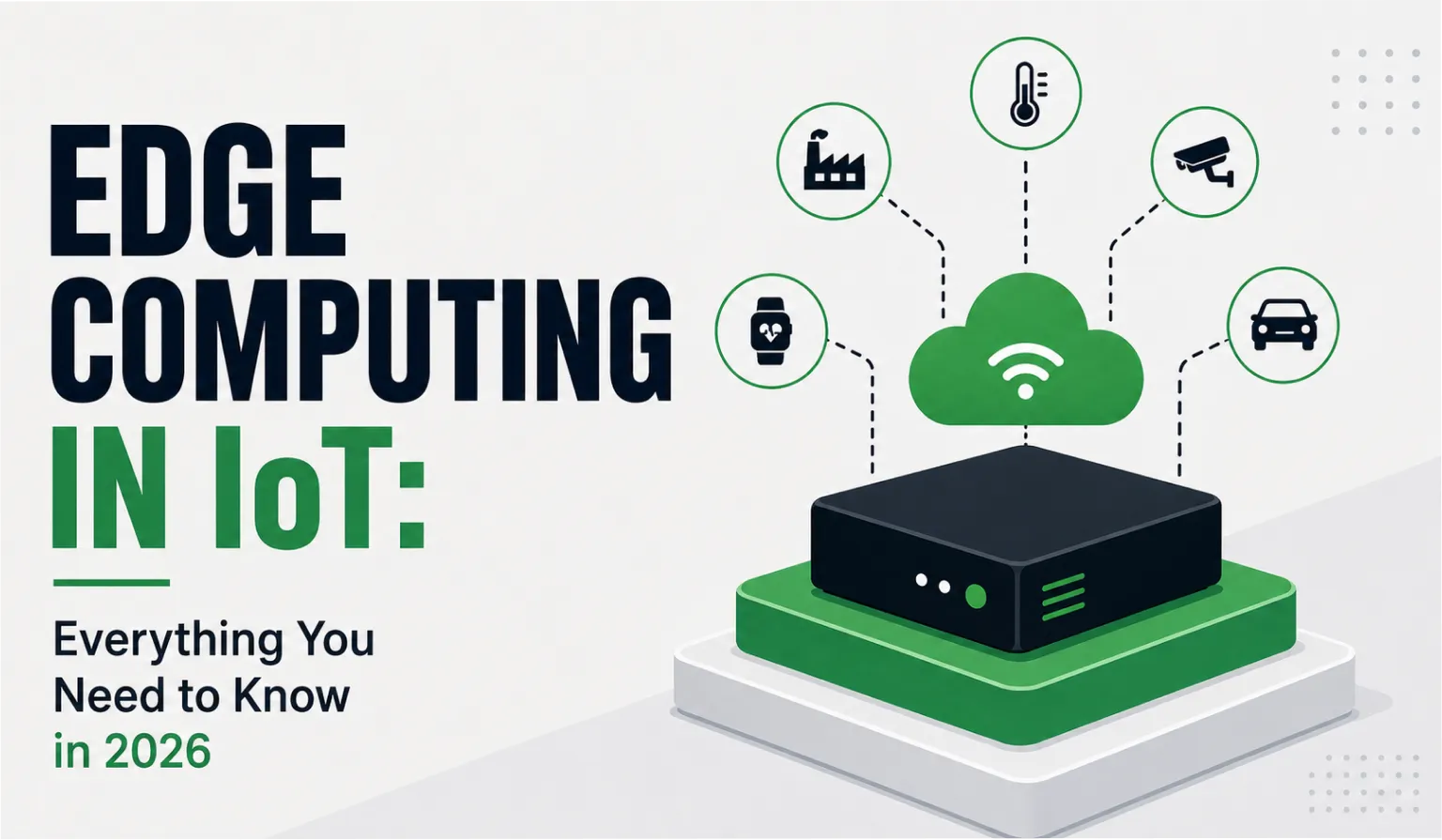
TL;DR: Edge computing in IoT involves moving processing of data from the cloud to devices or gateways. It ensures low latency, reduced bandwidth cost, and offline operation of the system. This architecture is divided into three layers: IoT devices, edge nodes, and cloud. Correct placement of workloads differentiates successful pilots from those that fail.
The IoT devices produce data continuously, but when it comes to transmitting all the data to the cloud, issues arise; these issues become even more pronounced in the long run. These include excessive latency for real-time decisions, high bandwidth cost, and lack of functionality as soon as there is any problem with connectivity. The vibration sensors reporting a machine fault 400 milliseconds after the actual incident cannot be classified as real-time.
Here is where edge computing in IoT comes into the picture. Based on our experience across over 150 customer implementations in manufacturing, healthcare, and logistics, we find that teams that adopt an approach that starts with the edge rather than the cloud see better latency, lower cloud costs, and higher reliability.
What Is Edge Computing in IoT?
Edge computing in IoT means processing data at the source, on the IoT device, a local IoT gateway, or an edge node, rather than routing everything to the cloud first. The Internet of Things creates vast amounts of telemetry data; the edge layer determines what gets sent up the pipe, and thus makes real-time data processing at the IoT edge possible.
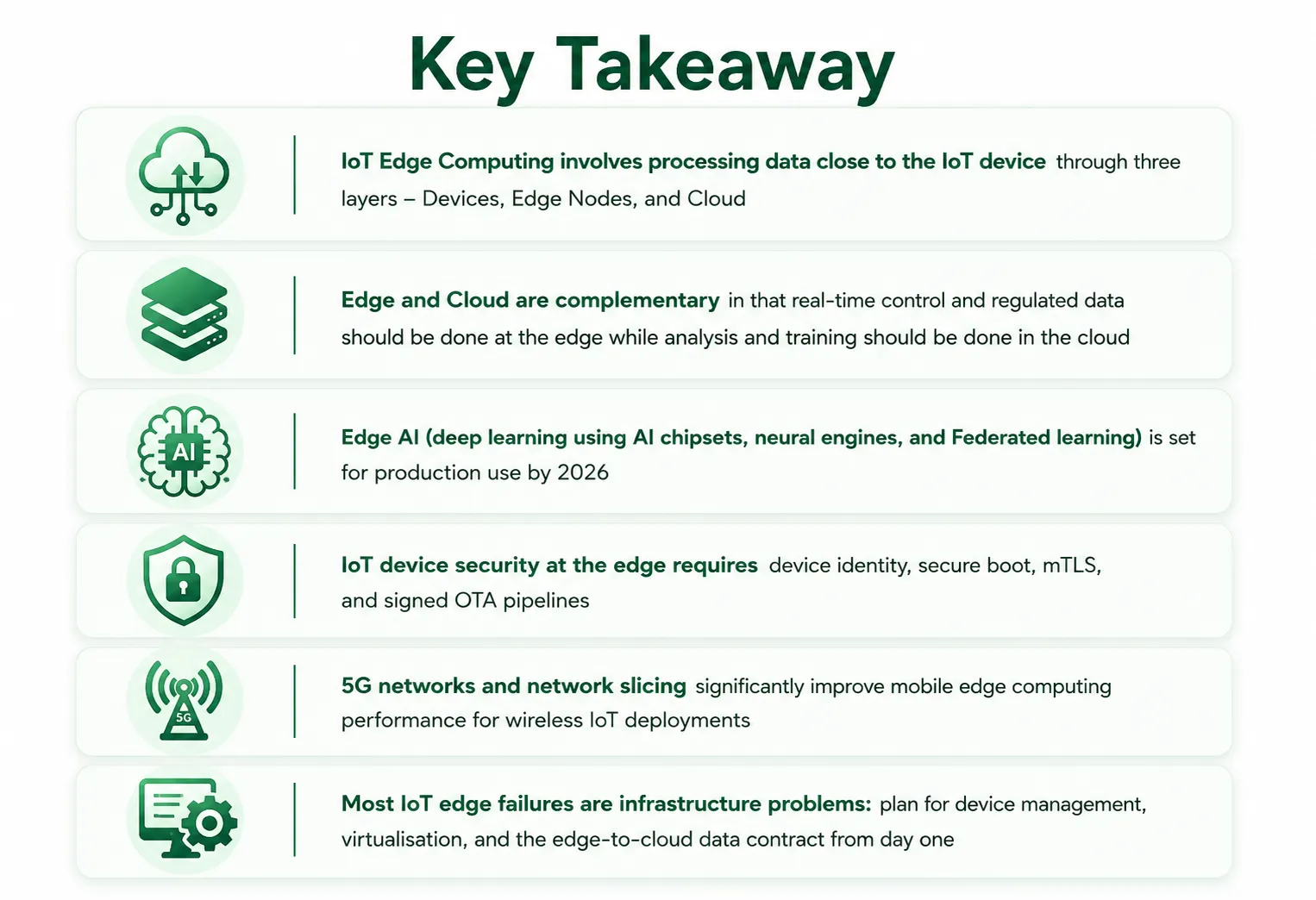
The standard IoT edge computing architecture runs three tiers:
- Device layer: Consists of sensors, actuators, cameras, and smart objects that produce raw telemetry data.
- Edge layer: Includes IoT gateways or edge nodes which normalize data, enforce policies, and perform local data processing or machine learning inference.
- Cloud layer: Long-term analytics, Foundation model training, fleet dashboards, and data platforms.
AI hardware in current times is creating confusion in terms of hierarchy. In-built AI chips or neural processors present on SoC platforms such as the NVIDIA Jetson or ARM Cortex-M microcontrollers that work to run deep learning algorithms belong to the TinyML category. Depending upon the computing needs, you can call these devices or edge nodes.

How Does Edge Computing Work in IoT: The Data Flow
A production IoT edge deployment follows four steps:
- Device generates telemetry: Temperature reading, vibration signature, camera frame, or multimodal sensing output from sensor networks.
- Gateway normalises: Protocol translation (MQTT, OPC-UA, Bluetooth LE), schema normalisation, and noise filtering via sensor fusion.
- Edge node acts: Machine learning inference or local rules trigger an action: halt the conveyor, send a nurse alert, or flag a shipment, without waiting on the cloud.
- Only relevant data travels upstream: Anomaly summaries, model confidence scores, aggregated trends. Raw telemetry stays local.
The cost of transporting data is minimized by up to 80% through the filtering of information at the edge as opposed to transporting everything upstream. The process continues to function even if there is no connectivity, an advantage which is essential in places such as remote IoT industrial applications, intelligent agriculture, and logistics vehicles.
Edge Computing vs Cloud Computing for IoT: What Actually Belongs Where
Edge computing is not a replacement for cloud computing. It is a correction to cloud-first designs that made sense when IoT deployments were small, and cloud egress was cheap. Neither condition holds at production scale. The skill is knowing which workloads belong where.
What belongs at the edge:
- Real-time control loops where sub-100ms response is non-negotiable.
- High-volume raw telemetry from sensor networks that is expensive to backhaul.
- Sensitive or regulated data that cannot leave the site without de-identification.
- Offline-capable device workflow for disconnected environments.
- IoT device security controls, local de-identification, and secure boot.
What belongs in the cloud:
- Long-term trend analytics requiring historical depth.
- Foundation model training and machine learning retraining.
- Fleet monitoring dashboards and asset management across distributed sites.
- Data platforms handling batch reporting and aggregation.
Our Take: Most IoT teams over-provision cloud infrastructure and under-provision edge nodes. The result is a system that works in the pilot and hits latency and cost problems at scale. Getting workload placement right upfront costs less than re-architecting twelve months in.

Comparison Table: Edge vs Cloud for IoT Workloads
Which fits your team?
- Sub-100ms response needed? Use edge processing on your IoT edge computing platform.
- Data regulated under HIPAA or SOC 2? Process locally before cloud upload.
- Hitting bandwidth ceilings on a cloud-first IoT platform? Map workloads above and move the right ones to the edge.
The Real Benefits of Edge Computing for IoT Operations
Edge computing in IoT delivers four concrete benefits that cloud-first IoT platform designs cannot match at scale.
Lower Latency for Real-Time Decisions
Cloud round-trips add 150 to 300ms per decision. Edge processing brings that below 10ms for local control loops. On a Smart Factory production line, that gap separates a safe stop from a safety incident.
Reduced Bandwidth and Cloud Costs
Edge filtering sends only relevant data upstream. Teams running edge-first IoT pipelines report 60 to 80% reductions in bandwidth and cloud ingress costs compared to streaming raw telemetry; learning how to reduce IoT bandwidth costs with edge computing is one of the highest-ROI decisions an engineering team can make.
Reliability During Connectivity Loss
When the network goes down, edge nodes keep processing locally and buffer data until connectivity is restored. For remote industrial IoT sites, logistics fleets, and healthcare devices, local data processing keeps the system operational when the internet is not.
Better Data Privacy and Compliance
Sensitive data is de-identified locally before cloud transmission. Secure boot, device identity certificates, and mTLS enforce IoT device security at the edge. The NIST AI Risk Management Framework references local processing controls as part of a compliant posture for AI-assisted deployments.
Real-World Use Cases of Edge Computing in IoT
Industrial IoT and Predictive Maintenance
A US logistics fleet deployed edge nodes running local machine learning inference on drivetrain sensor streams and cut unplanned downtime by 30 to 50%. The cloud received only anomaly summaries; predictive maintenance logic and local data buffering ran entirely on the edge-compute module. According to Gartner, 40% of enterprise operational workloads will incorporate Industrial AI agents by the end of 2026, and most of that Industrial AI will run at the device.
Smart Manufacturing and Quality Inspection
Computer vision models on Edge AI hardware such as NVIDIA Jetson inspect Smart Factory production lines in real time. Edge AI brings classification latency below 5ms; cloud-based inspection at 200ms-plus simply cannot keep up. Multi-agent systems across edge controllers use sensor fusion to catch defect patterns a single model would miss.
Healthcare Remote Patient Monitoring
Healthcare is one of the strongest use cases for artificial intelligence-assisted edge processing. Bedside IoT devices run anomaly detection locally on wearable sensors; only de-identified summaries reach the cloud EHR, keeping sensitive data on-site in line with data privacy regulations and HIPAA.
IoT Security at the Edge
Smart cities process traffic sensor data at edge nodes to cut management latency. Smart home devices and connected infrastructure for autonomous vehicles run Edge AI inference locally. Smart farming deployments use sensor networks across low-connectivity areas, with edge nodes buffering data and syncing when a connection is available. Keeping processing local reduces the attack surface and supports mobile edge computing at scale.
Common Pitfalls When Deploying IoT Edge Systems
Most IoT edge deployment failures are infrastructure and operations problems, not hardware problems. Here is where teams consistently go wrong, and what to do instead.
1. Treating the Edge Node as a Thin Relay
- Problem: Deploying an IoT gateway that only forwards data rather than processing it, paying for edge infrastructure while still bearing cloud latency and costs.
- Fix: Provision edge controllers with compute capacity. Run local rules or machine learning inference on the node.
2. Skipping Lightweight Virtualisation
- Problem: Running edge workloads directly on the host OS creates isolation failures and makes OTA updates risky at fleet scale.
- Fix: Use containerised workloads with lightweight virtualisation (Docker, containers, or K3s). Rollbacks become safer, and fault isolation becomes cleaner.
3. Underestimating IoT Edge Device Management Complexity
- Problem: Without a proper IoT device management platform, managing health monitoring, remote configuration, signed OTA pipelines, and certificate rotation across a distributed fleet is unmanageable. This is where IoT security breaks down.
- Fix: Select an IoT device management platform before deployment. Treat it as core infrastructure, not a post-launch concern.
4. Not Defining the Edge-to-Cloud Data Contract Upfront
- Problem: Getting the data format, frequency, and schema wrong means re-engineering the upstream pipeline after the edge layer is live.
- Fix: Define the data contract, format, schema, and frequency before writing the first line of edge code. Design to what the cloud expects from day one.
5. Ignoring Federated Learning and Model Update Pipelines
- Problem: Edge AI models degrade over time as conditions change. Teams that deploy without a retraining strategy end up with stale inference running on live systems.
- Fix: Build a federated learning or centralised retraining loop into the architecture from the start. Edge AI without a model update pipeline is a time-limited solution.
How BuildNexTech Helps You Deploy IoT Edge Applications That Reach Production
Most IoT pilots stall because teams underestimate the infrastructure layer: protocol integration, local inference pipeline setup, OTA management, and observability across a distributed fleet. That is the gap our IoT development services fill.
Our AIIoT application development work as an experienced IoT development company covers:
- Protocol integration (MQTT, OPC-UA, Modbus, Bluetooth LE) for any industrial IoT solutions stack.
- Local inference pipeline configuration and Edge AI deployment on edge computing platforms.
- Edge-to-Cloud continuum architecture, workload mapping, and custom software development for IoT.
- OTA update pipelines with secure boot and signed firmware for ongoing IoT device security.
- Fleet observability and IoT device management platform integration.
For teams evaluating an edge-first shift from cloud-first designs, we provide industrial IoT consulting to map workloads to the right tier without a full rebuild. Teams typically move from IoT pilot to production-ready IoT edge computing deployment in weeks, not quarters.
Who this is for:
- Engineering teams in manufacturing, energy, healthcare, or logistics running IoT-connected operations.
- Teams with pilots that have not reached production.
- Cloud-first IoT platform pipelines hitting latency or bandwidth cost ceilings.
If that describes your team, we are happy to walk through what edge-first IoT solution development looks like for your stack.
"The teams winning in IoT are not the ones who picked the right cloud platform. They are the ones who stopped sending everything there."
The Architecture Shift That Defines What Comes Next
Edge computing in IoT is not a trend. It is a correction to a cloud-first assumption that no longer holds at production scale. The question is which workloads, on which edge nodes, under which data privacy regulations, and with what AI-First architecture.
Teams that get this right are not the ones with the biggest data center budgets. They are the ones who asked early: What decisions need to happen at the device, and what is the true cost of waiting for the cloud? That question leads to an edge computing platform that works, a defensible IoT security posture, and a system built for digital transformation rather than deferred by it.
People Also Ask

What is an IoT edge computing platform and how should I select one?
IoT edge computing platforms provide local inference, OTA updates, and device management. The two most commonly used platforms are AWS IoT Greengrass and Azure IoT Edge.
What is the difference between edge computing and fog computing in IoT?
Fog computing adds an orchestration layer between edge nodes and the cloud. Edge computing performs local processing, while fog orchestrates at the distributed site level.
What is TinyML and when should I use it instead of a full edge node?
TinyML executes quantized deep learning models on microcontrollers without any cloud dependencies. It is thus ideal for battery-operated IoT devices requiring anomaly detection and condition monitoring.
How does 5G improve performance for IoT edge computing applications?
5G network slicing gives IoT control loops dedicated low-latency bandwidth. Mobile edge computing places compute at the base station, cutting round-trip latency.
What are the IoT device security best practices for edge deployments?
Use certificate-based device identity, mutual TLS, secure boot, and a signed OTA pipeline. NIST AI RMF governs regulated US edge deployments.


.webp)
.webp)
.webp)

.webp)
.webp)