

TLDR: Cloud migration? Most teams nail it. What trips them up is what comes after: AI agents running in the background, spending real money, making real decisions, with nobody watching. This guide covers the layers that actually matter in 2026: cloud migration services, Kubernetes orchestration, cloud security, FinOps for AI, and the governance model most cloud transformation programmes put off until something goes wrong.
A few years back, a US digital bank wrapped up its cloud digital transformation two years ahead of schedule-no small thing. The team was proud, leadership was happy, and the project was marked done.
Then, a year later, someone on the finance team spotted an anomaly in the cloud bill. It turned out that three AI workflows had been sitting live inside their public cloud environment for months, completely undetected. No spending caps. No permissions defined. No record of who authorised them or what they were doing. When the CTO finally heard about it, he did not mince words: "We built the house but forgot the locks."
Across 150+ client engagements in 30+ industries, the pattern repeats. Teams treat cloud infrastructure as the finish line when it is actually the starting point. Gartner's April 2026 IT spending forecast projects data centre systems spend growing 55.8% to exceed $788 billion, driven by aggressive AI infrastructure investment. The capital is there. The governance is not.
Why Cloud Infrastructure Is the Foundation of Every Digital Transformation Strategy
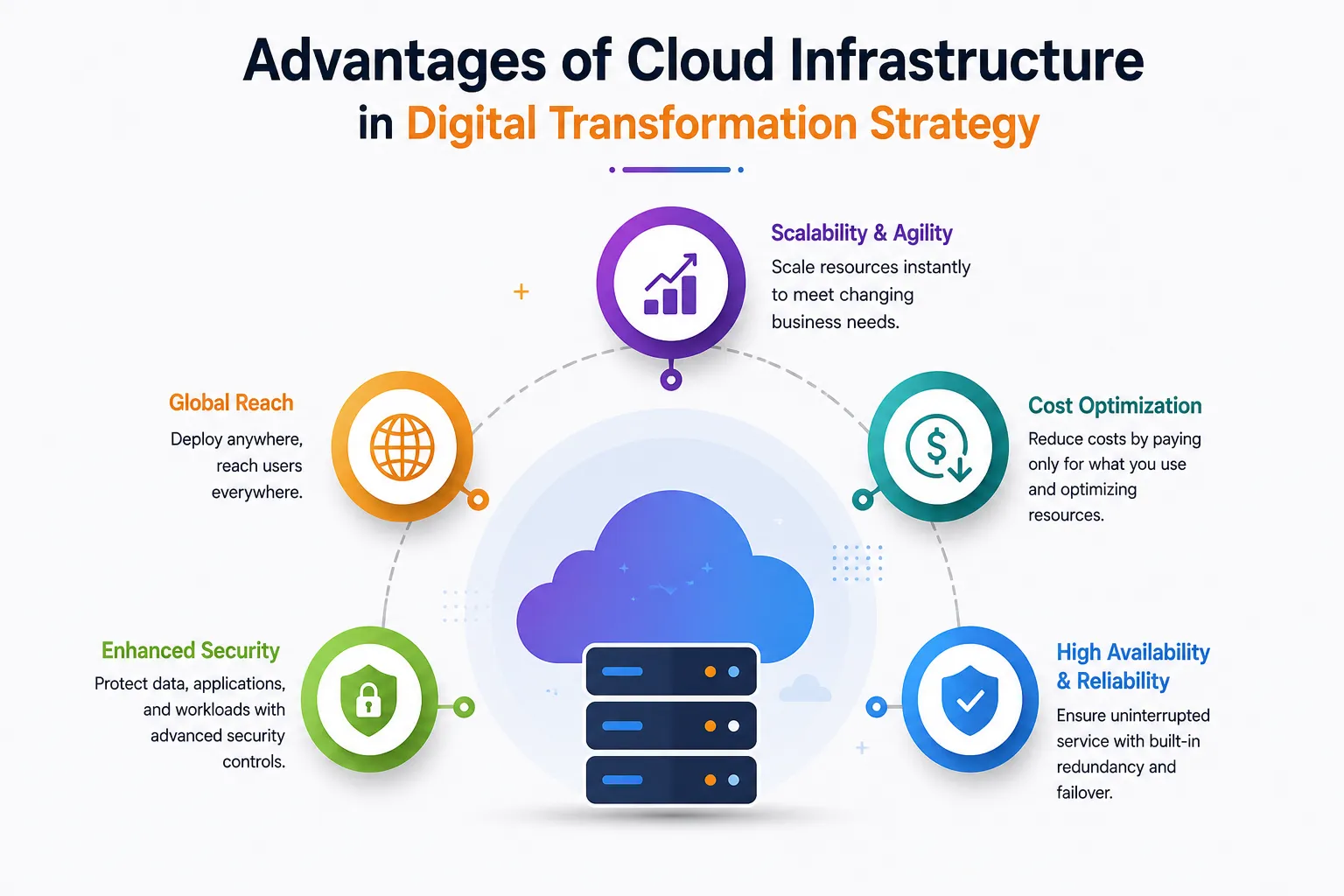
Cloud infrastructure determines what your Artificial Intelligence products can do, what they cost to run, and how fast they reach customers. McKinsey research estimates that a strategic cloud foundation can unlock over $3 trillion in global EBITDA value by 2030, with the biggest gains coming from innovation and speed to market, not infrastructure cost cuts. Three decisions define an AI-ready cloud foundation for digital transformation in cloud computing:
- Hybrid cloud computing or multi-cloud placement: Where data and applications live across public cloud, private cloud, or a combination of cloud platforms. The choice affects how fast AI applications respond, where data is legally allowed to sit, and how exposed you are if a provider changes its pricing.
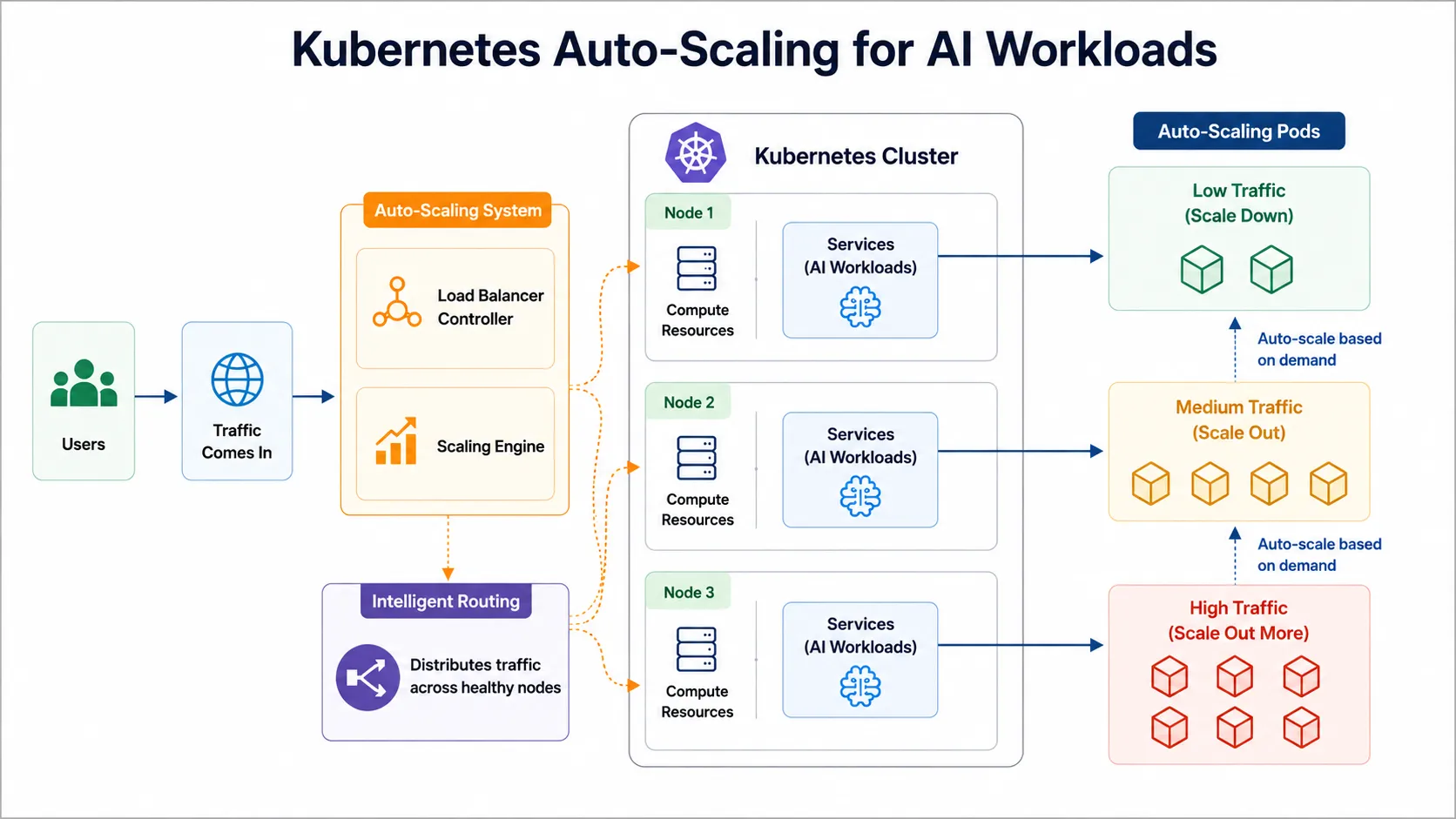
- Kubernetes-based container orchestration: The traffic controller for your AI applications. It manages computing resources and scales automatically when demand spikes.
- AI-native data pipeline design: Machine learning needs vector databases for smart search, feature stores for real-time inputs, and streaming layers that process big data as it arrives rather than overnight.
Hybrid Cloud and Multi-Cloud Architecture Decisions
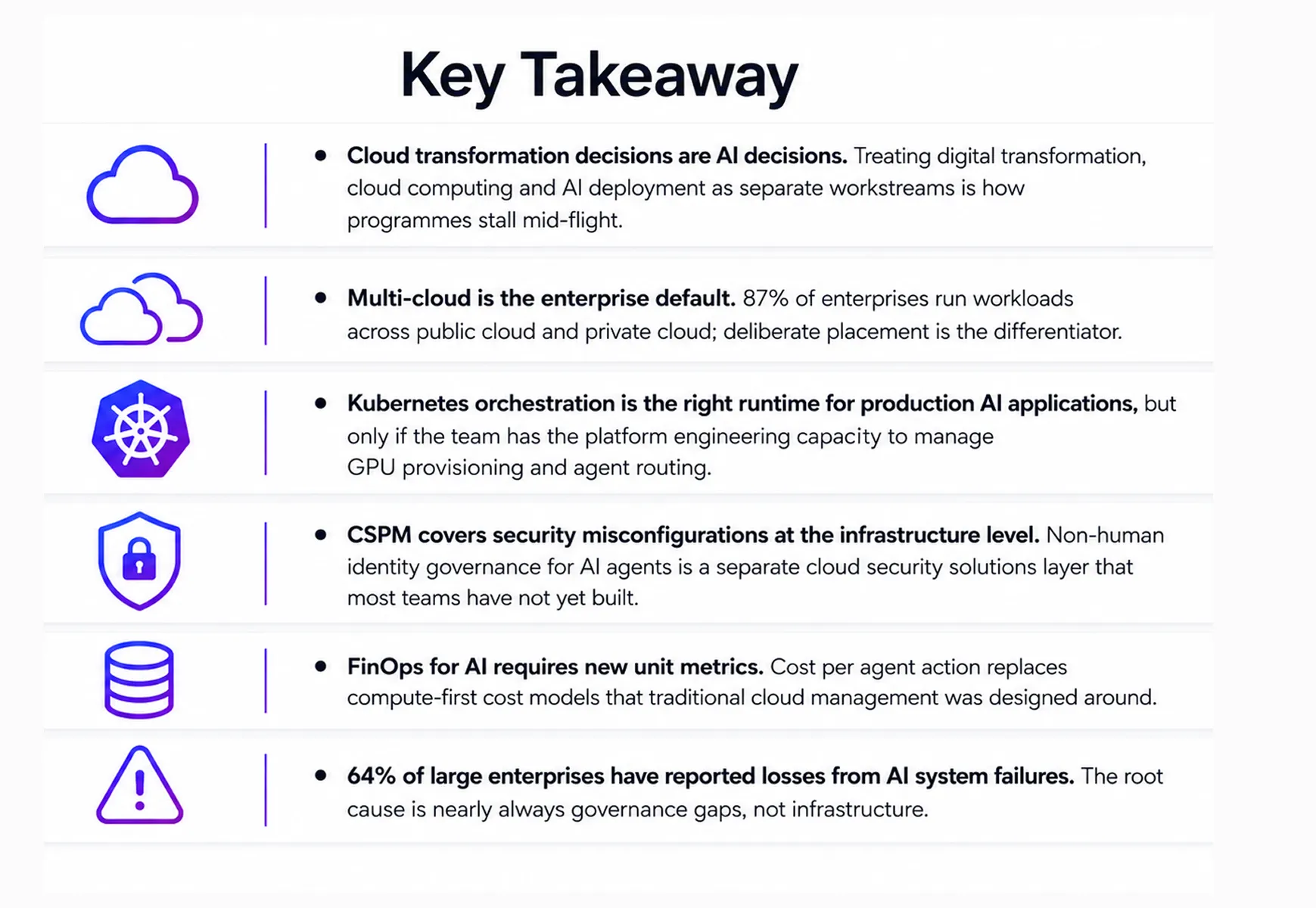
A multi-cloud strategy becomes non-negotiable when regulations require data in specific countries, when AI inference latency demands exceed one provider's network, or when vendor pricing concentration becomes a risk. Hybrid cloud computing gives that flexibility at the cost of greater complexity.
Cloud Migration in 2026: What Has Changed and What Still Breaks
Cloud migration used to mean copying your servers into someone else's data centre. That era is over. Today, cloud migration services involve a harder question: should each workload run on managed cloud services, on self-managed Infrastructure as Code, or not move at all? It is no longer about technical feasibility. It is about operational fit.
The most common failure is finishing the migration and discovering that no one built a recovery plan. A single outage in one cloud region brings down the whole business because no failover path exists.
Choosing Between Managed Cloud Services and Self-Managed Infrastructure
Not sure which model fits your team? Here is a straightforward comparison:
Kubernetes Orchestration and Cloud-Native Architecture for AI Workloads
Kubernetes is the engine room of modern AI deployment. Every major cloud provider runs on it because nothing else manages computing resources behind production AI applications at scale as well. Cloud-native applications expand and contract automatically as demand changes; a containerised legacy application on a Kubernetes cluster carries all the weight of its old architecture.
Kubernetes architecture also extends to edge computing vs cloud computing scenarios, where factories, retail stores, and IoT ecosystems need AI processing to happen locally. Serverless computing and serverless architectures layer on top of AI models that only run occasionally, eliminating the cost of always-on virtual machines.
Data Pipelines and Business Intelligence on Cloud-Native Infrastructure
A data pipeline is the route data travels from source to where it is used. Traditional pipelines run overnight; AI needs data moving constantly. Modern AI-ready data pipelines include:
- Vector databases for fast AI search across large datasets.
- Feature stores that serve real-time inputs to machine learning models.
- Streaming layers that process big data analytics workloads the moment they arrive, not hours later.
- Low-code/no-code tools that let business intelligence and data teams build pipelines without writing complex code.
A logistics firm we worked with cut reporting lag from 4.6 days to 6 hours after moving to a cloud-native pipeline.
Cloud Security in 2026: Zero-Trust, CSPM, and the Agentic Attack Surface
Most cloud security guides focus on infrastructure. The real threat in 2026 is different: an AI agent with too much access and no one watching what it does. 56% of cybersecurity executives say AI agents are creating attack surfaces that are faster and harder to detect than anything before.
Cloud security posture management (CSPM) is the baseline for cloud security services: it watches for security misconfigurations and exposed data, but does not cover what your AI agents are accessing or whether their behaviour has changed. Cloud security protocols such as NIST AI RMF, SOC 2, HIPAA, and FedRAMP address cloud security solutions across AI risk management, SaaS platforms, healthcare data in your cloud deployment models, and government clients. Zero-trust cloud computing security is the answer: every request is verified, every time.
The Cloud Governance Problem Most Transformation Programmes Do Not Solve
Most cloud digital transformation guides cover what to migrate and how to secure it. Rarely do they cover what happens after: who controls AI spending, who watches the agents, and who gets paged at 3 am. According to EY and AIUC-1 Consortium data from March 2026, 64% of companies with revenue above $1 billion reported losses exceeding $1 million from AI system failures. Most were governance problems: no clear ownership, no cost controls, no oversight model built before the AI went live.
FinOps for AI: Governing Token Costs and Inference Spend Across Cloud
Traditional cloud management tracks compute and storage costs. It cannot handle AI as a Service workloads, where costs come from entirely different sources: tokens consumed per AI request, spend per agent action, a charge for every user conversation. None of these appear in standard cloud reports.
The FinOps discipline for AI introduces new metrics: cost per GPU-hour for training AI models, cost per agent action, and cost per session. The FinOps Foundation's State of FinOps 2026 report confirms 98% of practitioners now actively manage AI spend, with governance overtaking optimisation as the primary concern.

How BuildNexTech Deploys Cloud-Ready AI
BuildNexTech works at the intersection of cloud-native applications and AI deployment. Our AI automation services give teams the orchestration layer, observability tools, and cost controls to run production AI on existing infrastructure without rebuilding from scratch.
A US hospital system cut administrative burden by 40% after deploying AI virtual assistants on cloud-based platforms. A UK financial services firm gave back 1.2 million hours through digital workers on a managed cloud. Teams choose BuildNexTech over AWS, Microsoft Azure, or Google Cloud Platform because the architecture handles routing, scaling, and multi-cloud workload placement without provider lock-in.
What a BuildNexTech Implementation Looks Like
Four stages from assessment to production:
- Days 1 to 3: Cloud environment assessment and AI workload classification.
- Days 4 to 7: Agent orchestration layer integration with existing Kubernetes clusters.
- Week 2: Data pipeline and RAG layer configuration; observability dashboards live.
- Week 3+: Production deployment with FinOps cost tracking per agent action.
At the end, your team owns a cost-governed AI deployment on your existing cloud infrastructure. No rearchitecting required.
Who This Is For
Engineering and leadership teams at Series B through enterprise scale, with AI and automation moving from demos into production on AWS, Azure, or Google Cloud Platform. If your team cannot answer what each agent action costs or who owns the governance model, that is where we start.
The Governance Layer Is the Transformation
You can move everything to the cloud. You can run it on Kubernetes. You can use cloud migration services to shift every workload off legacy infrastructure. None of it, on its own, gives you a competitive advantage.
The advantage is what sits above the infrastructure: FinOps discipline for inference costs, identity controls for AI agents, and cloud computing security that treats non-human actors with the same scrutiny as human ones.
The organisations with the most effective digital transformation strategies in 2026 treat cloud as a governed, cost-accountable operating platform for AI applications and customer experience delivery. The teams building that governance model now will have the cost clarity and deployment velocity to compete when the next wave of Artificial Intelligence capability arrives. That gap does not close itself.
People Also Ask

What is the difference between cloud migration and cloud-native transformation?
Cloud migration moves your existing systems to cloud infrastructure services. Cloud-native transformation redesigns those systems for the cloud from the ground up, with AI integration and flexible cloud deployment models built in.
How does Kubernetes orchestration support AI workloads?
Kubernetes acts as a traffic controller for your AI applications. It manages computing resources, handles GPU provisioning, and routes tasks across a Kubernetes cluster based on cost and latency signals.
What is FinOps for AI and why does it differ from traditional cloud management?
Traditional cloud management tracks server and storage costs. FinOps for AI tracks token volume, cost per agent action, and inference spend: the costs AI models generate that standard cloud tools cannot measure.
How do organisations secure AI agents running on cloud-based platforms?
Start with non-human identity governance: limit each AI agent's access, require explicit authentication, and log every action. Cloud security posture management covers infrastructure; zero-trust controls handle the agentic attack surface.
When does a multi-cloud strategy make more sense than a single cloud?
Multi-cloud makes sense when regulations require data in specific regions, when AI inference latency needs exceed one provider's network, or when public cloud vendor concentration risk becomes a real business concern.


.webp)
.webp)
.webp)

.webp)
.webp)