

Businesses are using Gemini to automate document creation, customer support, software development, workflow orchestration, and AI agent-driven business processes across departments.
Artificial intelligence has moved well past the proof-of-concept phase in enterprise settings. Today, organizations deploy AI not just to answer questions but to run entire business processes autonomously. At the center of this shift is Google Gemini - a platform that goes far beyond a standard virtual assistant or personal assistant to become a full enterprise automation engine.
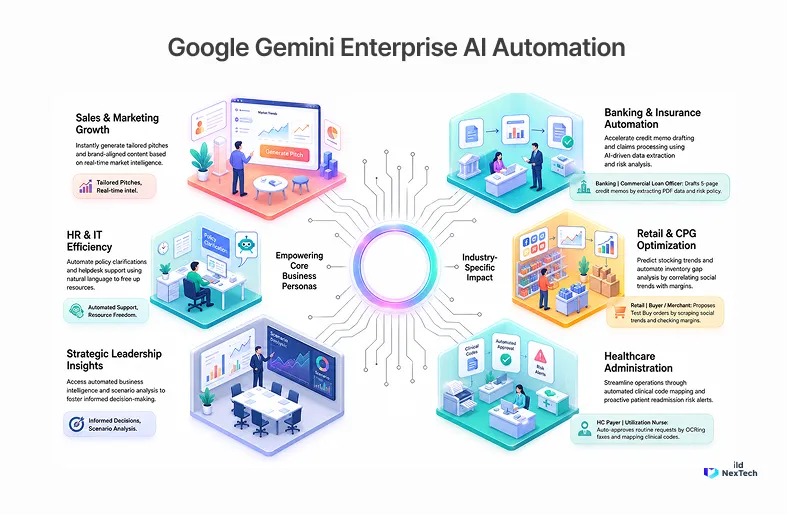
For CTOs evaluating enterprise AI strategy, QA engineers cutting test cycle times, and DevOps leads managing automation pipelines, this blog breaks down what Gemini brings to the enterprise, how businesses use it today, and where it is heading next.
What Is Google Gemini for Enterprises?
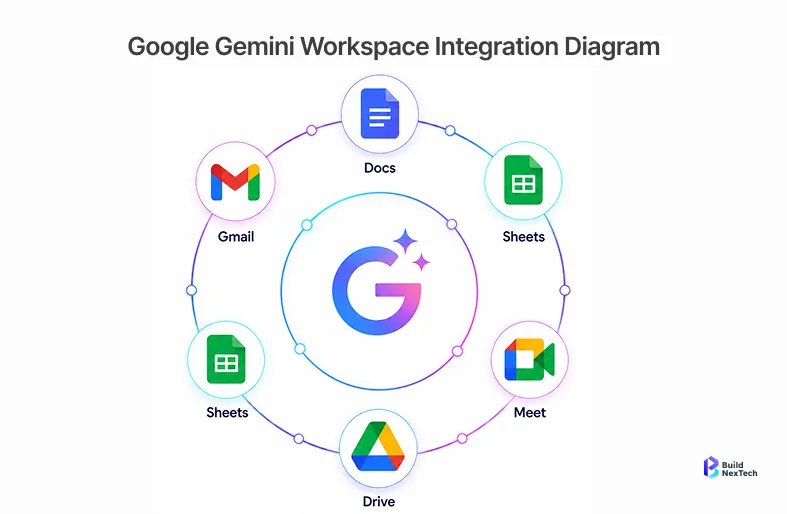
Google Gemini is a multimodal enterprise AI platform built natively across Google Workspace, Google Cloud, and Vertex AI. It is not a chatbot layered over your existing tools. It operates inside Gmail, Google Docs, Sheets, Google Drive, and Meet - reading organizational context and acting on it through AI agents, natural-language prompts, and automated workflows. Gemini functions as an intelligence layer across Google Workspace and Google Cloud, helping teams automate tasks, access information, and execute workflows from within their existing applications.
How Gemini Differs from Traditional Automation Tools and Why It Matters Now
Traditional automation tools follow predefined rules, while Gemini can interpret context, adapt to changing inputs, and generate actions based on user intent. For example, a DevOps lead can describe a deployment pipeline in plain English and Gemini can generate the workflow.
The shift matters because enterprises are no longer experimenting. They are running AI automation in production across finance, operations, software development, and customer service simultaneously - all powered by a single Google Cloud environment.
Core Capabilities and Features Driving Enterprise Adoption
Gemini's enterprise capabilities span several layers:
- Multimodal AI reasoning: Processes text, code, images, audio, and documents simultaneously - practical across QA, content creation, customer data analysis, and finance in one deployment.
- Native Google Workspace integration: Works inside Gmail, Docs, Sheets, Slides, and Google Drive without middleware. Teams access AI tools and workflow automation directly inside their daily applications.
- Gemini CLI and Code Assist: DevOps and QA engineers use Gemini from the terminal for code generation, automated testing, and IT operations.
- Google Workspace Studio: Enables teams to build AI-first apps, automate multi-step workflows, and create custom chat-based Q&A assistants without leaving the Workspace environment.
- Workspace Marketplace integrations: Teams extend Gemini's capabilities with third-party AI tools through the Workspace Marketplace, turning Google Workspace into a unified enterprise productivity ecosystem.
- 2 million token context window: Gemini's context window allows analysis of up to 1,500 pages or more than 30,000 lines of code at once, giving enterprises a concrete edge when processing large codebases, contracts, or enterprise data sources.
How Businesses Are Using Gemini to Automate Workflows
Automating Document Creation, Knowledge Search, and Content Management
One of the highest-impact use cases for Gemini Enterprise is content creation and document automation. Teams use Gemini inside Google Docs to:
- Draft proposals, SOWs, and client-facing reports.
- Generate training modules and product updates from raw source material.
- Run content synthesis across large document libraries using natural-language prompts.
In Google Drive, Gemini powers semantic search across enterprise data sources - eliminating data silos and surfacing the right file instantly from thousands stored across Google systems. For QA teams, test documentation, bug reports, and release notes generate automatically from sprint inputs, freeing engineers for higher-value work. Knowledge sharing across distributed teams improves dramatically when Gemini replaces keyword search with contextual, AI-driven retrieval.
AI-Powered Customer Support, HR, and Finance Automation
Gemini-powered voice agents and virtual assistants handle customer inquiries end-to-end - routing tickets, generating customer responses, managing customer conversations, and escalating edge cases while maintaining response quality. These capabilities extend into interactive voice response systems, giving contact center teams an intelligent alternative to rigid IVR menus.
In HR, Gemini automates onboarding, generates job descriptions, and powers employee-facing chat-based Q&A assistants for internal policy questions. In finance, KPMG used Gemini Enterprise to build an AI-native finance function for a major healthcare company - transforming the manual process of pricing disputes into an automated workflow that unlocked significant working capital.
Access control and audit logs ensure sensitive data and customer data stay protected across every automated interaction.
Streamlining Cross-Departmental Workflows with Gemini AI
Gemini's real leverage comes when it connects workflows across departments rather than automating them in isolation. Using multi-agent orchestration through Google Flow and the Gemini Agent Platform, enterprises build end-to-end pipelines where:
- An AI agent qualifies a lead and triggers CRM updates.
- A second agent drafts a contract in legal.
- A third notifies finance - all without a human managing the handoff.
In enterprise automation projects, the highest adoption typically occurs when organizations connect multiple workflows across departments rather than automating a single task in isolation. Multi-agent workflows often deliver broader operational impact because they eliminate manual handoffs between teams.
Real-World Enterprise AI Automation Use Cases
Boosting Productivity, Collaboration, and Data-Driven Decision-Making
Beyond individual productivity, Gemini reshapes how leadership teams make decisions:
- Executives use NotebookLM Enterprise to synthesize competitive intelligence into structured Mind Maps and Video Overviews.
- Operations leads run natural-language queries directly in Sheets instead of waiting on analyst support.
- Content teams use multi-modal content generation to produce product updates, marketing plans, and training material at scale.
Valeo, the global automotive technology company, deployed Gemini for Workspace across its 100,000-person global workforce. Following integration of Gemini Code Assist, over 35% of Valeo's code is now AI-generated - accelerating software development cycles across its engineering teams.
Accelerating Software Development and IT Operations with Gemini CLI
For DevOps leads and QA engineers, Gemini CLI is where automation becomes tangible. Teams use it to:
- Generate boilerplate code and write unit tests from natural-language descriptions.
- Perform automated code reviews and debug production issues directly from the terminal.
- Build self-healing test pipelines that adapt when UI changes break existing scripts.
Gemini CLI helps QA and DevOps teams accelerate test creation, automate code reviews, and streamline CI/CD workflows. In BuildNexTech's QA automation engagements with mid-size software teams, integrating Gemini CLI into test generation and release validation workflows - rather than using it as a standalone coding assistant - has reduced manual test authoring effort by approximately 40% across multi-sprint CI/CD pipelines. The machine learning layer behind Code Assist learns from a project's existing codebase, making recommendations increasingly relevant over time.
Automating Sales Prospecting, CRM Workflows, and Financial Operations
Sales teams use Gemini agents for lead qualification, automated CRM updates, meeting action items extraction, and sales cycle acceleration. Rather than manually logging every touchpoint, Gemini agents analyze customer conversations and extract structured data. The information is then pushed automatically into CRM platforms such as Salesforce and HubSpot.
AutoZone is transforming its customer service experience with Gemini Enterprise - automating complex merchandising data enrichment and accelerating software development through AI-driven coding and testing. For financial operations, AI process automation through Gemini reduces manual reconciliation, accelerates reporting cycles, and frees finance teams for strategic analysis.
Gemini, AI Agents, and the Rise of Agentic AI
What Is Agentic AI and How Gemini Powers Autonomous Workflows
Agentic AI describes systems that plan, reason, and take multi-step actions autonomously rather than responding to isolated prompts. Where traditional AI answers a question, an agentic AI completes a task end-to-end. Gemini Enterprise's Agent Platform enables organizations to build and deploy autonomous AI agents connected to enterprise data, internal tools, and third-party SaaS applications.
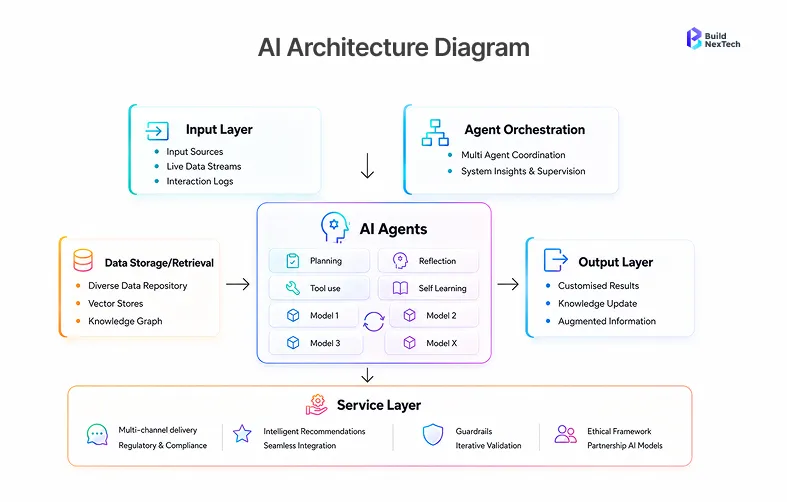
According to the 2025 KPMG AI Pulse Survey, 63% of business leaders plan to deploy AI agents from trusted technology providers within the next year. The transition from single-turn AI to multi-agent orchestration is the defining enterprise AI trend of 2026, and Gemini's Agent Platform is built specifically for this model.
Real Enterprise AI Agent Examples and Business Impact
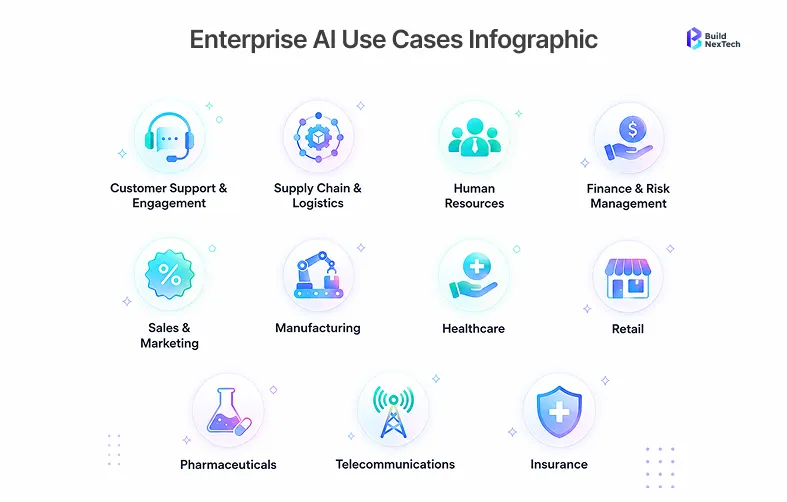
According to the 2025 KPMG AI Pulse Survey, 63% of business leaders plan to deploy AI agents developed by trusted technology providers within the next year, and organizations already in production are building agents across knowledge discovery, compliance automation, client reporting, and operational workflows. These deployments show how the same agent architecture scales across industries without rebuilding from scratch. These agentic AI examples range from:
- Internal knowledge search and chat-based Q&A agents.
- Compliance checklist automation for regulated finance workflows.
- Client report drafting agents using content synthesis across multiple data sources.
- Customer conversations analysis agents that surface insights from support interactions.
Building and Deploying Enterprise-Ready AI Agents with Gemini
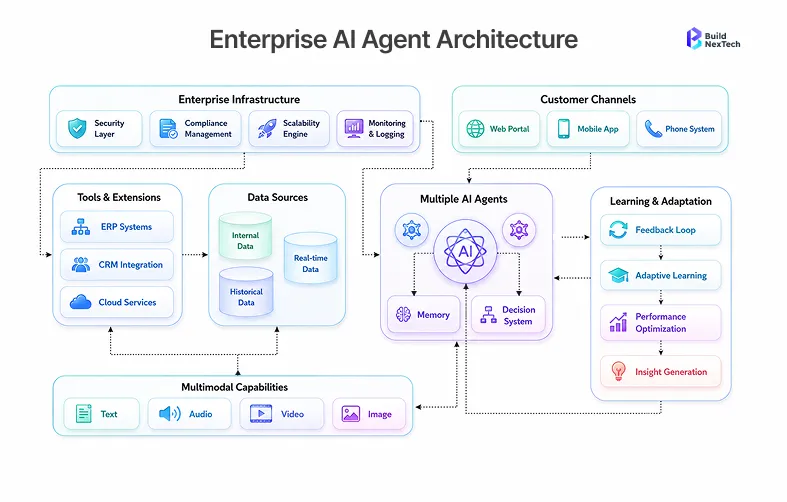
Building a production-grade AI agent with Gemini involves three layers:
- Connect the agent to verified enterprise data sources - BigQuery, Google Drive, or third-party platforms - through secure API integrations.
- Define the agent's reasoning scope, escalation rules, and output format.
- Govern it with DLP controls, access control policies, GDPR compliance settings, and audit logs.
Gemini's no-code Agent Builder in Google AI Studio lets operations managers build workflow agents using natural-language instructions without writing a single line of code. At BuildNexTech, every agent deployment begins with mapping current workflows before a single integration goes live - ensuring data leaks and data exposure risks are addressed from day one.
Gemini vs Other Enterprise AI Platforms
Gemini Enterprise vs Microsoft Copilot: Features, Pricing, and Fit
Gemini Enterprise and Microsoft Copilot are designed for different ecosystems. Gemini Enterprise integrates natively with Google Workspace and provides developer-focused capabilities such as Gemini CLI and Code Assist, while Microsoft Copilot is tightly integrated with Microsoft 365 applications.
For Google Workspace teams, Gemini Enterprise delivers a 15x larger context window than Microsoft Copilot and native Workspace integration that Copilot does not replicate inside Microsoft 365 - a decisive advantage for DevOps and QA teams running automation-heavy workflows.
For organizations prioritizing software development, testing, and automation workflows, Gemini CLI and its large context window provide capabilities that align well with engineering-focused use cases.
Gemini Enterprise vs AWS AI Services: Deployment and Scalability
AWS offers AI services through SageMaker, Bedrock, and Q Business - but these require significantly more infrastructure configuration to reach workflow-level deployment. Gemini Enterprise, delivered through Google Cloud and Vertex AI, deploys faster for teams already in the Google ecosystem because the Workspace integration is native rather than bolted on.
For enterprises running AWS infrastructure alongside Google Workspace, a hybrid architecture using Gemini for productivity and workflow automation paired with AWS for data pipeline infrastructure is a practical and increasingly common approach. The key is ensuring the secure connection layer between both environments meets the organization's data sovereignty and compliance requirements.
How to Choose the Right Enterprise AI Platform for Your Business
The right enterprise AI platform fits where your data already lives. A few practical decision signals:
- Google Workspace users: Gemini Enterprise is the natural choice - AI tools are already bundled.
- Microsoft 365 users: Copilot integrates natively within the Microsoft ecosystem.
- DevOps-heavy teams: Gemini CLI, Code Assist, and the machine learning layer behind them give Gemini a clear technical edge.
- Regulated industries: KPMG's deployment of Gemini Enterprise across 55,000 professionals globally proves AI Enablement and governance can scale together.
Implementing Gemini and Measuring ROI
A Practical Framework for Planning and Rolling Out Enterprise AI
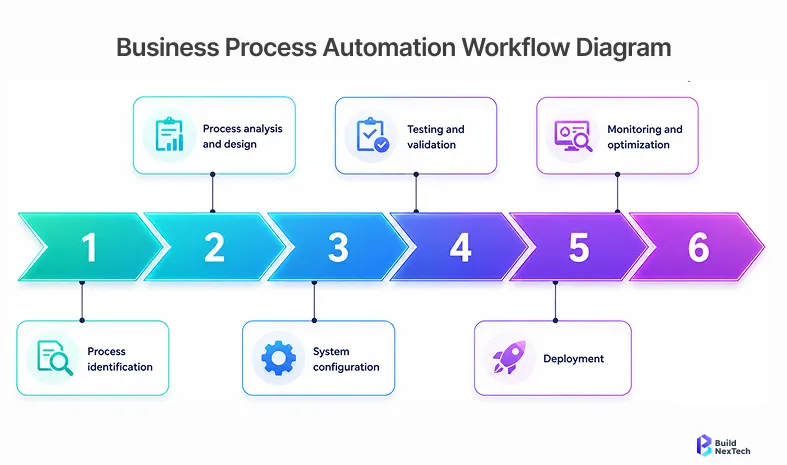
Successful Gemini deployments follow a phased approach:
- Identify three to five high-volume processes where AI grounding on internal data reduces manual effort immediately - document drafting, ticket triage, or QA test case generation.
- Build and validate agents in Google AI Studio before connecting to live enterprise data sources.
- Expand based on adoption metrics and measured output quality.
Teams at BuildNexTech begin every engagement with an AI readiness assessment that maps existing workflows to Gemini capabilities. This prevents the most common implementation failure - deploying AI broadly before the governance and integration layers are stable. Business process automation tools are only as effective as the processes they automate.
Security, Governance, Compliance, and Integration Considerations
Enterprise AI fails when data security is treated as a post-launch concern. Gemini Enterprise includes:
- GDPR compliance settings and data sovereignty controls.
- DLP controls that prevent sensitive data from leaving the Google Cloud environment.
- Audit logs for every AI interaction across the organization.
- ISO 42001, SOC 2, FedRAMP High, and HIPAA compliance - data is never used outside your domain without explicit permission.
For teams integrating Gemini with third-party SaaS applications, every connection needs validation against data security policies before going live. Customer data, financial records, and other sensitive data require explicit access control configurations. Default settings are not sufficient protection against data leaks or unintended data exposure.
Measuring ROI: Key Metrics, Cost Savings, and Productivity Gains
ROI from Gemini automation is measurable across three dimensions:
- Time saved: Reduced manual effort across repetitive business processes and administrative tasks.
- Cost reduction: Fewer human touchpoints per workflow and lower contractor spend on repetitive tasks.
- Quality improvement: Tracked through defect rates in QA, response quality scores in support, and accuracy rates in financial operations.
Set baseline measurements before deployment. Review quarterly. The enterprises showing the strongest ROI are those tracking metrics at the team level first before rolling up to organizational reporting. Workflow automation software delivers compounding value - but only when adoption and output quality are monitored consistently from launch.
The Future of Enterprise AI Automation with Gemini
Emerging Trends in Agentic AI, Automation, and Enterprise Platforms
The next phase of enterprise AI moves from single-agent automation to interconnected multi-agent orchestration, where networks of autonomous AI agents collaborate on complex, multi-step tasks. Several trends are reshaping how enterprises will use Gemini in the next 12 to 24 months:
- Voice AI expansion: Gemini is extending into voice agent workflows - AI voice generation for audio content, voice data processing, interactive audio experiences, and adaptive interactive voice response systems that replace rigid IVR menus with genuinely conversational AI.
- Multi-modal content generation: Enterprises are increasingly using AI to create training materials, documentation, presentations, and other business content at scale.
- Google Workspace Studio evolution: Studio is expanding to support more complex AI-first apps and connected workflows without requiring deep engineering involvement from every team.
- Unified workflow environments: Google Flow and the Agent Platform are evolving toward a single environment for managing AI agents, workflows, and business processes.
Preparing Your Business for the Next Generation of AI-Driven Operations
Organizations evaluating Gemini today should begin with a small set of high-volume workflows, establish governance controls early, and expand adoption based on measurable business outcomes. That means treating agent governance, data sovereignty, and workflow automation platform infrastructure as core strategic priorities. It also means investing in team capability - training QA engineers to work alongside AI-generated test suites and upskilling DevOps leads to manage multi-agent deployment pipelines as a standard part of the role.
Expected Gemini innovations include context windows beyond 2 million tokens, deeper multimodality, and one-click integration across all business tools - signaling that current capabilities are a foundation, not a ceiling. Organizations building on Gemini today are building on a platform that is actively accelerating.
How BuildNexTech Helps Businesses Design and Scale AI Automation
At BuildNexTech, we help organizations design Gemini-powered automation solutions, integrate AI agents into existing workflows, and deploy enterprise AI systems with security and governance controls built in. A common pattern across enterprise automation initiatives is that organizations achieve greater adoption when AI agents are connected across multiple workflows rather than deployed as isolated tools.
If your team is evaluating Gemini for enterprise AI automation and wants a clear, practical path to deployment, BuildNexTech brings both the technical depth and the enterprise AI implementation experience to get there right.
People Also Ask

Q1. Does Gemini Enterprise support multiple languages for global business operations?
Yes. Gemini Enterprise supports over 40 languages, making it a practical enterprise AI platform for multinational deployments. Teams run localized AI agents, automate customer support workflows, and generate multi-modal content across regional offices - all within a single Google Cloud environment without needing separate AI tools for each language.
Q2. Can small and mid-sized businesses use Gemini for AI automation, or is it only built for large enterprises?
Yes. Gemini AI is accessible to businesses of all sizes through Google Workspace plans that include Gemini capabilities. Small and mid-sized businesses can use Gemini for document creation, customer support automation, workflow management, content generation, and other AI-driven tasks without requiring large-scale enterprise deployments. Many organizations start with a few targeted use cases and expand adoption as business needs evolve.
Q3. How does Gemini handle hallucinations and factual accuracy in enterprise-critical workflows?
Gemini Enterprise reduces hallucination risk by grounding responses against verified enterprise data sources such as Google Drive, BigQuery, and connected business systems. This grounding mechanism anchors AI-generated outputs in finance, compliance, and operations workflows to accurate, company-specific data.
Q4. What happens to company data when employees use Gemini Enterprise - does Google use it to train its models?
No. Under Google's enterprise terms, data processed through Gemini Enterprise is never used to train Google's AI models. All customer data, sensitive data, and enterprise data remain within your organization's Google Cloud environment, protected by DLP controls, access control policies, data sovereignty settings, and audit logs - fully aligned with GDPR compliance and enterprise data security standards.
Q5. Is it possible to build custom AI agents on top of Gemini without a dedicated development team?
Yes. Gemini Enterprise's no-code Agent Builder in Google AI Studio allows operations managers and non-technical teams to build and deploy custom autonomous AI agents using natural-language prompts and pre-built templates - no coding required. For more complex workflows requiring third-party SaaS application connections, engineering support from a partner like BuildNexTech ensures secure, scalable deployment.


.webp)
.webp)
.webp)

.webp)
.webp)