
Our enterprise AI helps P&C carriers, life insurers, and digital platforms scale policy management and meet regulatory compliance without raising operational headcount.
48h to 6h
Reduction in claims processing times.
72%
Decrease in manual validation errors.
$1M+
Prevention in annual fraud losses.
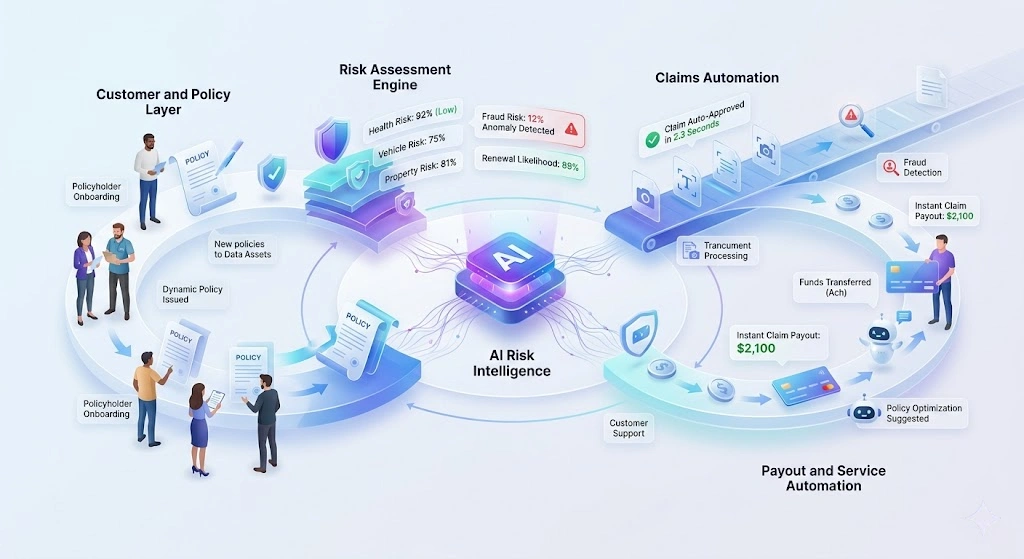
Our enterprise AI helps P&C carriers, life insurers, and digital platforms scale policy management and meet regulatory compliance without raising operational headcount.
48h to 6h
Reduction in claims processing times.
72%
Decrease in manual validation errors.
$1M+
Prevention in annual fraud losses.
AI delivers the highest ROI in data-heavy, regulated underwriting and claims processes. Here is how we apply it

Secure APIs handle FNOL intake and document extraction, dropping processing time from 48 to 6 hours.

Real-time anomaly analytics identify threats, decrease false positives by 45%, and flag suspicious claims.

Automate data extraction from loss runs and medical records into your PAS, accelerating risk assessment.

Intelligent workflows validate customer info, process renewals, and eliminate manual data entry bottlenecks.

Deploy Agentic AI for 24/7 policy inquiries, premium billing questions, and automated triage.
We build and deploy AI systems inside regulated insurance environments where data privacy, explainability, and compliance are non-negotiable.
Where AI Fits in the Insurance Stack
AI enhances core Policy Administration Systems (PAS) through a structured architecture
%201.webp)
Ingestion
Pull structured and unstructured data from legacy databases, FNOL documents, and adjuster reports.

Secure APIs
The secure bridge connecting infrastructure (like Guidewire or Duck Creek) to our AI engines.

Model Layer
Localized LLMs or Agentic AI for secure analysis, ensuring PII and PHI stay protected.

Human-in-the-Loop
AI handles tier-1 triage; complex claims and final underwriting decisions route to human adjusters.
Common Insurance Automation Challenges
.webp)
Connecting modern AI to monolithic core systems requires custom API middleware.

Regulators demand highly auditable logs detailing exactly why a claim was denied or a premium was priced.

Customer PII (and PHI for health/life) must stay in isolated cloud environments to ensure compliance.

Best Fit: Regulated carriers or MGAs processing high volumes with existing PAS/claims systems needing an AI layer.
Not a Fit: Off-the-shelf fraud tools, generic chatbots, or non-production POCs.
Best Fit: Regulated carriers or MGAs processing high volumes with existing PAS/claims systems needing an AI layer.
Not a Fit: Off-the-shelf fraud tools, generic chatbots, or non-production POCs.

Claims triage, FNOL document extraction, tier-1 customer support, and fraud anomaly detection.
Yes. Secure implementation utilizes isolated LLMs, custom APIs, and strict access controls to maintain data privacy.
Through a Human-in-the-Loop (HITL) architecture. AI recommends and organizes, but high-risk approvals route to humans.
Initial implementations like document extraction take 8 to 12 weeks, while core PAS integrations require longer rollouts.
Yes. Custom API middleware acts as a secure bridge, allowing predictive AI to analyze data without disrupting core administration software.
.webp)
.webp)
.webp)

BuildNexTech empowers businesses with expert web development, app development, and cloud migration services.


.webp)
.webp)
