

A logistics company came to us convinced their cloud migration was the finish line. Eight months of hardening had gone into their AWS environment: Encrypted buckets, tight IAM roles, a security team that could recite the shared responsibility model in their sleep. Then an auditor asked about the SFTP server still running in their on-prem data centre, untouched since the migration kicked off. Nobody had an answer.
Working across 150+ client engagements in 30+ industries, we see this pattern again and again: Security built for the data centre doesn't map cleanly to the cloud, disrupting the business processes that customer service and information technology teams depend on. This is why hybrid cloud security concerns keep landing on the CISO's desk after a "successful" migration. This guide covers hybrid cloud security architecture, hybrid cloud security risks, hybrid cloud challenges, and hybrid cloud security best practices.
Hybrid Cloud Security Architecture: The Core Building Blocks
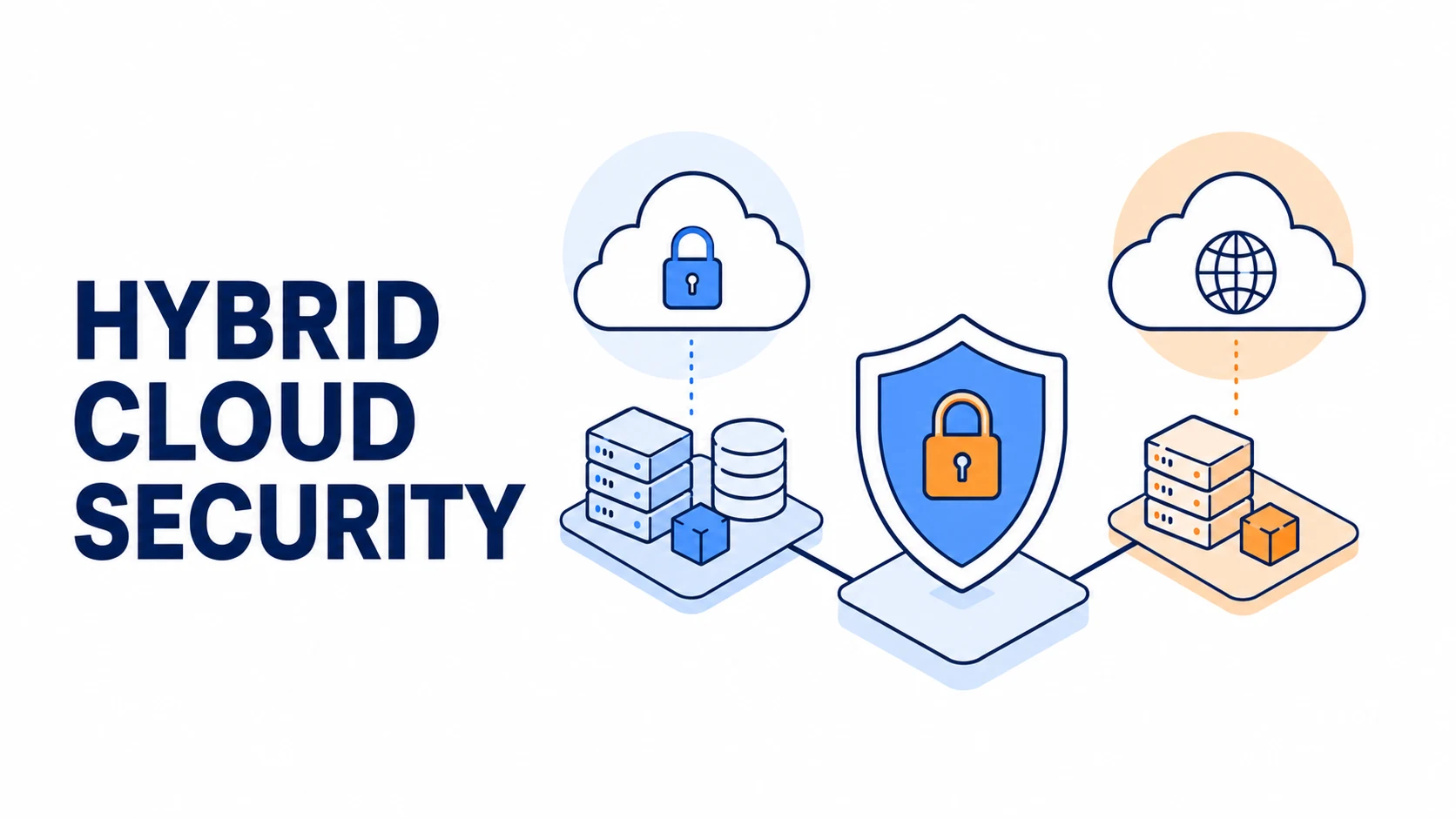
Hybrid cloud security means treating on-prem infrastructure, private cloud, and public cloud as one system with one set of rules, not three separate programmes that barely talk to each other. Get the architecture design right early, and everything else gets easier.
The Three Layers That Make Up the Architecture
Think of hybrid cloud security architecture as three layers stacked on top of each other:
- Edge: Next-generation firewalls anchor network security for hybrid cloud, handling perimeter defence, though the perimeter has mostly dissolved.
- Identity: Federation decides who touches what, whether the workload sits in Ohio or a container in eu-west-1.
- Workload: CNAPP and CSPM (cloud security posture management) controls extend into hybrid cloud application security, catching misconfigured buckets and over-permissioned accounts, from content authoring platforms to core banking systems.
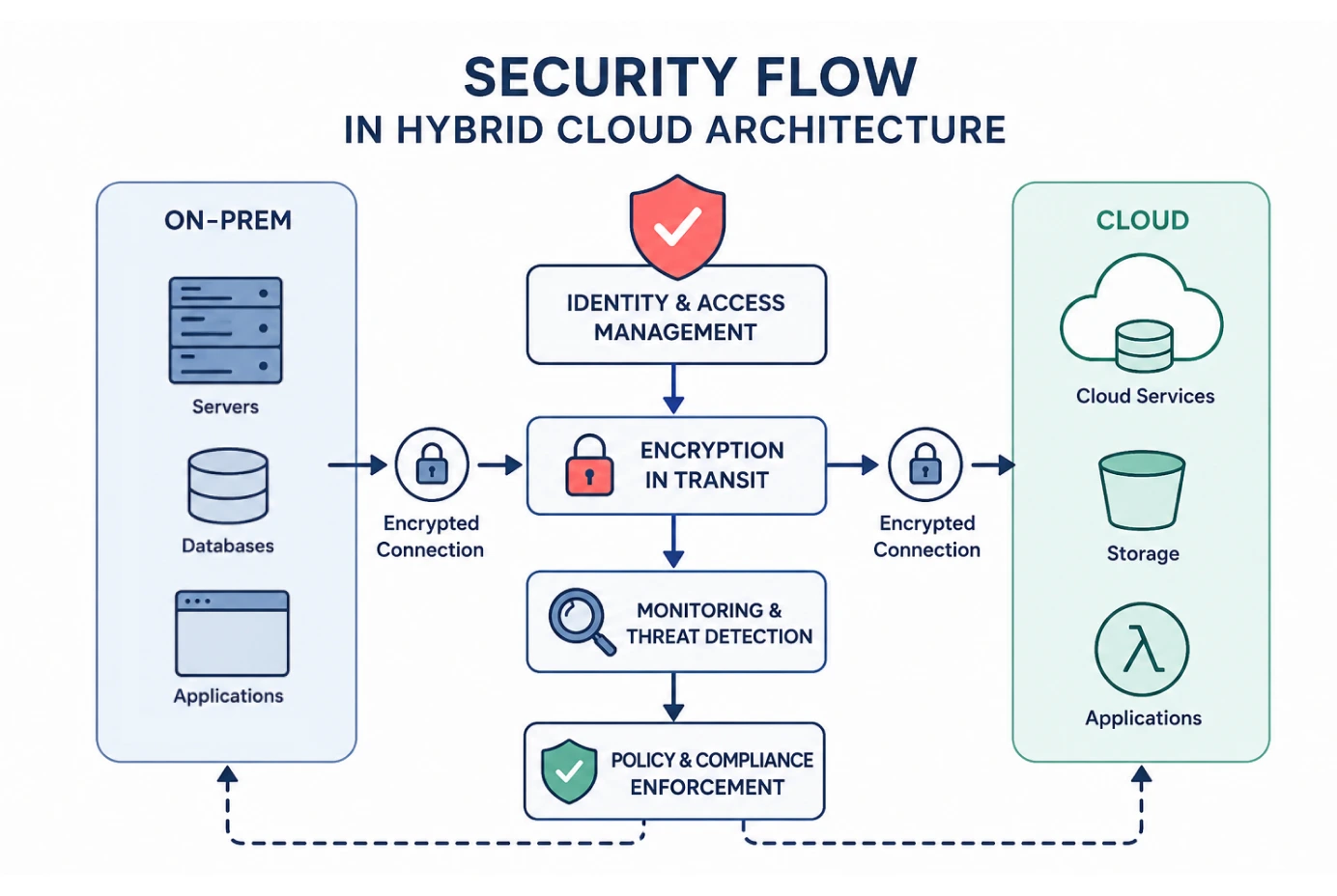
Tools like Azure Arc and AWS Systems Manager exist because someone needs one control plane tying these layers together, applying consistent management practices instead of five separate consoles. Architecture is not a diagram filed away; it determines whether your team finds a misconfiguration in minutes or an auditor finds it in months.
Shared Responsibility: Who Owns What
The shared responsibility model draws a line between what your cloud provider secures and what you do. Most programmes fail not from misunderstanding the model, but because that line shifts at every layer, and most "misconfiguration" breaches trace back to exactly this kind of hotspot:
- Public cloud: Provider secures infrastructure and hypervisor; customer owns identity, data classification, API configuration.
- On-prem: No split exists; the organisation owns the stack.
- Ambiguity hotspots: API configuration, IAM policy review, data classification.
Top Hybrid Cloud Security Risks in 2026
Knowing the architecture is only half the job. The other half is understanding what goes wrong, and in 2026, it is rarely the exotic attack; it is the gap nobody was watching.
Why the Risk Surface Is Growing in 2026
A mid-sized fintech we worked with had one incident in eighteen months, not the one their SOC was watching for. The breach came through an on-prem jump box nobody had rotated credentials on since a contractor left two years earlier, exactly the system complexity single-cloud playbooks miss.
The Flexera 2026 State of the Cloud Report shows 73% of organizations now operate hybrid cloud estates, exactly why hybrid multicloud security is now a board-level topic. Three drivers stand out:
- AI-assisted attacks probing for misconfigurations faster than any human red team, increasingly powered by generative AI tooling offensively too.
- Shadow IT spinning up resources outside governance.
- Policy drift between environments never designed to stay in sync.
Tooling and headcount rarely scale with hybrid sprawl. Closing the top two gaps, visibility and identity, closes most attack paths within weeks.
Visibility Gaps Across Multi-Environment Workloads
Siloed monitoring tools are why lateral movement between on-prem and cloud goes unnoticed. A tool watching AWS CloudTrail has no idea what is happening on-prem, so an attacker pivoting between environments looks invisible to either dashboard. Centralised SIEM must correlate identity and network events, closing this hybrid cloud security monitoring gap.
Identity and Access Sprawl
Inconsistent SSO and MFA enforcement is the easiest identity and access management gap in most hybrid estates, and attackers rely on it more than any other entry point. A user with MFA enforced in the corporate directory but not in a legacy app is a gap. Identity sprawl is rarely a side issue; it is frequently the whole incident.
Hybrid Cloud Security Best Practices for 2026
Best practice here is not a shortlist of hybrid cloud security solutions to buy off a vendor site; it is continuous improvement in sequence: Get the fundamentals right, in order. Four things matter: Zero trust, encryption, microsegmentation, automation.
Start With Zero Trust, Not More Tools
It is tempting to respond to a breach by buying another product, but more tools will not fix hybrid cloud risk; inconsistent policy enforcement will keep breaking through them regardless. The fix is simpler: Enforce the policies you already have, consistently. Phasing zero trust through existing identity infrastructure delivers cost avoidance rather than new spend, paying for itself the first time it prevents an incident.
Artificial Intelligence earns its place here too. AI-driven detection fits above rule-based SIEM, catching drift and unusual combinations static rules were never written to notice. Sequencing zero trust first outperforms buying every tool category at once.
Our Take: Zero trust remains the most promising model for closing the identity gap, not encryption and not segmentation. Identity is the one control plane spanning on-prem and cloud without a rip-and-replace.
Zero Trust Segmentation Across Environments
Zero trust means never trust, always verify, applied consistently whether the resource sits in a rack or an autoscaling container group. In practice, that means MFA, just-in-time access, and continuous verification.
Zero trust network architecture increasingly overlaps with SASE, or secure access service edge, combining network segmentation, zero trust network access, and cloud-based security services into one platform:
- Zero trust vendors, zero trust solutions, and SASE solutions matter less than sequencing.
- Get zero trust remote access and CSPM solutions enforcing policy before a full SASE framework or solution.
- SASE security depends on the same identity foundation, so start with how to implement zero trust first.
Unified Encryption and Key Management
Encryption is the backbone of hybrid cloud data protection and hybrid cloud data security alike, but it only works if key management sits in one place, not scattered across provider-native silos. Data encryption software that centralises key management beats stitching together provider defaults. Data at rest encryption and data in transit encryption should share one key layer, and classification comes before encryption policy design.
Extending Best Practices Into DevSecOps and the SDLC
Hybrid cloud security does not stop at infrastructure; it extends into DevSecOps: Folding security into every stage of delivery instead of bolting it on once code ships. A DevSecOps platform brings SDLC management, code analysis, code review, and automated testing into the pipeline:
- Code analysis and code review gates flagging misconfigured IAM policy before production.
- Automated testing checking security compliance alongside functional tests.
- AI-assisted development tools speeding up secure code, provided review happens at a management level.
- Continuous deployment pipelines enforcing the same zero trust policy everywhere.
Teams tracking lead time and defect rates should treat security gate failures as leading indicators. Team feedback from an expert review, run quarterly, catches drift a rules engine misses through root cause analysis. Good devsecops tools and devsecops services make this discipline faster.
Hybrid Cloud Compliance: Framework vs. Enforcement Point
Compliance frameworks read the same on paper everywhere, but where they get enforced is a different story, and that mismatch is where audits go wrong.
Where Each Framework Gets Enforced
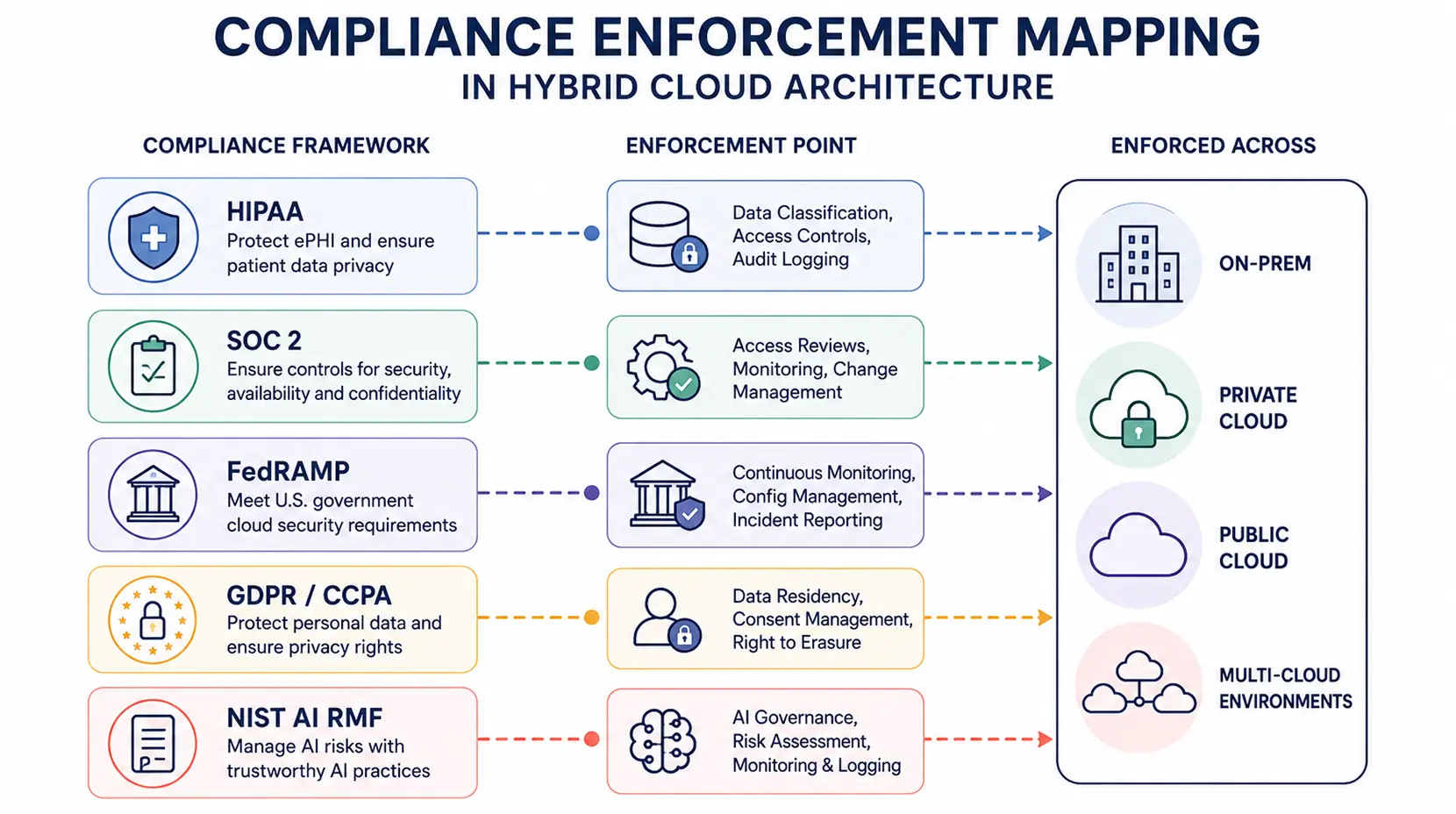
Teams treating an on-prem control and its cloud equivalent as identical usually fail their next audit on a technicality. The table maps five common frameworks to where enforcement happens:
Why Compliance Enforcement Keeps Shifting
Cloud compliance and cloud security and compliance efforts increasingly need to account for SASE cybersecurity controls at the edge, not just CSPM checks against workloads. As enforcement moves to the network edge, the enforcement point for a framework can shift even when its requirements have not.
Common Pitfalls in Hybrid Cloud Security
A retailer we advised had rolled out CSPM tools across every AWS account, yet their loyalty database, on an old on-prem server, sat outside that scope until a compliance review flagged it. Every pitfall traces to one cause: Attention funded in one environment, ignored in the other.
- Under-investing in cloud-native controls is the obvious pitfall.
- Over-investing in cloud while on-prem gets treated as legacy catches mature teams, an easy imbalance to miss as spend keeps shifting toward public cloud.
- Assuming portability: A CSPM policy for AWS rarely translates to an on-prem layer.
- Treating compliance as point-in-time: Posture passing in Q1 drifts by Q3 without root cause analysis.
How BuildNexTech Secures Hybrid Cloud Migrations and AI Workloads
We built our approach around one idea: Security belongs in the migration plan from day one, not bolted on after an auditor asks. That starts with zero trust and identity federation, baked in rather than retrofitted under pressure months later. Our hybrid cloud security services follow proven hybrid cloud security patterns, enforcing policy as code across on-prem, private, and public cloud from one control plane, the principle behind Azure Arc and AWS Systems Manager. For a healthcare CRM client, HIPAA controls were validated pre-cutover, not discovered as delaying gaps.
Teams weighing us against stitching together point tools usually ask whether their business sector is specific enough that a general approach won't protect hybrid cloud workloads properly. The pattern holds regardless of sector: Principles stay the same, only the compliance overlay changes. Sound management practices around identity governance cut alert fatigue, reflected in employee satisfaction. Teams choose BuildNexTech for unified AI Ops observability, one dashboard with GUI design built around what an analyst needs first.
What a BuildNexTech Implementation Looks Like
That plan breaks into three stages:
- Days 1-3: Discovery, mapping architecture, identity systems, and workloads touching regulated data.
- Days 4-7: Policy mapping and IAM federation, extending zero trust across environments.
- Week 2+: Phased migration, compliance validated at each phase, one dashboard for cross-environment policy and posture.
Who This Is For
This fits mid-market to enterprise teams across nearly any business sector: Healthcare, finance, logistics, the nonprofit sector, or product development teams shipping embedded topics like IoT and wireless technologies. The trigger is usually an audit finding, an upcoming migration with no plan, or a generative AI rollout with no governance model.
Conclusion
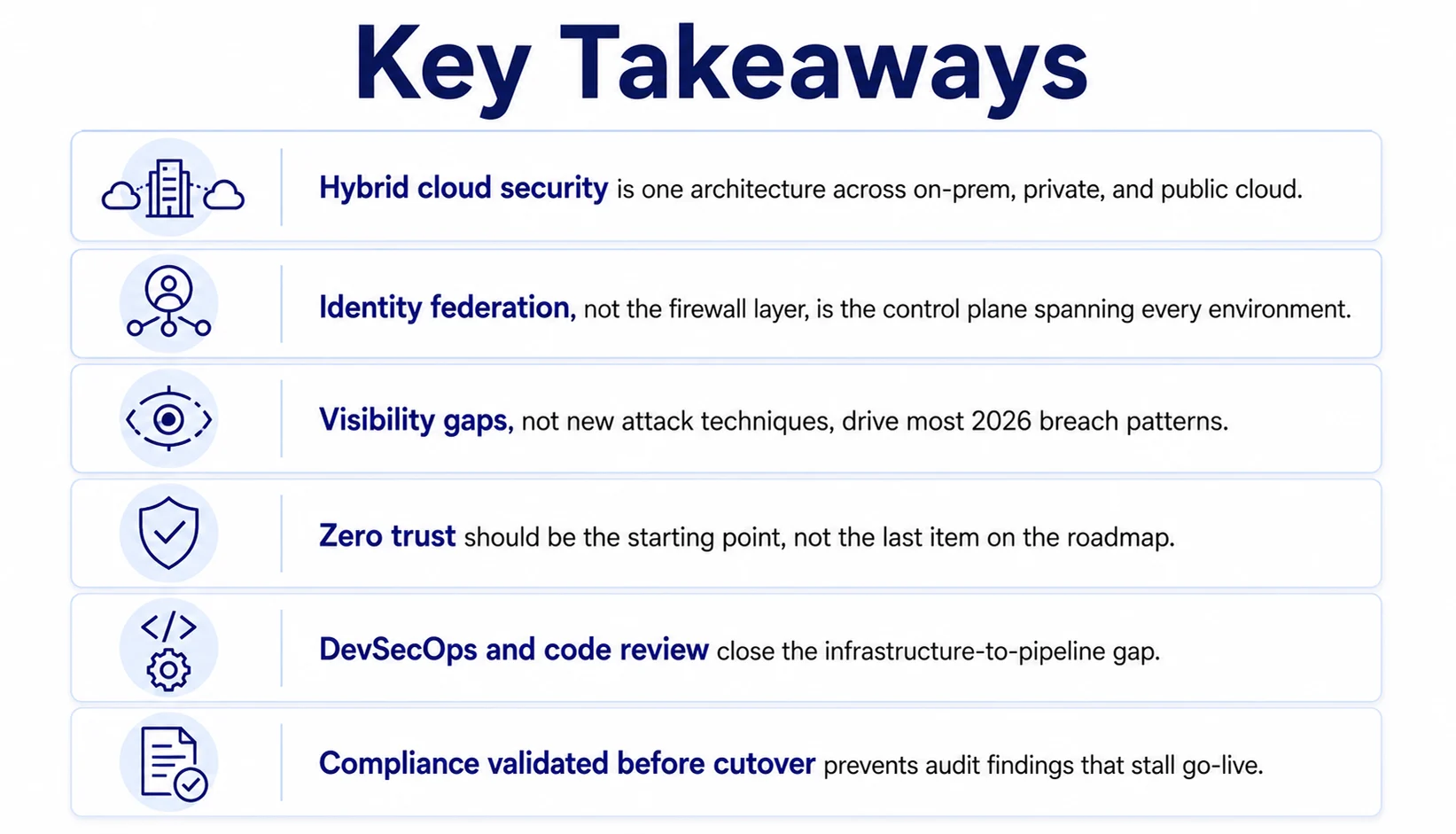
Hybrid cloud security in 2026 comes down to one architecture instead of three separate programmes, an honest read of real risks like AI-assisted attacks and policy drift, and best practices sequenced from zero trust through DevSecOps and SASE rather than bought all at once. Compliance follows the same logic: enforcement shifts by environment, and treating it as one continuous system avoids the pitfalls that catch everyone else.
None of this needs more tooling, just sequencing what you already have. That is the approach we bring to every migration at BuildNexTech. Teams that get this right will be the ones who closed the gap between policy and enforcement first.
People Also Ask

What is DevSecOps?
DevSecOps means building security checks into every stage of software delivery, not after release. The DevSecOps meaning centres on shared ownership of secure code across development, security, and operations.
What is SASE (secure access service edge)?
The SASE meaning combines network security and wide-area networking into one cloud-delivered service, enforcing consistent policy for users and workloads regardless of location, converging CASB, SWG, and zero trust.
What is zero trust architecture?
Zero trust architecture assumes no user or device is trusted by default, even inside the network perimeter. Every request is verified continuously using identity and device posture before access.
What is CNAPP?
CNAPP stands for Cloud-Native Application Protection Platform, combining CSPM, workload protection, and identity risk management into one tool, replacing multiple point products with a unified risk view.
What is data encryption?
Data encryption converts readable information into coded text that only authorised keys can unlock. At rest, it protects stored data; in transit, it protects data moving between systems.


.webp)
.webp)
.webp)

.webp)
.webp)