

TLDR: Most teams automate their CI/CD pipeline and stop there. The real cost sits after deployment: incident triage, provisioning, runbook execution. This guide covers all six DevOps pipeline layers and where BuildNexTech fits.
CI/CD is not DevOps automation; it is the first layer. What is a DevOps pipeline worth if it stops at deployment? You have automated the cheapest part and left the expensive part to humans.
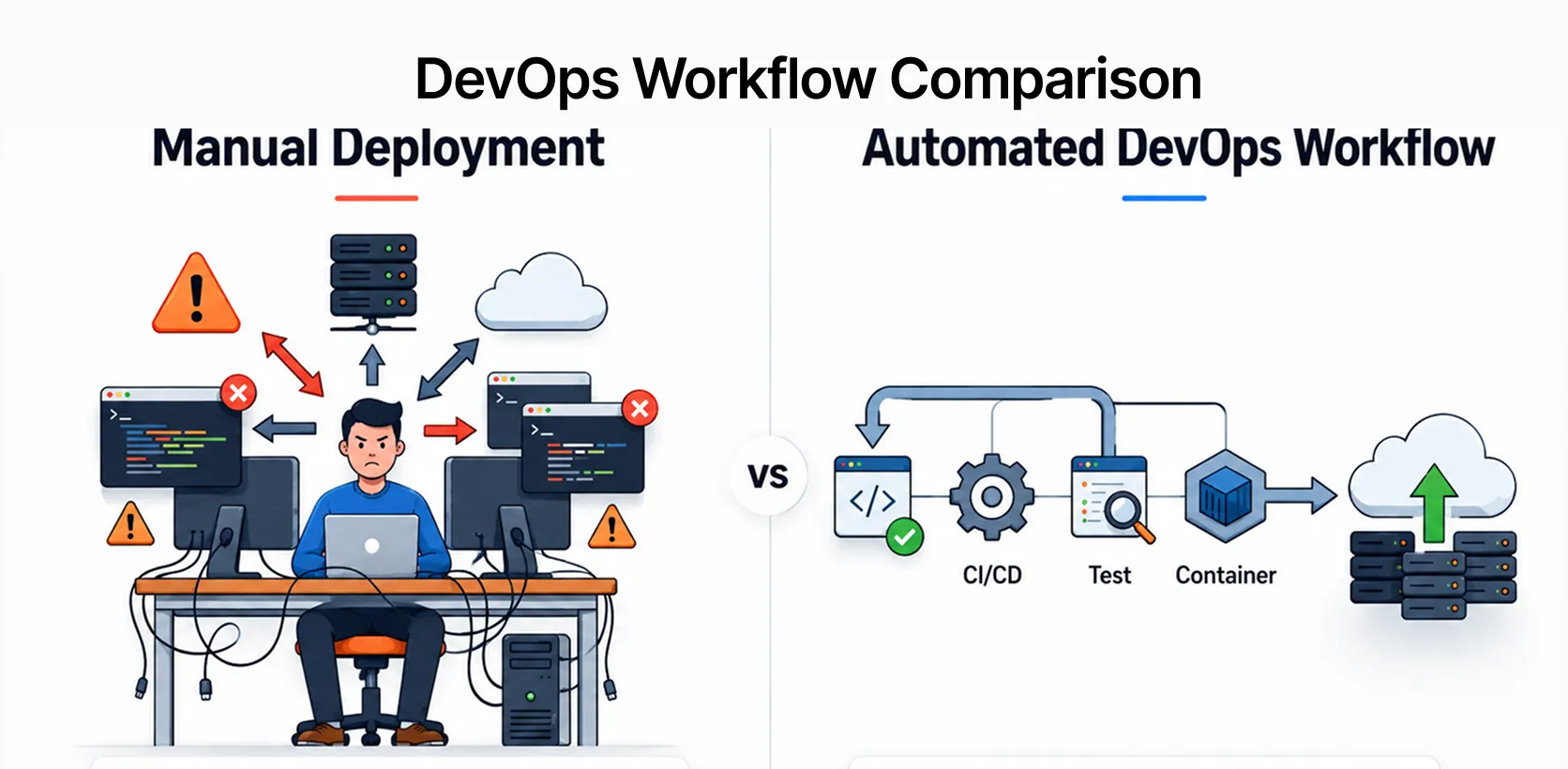
A logistics platform we worked with ran a tuned GitHub Actions ci/cd pipeline: parallel tests, container scanning, automated rollouts on Kubernetes on AWS. Deployment was fast. When an anomaly hit at 11 PM, the engineer still spent 47 minutes on a manual rollback.
The teams shipping the fastest are almost never the ones with the biggest headcount or the longest list of DevOps tools, but those using a DevOps automation platform to streamline their workflows. They are the ones where automation keeps running well past the deployment gate. We see it in every engagement, and the pattern is consistent enough that it stopped feeling like insight a long time ago.
What DevOps Automation Actually Covers (and Where Most Teams Stop)
So what is DevOps automation, really? Strip away the buzzwords, and it comes down to this: removing every manual handoff across the software development lifecycle: build, test, deploy, provision, secure, observe, respond. Nothing mystical about it. Most teams just stop measuring the moment code ships.
And the market reflects that blind spot. DevOps automation tools are growing from $14.95B in 2025 to $18.77B in 2026 at a 25.6% CAGR (The Business Research Company), most of it still going into ci/cd tools, the one layer already in decent shape.
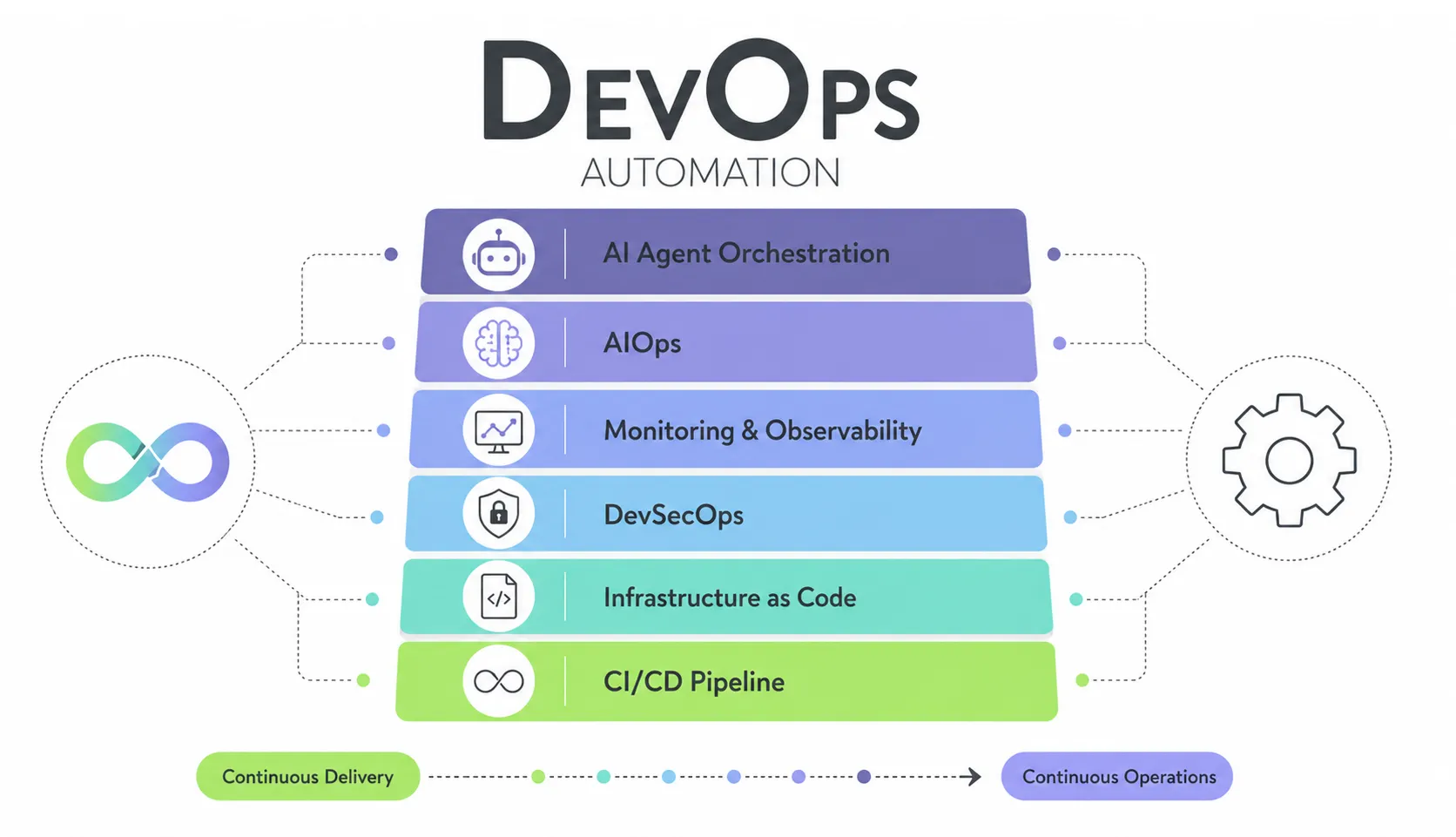
Here's the thing though: a complete DevOps pipeline needs six layers pulling together, not one. CI/CD, infrastructure as code, DevSecOps, AIOps, monitoring and logging tools, and AI agent orchestration. Skip a layer, and the rest end up compensating for it, badly.
CI/CD Pipelines: The Delivery Layer of DevOps Automation
What is ci/cd in software terms? A production-grade ci/cd pipeline in 2026 is not a build script; it is a full delivery system:
- Branch policies and quality gates.
- Parallel automated testing and test plans.
- Artifact versioning, container and secrets scanning.
- SLO-keyed rollback triggers.
What is ci cd pipeline design about? Deciding blast radius: Continuous Delivery keeps a human gate; Continuous Deployment automates it.
Dominant ci cd tools in 2026: GitHub Actions and Bitbucket repositories for cloud-native teams; Jenkins for deep customisation; GitLab CI/CD for source-to-deploy workflows; Azure DevOps for hybrid cloud and mainframe applications. Many pair these with automation testing services for fast suites. Perforce's 2026 State of DevOps Report found 76% of DevOps teams have integrated AI into ci/cd pipelines.
Quality Gates and Automated Rollback Design
Quality gates stop broken code advancing through the pipeline; placement matters more than tooling:
- Unit and integration tests at build.
- SAST and SCA at pull request.
- Container and IaC scans before promotion.
- SLO-based rollback triggers post-deployment.
Teams with automated rollback cut mean time to recovery by 65% on average, reducing blast radius before customers notice.
GitOps: Git as the Single Source of Truth for Delivery
GitOps manages application code and infrastructure state through Git, with ArgoCD or Flux reconciling live cluster state against the repository. Every rollback is a git revert, audit trail included. It is the standard for Kubernetes environments, eliminating drift by design.
Infrastructure as Code: Automating the Environment Layer
What is Terraform, and why does it anchor this layer? Terraform manages cloud infrastructure (compute, networking, storage, IAM, Kubernetes clusters) as version-controlled configuration, keeping environments reproducible and rollback-safe. Mature IaC tools resolve incidents three to five times faster.
The stack by function:
- Terraform for multi-cloud provisioning on AWS, Azure, GCP via Terraform providers; Terraform AWS configs support 3,000+ providers.
- Terraform Cloud for state management and Sentinel for governance.
- Ansible automation platform for config management via an Ansible playbook at deploy time.
- OpenTofu as the open-source Terraform alternative post-licence.
Terraform modules matter more than most admit. VPC, EKS cluster, RDS, and IAM as reusable Terraform modules turn a new environment into a 15-minute apply instead of a 3-day ticket. Terraform import brings unmanaged infrastructure under version control, and Terraform certification helps design cleaner boundaries.
Policy-as-Code: Governing IaC at Scale
Policy-as-code makes infrastructure as code tools governable at org scale: security, compliance, and cost rules run as executable code, enforced before any change applies:
- OPA/Gatekeeper for Kubernetes admission control.
- Checkov and tfsec for IaC security scanning.
- Sentinel for org-level guardrails on Terraform plans.
Policy-as-code fixes this structurally: no misconfigured bucket or over-permissive role reaches production.
DevSecOps: Embedding Security Into Every Pipeline Stage
What is devsecops? Automated pipeline stages replace post-deployment reviews. This shift-left approach means vulnerabilities reach developers as PR feedback, not tickets filed later.
Six devsecops tools by stage, a genuine ci cd security chain:
- SAST (Semgrep, SonarQube) at commit.
- SCA (Snyk, Dependabot) at dependency resolution.
- Secrets scanning (GitLeaks, TruffleHog) in CI runners.
- Container scanning (Trivy) before registry push.
- IaC scanning (Checkov) before infrastructure apply.
- DAST (OWASP ZAP) before production.
Here is what most teams get wrong: hard-blocking gates at every stage create friction and workarounds. The fix, and the mark of a mature security solution, is risk-stratified gating: critical/high findings block, medium routes as feedback.
Secrets Management and Pipeline Credential Security
Hardcoded credentials and over-permissive CI service accounts remain the most common failure among DevOps security tools in 2026:
- HashiCorp Vault for dynamic, short-lived credential injection.
- OIDC-based credential federation, removing static AWS keys from runners.
- Least-privilege IAM design for automation service accounts.
Automation needs credentials at scale, so one bad account can compromise the pipeline. SOC 2 and NIST AI RMF require auditable access as baseline.
AIOps: Adding Intelligence to the Operations Layer
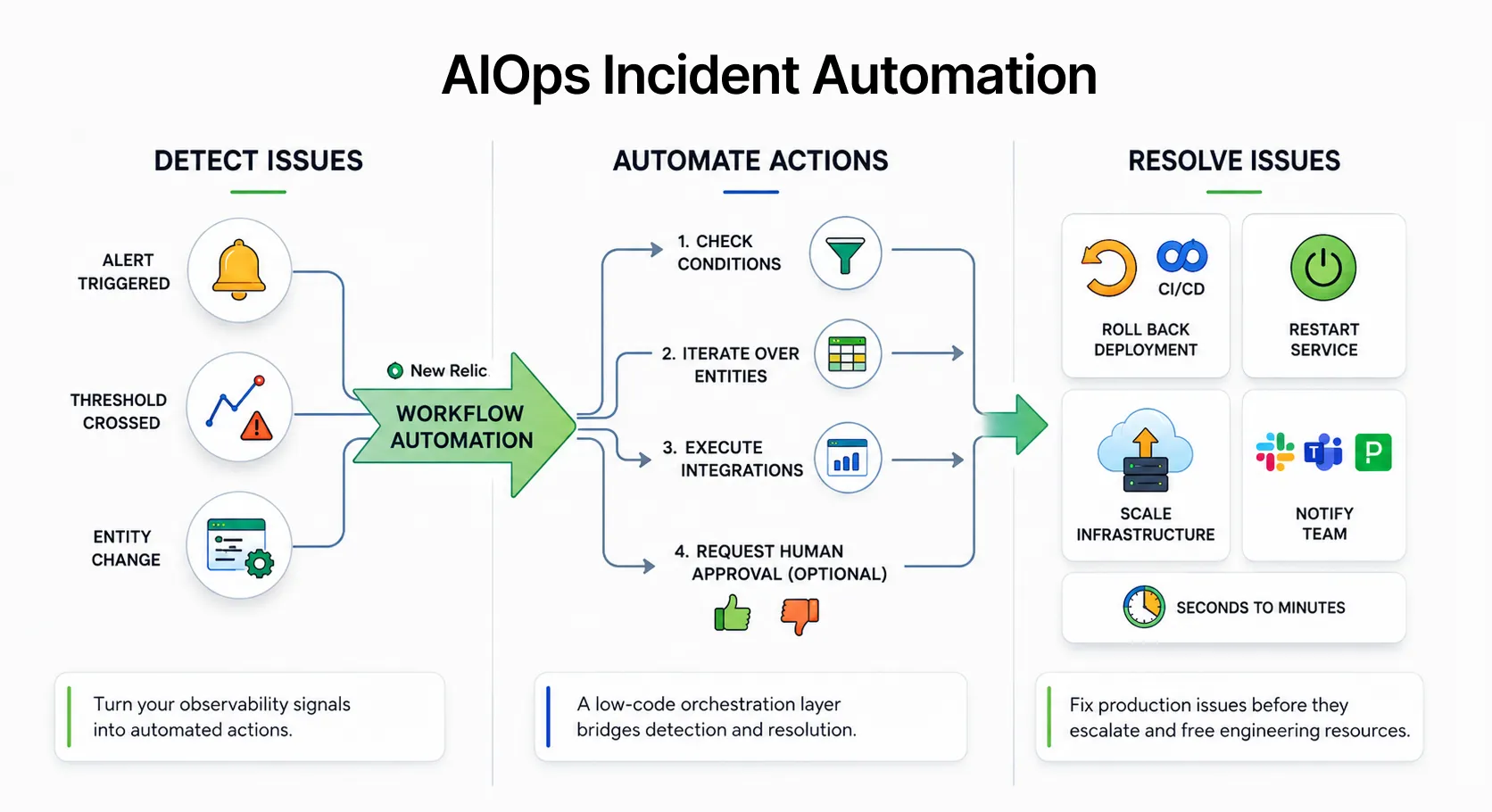
AIOps applies ML to operational telemetry (logs, metrics, traces, incident history) to automate decisions that once needed human judgment. Rule-based monitoring just says "alert past 80% CPU." An AIOps platform learns what abnormal looks like here.
Three highest-ROI use cases in 2026:
- Intelligent alert correlation, grouping related signals into one incident instead of 400 separate pages.
- Predictive deployment risk scoring, using AI-powered analytics on deployment history to flag risky releases.
- Automated rollback triggers, firing without human input when SLO metrics slip.
AIOps Tool Stack: What High-Performing Teams Are Running in 2026
The AIOps tools stack by function:
- Datadog and Dynatrace for observability with ML anomaly detection.
- PagerDuty for AI-assisted incident routing.
- Harness for AI-powered deployment verification.
- OpenTelemetry as the vendor-neutral standard for metrics, logs, and traces.
- Prometheus and Grafana for open-source log management on Kubernetes.
Mature teams run three to five of these together, and value compounds when tools share telemetry.
How BuildNexTech Powers Full-Loop DevOps Automation
The post-deployment layer is where rule-based automation runs out: incident triage, runbook execution, provisioning, access grants are judgment calls no DevOps pipeline tools handle alone. Most DevOps consulting stops at CI/CD advice. A 400-location US retail chain ran IT operations via manual ticket routing; after AI agent orchestration, 64% of tickets auto-resolved.
BuildNexTech's AI automation services sit across the full loop, letting teams build and govern agents that run the operational layer at production speed:
- Multi-agent orchestration for incident response.
- A low-code builder with Smart Templates and a Smart Checklist, skipping fragile scripts.
- Enterprise observability so every agent action is auditable.
- Model-agnostic architecture, avoiding vendor lock-in.
Teams using these DevOps automation services go from first agent to production-ready in days, integrating with existing core services.
What a BuildNexTech DevOps Automation Deployment Looks Like
- Day 1 to 3: discovery, mapping the DevOps pipeline and connecting to CI/CD, monitoring, and incident tooling.
- Day 4 to 7: first agent deployment against frequent incident patterns, approval gates active.
- Week 2: production rollout with full observability.
- Week 3+: expansion into deployment verification, provisioning, and compliance evidence.
At rollout, the team owns a governed, AI-powered layer across the DevOps pipeline, without a separate cloud DevOps services contract.
Who This Is Built For
The profile: US-based engineering organisations at 50 to 2,000 employees running container orchestration on Kubernetes across AWS, Azure, or GCP, with site reliability engineering teams where MTTR runs in hours.
Two readiness signals: MTTR above 60 minutes despite mature monitoring, and platform engineers maintaining 10+ scripts that keep breaking. If that sounds familiar, let's talk.

Closing Thoughts
The six-layer model here isn't some future roadmap slide. It's what the best engineering teams already run today. Deep continuous integration got most teams this far and no further, since it was never built to handle incident triage or provisioning. Keep treating DevOps automation as CI/CD tooling, and you're just stacking operational debt one service at a time. DevOps technology keeps moving fast, especially at the edge computing and AI layers, and the real advantage now sits in the gap between deploying quickly and operating quickly.
People Also Ask

What does DevOps automation typically cost to implement?
Honestly? It depends on team size and toolchain maturity. Most mid-sized teams end up budgeting for licensing, integration time, and ongoing governance, not one neat number.
Does DevOps automation work in hybrid or on-premises environments?
Yes, more teams do this than expected. Hybrid and on-prem setups work fine once IaC and DevSecOps tooling support them; Terraform and Ansible handle on-prem infrastructure well.
How is DevOps automation different from traditional IT operations automation?
Traditional IT operations automation still waits for someone to trigger a runbook. DevOps automation skips that step: it's built into the pipeline, so provisioning, security, and recovery just happen.
What should a team have in place before adopting AI agent orchestration?
Get observability and incident classification sorted first, and write the runbooks down. AI agents are only as good as the telemetry feeding them, so give them clear escalation paths.
How long does it take to see ROI from DevOps automation?
Most teams feel a difference within 4 to 8 weeks of a phased rollout, usually faster incident response. The bigger payoff, full-loop ROI, arrives over two to three quarters.


.webp)
.webp)
.webp)

.webp)
.webp)