

.webp)
A mid-sized fintech company came to us with a strange complaint: Their new AI agent was brilliant in the demo and unreliable in production. Ask it for last quarter's revenue twice, in two tools, and it gave two numbers, both technically correct, neither trustworthy. The team assumed the model was the weak link.
It wasn't. The agent was re-deriving business logic on every prompt, guessing at joins and metric definitions nobody had written down. Point a large language model at a warehouse with no shared business definitions, and accuracy can fall from over 90% to as low as 10-20%. Across 150+ client engagements in 30+ industries, we see this failure mode more than any other. This guide covers what a semantic layer is, why AI agents need one, and how to evaluate an implementation.
What Is a Semantic Layer?
A semantic layer is a governed business-logic layer sitting between raw data and the applications, including AI agents, that consume it. Before it exists, business definitions live scattered across dashboards, dbt models, and wiki pages, disconnected from the data assets they describe. Every new tool on the data platform semantic layer rediscovers the logic by copying an old query, with no metadata layer to check against. A semantic data layer replaces that guesswork with one certified place to look, backed by governed metadata, giving the business a single source of truth: One certified answer, not five slightly different ones.
.webp)
Semantic Layer vs Data Model
- A data model describes how data is stored: Tables, columns, keys, the physical structure a database engine understands.
- A semantic layer describes how that data should be understood, translating raw schema into business semantics an agent can act on.
- The model answers "where does this number live?" The layer answers "what does it mean, and who can see it," things like the agreed meaning of "revenue" or the join path between customers and contracts.
Why AI Agents Specifically Need a Semantic Layer
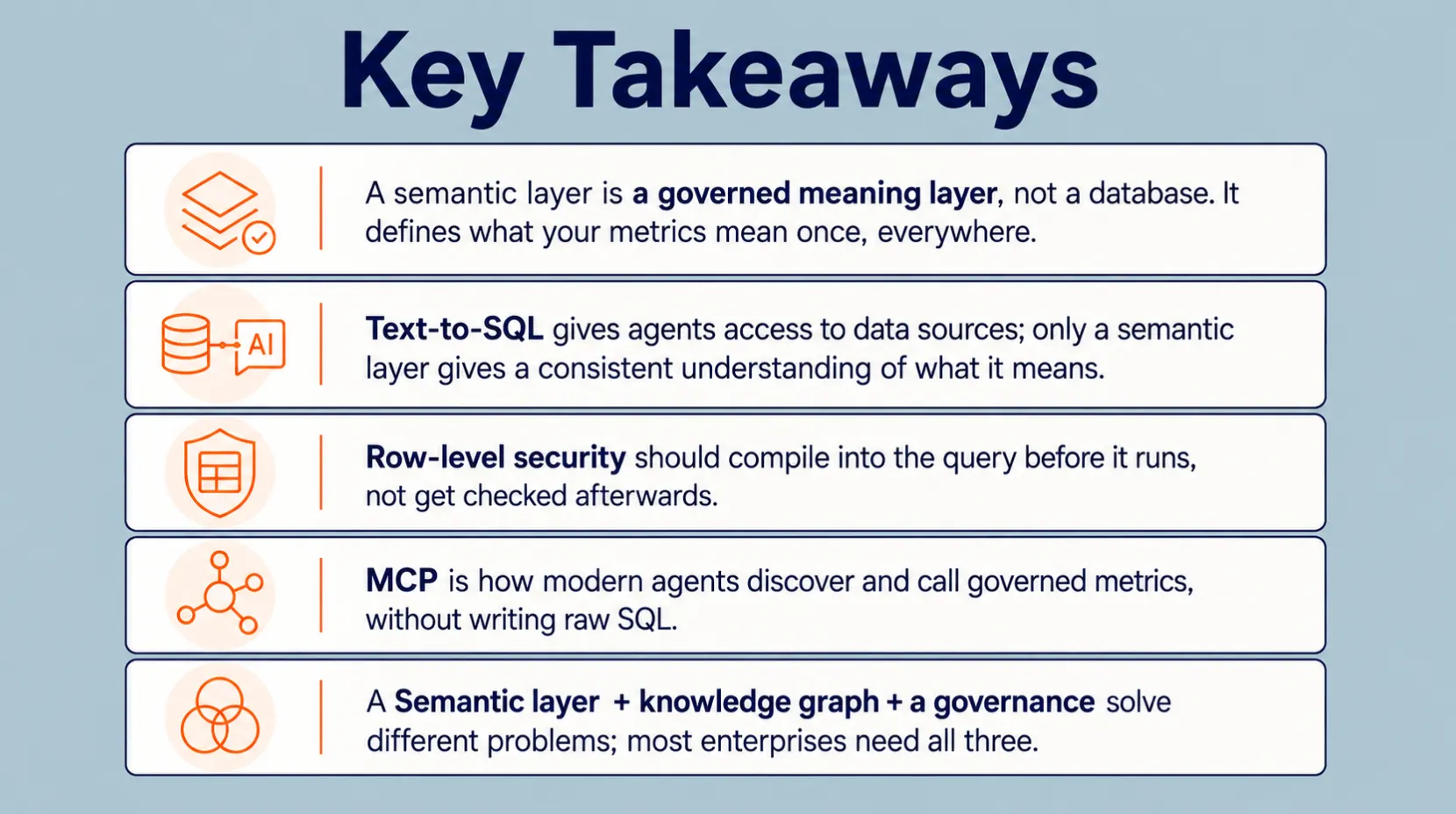
Text-to-SQL gives an agent access to your data warehouse, not understanding of it. Pointed at raw tables, AI models re-derive joins and metric logic on every prompt, so the same question can return different answers across sessions. That gap shows up in a few specific pain points once agents move past a demo:
- No shared definition of "correct." Finance, ops, and sales each write their own version of "revenue," and an agent querying raw tables has no way to know which one applies.
- Logic gets re-derived, not reused. Every prompt is a fresh guess at joins and filters, so the same question asked twice can return two different, equally plausible-looking answers.
- Access control isn't built into the query. A correct query and one that leaks another customer's data look identical to a model working from raw schema alone.
- The problem compounds with scale. One agent guessing wrong is a bad demo; ten agents guessing differently across departments is a trust problem the business notices.
A governed semantic layer for AI closes this gap by giving the model a certified set of metrics and access rules to select from, instead of logic to invent from scratch.
How a Semantic Layer Prevents Agent Hallucination
Hallucination in enterprise agents usually isn't the model making things up from nothing. It's the model guessing at business logic nobody wrote down, and guessing confidently enough that the answer looks trustworthy. Here's how a semantic layer closes that gap:
- It replaces guessing with selection. Instead of the agent deciding which table holds "customer," which join avoids double-counting, or which definition of "revenue" applies, it picks from one certified answer that's already been agreed on.
- It enforces the rule before the answer is generated, not after. The semantic layer decides which metric and logic apply, so the model never has to invent a join or a filter on the fly.
- It narrows the model's options, not its intelligence. The agent isn't smarter for having a semantic layer in place; it simply has fewer wrong paths available to take.
- It matters more, not less, for generative use cases. A bigger context window doesn't fix this, since it just gives the model more raw material to guess from, which is exactly why a semantic layer for genai and a semantic layer for llms deployments need certified definitions rather than more context.
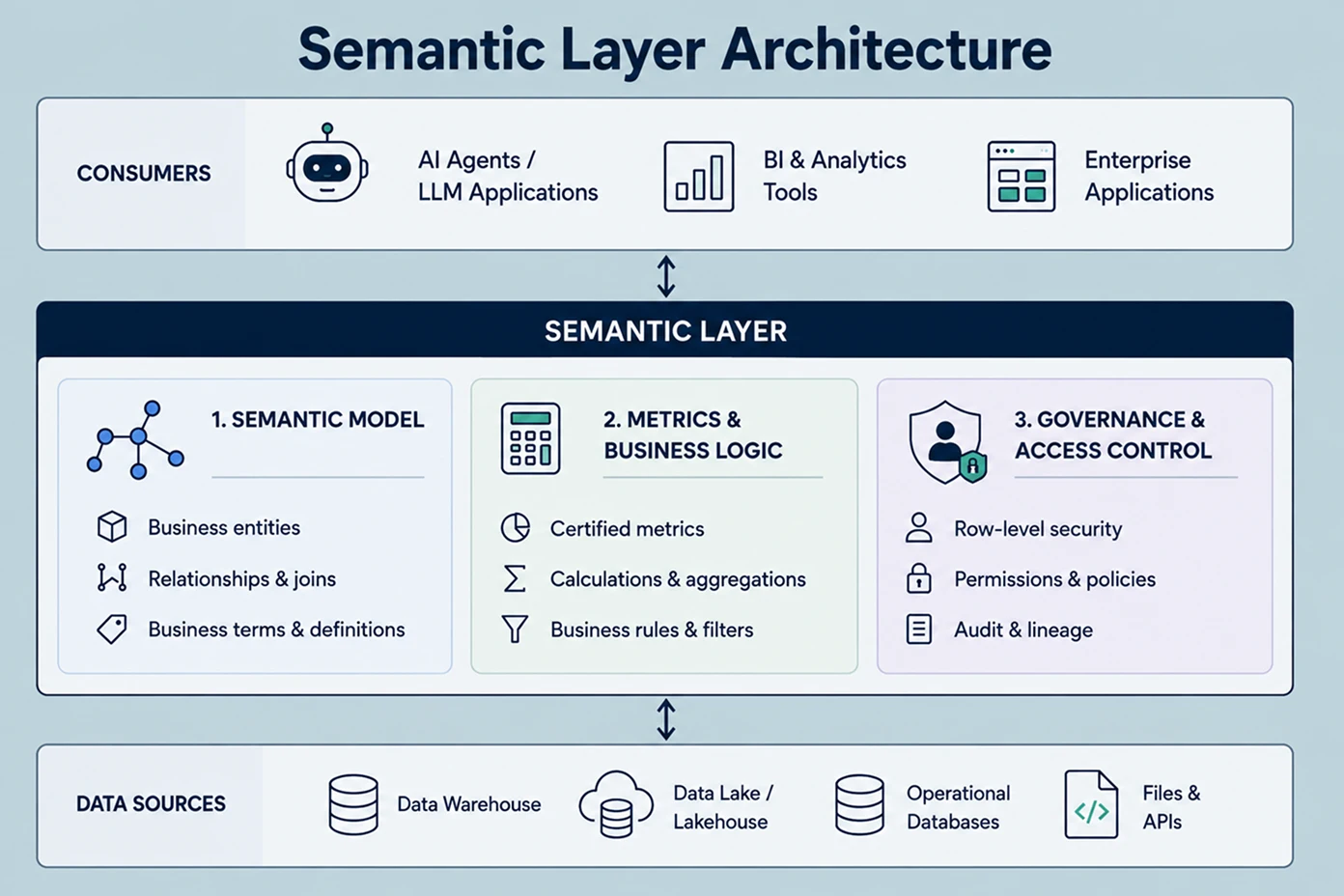
Semantic Layer Architecture for AI Agents
A production-grade semantic layer breaks into three layers that work together:
- The semantic model defines entities, relationships, and synonyms, the vocabulary an agent reasons with.
- Metric definitions carry the actual business logic, the calculation behind "net revenue" or "active customer."
- Governance sits above both, controlling ownership and who is allowed to query what.
Agents reach this stack through MCP servers or API calls, not raw connections into cloud warehouses. What is a data pipeline in this context? It's the process that moves and transforms raw data before it reaches the warehouse, so getting the data engineering foundation right matters, since bad Data Pipelines just get governed consistently, not fixed. Data lineage traces a number back to its source, metadata catalogues give data analysts one place to search instead of five, and version control tracks metric changes before they break reports.
Roughly what that exchange looks like via MCP:
{
  "method": "metrics/query",
  "params": {
    "measures": ["revenue.net"],
    "dimensions": ["region", "quarter"],
    "filters": [{ "member": "customer.tenant_id", "operator": "equals" }]
  }
}
// Compiled with the caller's tenant and role already applied.
Where It Fits in the Modern Data Stack
- The semantic layer sits between the governed warehouse and every consumer: Power BI dashboards, self-service analytics, AI-powered analytics, and AI agents all pull from the same source.
- It can be warehouse-native (Snowflake, Databricks), headless and code-first (dbt's MetricFlow, Cube), or wrapped inside a broader AI-native backend architecture.
- Which shape fits depends on how many cloud warehouses your agents reach, and how many enterprise apps query the same metrics, which matters for a universal semantic layer enterprise rollout.
Semantic Layer vs Data Governance vs Knowledge Graph
These three concepts get used interchangeably, costing teams real time. What is data governance, in plain terms? It sets the rules; a knowledge graph maps relationships; a semantic layer compiles governed logic into something queryable.
Context layers sit above all three, wrapping metrics, relationships, and policy into a shared knowledge base every tool can query. This is also where the ontology vs semantic layer distinction matters: An ontology defines the concepts a business uses; a semantic layer turns those into queryable metrics.
Most data governance solutions and data governance software handle policy well but stop short of what an agent can query; the gap a semantic layer for data governance closes. Neither replaces the responsible AI governance layer deciding who can touch the data, and "our data is too specific" is a fair worry: Metric logic rarely transfers between industries, but the architecture pattern does.
Comparison: Semantic Layer Approaches for AI Agents
Evaluating semantic layer tools gets easier once options sit side by side, since vendor marketing tends to blur real architectural differences in query optimization and governance depth.
Which one fits your team?
- Deep in dbt, want an open model? Start code-first.
- Every agent lives in one warehouse? Warehouse-native is enough.
- Need governed access shipped in weeks, no lock-in? That's the implementation-led path.
Common Pitfalls
A retail client came to us six weeks into an agent pilot with a governed semantic layer already in place, and the numbers were still inconsistent. The layer was correct: three agents each cached a stale copy of the definitions and never refreshed after a revenue rule changed mid-quarter.
What Actually Breaks in Production
- Building the layer isn't the hard part. Keeping every consumer synchronised, especially caching agents, is where governance quietly breaks down.
- A Gartner analysis of data and analytics priorities points to universal semantic layers becoming core AI infrastructure by 2030.
- Treating certification as a one-time project, not an owner-assigned process, is common, as is skipping row-level security until "phase two," which never happens.
- Building an AI-ready semantic layer so broad on day one that nothing ships for months is the quiet killer of most rollouts.
How BNXT.ai Builds AI-Ready Semantic Layers for Enterprise Teams
BuildNexTech offers AI consulting services and generative AI consulting services, designing governed semantic layers that connect existing warehouses, dbt models, and BI tools to production AI agents. The approach runs on an AI Agent Factory model, pairing AI integration work with repeatable patterns for how to build AI agents. A US digital bank used this to cut manual underwriting review by 65% once agents were grounded in certified definitions instead of re-deriving logic each request, and the approach covers AI agent examples like support copilots, AI voice agents for customer calls, and autonomous underwriting agents.
What a BNXT.ai Semantic Layer Implementation Looks Like
- Discovery (days 1-3): Maps existing definitions and flags where departments disagree.
- Modelling and governance mapping (days 4-7): Resolves conflicts into one certified model.
- MCP and agent integration (week 2+): Wires the model into the team's agent framework.
- Monitoring: Keeps pace as metric logic and data sources drift.
Who This Is For
- This fits mid-to-large enterprises already running agents against fragmented warehouse data, hitting one of three triggers: Inconsistent answers across departments, a stalled pilot, or a new AI initiative about to hit production without governed metrics.
- Teams researching the best AI agents often focus on the model first; the semantic layer underneath usually matters more.
Conclusion
The organisations getting real value from AI agents are not the ones with the biggest models. They are the ones that stopped treating "what does revenue mean" as a question every agent should answer for itself. A unified semantic layer turns scattered business definitions into one governed source every tool can trust.
That governance is what separates an agent that's occasionally right from one a business can actually put in front of customers. Teams still debating whether they need this are usually already fielding conflicting numbers from finance and ops, and that gap only gets more expensive to close the longer it waits.
People Also Ask

Is a semantic layer worth it for a small or mid-sized team, not just large enterprises?
Yes, if agents already touch production data. Smaller teams often get more value proportionally, since one certified metric set is easier to maintain with a lean data team than a sprawling one.
Semantic layer vs metrics layer: what's the difference?
A metrics layer is narrower, focused purely on calculated numbers like revenue or churn. A semantic layer includes metrics but also covers entities, relationships, and synonyms, giving agents broader business context to reason with.
Can a semantic layer be built before the underlying data pipeline is fully mature?
Yes, though it's harder. Starting with one clean, high-value data source and expanding as pipelines mature usually works better than waiting for a perfect warehouse before defining any business logic.
Does a semantic layer help with voice-based or conversational AI agents specifically?
Yes. Voice and conversational agents rely even more heavily on certain, fast answers since there's no screen for a user to double-check a number against, making governed definitions especially important there.
How is a semantic layer different from just writing good prompts for an LLM?
Prompts guide tone and reasoning; they don't enforce data accuracy. A semantic layer AI setup constrains what an LLM can query and how, which prompting alone cannot guarantee, no matter how carefully it's written.


.webp)
.webp)
.webp)

.webp)
.webp)