

.webp)
Shipping an LLM API call is easy. Keeping it stable at 10,000 requests a day, under budget, without silent failures: that is where most teams hit a wall. Everyone is adding AI to their backend. Fewer are asking whether their backend was ever built to handle it. That gap between adding AI and architecting for AI is exactly where production systems break. Not in demos. Not in staging. In the moments that actually cost you.
TL;DR: AI workloads violate three foundational backend assumptions: predictable latency, stateless scaling, and deterministic logic. Fixing this means treating artificial intelligence and machine learning as structural constraints in your system designs, not feature-layer additions.
IDC projects global AI spending will surpass $300 billion by 2026. Yet most technology infrastructures were never designed to govern a single ML inference call at scale. The result: compounding latency, runaway cloud computing bills, and AI-driven analysis that degrades silently under real load. Across 150+ client engagements in fintech, healthcare, and logistics, we have seen the same failure repeat. Teams treat AI capabilities as optional add-ons to core components rather than constraints on software architecture from day one.
Why Traditional Backend Architecture Breaks Under AI Workloads
Traditional backend development rested on three assumptions that generative AI and machine learning shatter simultaneously. These assumptions run deep into core components like load balancers, service contracts, and data access layers.
The Assumptions That No Longer Hold
Three architecture patterns collapse the moment ML inference, distributed systems coordination, or real-time anomaly detection enters the request path:
- Predictable latency: A database read takes 2-5ms at p99. An LLM call takes 400ms to 12 seconds.
- Stateless scaling: Multi-agent coordination is inherently stateful, violating standard stateless service contracts.
- Deterministic logic: AI outputs are probabilistic. Your backend needs confidence thresholds and fallback paths as first-class concerns, not afterthoughts.
Most teams hit this wall at the six-month mark. Adding retry logic treats the symptom, not the cause.
What "AI-Native Software Architecture" Actually Means
Traditional system designs were optimised for throughput and fault tolerance, not for probabilistic outputs and token-cost budgeting. AI-native software architecture treats intelligence as a structural constraint from day one.
A fintech team we worked with processed 4,000 transactions per second. Adding an LLM scoring layer required rethinking data access, inference routing, and result merging under 50ms. That was a software architecture problem, not a machine learning one. AI-native system designs ask different questions before any model is selected.
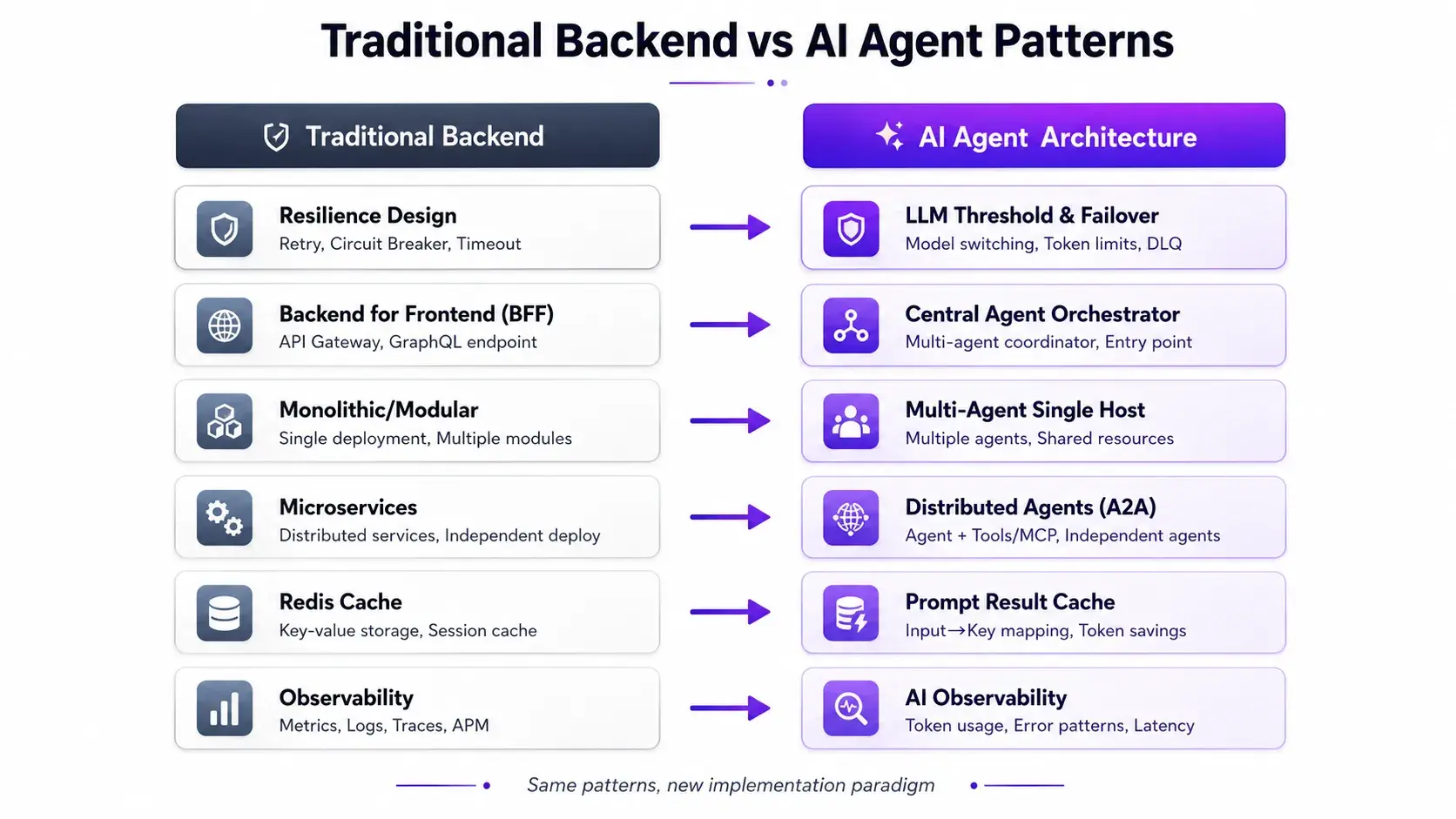
LLM Inference as a First-Class Backend Concern
Most teams treat ML inference as a simple API call. But every timeout, cost spike, and degraded response is an architectural decision that directly shapes user experience at scale.
Why Inference Is an Architectural Decision, Not an API Call
Production-grade ML inference uses tiered model routing:
- Tier 1 handles classification with fast, cheap models
- Tier 2 covers most user-facing requests
- Tier 3 reserves high-capability reasoning for tasks that genuinely need it
A router assigns tiers based on complexity signals and cost thresholds. Teams implementing this cut inference spend by 60-70% without degrading user engagement, because most requests never needed a Tier 3 model. Omitting this layer turns every latency spike into a user experience incident.
Optimising the Inference Layer at Scale
KV cache management, speculative decoding, and context window budgeting are the primitives that drive system-level efficiency at scale. Serverless Functions and Container Orchestration via Kubernetes configurations are the standard execution layer for scalable ML inference in 2026. Cloud computing bills for AI-native teams are dominated by inference costs. Getting this right in the architecture phase is not optional.
Rearchitecting the Data Pipeline for AI-Ready Backends
AI workloads demand a fundamentally different data layer, one built for low-latency retrieval and real-time context, not the scheduled batch-oriented movement that traditional ETL was designed for.
From ETL to Real-Time AI Data Pipelines
The modern AI data pipeline runs through six stages: ingestion, transformation, feature store, vector index (Pinecone, Weaviate, or pgvector on Postgres), retrieval layer, and LLM inference. Retrieval-Augmented Generation using natural language processing sits directly in this critical path.
A US hospital system we supported saw AI assistants failing to surface relevant patient history until they rebuilt the retrieval layer on a vector index. Administrative review time dropped by 40%. Teams that serve RAG context from a traditional ETL backend hit retrieval latency that dominates total inference time.
Vector Databases and the Retrieval Layer
A vector database is a storage system optimised for similarity search over high-dimensional embedding vectors, not SQL queries or standard SQL command patterns. Use a dedicated vector store for:
- Recommendation engine workloads
- Predictive analytics retrieval at scalegenerative AI
- Semantic search across large datasets
For lower-throughput use cases, pgvector on Postgres handles production load without adding infrastructure complexity. One dimension most teams miss: AI pipelines need lineage and auditability through to the inference layer for regulatory compliance under NIST AI RMF and SOC 2. This matters especially when user data flows through retrieval pipelines; any lineage gap becomes a compliance exposure. Embed this before the first audit, not after.
.webp)
Serverless and Event-Driven Architecture in AI-Native Systems
Serverless computing and AI workloads align naturally because inference is bursty and unpredictable, making traditional always-on services an expensive and inefficient fit for how AI demand actually behaves.
Why Serverless Computing Fits AI Workload Patterns
Serverless Functions scale automatically in response to events, with billing tied to actual compute consumption. Provisioning always-on GPU endpoints for peak capacity that arrives three times a week is wasteful. Cloud-native Container Orchestration handles stateful agentic workflows at production scale via durable functions and managed checkpointing. Edge computing reduces latency further for inference requiring real-time asset generation, Augmented Reality overlays, Virtual Reality environments, or user interface rendering close to the user.
Event-Driven Architecture as the Backbone of AI Pipelines
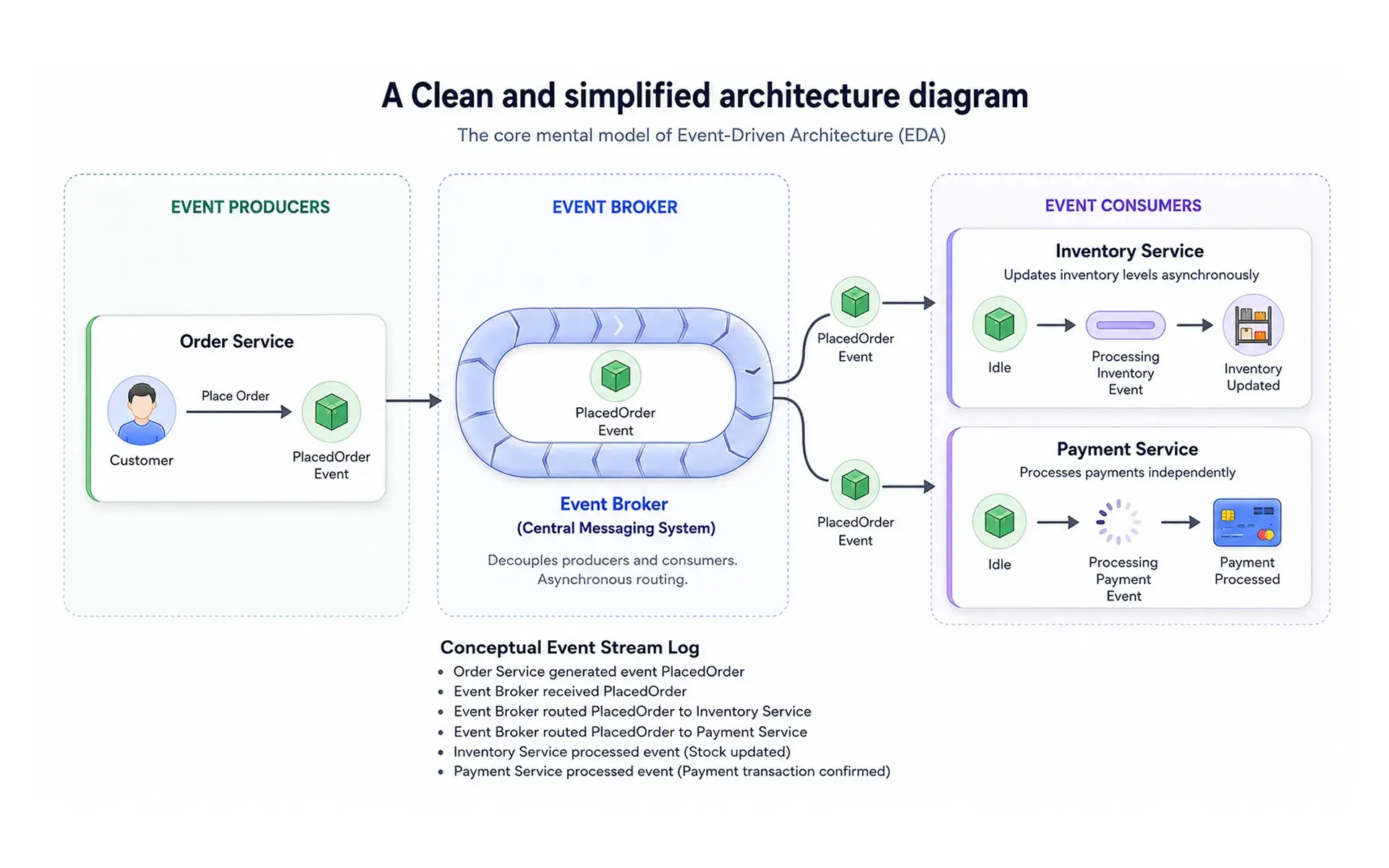
Event-driven architecture decouples the parts of your technology infrastructure that should not block each other:
- A document upload triggers an async summarisation pipeline
- A user query routes to the appropriate model tier
- Neither interaction needs to be synchronous
Enterprise adoption of event-driven architectures is accelerating rapidly, driven by the need to support real-time AI at scale. Managed queues (SQS, Pub/Sub, Kafka) buffer inference demand without propagating latency to the user-facing layer.
AI Workflow Automation and Self-Healing Infrastructure
Reactive monitoring was designed for predictable systems. But AI at Work introduces task chaining and smart infrastructure dependencies that make traditional monitoring blind to the failures that actually matter.
From Reactive Monitoring to Predictive, Self-Healing Systems
A US logistics fleet cut unplanned downtime by 38% after deploying predictive analytics pipelines that flagged failures before they occurred. The on-call team did not change. The architecture did.
AI workflow automation at the operational layer follows three patterns:
- Predictive auto-scaling: ML models scaling ahead of demand, not in reaction to it
- Intelligent DevOps tasks: AI agents scanning for regressions before a deploy reaches users
- Self-healing services: anomaly detection and remediation running at machine speed
AI tools for this are production-ready in 2026 for teams with existing observability tooling.
Guardrails That Make AI Automation Safe at Production Scale
AI-driven technology architectures only deliver velocity when the backend provides guardrails that make AI output reviewable, auditable, and reversible. Without output validation, AI-driven systems are far more exposed to online attacks that exploit unpredictable model behaviour.
The guardrails that matter:
- Strong type contracts that constrain what automation can touch
- Confidence thresholds and human-in-the-loop gates for high-stakes actions
- LLM-specific observability covering token cost, latency, and output quality built in from day one
This closes system security gaps and avoids security risks in regulated environments. Ungoverned AI automation is not a security solution. It is a compliance liability.
What Most Backend Teams Get Wrong When Integrating AI
Most of the problems we see are not really AI problems. They are software development decisions made before anyone anticipated inference latency or agentic state management.
Treating Model Selection as an Architecture Decision
Teams spend months comparing SageMaker versus Vertex AI versus Azure ML as if model platform selection determines production success. It does not. Data access layer design, inference routing logic, and evaluation pipelines matter far more. AI capabilities are widely available in 2026. The system design around them is the differentiator. A well-architected backend with a mid-tier model outperforms a poorly-architected backend with a frontier model, every time.
Ignoring the Application-Layer Orchestration Gap
Every major platform covers infrastructure and security service configuration. None address the layer above the inference API where multi-agent coordination, tool use, workflow state, and cross-model routing must live. Teams build this from scratch using LangChain, LlamaIndex, or LangGraph. Across our engagements, teams that planned two sprints for this layer typically needed six. Executive Programs and digital transformation roadmaps rarely account for this gap until it has already delayed delivery.
How BuildNexTech Helps Engineering Teams Build AI-Native Backends Faster
BuildNexTech operates at the application-layer orchestration level that most platform documentation ignores.
What a BuildNexTech Integration Looks Like in Practice
The engagement runs in two weeks:
- Days 1-3: Architecture scoping against your existing stack: AWS API Gateway, event broker, data layer, inference endpoints. By day three, we have mapped your architectural workflows: how data moves from ingestion to inference to response.
- Days 4-7: First agentic workflow deployed with model routing, tool definitions, and observability live in your environment.
- Week 2+: Iteration on routing logic, context window budgets, cost thresholds, and escalation triggers based on live telemetry.
A UK financial services firm recovered 1.2 million hours of staff capacity after a BuildNexTech AI automation engagement.
Who This Is For
Engineering teams with AI capabilities on the roadmap but without a dedicated ML infrastructure team. The conversation usually starts in one of three situations:
- LLM API calls are live, but no routing, cost controls, or observability are in place
- A multi-agent workflow has been in scoping for more than two sprints without a production-ready design
- The team finds no cloud-native platform addresses the application-layer orchestration gap natively
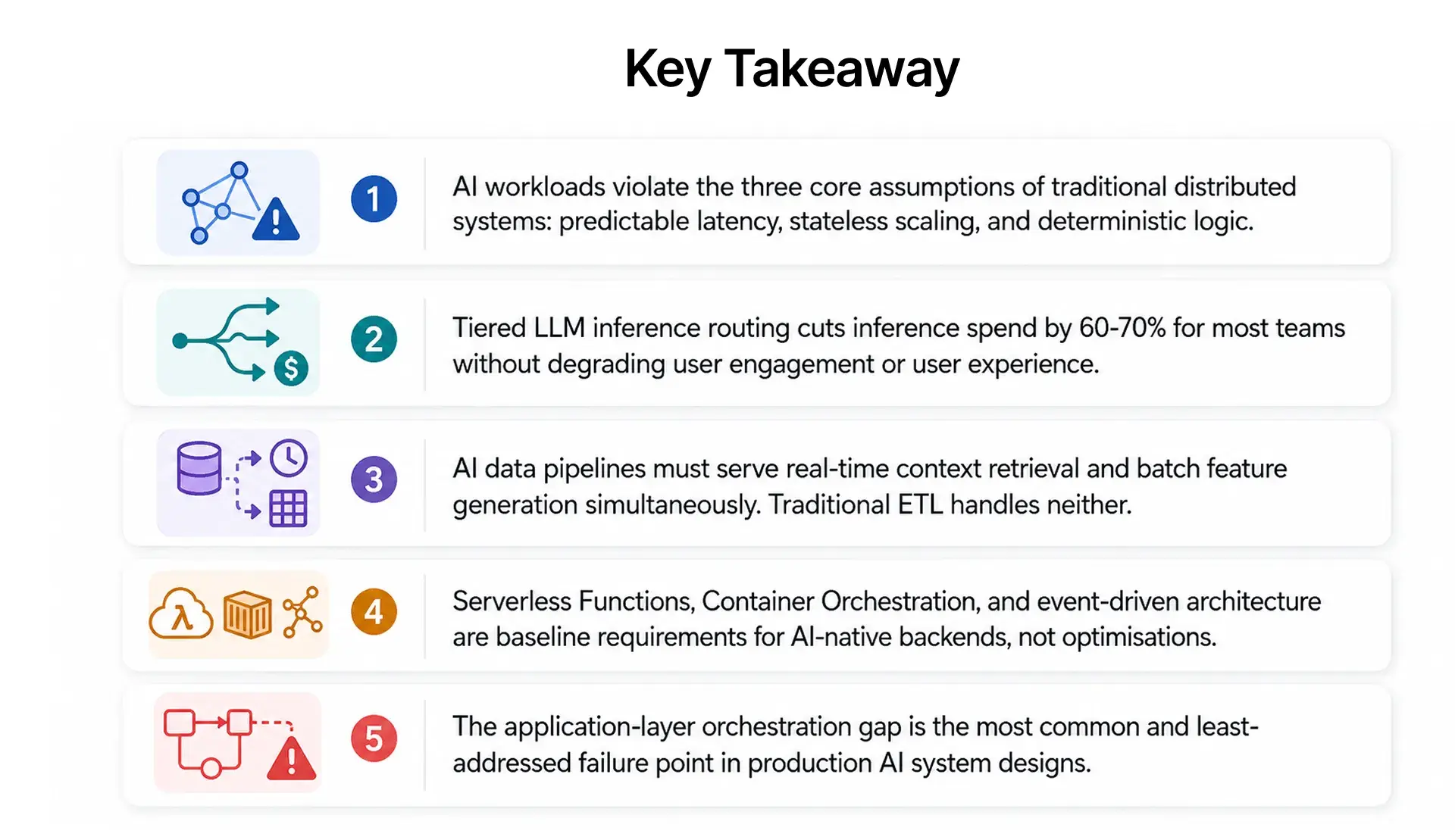
The teams shipping the fastest AI products in 2026 are not the ones with the best models. They are the ones who got the software architecture right before they scaled. Inference routing, real-time data pipelines, event-driven decoupling, governed automation: none of these appear in a product launch announcement. All of them determine whether the product survives its first three months in production. The AI capabilities get the credit. The backend architecture does the work.
People Also Ask

What is software architecture in the context of AI-native backend systems?
AI-native software architecture embeds intelligence as a structural constraint from day one, with the inference layer, vector retrieval, and agent orchestration designed before any model is selected.
What is a data pipeline in an AI backend and how does it differ from traditional ETL?
An AI data pipeline serves both real-time ML inference context retrieval and batch feature generation. Traditional ETL handles only scheduled, structured data movement, not low-latency semantic retrieval.
What is AI inference and why does it matter as a backend architecture concern?
AI inference generates model outputs at request time with non-deterministic latency and compounding token costs. Serving architecture decisions made upfront cannot be retrofitted after production deployment without significant rework.
When does serverless computing architecture make sense for AI workloads?
Serverless suits event-triggered inference and async workflows where cold-start latency is acceptable. Dedicated endpoints are needed for high-throughput, stateful agentic workloads where cold-start overhead directly degrades user experience.
What is a vector database and when does a backend actually need one?
A vector database handles similarity search over embedding vectors. Use one for RAG retrieval, recommendation engine workloads, or high-throughput semantic search where SQL queries on structured fields cannot suffice.


.webp)
.webp)
.webp)

.webp)
.webp)