

.webp)
Have you ever tried talking to a character in a video game and got the exact same answer no matter what you said?
Picture this: you walk into a tavern. The barkeep says, "Greetings, traveller." You start a brawl, come back the next day. "Greetings, traveller." Same words. Same face. That is a broken record with better graphics.
AI NPCs are changing that. Powered by natural language processing, machine learning, and generative AI, non-player characters can now hold real conversations, remember what happened last week, and respond differently to every player. It is shipping in games today.
TLDR: AI-driven NPCs replace pre-written dialogue trees with real-time deep learning. Characters now hold long-term memory, track player behavior, and adapt. PUBG, inZOI, and Ubisoft's Teammates are already live.
What Are NPCs, and Why Do They Feel Like Broken Records?
Non-player characters have existed in virtual worlds for decades. A writer typed every possible line in advance, and the character delivered those lines on repeat to every player, every session. Dialogue trees were the only practical answer the gaming industry had at scale.
According to the 2025 GDC State of the Game Industry report, over 50% of game studios now use generative AI in their pipeline. Three years ago that number was near zero.
Why Scripted Characters Were Good Enough, Until They Weren't
Scripts made sense: fast, predictable, no internet required. But player expectations have shifted. People use conversational AI tools every day. When you speak to a game character reading from a fixed menu after using a chatbot that morning, the gap is jarring. Immersive worlds built on scripted loops feel hollow.
How AI Is Making Game Characters Actually Come Alive
An AI-driven NPC uses a large language model as its brain. Game developers define who the character is, what they know, and what they cannot say. Natural language processing and deep learning algorithms handle every player interaction in real time, within those rules.
Three things make this genuinely different from any dialogue tree:
- Real conversation: Players go off-script, argue, or change the subject. The character responds in natural language rather than defaulting to "I don't understand."
- Long-term memory: AI NPCs store key player interactions and surface them in later sessions. The world starts to feel like it noticed you.
- Emotional states: Whether a character is cautious, warm, or sarcastic, that emotional depth stays consistent across every session, shaped by rules defined upfront.
Modern AI NPC systems use a layered stack. Behaviour trees and hierarchical finite state machines govern high-level decisions. Utility AI and action scoring handle priorities. Deep learning algorithms manage dynamic NPC AI at the conversation layer. Behaviour blending keeps transitions natural, and self-learning NPCs via behavioural learning adjust based on player interactions.
Our Take: One writer defines a personality; deep learning expresses it across thousands of unique player interactions. That is character development at scale.
The Evolution of NPCs: From Scripted Lines to Living Characters
The gap between what NPCs used to be and what they are becoming is most visible when you look at how far they have come within a single franchise.
Grand Theft Auto
- GTA III: Pedestrians were essentially props, walking fixed paths, saying a handful of lines, scattering when trouble started
- GTA IV: Characters reacted to the environment and held basic contextual conversations, making the world feel noticeably more alive
- GTA V: NPCs called the police, fled in panic, or fought back with more believable logic based on what the player actually did
- GTA VI: Based on everything Rockstar has shown, characters are expected to remember interactions and respond with far greater situational awareness than anything seen in the series before
Red Dead Redemption
- Red Dead Redemption 1: Townspeople reacted to Arthur's honour level and reputation, a genuinely impressive system for its time
- Red Dead Redemption 2: NPCs greeted you differently based on your history, remembered if you had wronged them, and carried on lives that felt independent of the player entirely
God of War
- God of War (2005): Enemies and NPCs were purely functional, existing to fight or deliver information and nothing more
- God of War (2018): Atreus and the world characters held real conversations with Kratos, reacted emotionally, and carried narrative weight across the entire journey
- God of War Ragnarok: Companion characters remembered past events, referenced earlier choices, and felt like people with ongoing internal lives rather than set pieces
That progression, from scripted props to context-aware, memory-driven characters, is exactly what AI NPCs are now accelerating. What took these studios years of iteration, modern deep learning and natural language processing can begin to replicate from the ground up.
The Three Things AI Gives Characters That Scripts Never Could
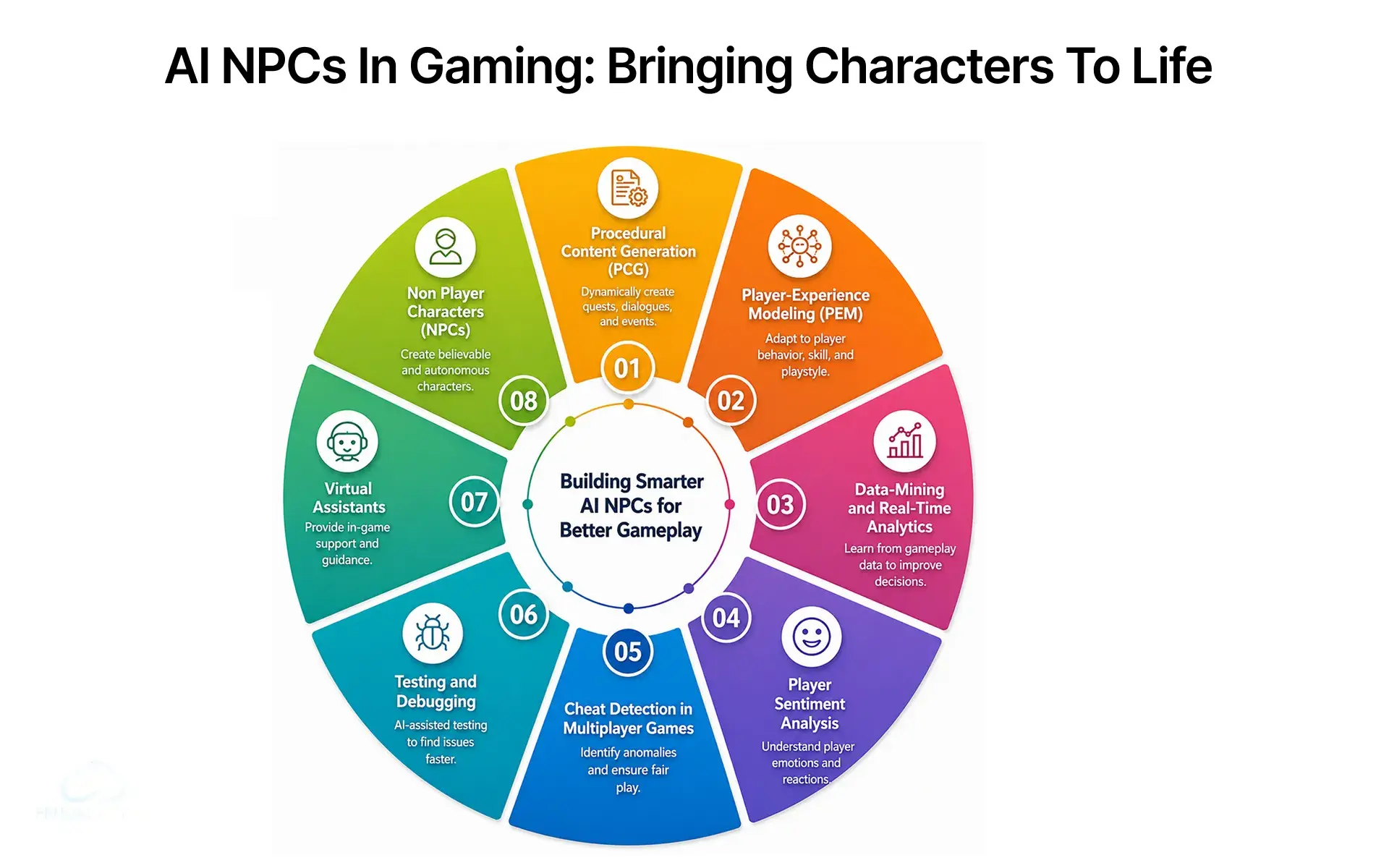
The Nemesis System previewed what AI-driven NPCs now generalise across entire game worlds. Procedural content generation lets AI characters produce context-appropriate responses without a developer writing each one. Computer vision, as seen in Convai, lets characters understand the game environment visually. Relationship building becomes genuinely dynamic: player behaviour shapes how non-player characters respond to that specific player over time.
Real Games Already Doing This: What It Feels Like to Play
The gaming industry has moved faster on AI NPCs than most people realise. Several major titles are already shipping characters built on natural language processing and deep learning, and the player experience is noticeably different from anything scripted. Here is what that looks like in practice.
PUBG's AI Teammate That Talks Strategy With You
- Powered by NVIDIA ACE: real-time tactical advice, loot sharing, and combat support with no second human player needed
- Player interactions with PUBG Ally feel like playing with a friend, not following a scripted tutorial.
Ubisoft's Squad Members Who Read Your Mood
- From Ubisoft's Teammates experiment: AI squad members that respond to voice in real time and pick up on tone, not just words
- Each carries consistent emotional states; the human writer sets the rules, the AI improvises inside them, and interactive storytelling stays coherent
inZOI's City of Characters Who Have Their Own Lives
- Smart Zoi gives 3D characters their own behavioural learning and autonomous decision-making
- Instead of fixed daily loops, characters react to the game environment around them: a kind-natured character might stop to help a stranger and adjust their own schedule, making these immersive worlds feel genuinely inhabited
The Tools Game Developers Are Using to Build AI Characters
Three platforms are leading the way when it comes to giving game developers the infrastructure to build AI-driven NPCs at scale. Each takes a different approach, so the right choice depends on what your game needs.
NVIDIA ACE: The Platform Behind Autonomous Game Characters
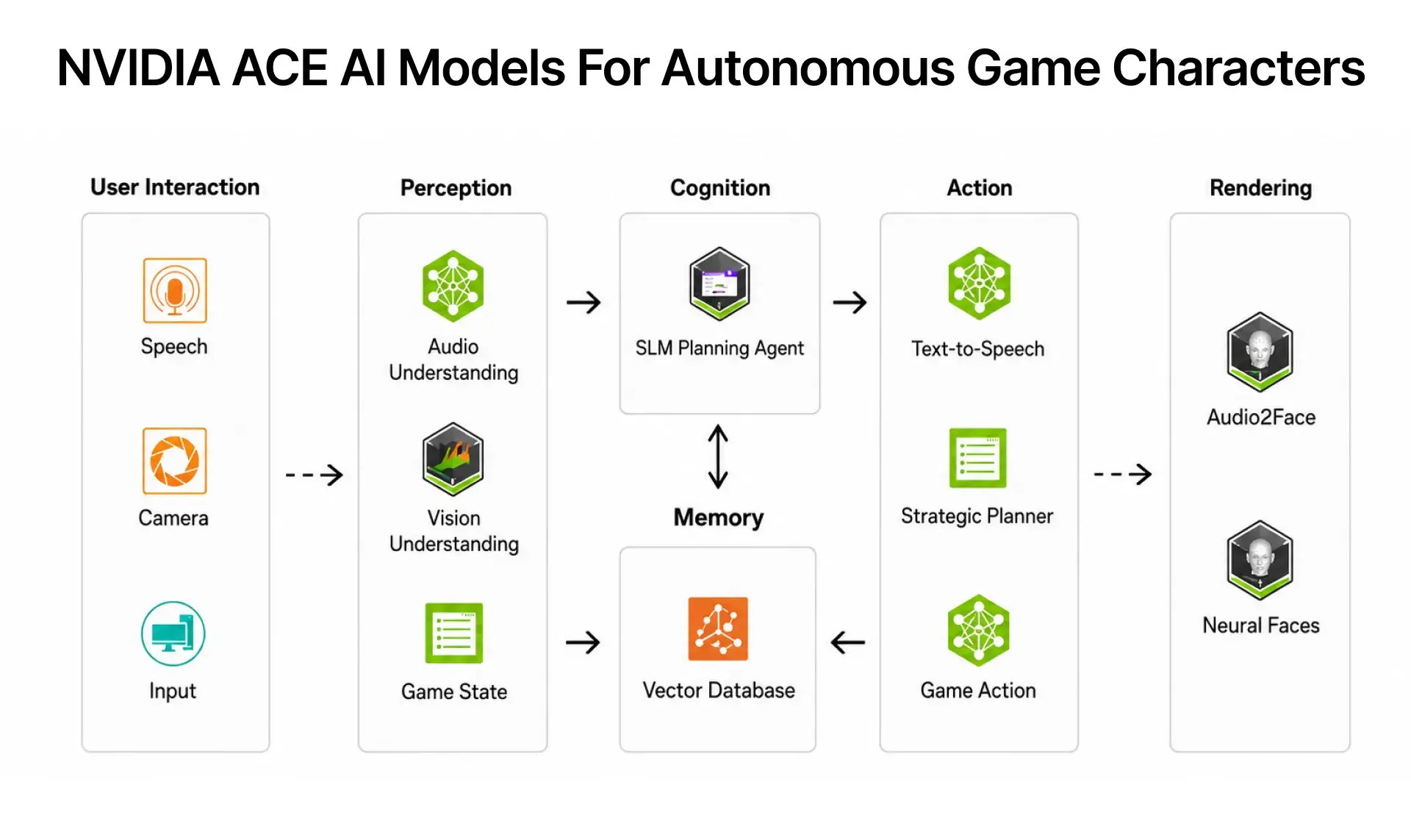
NVIDIA ACE gives 3D characters voice input, reply generation via the Avatar Framework, and real-time facial sync. Optimised setups achieve under 200 milliseconds of response latency. Live in PUBG, inZOI, and NARAKA: BLADEPOINT Mobile right now.
Inworld AI: Giving Characters Personality, Feelings, and Memory
Inworld AI builds characters with defined emotional depth, long-term memory, and consistent emotional states. The mobile game Status reached 500,000 daily active users in 19 days, with players averaging 90 minutes per session. Unity and Unreal Engine plugins are both available.
Convai: Characters That Can See What Is Around Them
Convai's standout capability is computer vision integration: AI characters understand the game environment visually. The Convai Playground lets game designers prototype character behaviour without writing code, and player behaviour feeds back into responses, creating genuine dynamic NPC AI. Unity and Unreal Engine are both fully supported.
What Most People Do Not Tell You About AI NPCs
Most coverage focuses on what is impressive. Three things consistently missing from top-ranked content are worth understanding before you build.
AI Characters Can Still Say the Wrong Thing: Here Is How Developers Handle It
Language models inside virtual and augmented reality environments can produce responses that break character or contradict the story. The fix is disciplined: precise character definition, strict behavioural learning rules, and pre-launch testing to catch edge cases. Building AI-powered systems that are safe and scalable means this groundwork must happen before launch.
Making AI Characters Fast Enough to Feel Natural
When a player speaks, the game sends that input to a language model, waits, and plays the response back. If that cycle exceeds one second, the conversation collapses. Studios solving this split the load: smaller on-device models for quick interactions, larger models for high-stakes moments.
AI Characters and Real Voice Actors: A Conversation the Industry Is Having
SAG-AFTRA reached a new interactive media agreement in 2025 giving performers stronger rights over AI use of their voice and likeness in video games. Studios that have moved ahead with AI-generated voices without player-facing transparency have seen real audience pushback. Character development built on AI needs an ethical framework from day one, not retrofitted after launch.
How BuildNexTech Helps You Build Smarter AI Experiences
The conversational AI stack behind AI NPC games powers customer service, training simulations, and onboarding flows across industries. The engineering is identical regardless of context. BuildNexTech has helped 150+ teams across 30+ industries go from first conversation to live deployment in 30 to 45 days, cutting manual processing by over 60% and building AI systems that respond in under half a second.
We have worked across fintech, healthcare, retail, edtech, and logistics. Whether you are building a game character with long-term memory and emotional depth, or a customer-facing AI agent that needs to stay on-brand across thousands of player interactions, the approach is the same: define the personality clearly, build the speed architecture correctly, and test obsessively before it reaches real users.
What Working With BuildNexTech Actually Looks Like
Week one, we sit with your team, understand what you are building, and map which AI approach actually fits. There is no one-size-fits-all answer. Week two, we design the character's personality, emotional states, and behavioural rules. Weeks three and four, we build and integrate into your game engine or product. From week five onward, we test with real players, tune based on player behaviour data, and hand it off ready to ship. You own the result. We are not a subscription you depend on indefinitely.
Who This Is for You
You are building a game and want non-player characters that feel genuinely alive, not characters that loop the same three responses until a player stops caring. Or you have a prototype that keeps going off-script in testing and you cannot work out why. Or you watched a demo of NVIDIA ACE or Inworld AI, knew immediately you wanted something like it, and have not found a team to take it from demo to production. If any of that sounds familiar, we would like to hear what you are working on.
KeyTakeaways
- Dialogue trees were a production constraint. Generative AI removes that constraint at scale.
- Real AI NPC games are live in 2025: PUBG Ally, Smart Zoi, and Ubisoft's Teammates are shipping or in active testing.
- NVIDIA ACE, Inworld AI, and Convai are the dominant platforms. Natural language processing, computer vision, and behavioural learning differ across each.
- SAG-AFTRA's 2025 agreement means the voice consent question needs an answer before launch, not after.
- The same conversational AI stack powering AI NPC games applies directly to enterprise AI agents, customer service, and onboarding flows across any industry.
The Conversation Is Already Happening Inside Your Competitors' Games
That barkeep who remembered your bar fight is a signal of where immersive worlds are heading. Studios getting this right in 2025 will have engagement numbers that look inexplicable to anyone still shipping scripted characters. We are ready to have that conversation.
People Also Ask

What is an AI NPC and how is it different from a regular game character?
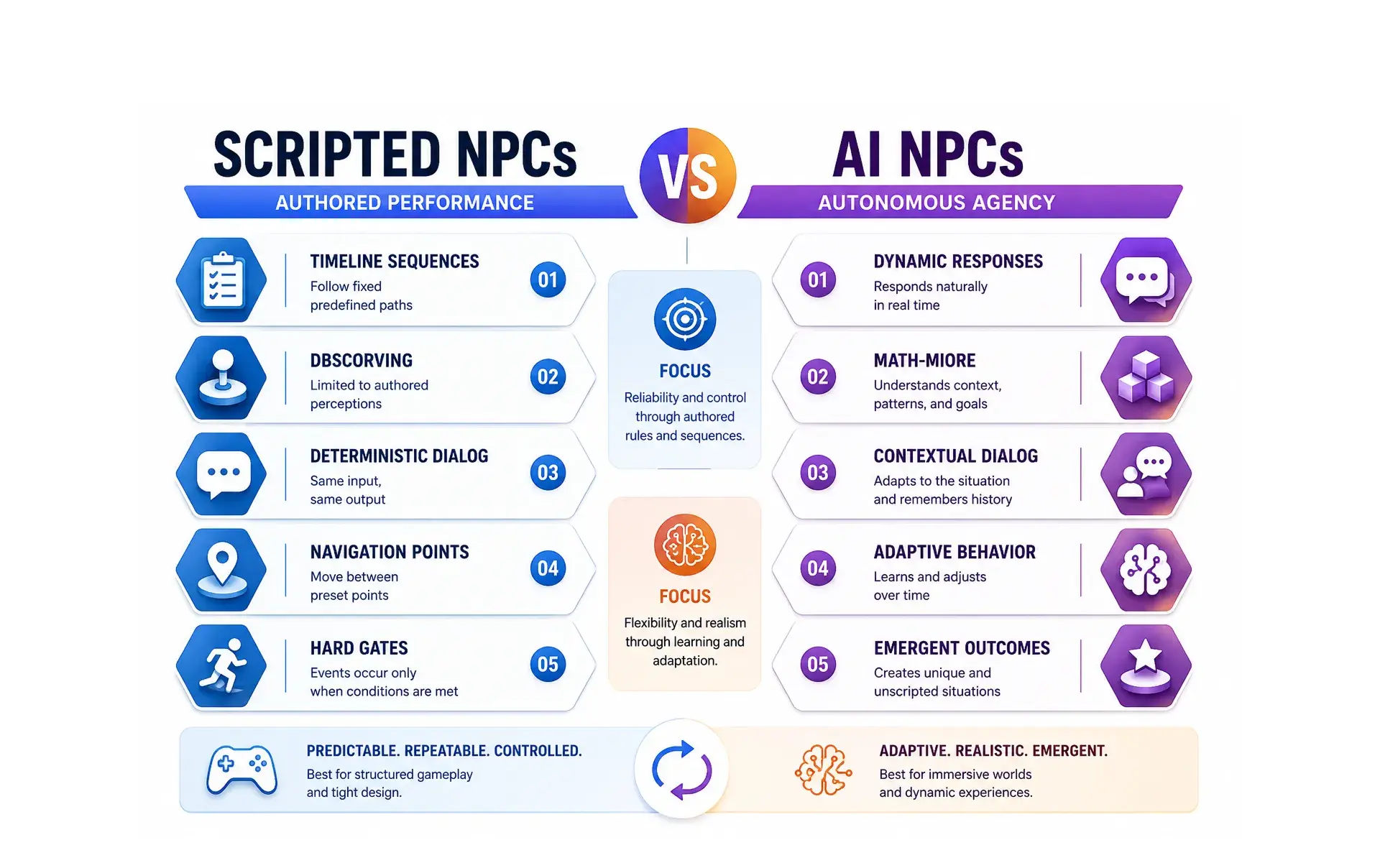
A regular character reads from pre-written dialogue trees. An AI NPC uses natural language processing to generate unique responses in real time, adapting to each player's behaviour and history.
Which games have AI NPCs right now in 2025?
PUBG Ally, Smart Zoi in inZOI, and NARAKA: BLADEPOINT Mobile are all live. Ubisoft's Teammates is in active testing. Inworld AI's Status hit 500,000 daily users in 19 days.
Do AI game characters actually remember what you did before?
Yes, if long-term memory is built into the system. Characters store key player interactions and surface them later. Some systems reset each session depending on performance configuration.
Will AI characters replace human writers and voice actors in game development?
No. Human writers define personalities, emotional states, and behavioural rules. AI generates conversations within those rules. SAG-AFTRA's 2025 agreement also explicitly protects voice performers' rights.
Can BNXT.ai help us add AI characters to our game or product?
Yes. BuildNexTech designs, builds, and integrates AI-driven NPC systems across Unity, Unreal, and web environments. We typically go from brief to live in under 45 days. Contact us here.


.webp)
.webp)
.webp)

.webp)
.webp)