

Every enterprise has a copilot story right now. GitHub Copilot rolled out, developers liked it, code review got faster, and then six months later, someone asked why delivery timelines had not moved. The answer nobody wants to give: a copilot and an autonomous AI agent are not the same thing, and conflating them is costing engineering teams months of misallocated expectations.
Across 150+ client engagements spanning customer service, supply chains, and Human Resources, the pattern is consistent. Organisations that plateau on Copilot ROI are not failing at AI adoption. They are using the wrong category of tool for the job. This blog breaks down the architectural difference, where autonomous AI agents outperform copilots, and what a production-ready deployment actually takes.
The Copilot Ceiling: What Assistive AI Can and Cannot Do
A fintech team came to us fourteen months into a Microsoft 365 Copilot rollout with a familiar problem. Emails drafted faster, meeting summaries automated. But the compliance team was still manually pulling data from three systems every Friday. The copilot had made people faster at their tasks. It had not touched the workflow at all.
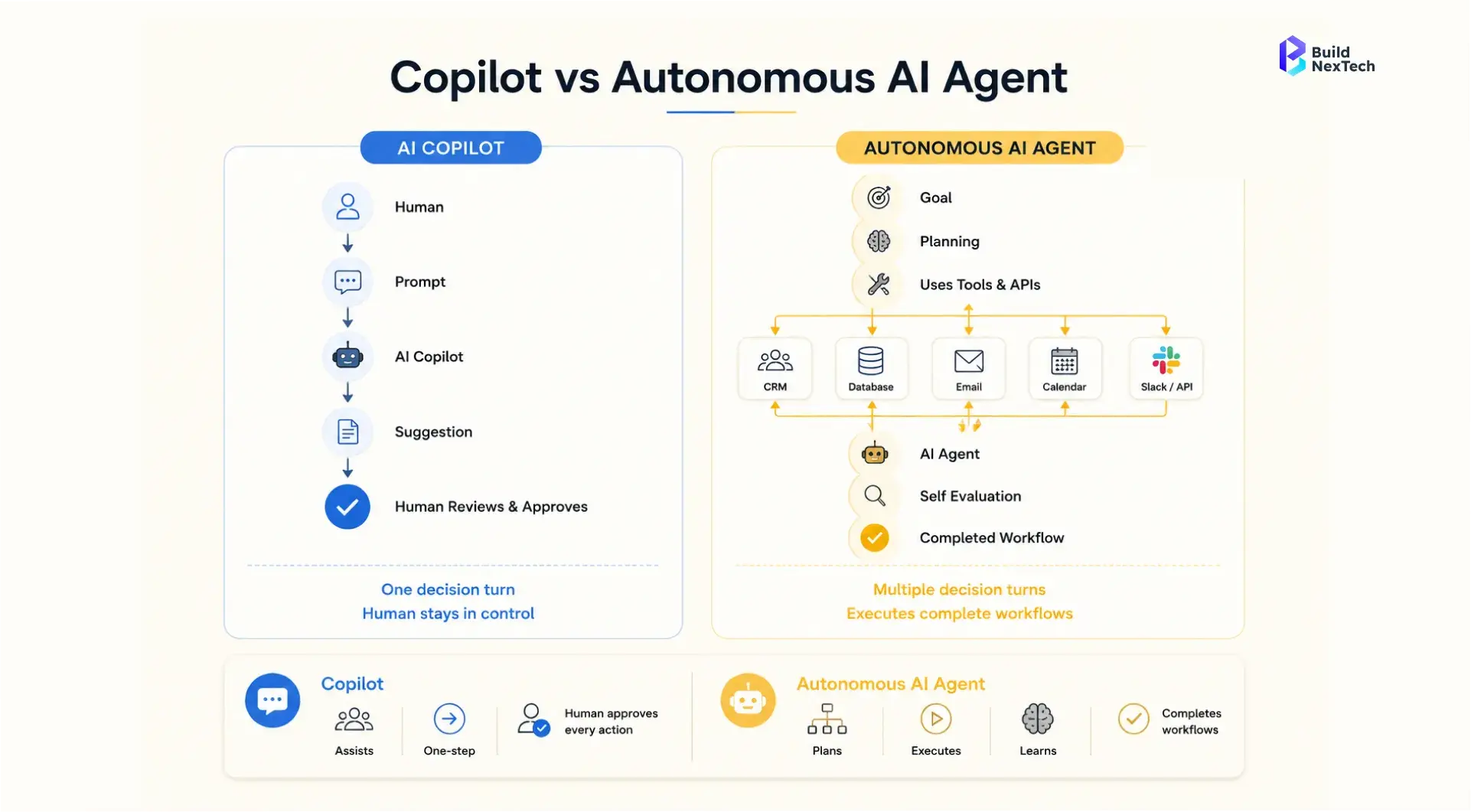
That is the ceiling, and it’s architectural. Copilot is an application working on a one-input-one-output cycle: the human asks for something, and then the machine provides a response for consideration. It works with drafting, summarizing, and code completing.
It breaks the moment the problem requires more than one decision turn, more than one system, or action without a human in the approval seat. GitHub Copilot and Microsoft 365 Copilot are the clearest large-scale examples: strong individual productivity signal, negligible workflow transformation.
The decision turn count makes this concrete. One turn before human approval is a copilot. With five or more turns, the AI agent becomes autonomous: the system sees a goal, plans how to achieve it, executes the plan using various tools and APIs, and then achieves the goal.
Why 'Human-in-the-Loop on Every Step' Breaks at Scale
The instinct to keep humans in every approval seat feels like good governance. At enterprise throughput, it becomes the bottleneck. A McKinsey analysis found organisations moving to agent-executed workflows achieved 40% higher productivity gains, specifically because they removed human checkpoints from routine decisions and reserved them for genuinely ambiguous cases.
What Autonomous AI Agents Actually Are: Architecture First
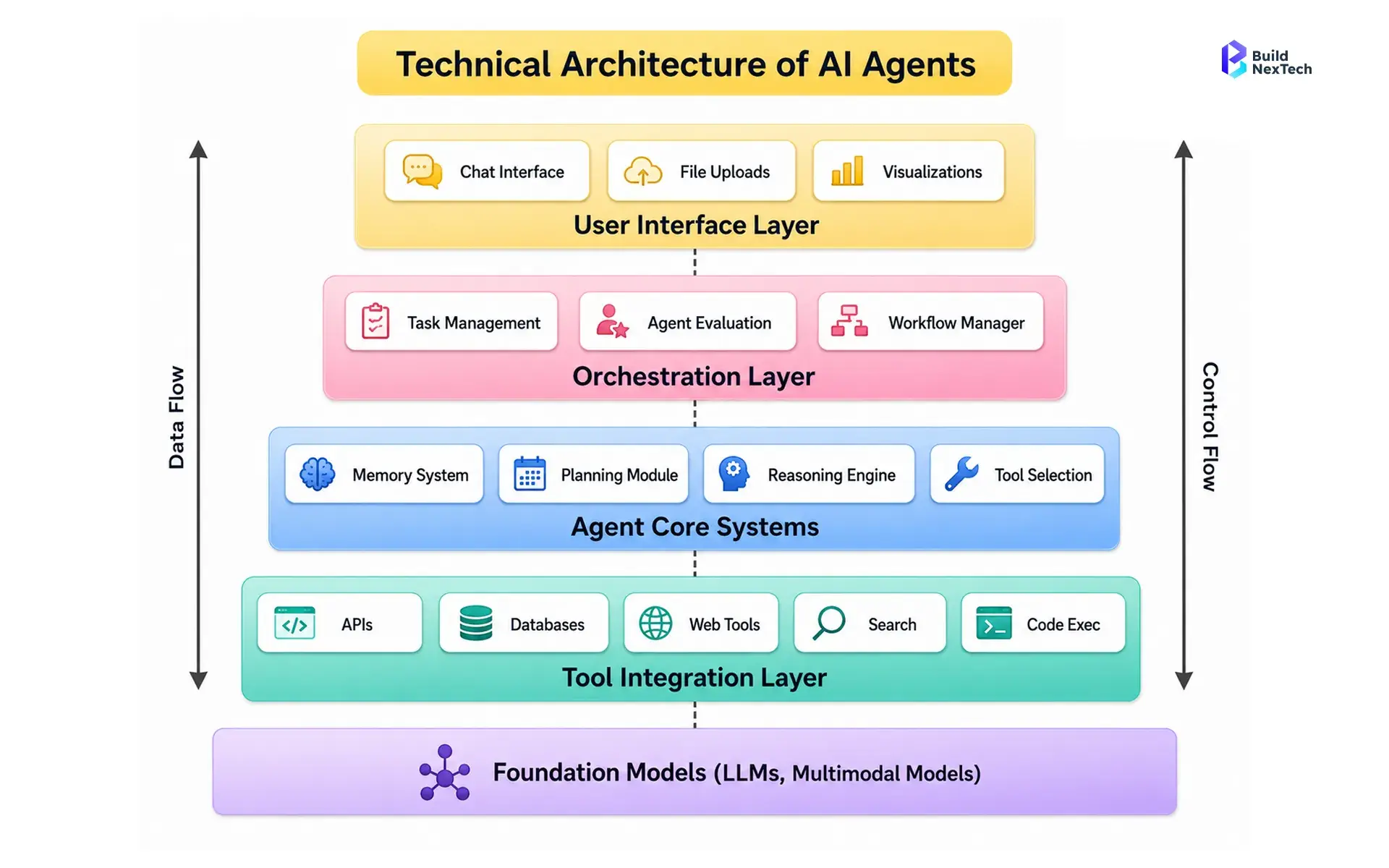
An autonomous AI agent is an entity that senses an objective, reasons through several stages based on machine learning algorithms, performs actions with the help of tools, and loops until the objective is achieved without seeking human approval after each step of the process.
The agent does not wait for a command to be given. It acts, checks its work, corrects, and shows the result only when the job is done or a critical decision needs human input.
Five components make this possible in any production-grade agent:
The contrast with a copilot is not subtle. A copilot drafts an email. An autonomous AI agent researches the account, identifies renewal risk using predictive analytics, drafts the outreach via conversational AI, creates a CRM task, and requests approval only before sending. Copilot Studio is moving toward this architecture, but most enterprise deployments still require custom orchestration to reach true multi-step autonomy within a real agent framework.
Decision Turn Count: The Metric That Separates Copilots from Agents
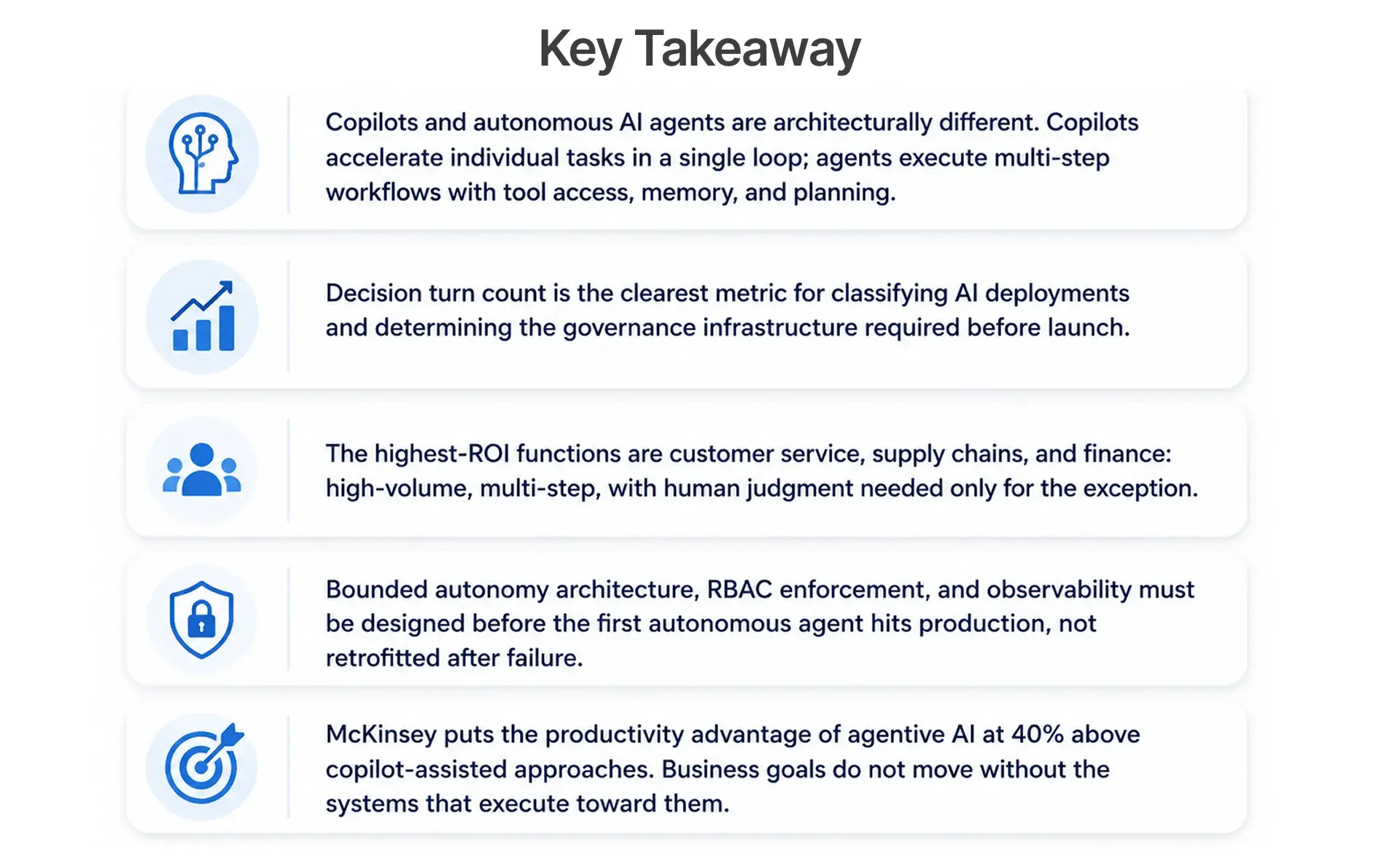
Decision turn count is the most useful classification tool for engineering leads. One turn: copilot. Five or more: autonomous agent. This metric sets the governance model required, the observability infrastructure needed to audit behaviour, and the risk profile of the deployment.
A team that designs a five-turn agent without an audit trail is not running an AI system. It is running an unmonitored decision-maker with API access.
Where Autonomous AI Agents Outperform Copilots: By Function
Where does agentic AI actually move the numbers? The answer is consistent across customer service, supply chains, and business intelligence functions.
Finance and Operations Workflows
Invoice processing, expense auditing, and financial reconciliation are where autonomous AI agents routinely handle almost every task end-to-end with no human touchpoint. The agent ingests a document, extracts line items using natural language processing, cross-references purchase orders, flags discrepancies, and routes exceptions to a reviewer, completing the workflow in seconds rather than days.
For a UK financial services firm, digital workers returned 1.2 million hours annually by owning this class of multi-step operation. Robotic process automation handled the structured tasks; autonomous AI agents handled the reasoning layer on top. That combination is what moves finance operations from faster to fundamentally different.
Customer Experience and Support Resolution
Support chatbots and autonomous AI agents are not the same thing. A chatbot matches intent to a scripted response. An agent accesses CRM history, identifies the root cause, drafts a resolution, updates the ticket, and issues a refund where policy permits, without a human rep in the loop for standard paths.
The 2026 Salesforce State of Service: AI Agents Edition report found that agentic support has achieved mainstream adoption across 66% of service organizations, with deployments directly driving customer satisfaction (CSAT) as the top-improving KPI. For a 400-location US retail chain, BuildNexTech's agentic AI auto-resolved 64% of IT tickets without human intervention. The agent did not just close tickets faster; it changed what the support team spent their time on entirely.
The Governance Gap: Why Most Enterprise Agent Deployments Stall
A logistics firm brought us in after their autonomous AI agent project hit a wall at week ten. The agent worked in testing. It failed in production, not because the model was wrong, but because nobody had mapped what it should do when encountering a data record that violated three business rules simultaneously. That is a governance failure, not a model failure.
The OutSystems 2026 State of AI Development report found 97% of enterprises are exploring autonomous AI agents, but only 36% have a centralised governance model in place. And Founder Reports' AI in the Workplace Report showed that 44% of employees say their company does not have a clear AI policy, or they're not sure if one exists. Gartner projects 40% of agentic AI projects will be cancelled by 2027 due to inadequate risk controls.
Data privacy requirements compound this: agents accessing customer records across systems require explicit permission boundaries before touching production data. The gap between organisations exploring agents and organisations running them safely is almost entirely a governance gap, not a capability gap.
What Bounded Autonomy Architecture Looks Like in Practice
Bounded autonomy means agents operate within explicit operational limits. Four controls are non-negotiable before any autonomous AI agent goes to production:
- Full observability: every action logged and traceable across the inference pipeline
- Human-in-the-loop gates: at high-stakes decision points identified during scoping
- RBAC enforcement: on all data, the agent can read and write
- Automated red-teaming: for prompt injection of vulnerabilities before launch
US enterprises should map deployments against the NIST AI Risk Management Framework. Multimodal AI and Synthetic Data capabilities introduce additional surface area that governance models must explicitly address.
How BuildNexTech Accelerates Enterprise Agent Deployment Without the Governance Gap
Most engineering teams spend six to twelve months on infrastructure before a single production agent ships. That timeline is not model development; it is the orchestration layer, observability tooling, multi-agent coordination logic, and governance controls. Generative AI and Voice AI capabilities have accelerated what agents can do. They have not simplified what it takes to deploy them safely.
BuildNexTech's AI services platform eliminates that runway: low-code agent orchestration with built-in observability and bounded autonomy gates, RBAC enforcement from day one, model routing across multiple LLMs, and multi-agent coordination that manages context handoff and exception escalation automatically. Teams that have worked with BuildNexTech go from concept to a production-ready agentic AI workflow in days rather than months.
For a US digital bank, agentive AI cut manual underwriting by 65%. For a US hospital system, AI virtual assistants reduced administrative burden by 40%.
What a BuildNexTech Agent Deployment Looks Like
The sequencing is consistent across every AI agent development engagement:
Who This Is Built For
This fits engineering-led organisations at Series B through enterprise scale, already running AI in at least one function and hitting the Copilot productivity ceiling. Three situations signal the right moment: copilot ROI has plateaued; an agent built in-house is becoming too complex to manage; or data privacy requirements are blocking production because the audit trail was never designed in.
If any of those sound familiar, the answer is not a bigger team or a longer runway. The case studies show how teams in each of these positions moved forward in weeks.
The Window for Deliberate Deployment Is Closing
The copilot wave moved fast. The autonomous AI agent wave is moving faster. The organisations that lead are not those with the biggest AI budgets; they are the ones who treated this as an operating model decision, not a tooling upgrade.
They designed the governance infrastructure before discovering the gaps in production. Business goals do not move without the underlying systems that execute toward them. That decision, made in the next six months, will compound for years.
People Also Ask

What is the difference between an AI copilot and an autonomous AI agent?
A copilot assists within a single prompt-response loop: the human reviews every output before anything happens. An autonomous AI agent pursues a goal across multiple decision turns, completing the workflow before surfacing a result.
Is GitHub Copilot an autonomous AI agent?
No. GitHub Copilot is a code-completion assistant that enhances individual developer output within a single interaction. It does not orchestrate workflows or take multi-step actions independently.
How do enterprise AI agents handle data privacy and compliance?
Production agents require a bounded autonomy architecture: RBAC enforcement on all data access, a full audit trail of every action, human-in-the-loop gates at high-stakes decision points, and alignment with NIST AI RMF.
What does an AI agent development project involve?
Four stages: workflow scoping and decision-turn mapping (days one to three), system integration (days four to seven), supervised deployment against performance gates (week two), and iterative autonomy expansion based on logged precision rates (week three onward).
Should we build autonomous AI agents in-house or use an agentic AI service?
Building in-house typically requires six to twelve months of infrastructure work before a single production agent ships. An agentic AI service compresses that to weeks by providing the orchestration, observability, and governance layer pre-built.


.webp)
.webp)
.webp)

.webp)
.webp)