

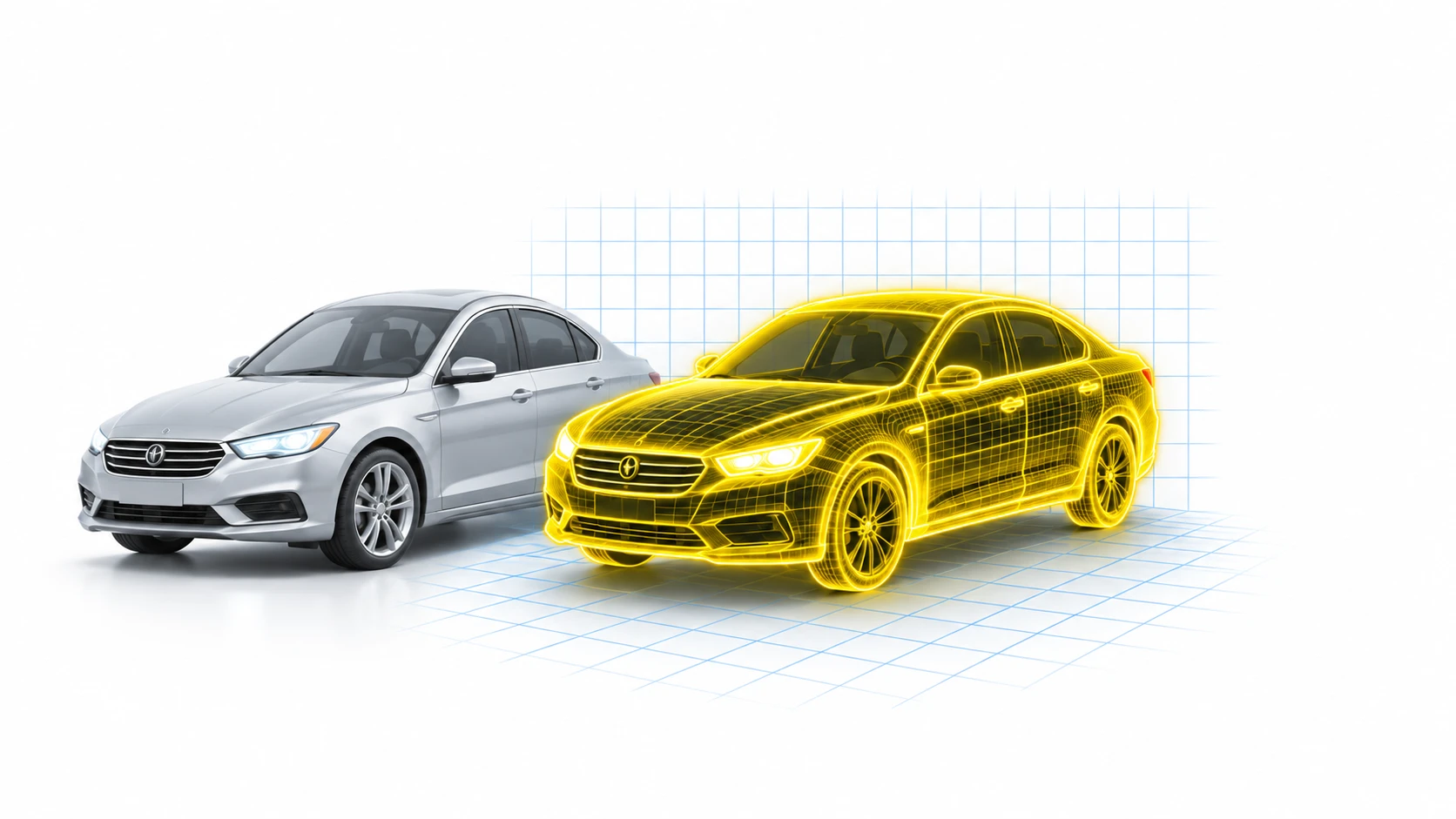
Picture yourself on a factory floor, glancing from a running machine to a screen showing its virtual double. The screen reveals more than the steel in front of you: live performance, internal behaviour, and early warnings about faults that have not happened yet. On a bottling line, that could be a filler motor's bearing quietly wearing out.
That virtual double is a digital twin: a model fed by real-time data that turns wear into an early signal instead of a surprise stoppage. Across 150+ client engagements, BuildNexTech has seen teams succeed and stall with this technology. This guide covers how twins work, how they predict failures, and where projects break.
What Is a Digital Twin?
A digital twin is a data-driven virtual model of a physical object, system, or process, kept current by real-time data. Hence, it mirrors how the original behaves and changes. That is the digital twin definition. It joins sensor data, engineering models, and analytics, so teams can test scenarios on the copy before changing anything real. Some vendors call advanced versions digital doppelgängers.
Every twin mirrors something specific. It can cover many kinds of real-world objects:
- Physical assets: Single machines, vehicles and aircraft engines.
- Production systems: Assembly lines and whole factories.
- Infrastructure: Buildings, bridges, power grids and transport networks.
- Complex environments: Smart cities, energy systems and hospitals.
Components of a Digital Twin System
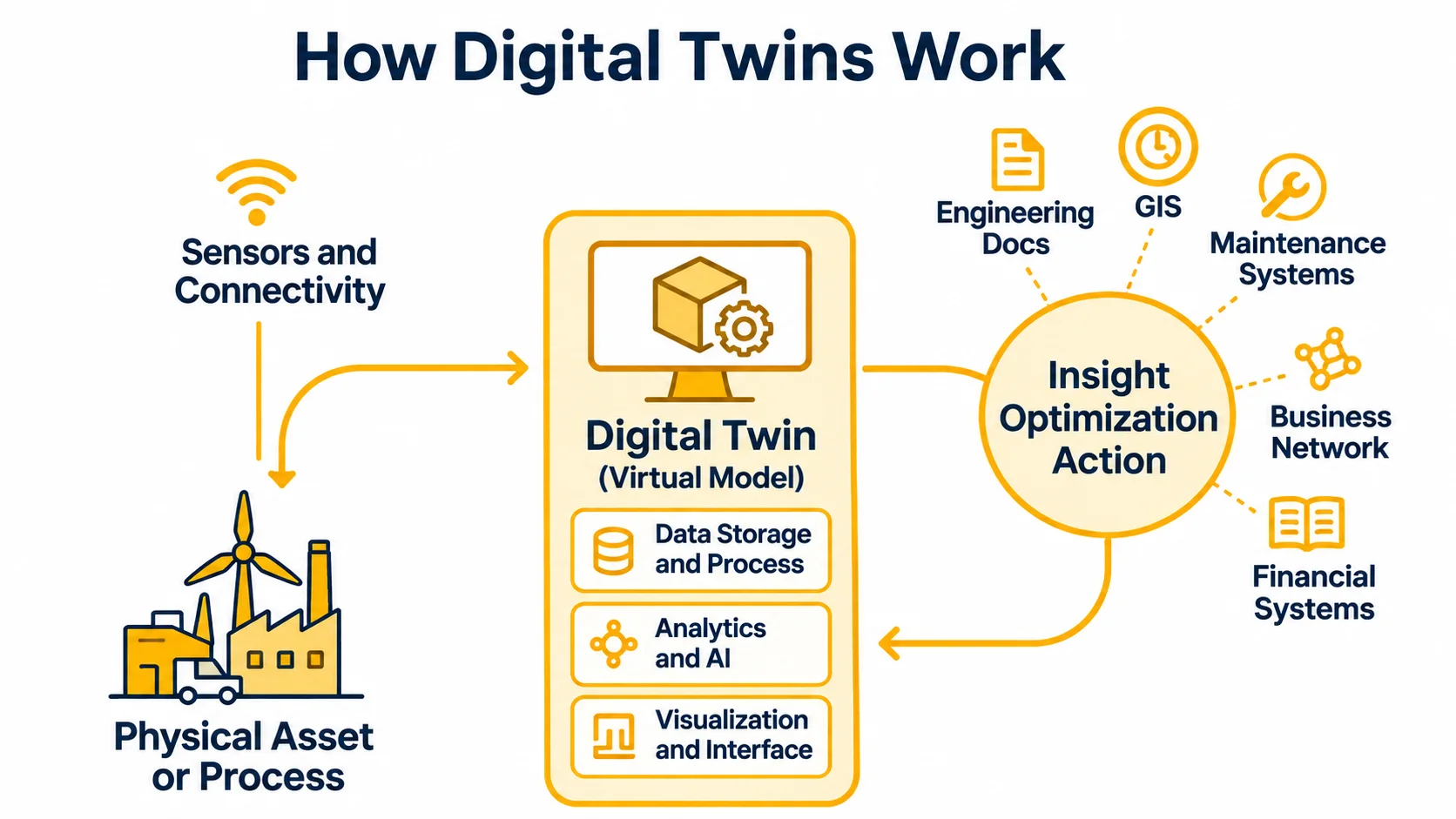
A digital twin runs on a connected set of technologies that tie a physical operation to its virtual copy. The six components are:
- Physical asset and IoT sensors: The machine or process itself, with sensors recording temperature, pressure, vibration, and speed.
- Data pipeline: Carries sensor data to the digital side and merges it with enterprise systems.
- Virtual model: A digital copy of the asset's structure, operating limits, and performance history.
- Analytics engine: Uses AI, machine learning, and predictive models to spot unusual behaviour and test changes.
- Visualization dashboards: Show live conditions through charts and 3D views, so teams see what needs attention.
- Feedback loop: Returns insight to the asset as operator guidance or automated adjustments.
How Does a Digital Twin Work?
Digital twin technology joins physical systems, data collection, networks, software models, and analytics. The architecture varies by application, but the pattern holds: IoT sensors send real-time data, artificial intelligence runs simulations, and a feedback loop returns decisions, so the model changes as reality does. Digital twin software such as Microsoft Azure Digital Twins and AWS IoT TwinMaker follows it, keeping a set frequency and fidelity.
Digital twin vs simulation is the question we hear most. Four terms matter:
- Simulation: Studies one process under assumed conditions, often as a one-off design test.
- Digital twin: Runs many processes on live data and returns decisions to the asset.
- Digital shadow: Receives live data from the asset but sends no decisions back.
- Digital thread: Links data across the asset's lifecycle, from design through service.
Types of Digital Twin Models
Types of digital twins run from narrow to broad. Hybrid twins blend physics-based mathematical models with machine learning.
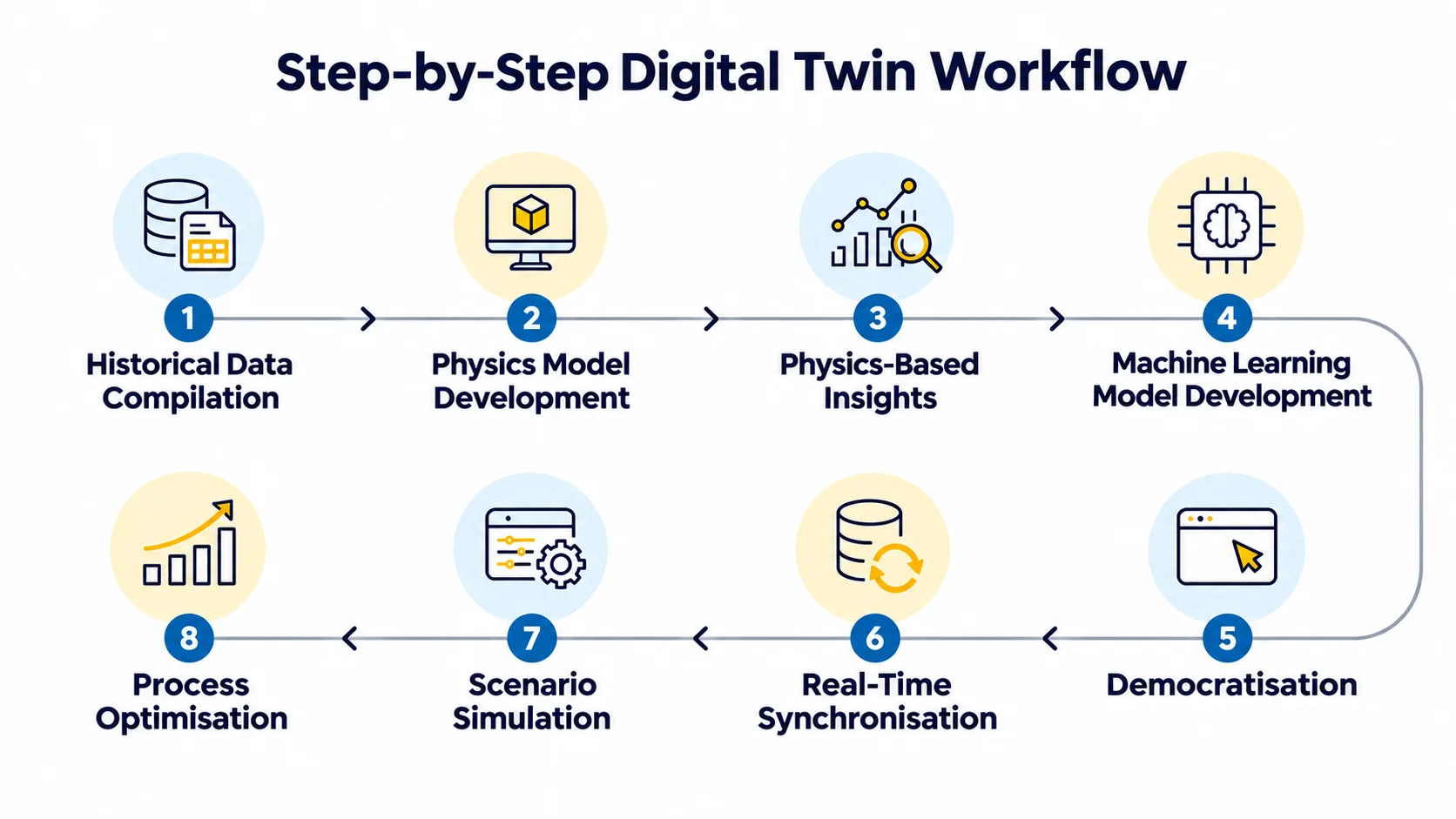
Step-by-Step Digital Twin Workflow
Eight steps cover most implementations:
How Digital Twins Predict Real-World Problems
A digital twin predicts problems by syncing live sensor data with a virtual model, then running AI simulations to forecast failures before they happen.
A US logistics fleet we worked with inspected vehicles on a fixed schedule and still lost trucks between checks. Its twin flagged the gap weeks before failure through four stages:
- Live intake: Sensors stream temperature, vibration, pressure, and load.
- Baselining: Readings are weighed against design limits and maintenance history, so normal load spikes are not read as faults.
- Prediction: Machine learning and physics-based models spot subtle anomalies and estimate when a part will degrade.
- Feedback: Alerts and suggested adjustments reach operations before a breakdown.
Predictive Maintenance with Digital Twins
Readers often search for what predictive maintenance is, and the answer is simple: Servicing equipment when data says it is needed, not when the calendar does. It replaces guesswork:
- Degradation tracking: Live vibration, heat, and current readings are compared with a physics-based baseline.
- Remaining useful life: Predicting equipment issues starts with sensor trends and failure history, projected forward.
- Predictive maintenance machine learning: Gradient boosting or LSTM networks produce the forecast.
- Virtual repair testing: Engineers trial fixes in the twin first.
- Targeted work orders: Alerts name the fault and part for technicians.
- Result: Predicting equipment issues early cuts downtime 30 to 50% for that fleet.
Anomaly Detection in Digital Twins
Anomaly detection algorithms fall into three families:
- Statistical thresholds: Flag readings outside a fixed band.
- Isolation-style models: Isolate rare readings.
- Learned baselines: Built from each asset's own history, so they adapt.
Real-World Digital Twin Examples by Industry
Digital twin use cases matter only when the twin changes a decision, and clinical trials follow the same logic. Smart manufacturing is where twins pay back fastest, while a smart city project works best starting with one corridor, not the whole city. Smart city technologies then scale from that proof. Nine uses stand out:
- Schedule testing: Process twins replay a proposed shift pattern against live data.
- Semiconductor fabrication: Process twins catch drift before wafers are scrapped.
- Additive manufacturing: Twins tune print parameters, including multi-material processes.
- Hybrid autonomous manufacturing: Machines self-adjust while humans handle exceptions.
- Maintenance link: Digital twins in manufacturing pair with predictive maintenance and enterprise asset management.
- Urban planning: Twins test signal timing before roads jam.
- Energy: Smart grid technology feeds load data into twins that cut energy use.
- Buildings: Readers ask what BIM is, which means building information modelling, a shared digital record.
- Carbon emissions: Twins show which retrofit saves the most.
Smart manufacturing and city projects share one pattern. Start with a single asset or corridor, prove the decision it changes, then scale.
Challenges of Implementing Digital Twins
Picture a plant with a 3D twin and six weeks of sensor history. The pilot dies in review. Capgemini found only 13% of organisations excel in the six areas key to effective deployment.
Run a data audit first, then unify sources with standard APIs, middleware, and data lakes on a proper data foundation. Connecting a twin to live control systems widens the attack surface, and a one-asset pilot costs a fraction of one unplanned stoppage. Eight points keep projects on track:
- Silos: Each department keeps its own tools, so one asset is described three ways.
- Inconsistent sensor formats: None surface until modelling starts.
- OT and IT friction: Two teams, two vocabularies.
- Controls: Apply NIST-aligned controls, encryption and role-based access, and segment OT networks.
- Vendors: Request SOC 2 reports.
- Data privacy: Patient data and clinical trial records raise the stakes, so data privacy rules apply from day one.
- Right-sized start: A minimum viable twin tied to one outcome, rolled out in stages.
- Skills gap: Data science, software, and domain skills are scarce, so upskilling builds the talent pipeline.
Top Applications of Digital Twin Technology
The digital twin market was valued at USD 24.48 billion in 2025, and four technologies power almost every application:
- IoT sensors: Capture sensor data from the asset.
- Artificial intelligence: Turns that data into predictions.
- Cloud computing: Stores history and scales the models on an AI-ready cloud foundation.
- Edge computing services: Process urgent data near the machine.
A twin of the customer journey, built from customer relationship management data, lets customer service teams test changes first.
Manufacturing and Industry 4.0: Smart manufacturing twins copy lines, machines, or whole factories. Replaying workflows predicts machine wear before a line halts and cuts unplanned downtime.
Healthcare and Patient Monitoring: Patient-specific twins test treatments virtually before clinical trials scale. Twins simulate patient response, so clinical trials need fewer participants, and a twin built from historical patient data can replace a placebo group and shorten clinical trials. Virtual testing screens risky candidates before clinical trials begin.
Automotive and Autonomous Vehicles: Carmakers use twins for design, crash testing, and fleet monitoring. Autonomous teams train driving AI in simulated environments before road trials.
Aerospace and Defense: Aircraft engines, flight systems, and maintenance schedules each get a twin. Operators forecast fatigue and shorten inspections.
- Energy, Utilities and Smart Grids: Supports energy-efficient network management.
- Construction and Building Information Modeling (BIM): Catches clashes before concrete is poured.
- Logistics and Supply Chain Optimization: The Port of Rotterdam guides vessels with a harbour twin.
- Agriculture and Precision Farming: Predicts irrigation needs from soil data.
How BuildNexTech Helps You Build Digital Twin Intelligence
BuildNexTech is the AI layer on top of your twin, built for AI-driven digital twins. Our AI-native architecture covers model routing, anomaly and forecasting agents, and observability across cloud computing and edge setups, while a low-code builder lets engineers adjust agents without releases, and no model lock-in keeps swapping easy.
Among AI consulting companies, we focus on one outcome: A twin that changes a decision. Our AI consulting services cover AI strategy consulting to pick the first asset, and AI integration consulting to connect the twin to your maintenance systems. See our case studies.
Conclusion
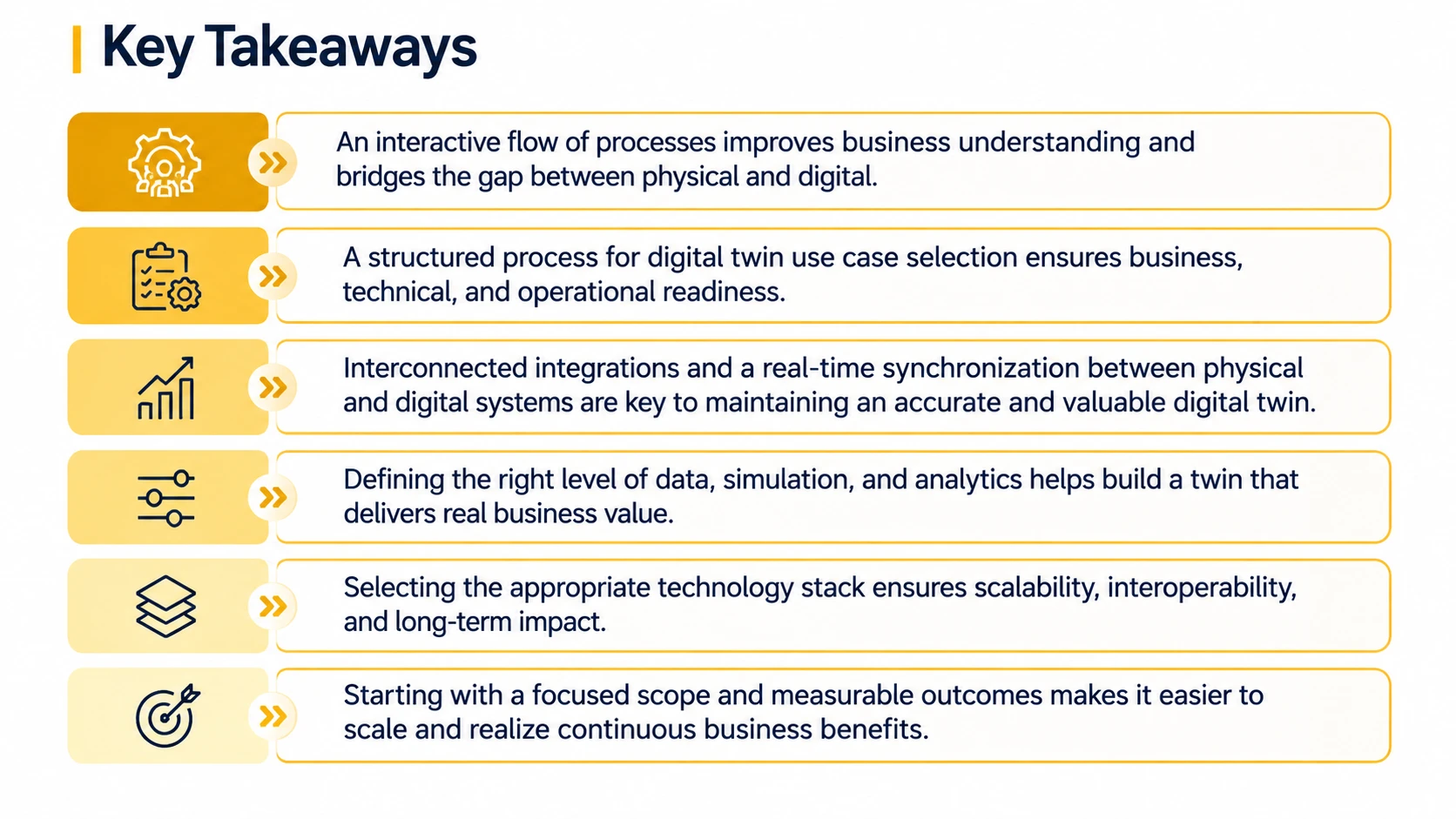
A digital twin earns its cost when it turns a signal into a decision before the asset fails. Teams that have worked closely with BuildNexTech, rated 4.3 on Trustindex, start with one asset and expand only once recalibration is routine and the alerts are trusted.
The technology is rarely the obstacle. Data quality, alert trust, and life after the pilot are, and whether your organisation can own that last part is a harder question than any vendor will raise. Few teams answer it honestly, and fewer answer it early enough.
People Also Ask

How do you add a digital twin to older machines that have no built-in sensors?
Retrofit clip-on vibration, temperature, and current sensors, then stream readings through a gateway. Many plants twin ageing equipment this way, keeping pilots cheap and fast.
How does a digital twin fit alongside SCADA and our existing monitoring tools?
A twin sits on top of SCADA, historians, and maintenance systems, reading their data and adding prediction. Existing tools keep controlling and recording, so nothing is replaced.
How do you combine data from machines made by different vendors?
Normalise the data first, so units match. Open protocols such as OPC UA and MQTT let mixed fleets feed one model, though proprietary formats still need adapters.
Which roles does a team need to keep a twin running?
You need a data engineer for pipelines, a domain engineer who knows the asset, and an ML specialist for models. One operations owner decides what each alert triggers.
What should we do with a twin when the physical asset is upgraded or replaced?
Version the model, update parameters and sensor mapping, retire stale training data, and rerun validation before trusting predictions on the modified asset. Treat it like a new release.