

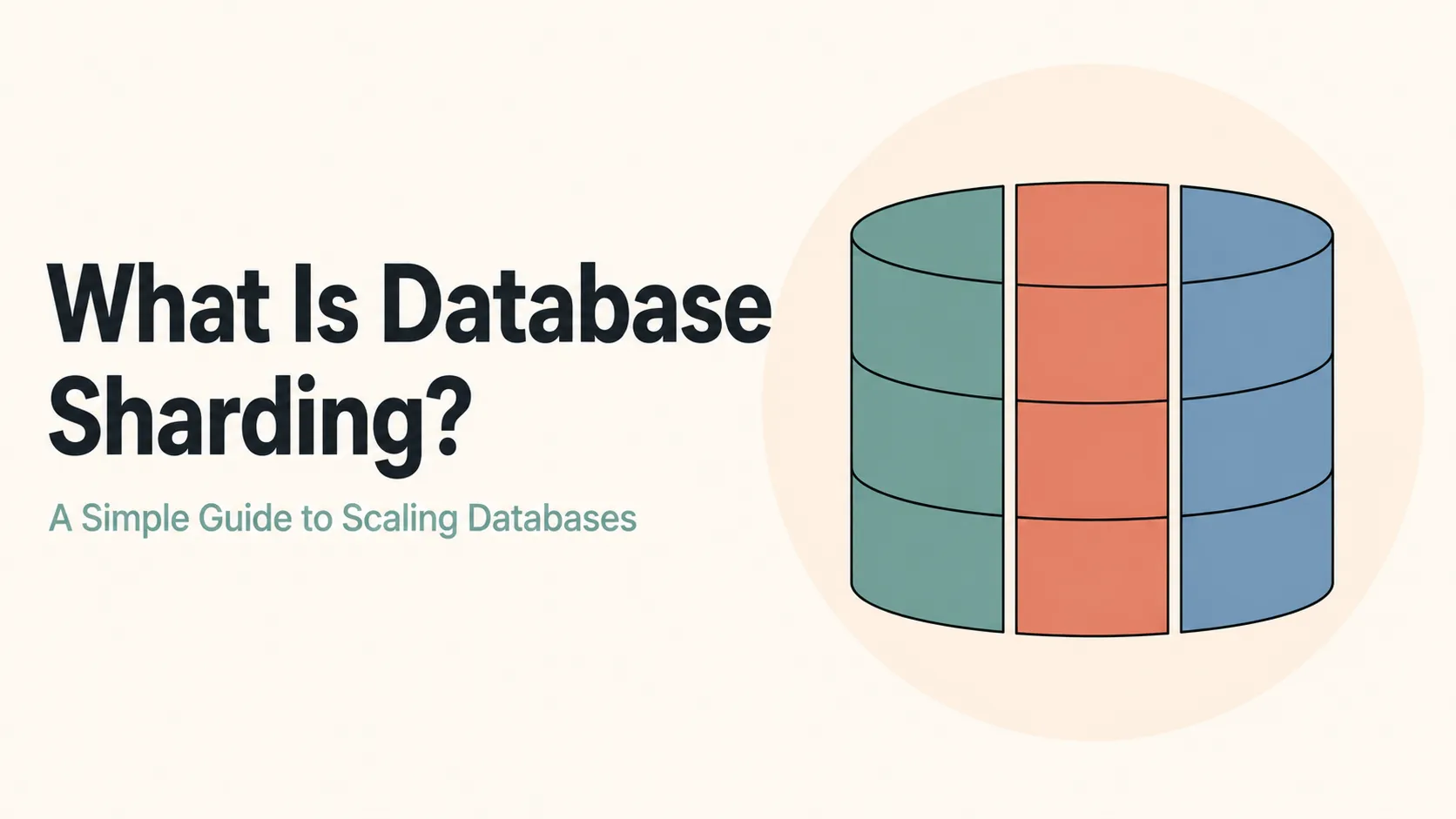
A fintech startup came to us sure their database needed sharding. Checkout queries kept timing out every Friday at peak transfer times. What is database sharding? Splitting a big database into smaller shards spread across servers. Sharded on a whim, this team would have traded one problem for a distributed systems problem they never needed.
Across 150+ client engagements in 30+ industries, we see this pattern often: Teams reach for sharding before trying indexing and query tuning. A 2026 benchmark shows the cost: Eight shards raised recall from 0.962 to 0.985, but slowed search from 4.19 to 22.65 seconds. This database sharding explained guide covers the database sharding definition and database scalability framework.
How Database Sharding Works
Database sharding, sometimes written as data sharding, means splitting one big dataset into smaller pieces called shards. This is horizontal scaling, also called horizontal sharding: add machines instead of making one bigger. Each shard uses the same schema but holds a slice of the data, so together they work as one system.
Here is what happens:
- The dataset splits into logical shards, each mapped to a physical shard on its own database server.
- Most systems use shared-nothing architecture: Each shard runs independently, sharing nothing with its neighbours.
- A router, load balancer, or application servers check each query, find which shard holds the data, and handle routing requests there.
- Get the shard key right, and a slow monolithic database becomes several faster ones. Get the data distribution wrong, and you add new failure points.
Done well, sharding a database delivers:
- Faster response times, since queries touch smaller datasets
- High availability and fault tolerance, since one shard failing doesn't bring the system down
- A better user experience under heavy query load, as traffic spreads across servers
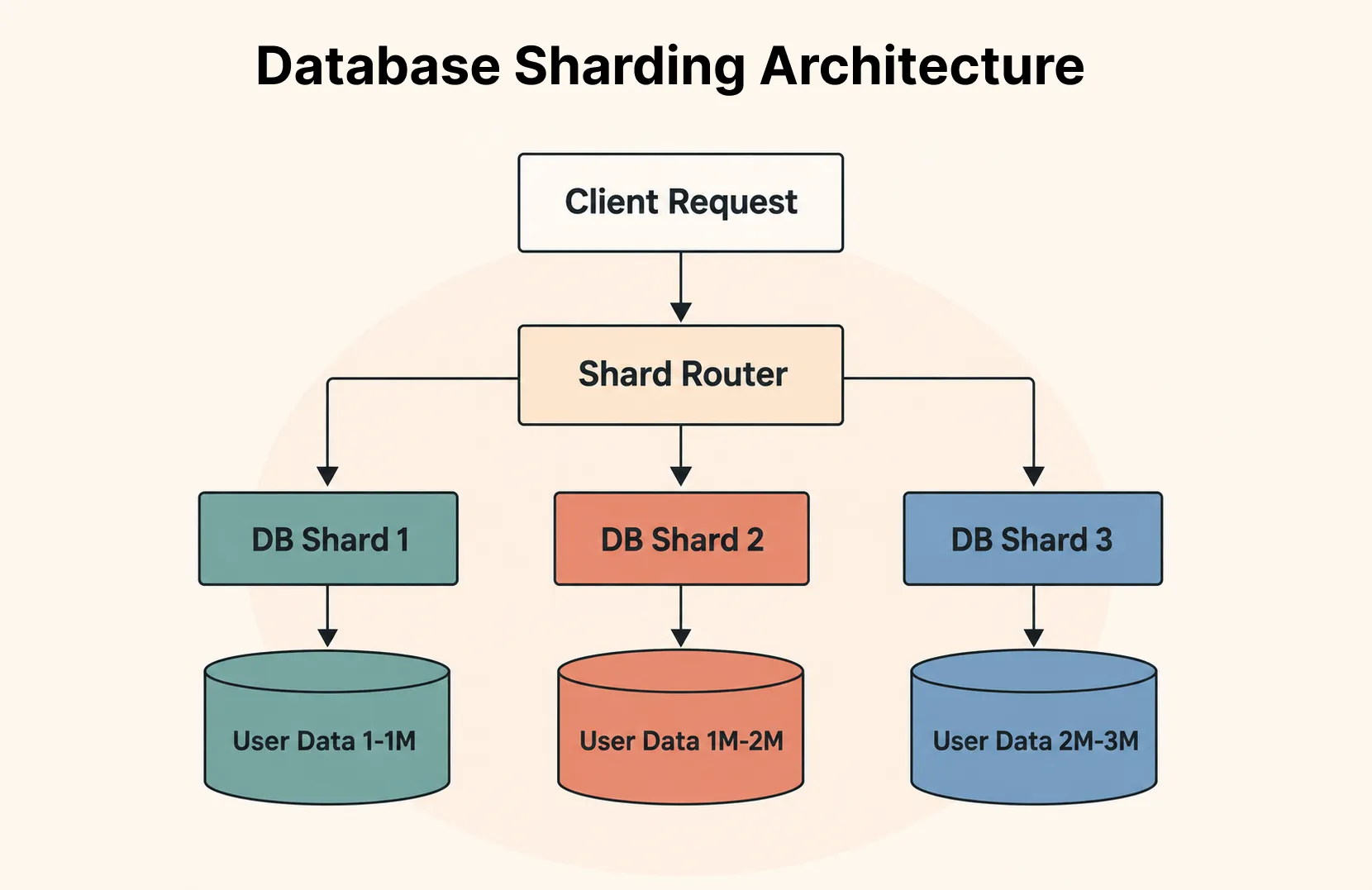
What a Shard Key Is and Why It Determines Everything
The sharding key, often just called the shard key, is the field or combination of fields that decides where each row lives. Get it wrong, and you create data hotspots, where one shard carries most traffic while the rest sit idle.
A workable shard key spreads data evenly and lines up with common query patterns, so most requests hit one shard instead of scattering under heavy query load. Picking a customer ID clustered around a handful of enterprise accounts is a textbook way to build database hotspots without meaning to.
Sharding vs. Partitioning vs. Replication
Sharding, partitioning, and replication solve three different problems. This is the classic database partitioning vs sharding question.
A team with a read-scaling problem can often solve it with replicas, never touching a database sharding vs partitioning decision. That is a cheaper fix.
Example: Partitioning vs. Sharding in a Multi-Tenant SaaS App
Consider a multi-tenant SaaS platform storing sales records. Partitioning that table by date range keeps everything on one server. Sharding the same database by tenant ID moves each tenant's data onto a separate physical shard, reached for once large tenants contend for a server's resources.
Common Database Sharding Strategies
Gartner puts 2024 growth in the nonrelational DBMS segment at 22.7%, nearly double relational systems' 10.8%, as teams outgrow a single instance. That is the proof: picking the right approach matters more. Four sharding architectures dominate: range-based, hash-based, directory-based, and geo-sharding.
Range-Based and Hash-Based Sharding
- Range-based sharding: Assigns contiguous blocks of shard key values to each shard, e.g., customer IDs 1 to 1,000,000 on shard one. It suits range criteria well, since "customers between X and Y" often touches one shard. The risk: Uneven activity turns one shard into a hot spot.
- Hash-based sharding: Runs the shard key through a hash function to pick a shard, spreading data evenly. Consistent hashing eases adding shards later. The tradeoff: Hashing destroys ordering, so range queries scatter.
Directory-Based and Geo-Sharding
- Directory-based sharding: Keeps an explicit lookup table mapping keys to shards. This directory approach is flexible, but the lookup service is a single point of failure if unmonitored.
- Geo-sharding: Is the geo-sharding database approach, partitioning data by geography and keeping infrastructure close to regional users, delivering lower latency plus a straightforward answer to data-residency requirements.
Range sharding suits predictable access, hash sharding suits even load, and directory or geo-sharding suits flexibility. Graph databases such as Neo4j sit outside this comparison, covered by a Neo4j 2025 graph database benchmark scalability study in the FAQ.
NoSQL Sharding in Practice: MongoDB
MongoDB's sharded-cluster model is the database sharding MongoDB engineers use daily: Shards, config servers, and a mongos router. Azure SQL sharding and SQL Server sharding exist too, but need more manual sharding effort. Citus, a distributed SQL database, extends this to PostgreSQL with standard SQL commands, a win for relational database scalability.
Choosing a Shard Key in MongoDB
- A MongoDB compound shard key, built from more than one field, gives finer distribution control than a single field allows.
- A MongoDB compound shard key example: Combine tenant_id with a created_at timestamp, spreading writes evenly while supporting date-range queries.
- Relational teams reaching for equivalent capability look at Vitess or Citus.
Changing a Shard Key in MongoDB
- Since version 5.0, this MongoDB change shard key process runs through live resharding, on a cluster that stays online.
- Resharding handles data migration and schema changes without the full rebuild once required.
- Setup on Atlas takes a day or two; an existing cluster takes weeks.
A logistics firm we worked with had a database timing out at peak hours. Our engineers audited query patterns first, found 80% of the load came from three poorly indexed joins, and closed the gap with indexing and a connection pooler. Downtime dropped by 30 to 50% without a line of sharding code; sharding earned its place six months later, once growth outpaced tuning.
Sharding Strategy Comparison
The table below offers a quick database scalability comparison across the four strategies covered above.
Which one fits your team?
- Under a few hundred GB with headroom? Partitioning and indexing.
- Queries hit predictable ranges? Range-based sharding.
- Even distribution matters more than range queries? Hash-based sharding.
When Sharding Makes Sense, and When It Doesn't
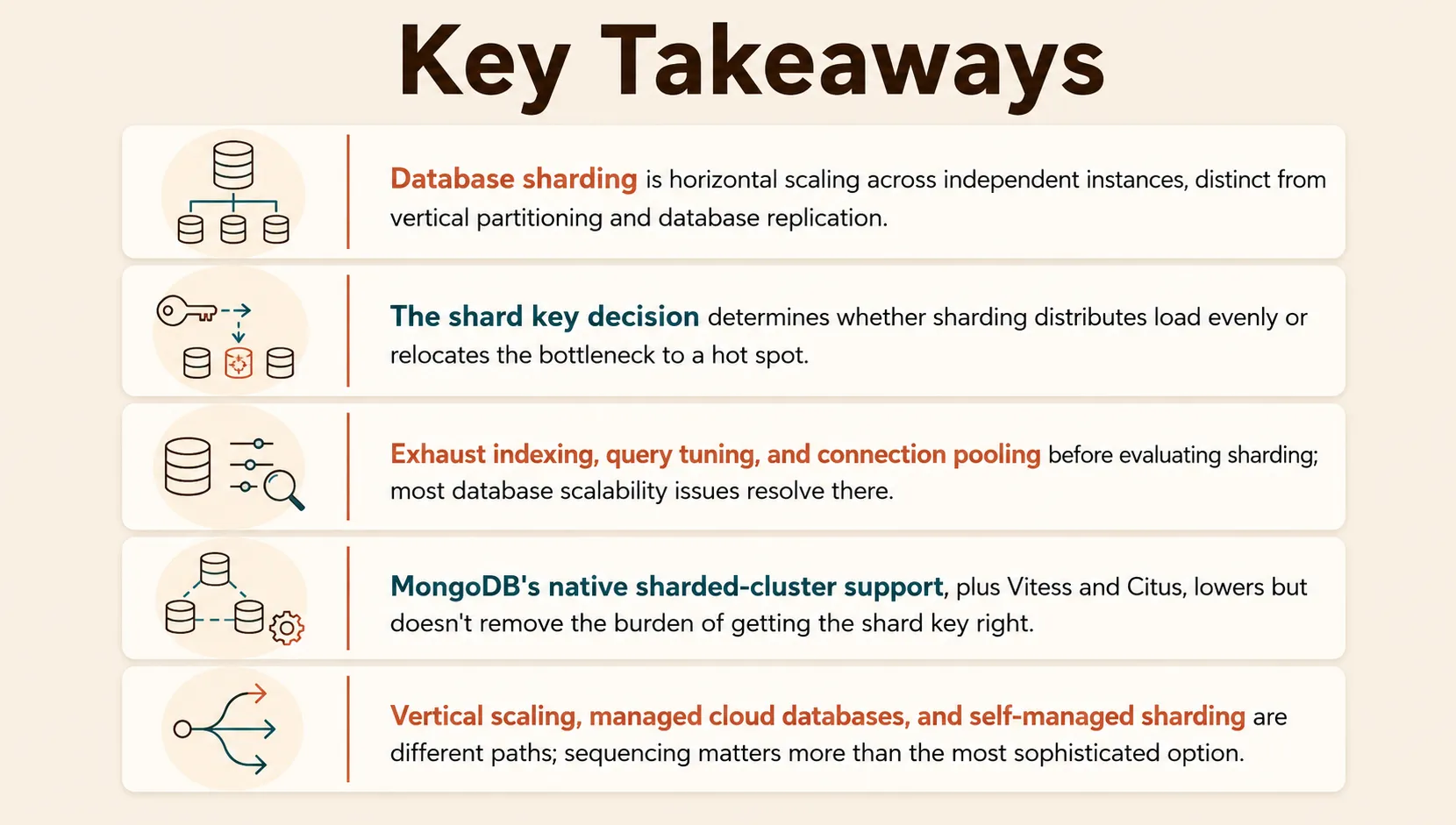
Exhaust indexing, query optimisation, and connection pooling before sharding enters the conversation. Those fixes solve most "our database is slow" tickets. Sharding earns its place only when a signal shows up, and budget holders should know the cost:
- A genuine storage ceiling on the current instance
- Sustained write throughput a single primary cannot absorb, even after tuning
- A hard data-residency requirement no tuning will satisfy
- Server costs and engineering hours before any added capacity
- Cross-shard query complexity and distributed transactions, adding coordination overhead
- ACID transactions once trivial on one instance, now needing coordination across shards
- Manual sharding without this groundwork, a common cause of malformed data, database outages, and system failure.
Choosing the Best Database Architecture for Scalability
Three distinct paths exist for scaling beyond a single instance, and the right database architecture pattern depends on consistency requirements, team size, and compliance posture. There is no single best database for scalability that fits every workload. What does scalability in a database mean? How well a system absorbs growth; what is meant by scalability in database design.
- Vertical scaling: Buying a bigger machine, the right first move for teams under a few hundred gigabytes.
- Managed cloud databases such as Aurora, Cosmos DB, and MongoDB Atlas: often the best cloud database for security and scalability, with less burden than a sharded cluster.
- Self-managed sharding: The most flexible and generally most expensive path, suited to teams with sustained scale.
PostgreSQL remains the most-used database among professional developers at 55.6% per Stack Overflow's 2025 Developer Survey; relational teams reaching that scale need a tool such as Citus. For microservices database scalability, teams shard by service boundary, keeping cloud database scalability manageable. What is sharding in database terms is one path within a broader hybrid and multi-cloud data architecture, and scalability in database systems starts with the path that the scalability database growth demands.
How BuildNexTech Helps Engineering Teams Architect for Scale Without the Sharding Tax
Our cloud migration and data architecture practice exists for this decision point. We assess query patterns, indexing health, and load profile, then map whether the answer is sharding, managed scale-out, or a hybrid path. We help teams cut infrastructure-related downtime by 30 to 50% without a full resharding project.
Engineering teams choose BuildNexTech over a DIY effort for three reasons: Migration depth from repeated cutovers, a security-first approach to data in transition, and a record of scaling systems without over-engineering them. That discipline turns a scaling decision into business success. The costliest decision is delaying it until the wrong technology is embedded.
What a BuildNexTech Scalable Data Architecture Engagement Looks Like
The engagement runs in three phases:
- Days one to five, the audit: Query patterns, indexing, connection handling, load vs forecast growth
- Days six to ten, the recommendation: Targeted tuning, managed scale-out, or a phased sharding plan with a named shard key strategy
- Week three onward, the rollout: Engineers embedded alongside your team
Who This Is For
This fits teams hitting single-instance limits without in-house distributed-systems expertise. Two signals matter: Slowdowns despite indexing, and a storage ceiling vertical scaling can't absorb.
Conclusion
Sharding solves a specific class of scaling problem: A genuine storage ceiling, sustained write throughput a single instance cannot absorb, or a hard data-residency requirement. It does not solve a database that merely feels slow, and treating it as a general fix is how teams maintain complexity that never needed to exist. The decision is a sequencing question: rule out cheaper fixes, name the signal, then choose the strategy matching your query patterns.
People Also Ask

What does scalability mean in a database?
By database scalability definition, what is database scalability comes down to handling growing data or traffic without a performance drop. Databases scale either vertically or horizontally.
How do you enable sharding on a MongoDB database?
This MongoDB enable sharding on database workflow starts by designating a shard key on the target collection. MongoDB then distributes existing and new documents across the configured shards automatically.
Can SQL Server or Azure SQL databases be sharded?
Yes, though neither supports it natively the way MongoDB does. Azure SQL offers elastic database tools for sharding, while SQL Server typically relies on partitioned views or custom routing logic.
Can graph databases like Neo4j be sharded?
Graph database sharding is possible but harder than relational or document sharding, since connected nodes often span shards. A 2025 Neo4j benchmark showed read latency climbing sharply at scale.
What is linear scalability in a database?
A linear scalability database sees capacity grow in proportion to resources added, so doubling servers roughly doubles throughput. Few real systems achieve this, since coordination overhead eats into the gains.


.webp)
.webp)
.webp)

.webp)
.webp)