

A platform team lets a coding agent clear its dependency-upgrade backlog over a weekend. By Monday, it has opened 38 pull requests, every one passing CI, and the two reviewers on call cannot say which changed authentication logic. The pipeline is green, but nobody can explain what was checked or who is accountable for it.
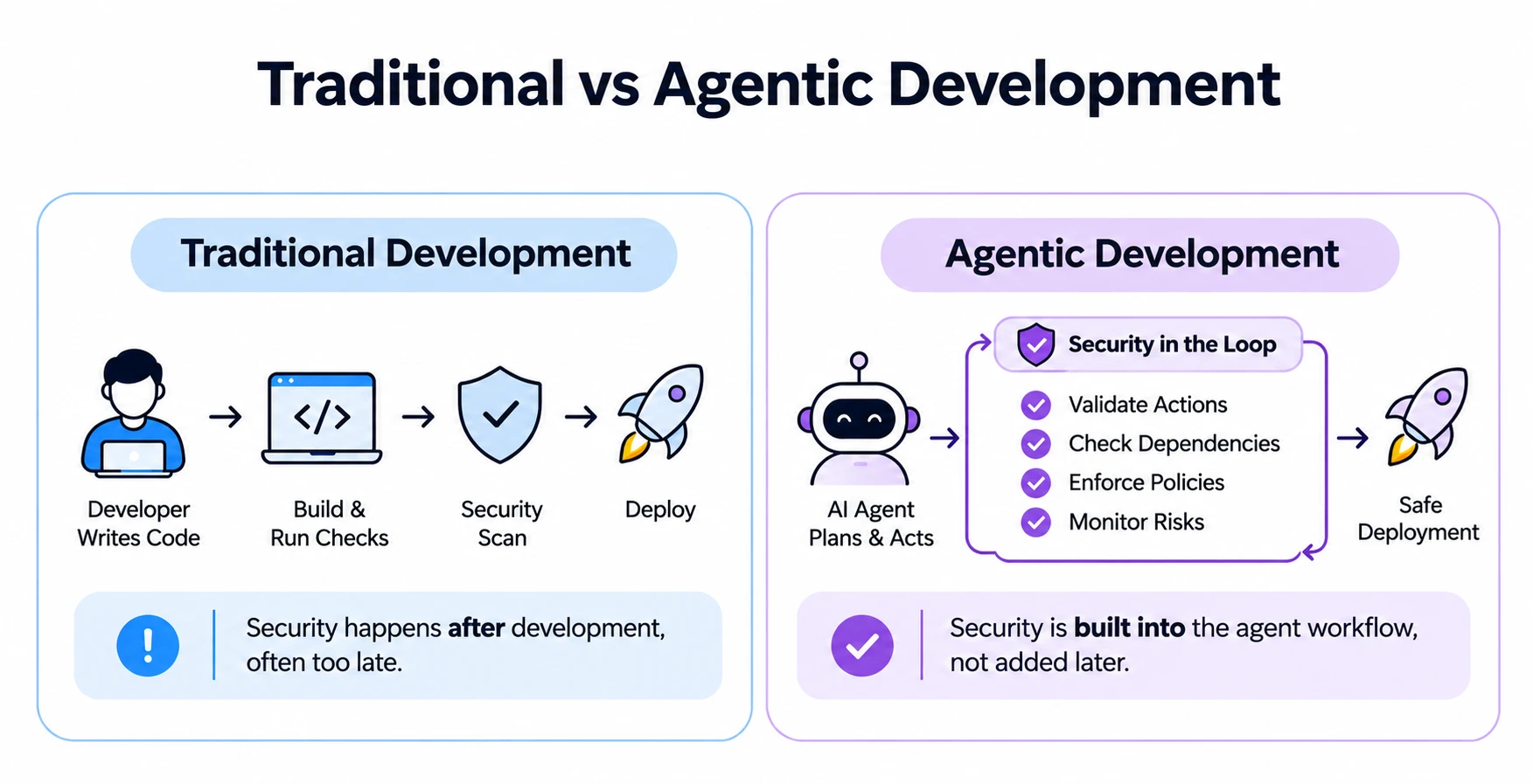
That is agentic development: AI coding agents plan, write, test, and ship code with limited human intervention. Application security was built for human-paced commits, so development-workflow controls now run after the agent has already acted. This guide explains which assumptions break, where new risk enters, and what replaces the old model.
Why Is Traditional AppSec Built for Human Developers?
Every security control carries a picture of the person it was designed for. Most of today's checks were shaped around developers who write in small steps, read feedback, and own what they ship. Knowing that picture makes it easier to see which controls still protect you, and which ones quietly stop working once an agent takes over.
Three Assumptions That No Longer Hold
Three assumptions sat quietly under that model, each depending on a person doing the typing.
- Human speed limits: Legacy AppSec assumed developers wrote code at a linear, manageable pace, so manual triage and code review kept up.
- Predictable interception points: IDE plugins, pre-commit hooks, and PR gates assume a human author who receives feedback before the change reaches the main branch.
- Human accountability and intent: Review assumes the submitter understands the code, which fails when large agent-generated pull requests hide architectural intent and subtle logic flaws.
Shift left shortened the distance between introduction and fix, but still assumed a human author.
How Agents Bypass IDE Plugins, Pipelines, and Git-Author Routing
Agents operate outside the path legacy controls watch. Four security checkpoints fail as a result.
- IDE plugins: Cloud-run agents work in development environments with no IDE session to scan.
- Pre-commit hooks: Local agents act on the machine before any commit exists.
- Pipelines and PR gates: CI scans see only the finished pull request, after the agent has acted.
- Git-author routing: Bot commits, and developer attrition leaves findings with no active owner.
The result is a backlog that grows while nobody can work it down.
How Agentic Development Changes the Software Lifecycle
Agentic development changes the software development lifecycle by moving work from people to agents. In agentic AI vs. generative AI, the difference is action: An AI code generator suggests, while agents run AI agentic workflows end to end.
- Plan: Agents split a task into steps and choose their own tools.
- Write: They produce complete changes, not snippets.
- Test: They run builds and retry until checks pass.
- Ship: They open pull requests and trigger pipelines.
Claude Code, Cursor, and GitHub Copilot are the best-known AI agent examples, and many teams first meet the best AI agents in customer service. Building one AI agent is simple, but coordinating multiple agents multiplies risk.
The Scale and Quality Problem in AI-Generated Code
AI speeds up delivery faster than security can follow. A Cloud Security Alliance research note found:
- AI-assisted developers commit three to four times faster than their peers.
- Monthly security findings rose from roughly 1,000 to over 10,000 in six months across Fortune 50 enterprises.
Review queues outgrow headcount, so findings get triaged by severity alone.
New Risks Traditional AppSec Cannot See
Traditional application security asks whether code is secure. Agentic development adds a harder question: Whether the AI systems that created the code can be trusted. The OWASP Top 10 for Agentic Applications 2026 now catalogues that wider surface, which spans what agents use, do, and generate.
What Agents Use: MCP Servers, Skills, and Packages
Agents add dependencies without waiting for approval. A lockfile-based SBOM catches packages committed to the repo, but misses runtime-added MCP servers, skills, and installs outside it.
- MCP servers: Pulled in at runtime, so unvetted tools can join the workflow.
- Slopsquatting: Models invent package names that do not exist; attackers register them with malicious payloads, and agents install them.
- Agent skills ecosystem: Shared skills run with the agent's own access, so a poisoned one inherits its permissions.
Software supply chain security news today keeps reporting poisoned registries; agents widen that exposure by installing packages unreviewed.
What Agents Do: Pre-Commit Actions at Machine Speed
Before any commit, agents act on the machine and connected systems. Each action is a place where policy can fail.
- Shell commands and file reads: Agents run commands and open files.
- API and tool calls: They reach internal services and external tools through MCP servers.
- Credential access: They use tokens scoped far wider than one task needs.
- Prompt injection: Instructions hidden in repo files, issues, or tool responses let online attacks redirect all of it.
None of this leaves a scannable artefact until the damage is done.
What Agents Generate: Insecure Code Before Review
Agent output can reach a commit before security ever sees it. Pattern scanners then miss the flaws that matter most.
- Missing checks: An absent access check leaves no pattern for SAST to match.
- Policy-breaking logic: Valid syntax can still violate business or security rules.
- Authorization flaws: Access rules applied inconsistently across files leave one endpoint open.
- Volume: Reviewers cannot audit intent across very large pull requests.
Reviewing output is no longer enough; the process that produced it needs controls too.
Traditional AppSec vs Agentic AppSec
The two models differ in when security acts and what it governs. The table compares them side by side.
Where SAST, DAST, and DevSecOps Fall Short
Classic tools still work for what they were built to do. They miss most of what agents introduce, because each was designed around a human author.
- SAST: SAST tools and a SAST scan match known patterns, so they cannot flag an absent check.
- SCA: It misses hallucinated packages that resolve to a malicious artefact.
- DAST testing: It finds runtime access flaws but late, in pre-prod; security penetration testing shares the delay.
- DevSecOps: Checks run in CI/CD after the commit, so even DevSecOps best practices trail the agent.
DevSecOps tools, application security software, and other security tooling inherit that ordering, because all assume a human author. In the SAST vs DAST debate, neither should go first; keep both as a confirmation layer behind prevention.
What an Agentic AppSec Model Requires
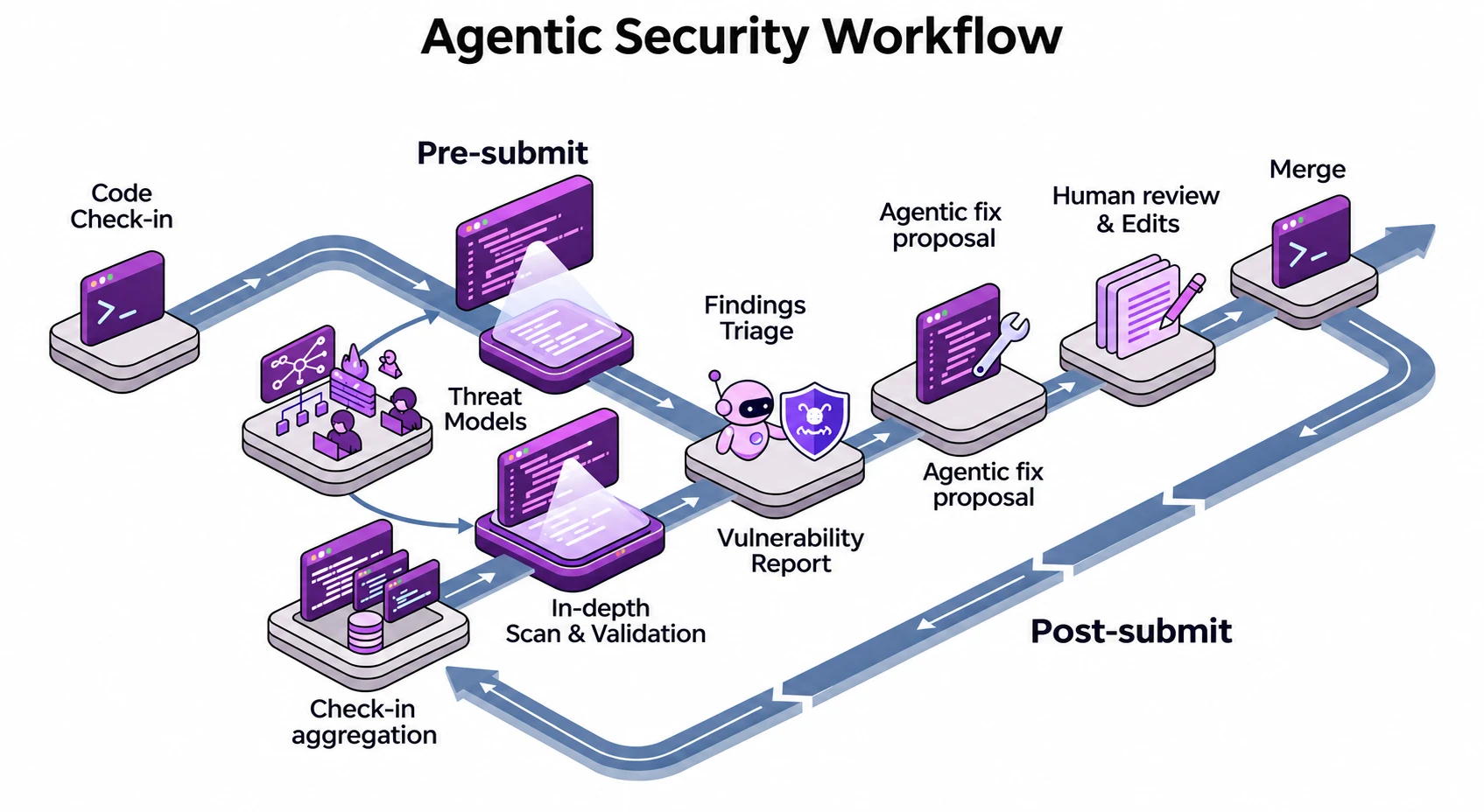
Agentic security has three working parts: Prevent, detect and triage, then remediate and validate. It is not a better scanner. Forrester calls the category agentic development security (ADS), and Snyk, Arnica, and Endor Labs describe it differently while agreeing that controls move upstream.
Prevent: Security Inside the Agent Loop
Securing AI agents starts before they act, through four main controls.
- Policy enforcement: Pipeline hooks inside the agent loop allow, block, or audit shell commands, file reads, and MCP calls; CI/CD agents get the same hooks.
- Least privilege: Sandboxes, MCP allowlists, and short-lived tokens tied to identity standards such as OIDC.
- Threat modeling: Add agent inputs, then map the security policy to NIST SSDF and governance frameworks.
- API controls: Treat agent tool calls as API traffic under cloud API security, an API security platform, and API security management, with AI guardrails.
Detect and Triage: Context Over Pattern Matching
Detection must understand what code does, not only how it looks. Context matters more than volume once findings multiply.
- Context across files: An AI Security Engineer agent traces data flow and intent, not signatures.
- Reachability: Rank findings by reachability and exploitability, not raw severity, so teams fix what attackers can reach.
- Continuous controls: Re-score findings when risk changes, such as a CVE joining the CISA KEV catalogue.
- Routing: Resolve the active human behind a bot commit so findings reach someone who can act.
Remediate and Validate: Humans in the Loop
Fixes should move fast, but nobody grades their own work. Humans set the rules rather than approve every step.
- Autonomous fixes: Ship only where merge risk is low; everything else queues for human review.
- Independent validation: The system that wrote the code never certifies it; a separate agent or reviewer does.
- Human judgment: People sign off on auth changes, CI configuration, and releases.
- Audit: Outcomes and policy changes are logged so humans can review them.
How BuildNexTech Secures Agentic Development
BuildNexTech governs and observes the AI agents a team already runs, delivered as a security service around your stack rather than a rip-and-replace security solution. An AI-native architecture, a low-code agent builder, enterprise-grade observability, and no model lock-in keep enterprise AI agents visible, whichever model sits underneath.
Teams choose this over custom builds or legacy AI workflow tools because governance ships with the agents, not as a bolt-on. The same approach applies across industries, from fintech to healthcare, with full visibility of every agent action. Existing workflows keep running while governance is added around them.
What Implementation Looks Like
Rollout runs in four phases. Each one ends with something your team can use straight away.
- Day 1 to 3 (Discovery): Inventory every agent, MCP server, and model in use, and note what each can access.
- Day 4 to 7 (Integration): Connect policy hooks, model routing, and observability to your existing pipeline.
- Week 2 onwards (Deployment): Start with the highest-risk repositories, then widen coverage team by team.
- Ongoing: Monitor agent decisions, tune policy, and extend coverage across teams.
Conclusion
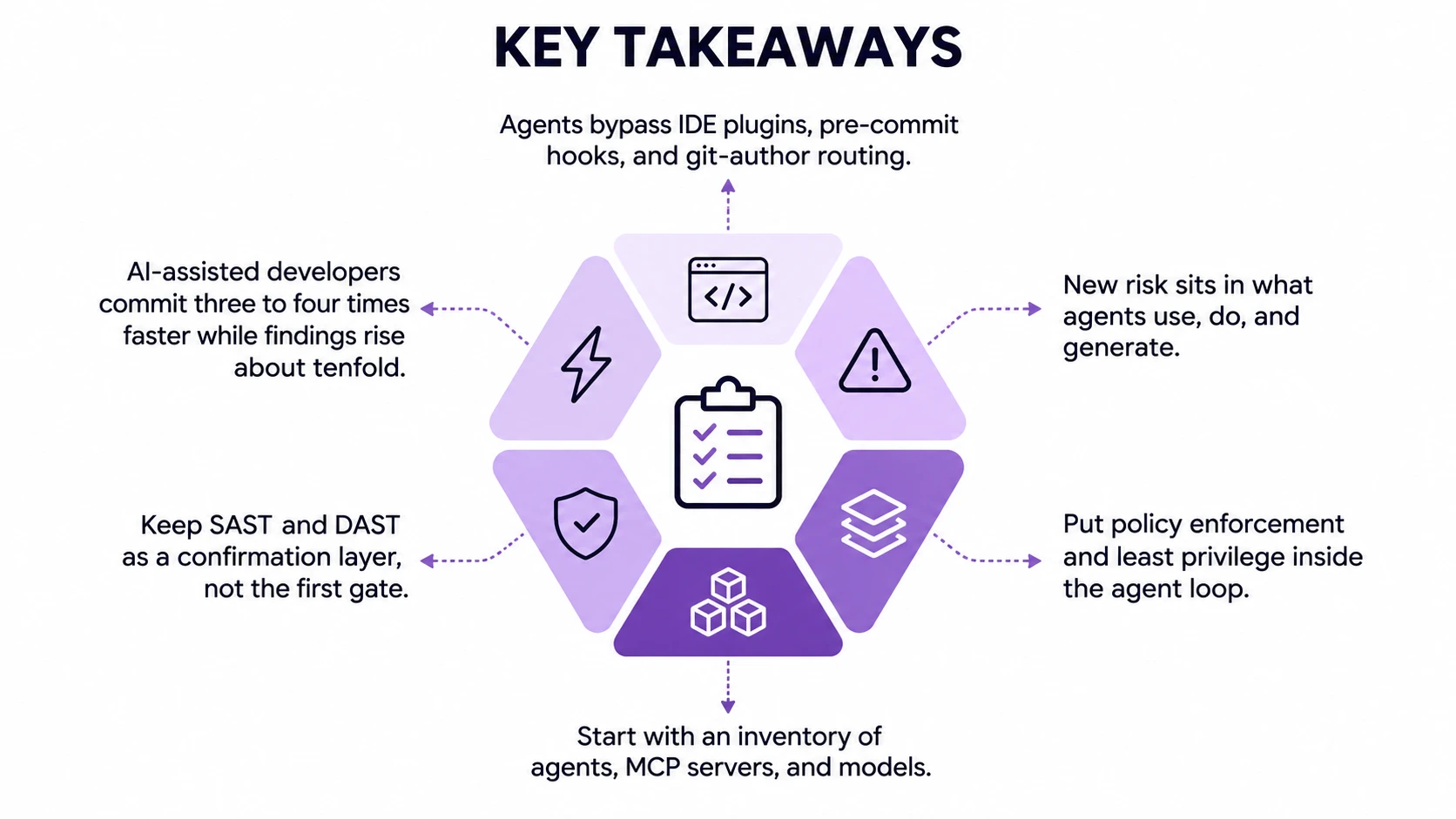
The assumptions behind traditional AppSec broke when the author changed, and the risk moved into the process. Agentic development puts an agent's inputs, actions, and output ahead of any scanner, so the model that works prevents first, detects with context, and validates independently.
That does not mean discarding what you have. Keep scanners as a confirmation layer, add policy inside the agent loop, and keep humans in the loop for decisions needing judgment. The test is whether your controls would still fire if no human touched the next pull request.
People Also Ask

What does agentic AI mean for engineering teams?
It means software that sets sub-goals, chooses tools, and acts on them without waiting for a prompt each time, so security teams must govern behaviour and permissions, not only outputs.
What is software supply chain security?
It is the practice of protecting everything that flows into a software build, including dependencies, tools, and build systems, from tampering, so that what ships matches what the team intended.
What is an SBOM?
A software bill of materials is a machine-readable inventory of the components, libraries, and versions inside an application, helping teams trace vulnerable dependencies quickly when a new flaw is disclosed.
What is DevSecOps?
It is a working model that builds security into every delivery stage, with developers, security, and operations sharing responsibility and automating checks in CI/CD instead of a final gate.
How reliable is an AI code detector at flagging agent-written code?
Detectors guess from style and miss edited output, so they are unreliable. Tag provenance at the source instead, using agent identities and commit trailers, so every change traces to a human.