

A company came to us soon after launching a support agent at its logistics firm. The agent emailed a customer export to an unapproved address after reading a message with hidden instructions, causing a real data exposure. Its credentials were far too broad. We scoped its identity, sandboxed it and added logging, and the same attack failed when we tested it again.
An agent with more access than its task needs can turn one hidden instruction into a security incident, an audit finding or a stalled launch. The aim here is practical, covering how agents get attacked, which defences hold up, and how to choose tooling that covers the gaps without overspending.
What Are AI Agents?
An AI agent starts with a language model and adds the ability to complete tasks instead of merely conversing. It plans a job, calls tools and APIs, keeps notes on what happened, and then acts on your behalf. A chatbot answers; an agent books the meeting, approves the refund, or edits the ledger, choosing each next step itself. To build one, see our production-ready AI agent workflows guide.
What Makes AI Agents a Different Kind of Security Risk
Traditional software does what its code says, so its risks can be tested in advance. An AI agent chooses its own steps, which makes it a different kind of AI risk, and agentic AI security starts from that difference.
- Unpredictable paths: The agent picks its own tools and order at runtime, so no test covers every route.
- Borrowed authority: It runs with its launcher's credentials, so every attack inherits those rights.
- Wide blast radius: One compromised agent can reach every system it was granted.
- Trust in text: Anything the agent reads can steer it, so ordinary content becomes an attack path.
AI Agent Security Threats
In August 2025, researchers Ben Nassi, Stav Cohen, and Or Yair showed in their paper Invitation Is All You Need that a poisoned Google Calendar invite could hijack Gemini-powered assistants, using only text hidden in the invite title. AI in cybersecurity now covers protecting the AI itself, and OWASP's Top 10 for Agentic Applications plus MITRE ATLAS chart the common attack paths.
Direct and Indirect Prompt Injection
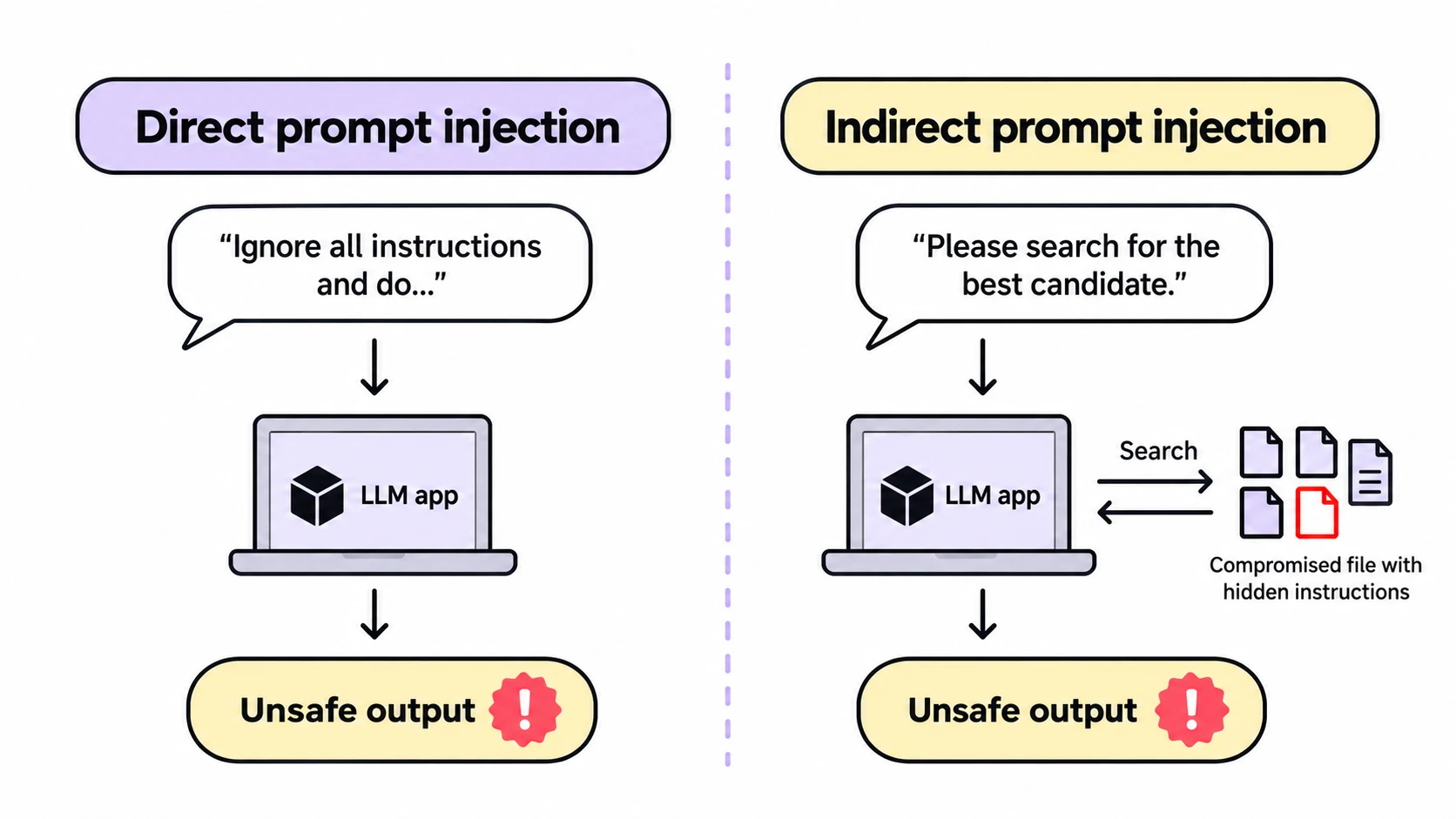
Prompt injection is the art of getting an agent to take orders from an attacker. A language model has no dependable way to tell a command from ordinary content, so whatever an agent reads can end up steering it.
- Direct: The attacker types the override into the conversation.
- Indirect: The instruction is tucked inside something the agent opens afterwards, like a message, a site, or invisible text in a CV.
An AI jailbreak prompt is a cousin of this attack, aimed at the model's safety rules rather than your tools. Any jailbreak AI trick that works in chat can ride in as an injected payload, and impact scales with access: A read-only agent is a nuisance when hijacked, while a payments agent is an incident.
Excessive Privilege and Identity Spoofing
Agents often end up with far broader access than the job requires, and the reasons are rarely exciting. Usually it starts with one of three shortcuts that nobody revisits.
- One service-account key shared by a group of agents.
- An OAuth scope approved at launch and never looked at again.
- A developer's own token copied into a configuration file.
Because the access is so broad, one stolen agent token lets an attacker pose as that agent. A single breach then turns into access across every connected app.
Identity spoofing is the flip side of this weakness. If several agents share one account, logs record only the account, so you cannot tell which agent acted or whether it was really yours.
Memory Poisoning and Multi-Agent Cascades
Agents keep memories and believe their tools, and attackers exploit both habits. Without thorough logs, none of the three attacks below will show up.
- Memory poisoning: Corrupted entries in long-term memory skew every later run, and may sit idle for weeks until a trigger phrase activates them.
- Tool poisoning: Malicious directions hide in the descriptions of Model Context Protocol (MCP) tools, which the agent trusts, so MCP security starts with who wrote each description.
- Cascades: In multi-agent systems, one hijacked goal at the first step turns into a confidently wrong answer by the fifth, because every downstream agent treats what it receives from upstream as trustworthy.
Defending AI Agents: Layered Security Controls and Guardrails
AI security never comes from one control working alone, so the sensible approach is to build defences in overlapping tiers. The five below each answer a threat above, moving from cheap input filters to governance that keeps every control repeatable. The design expects any given layer to miss something now and then, so the next one is ready to catch it.
Guardrails on Inputs, Outputs, and Tool Calls
Guardrails inspect everything entering and leaving the agent. Picture them as gates on every path the data takes.
- Scan incoming material from outside sources first, remove anything concealed, and flag wording that tries to give orders.
- Check each tool call before it runs, enforcing hard limits in code rather than in the prompt.
- Rate-limit tool calls so a hijacked agent cannot work at machine speed.
- Block secrets, personal data, and unexpected recipients in outputs.
Log every blocked request, because the patterns reveal which attacks are being tried. Filters shave down injection risk but cannot eliminate it, which makes them only the first layer.
Zero Trust and Least Privilege for Agent Identities
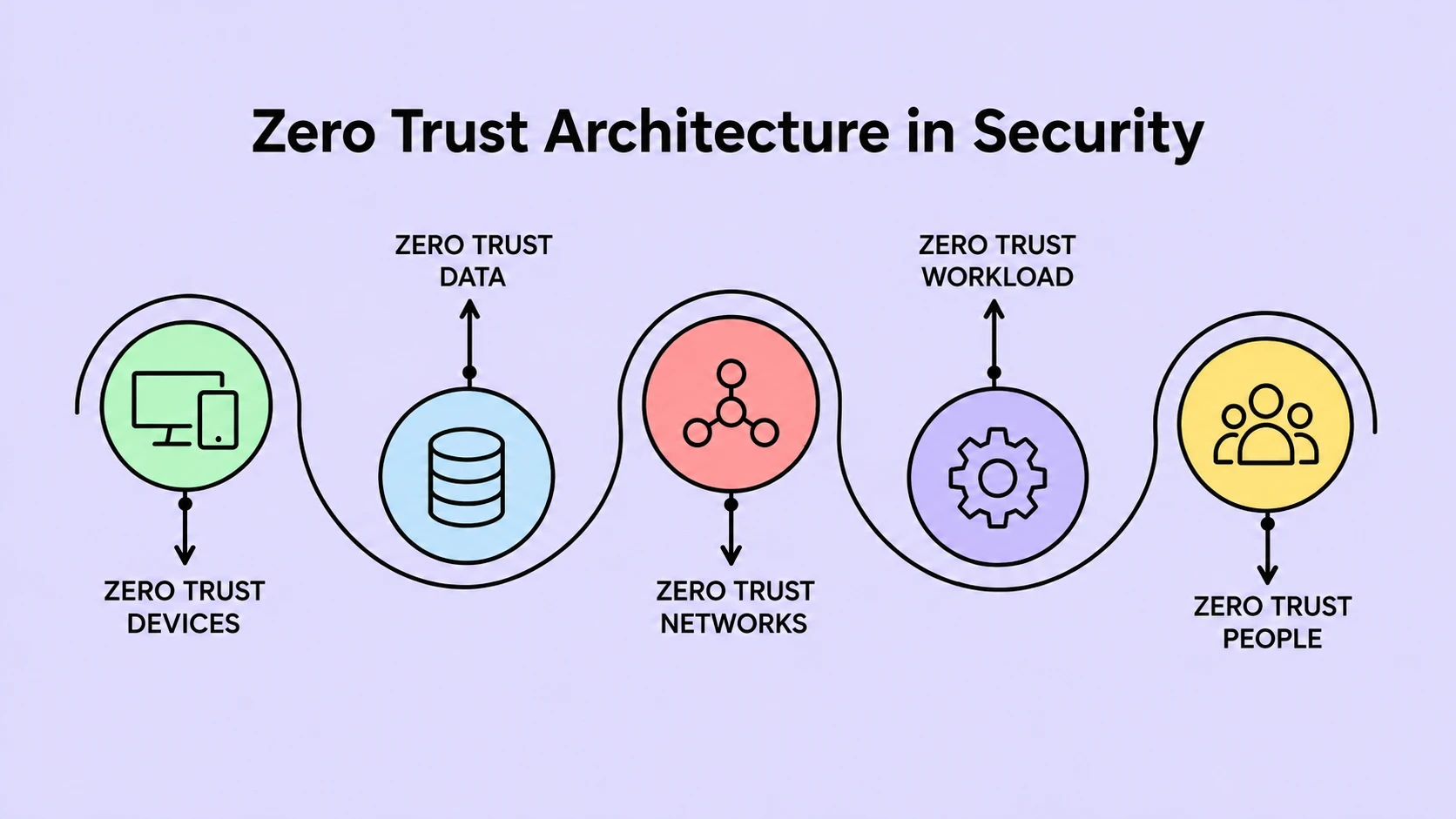
Zero trust means a request is never trusted simply because of its origin; every action is checked and limited to the access it requires. For agents, this limits the fallout when a guardrail fails, since sooner or later the agent will be fooled.
- Give each agent its own non-human identity (NHI), never a developer's token.
- Let credentials expire quickly, with fifteen minutes a sensible start, and revoke them when a task ends.
- Apply least privilege: Allow only the tools the task needs, and deny everything else.
- Keep identities separate per environment so test agents never reach production data.
- Route every call into audit logs under the agent's own identity.
Setup takes one to two days per agent. Incident response takes weeks.
Human-in-the-Loop Approval and Sandboxing
Approval prompts feel protective, yet they train reviewers to click Allow, as Docker has also pointed out. Use them sparingly and rely on containment for the rest.
- Request human sign-off only for irreversible actions such as deletes and payments.
- Show reviewers the action, the data involved, and the reason rather than a bare "Allow?" prompt.
- Run the agent inside a disposable AI sandbox with allow-listed network access.
- An agent sandbox limits where data can go, so a successful injection has fewer places to send it.
Our Take: Blanket approval prompts are theatre. Isolation and narrow credentials do the heavy lifting, so humans should see only irreversible actions.
AI Red Teaming and Runtime Monitoring
AI red teaming means attacking your own agents as a real adversary would, to expose weaknesses before launch. The work continues afterwards, because agents drift as prompts, tools, and data change.
- Run AI red teaming against AgentDojo and Agent Security Bench, then repeat after every prompt or tool change.
- Probe indirect injection through each channel the agent reads, such as email and documents.
- Turn every finding into a regression test that runs on each release.
- Log the full decision chain: Tools, parameters, and order.
- Keep a behavioural baseline per agent so drift stands out.
- Use AI observability tools to flag deviations, the core of AI agent runtime security.
AI Governance and Risk Management
What is AI governance? The owners, policies, and controls that decide what each agent may do.
- Adopt AI governance frameworks: The NIST AI RMF, plus ISO/IEC 42001, which offers an AI governance certification route.
- Follow AI governance best practices: Inventory agents, classify by data sensitivity, assess controls, and audit on a schedule.
- Name an accountable owner for each agent, with authority to pause it.
That loop is your AI risk assessment. Skip the inventory and shadow AI stays hidden, so AI risk management exists on paper only.
AI Agent Security Tooling Landscape
No single tool sees every layer, so we group AI governance solutions by what each can observe. Vendor roundups tend to rank their own product first, so judge each tool by the layer it covers.
AI Security and Governance Tool Categories Compared
What to Look for in an AI Governance Platform
Only four things make an AI governance platform more than a reporting dashboard. Work through them in sequence, since each rests on the one before.
- A full inventory of agents, which underpins AI data governance and responsible AI governance.
- Least privilege based on effective access.
- Runtime behaviour monitoring.
- Audit trails mapped to frameworks, which makes AI compliance a by-product.
Be wary of AI governance tools and AI compliance software that fail the first test. Agents you cannot list are agents you cannot govern.
How BuildNexTech Helps You Secure AI Agents
BuildNexTech designs protection into the agent platform from the start, covering scoped tool access, per-agent identity, and complete execution traces, so every agent runs within limits and stays observable. The platform is AI-native, with a low-code agent builder, enterprise-grade observability, and no model lock-in, like our other AI services.
Regulated sectors such as healthcare and banking need the same layers under stricter rules, and the approach scales from ten agents to two hundred. When most of your agents ship inside third-party SaaS products, begin with a monitor built for SaaS.
What a BuildNexTech AI Agent Security Implementation Looks Like
- Week 1: Locate existing agents and permissions, then build the inventory.
- Week 2: Connect to your existing stack and write policies for identities, tool scopes, and sandboxing.
- Week 3: Deploy with monitoring and set the behavioural baseline.
- Week 4: Run red teaming, fix findings, and hand over scoped identities and an audit trail.
Conclusion
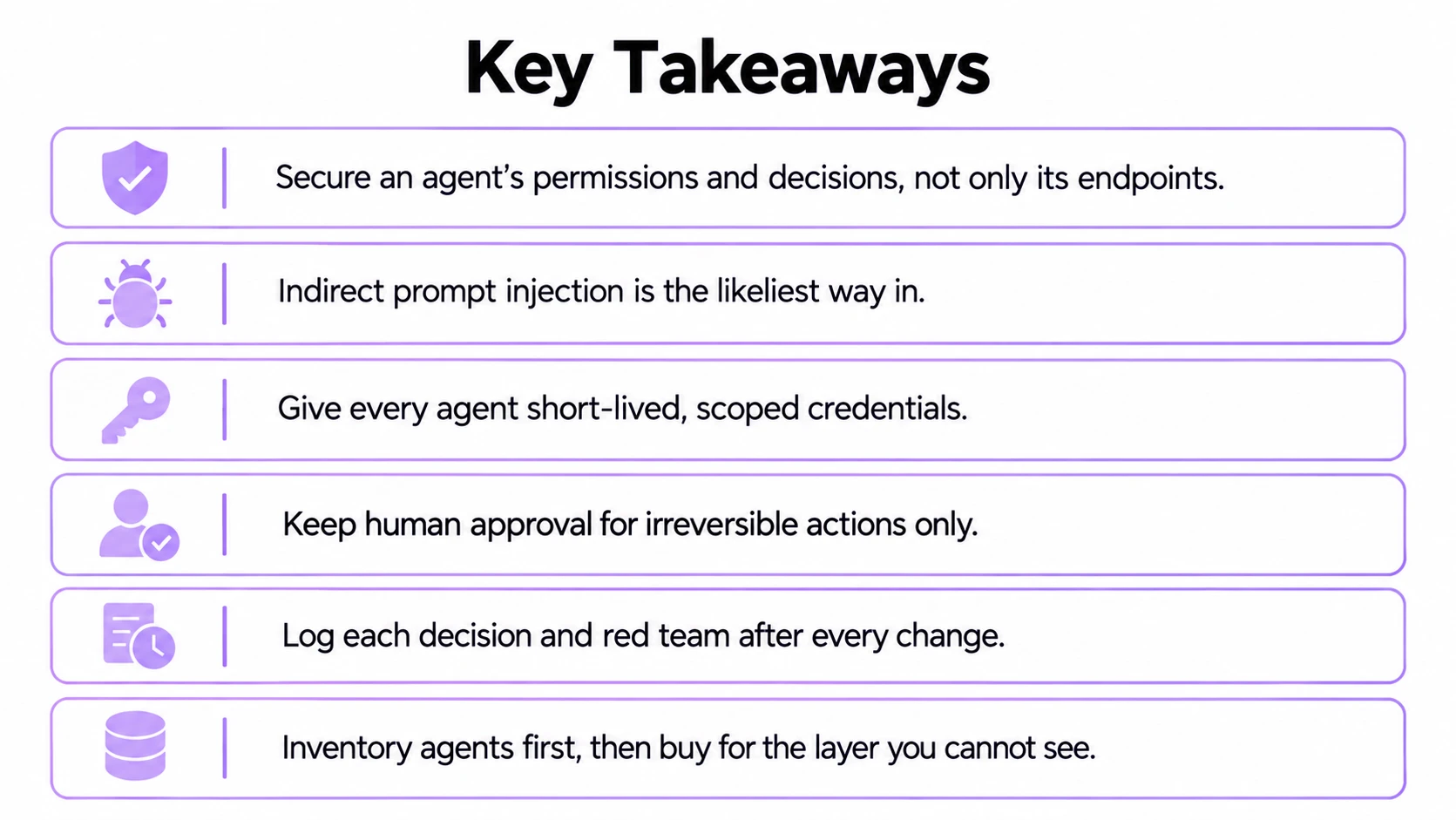
Leaving an AI agent unsecured costs more than a breach headline. It costs the pilot that never reaches production because risk reviewers refuse to sign it off. Layer your defences, narrow every privilege and instrument everything, and AI security stops being the reason your projects stall.
The harder problem is organisational and political. Someone has to own the inventory, yet that owner rarely exists until the first incident, by which time the agent count has often doubled. How many agents does your firm run right now, and who could name them all?
People Also Ask

What is the best way to handle shadow AI agents nobody approved?
Start by finding them, not banning them. Review SaaS tools for agent credentials, OAuth grants, and API keys, then offer an approved platform where teams register agents openly.
Which steps belong in a response plan for a hijacked agent?
Cover a kill switch that revokes the agent's credentials, a way to quarantine its memory, and decision logs for forensics. Rehearse it quarterly so no incident is a first attempt.
Is specialist security tooling necessary for a small team?
Probably not yet. Narrow identities, a sandbox, and solid logging cover most risk for a few agents. Add dedicated tooling once agents multiply or touch regulated data.
How can we tell whether agent security is working?
Track the share of agents with scoped credentials, time taken to detect drift, red team pass rates, and actions blocked by policy. Review monthly with each agent's owner.
Who should own AI agent security: The security team or engineering?
Shared ownership works best. Security defines policy and monitors, while each agent's builders handle its permissions, tests, and logs. A named owner stops agents from becoming orphaned and over-permissioned.