
.webp)
Your engineering team has three browser tabs open. ChatGPT, Claude, Google Gemini. Somewhere in Slack, someone is arguing the company should just pick one AI model and move on. They are asking the wrong question. Artificial intelligence and large language models now sit inside every serious tech stack, and the real decision engineering leaders face is not which one wins; it is how to route work across all three without losing visibility. Across 150+ client engagements, BuildNexTech has watched the "pick one" instinct cost more in rework than it ever saved in simplicity.
Claude vs ChatGPT vs Gemini at a Glance
Model performance shifts fast enough that any static ranking is stale within weeks. Model capabilities across the three flagship AI systems still follow a consistent pattern right now, and that pattern is what actually matters for procurement decisions rather than whichever leaderboard topped Hacker News last Tuesday.
Comparison Table: Coding, Reasoning, Context.
All three flagship plans land in a similar monthly price range, so price is rarely the deciding factor. The gap that actually matters shows up in generative AI output quality under production load, not on a pricing page.
Coding and Software EngineeringAI systems
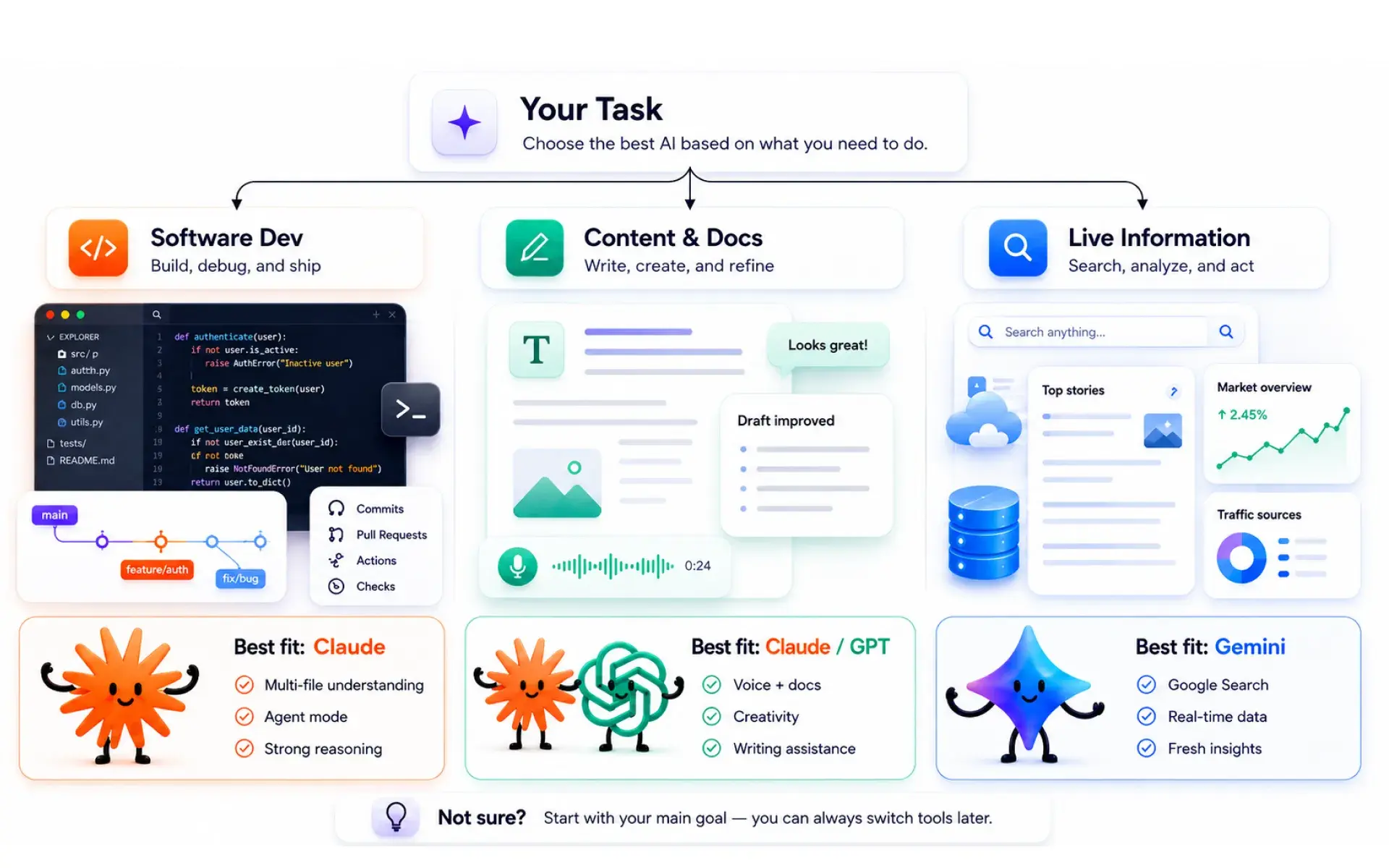
Claude Code has become the reference point for agentic, multi-file engineering work, the kind of task where a model holds several constraints without dropping one. OpenAI Codex counters with quicker code completion inside familiar IDEs and handles short Python scripts well under agent mode. Gemini's edge is not code quality; it is the volume of context it can hold, which matters for full codebase reviews rather than single functions. For teams running serious AI software development pipelines, this distinction decides which model sits at the centre of the workflow and which ones stay on the edges.
When Context Window Size Actually Matters
A million-token context window sounds impressive on a spec sheet. It changes outcomes for full codebase audits or long regulatory filings. For a routine pull request, it is closer to a vanity metric than a genuine advantage, and API costs climb fast if a team defaults to the largest context window for every task regardless of need. Short-output conditions, quick single-sentence answers, rarely benefit from a bigger context window at all.
Reasoning, Writing and Everyday Features
Claude is consistently rated ahead on instruction-following and long-form writing tone across independent tests, which is why it anchors most research workflow tools. The Artifacts feature lets teams generate and iterate on documents, code, and diagrams inside the same thread, and the Claude Chrome extension adds real browser control, letting the model read a page and act on it directly. Claude Cowork extends that further into genuine autonomous multi-step capability across tools, coordinated through a Model Council pattern that checks output before anything ships to a client.
ChatGPT's breadth, its voice feature, Sora 2, and wide plugin support win on tasks that need more than text. Its video analysis and audio analysis capabilities are genuinely strong for teams producing multimedia content rather than pure prose. Gemini's real-time web searching integration gives it a real advantage anywhere current information matters more than polish, and its native pull from Google Cloud services makes it the natural default for teams already deep in that ecosystem. Gemini's Nano Banana image tool has also become a genuine differentiator for visual analysis and quick image editing work, an area where the other two still lag.
Instruction-Following on Complex, Multi-Constraint Prompts
The gap between models widens once a prompt carries five or more simultaneous constraints, and it widens further under production load rather than in a clean demo. Deep research tasks expose this fastest, since they compound small instruction failures across many steps until the output drifts from the brief entirely.
Enterprise Fit, Governance and Compliance
ChatGPT Enterprise and Claude Enterprise both offer strong controls, but the real differentiator is what surrounds the model. Teams inside Google Workspace tiers pull naturally from Google Docs, Google Sheets and Google Drive. Teams standardised on Microsoft 365 Copilot benefit from Microsoft Copilot and Azure OpenAI Service sitting inside an existing tech stack, alongside planning tools like Jira Product Discovery. Vendor lock-in is the risk most comparison guides skip entirely, and it is usually the one that costs the most eighteen months in.
Data Retention, Training Opt-Outs and Audit Requirements
Before a regulated team signs anything, check the vendor's data processing agreement for training opt-out defaults, retention windows, and whether audit logs cover individual API calls. Security & Privacy sits at the centre of any serious business AI rollout, and it goes further than model behaviour alone. AI security now means evaluating the model provider's own security service and security solution stack, not just the model's answers. A vendor's infrastructure has to withstand online attacks the same way any customer-facing service does. Site owners running high-traffic AI products already recognise a Cloudflare Ray ID from a blocked request log, and enterprise buyers should ask the same question of any AI vendor: what happens to a request the moment something looks malicious? Differential privacy commitments and clear audit logs matter more once volume moves past pilot stage, particularly against risks like SQL command injection through connected tools or malformed data entering an agent pipeline.
.webp)
Model Comparison Table: Build vs Buy vs Orchestrate
The Multi-Model Reality Inside Most Engineering Teams
Model releases now ship on a cadence of weeks, not quarters, so a fixed "winner" call goes stale fast. The current AI boom rewards teams that treat model selection as an ongoing process, not a one-time decision made once and never revisited. That shift changes what a good AI strategy actually looks like day to day.
How Teams Already Split Traffic Without Realising It
Engineering teams already split traffic across models by task type, informally and without observability. A developer reaches for Claude Code for a refactor, ChatGPT for a quick brainstorm, Gemini for anything needing web searching, often within the same afternoon and without anyone tracking which model touched what or why.
Where Ad-Hoc Routing Starts to Cost You
This works fine at ten users making their own calls. It breaks down once usage moves from experimentation into production volume, spend spreads across three separate invoices, and different user personas inside the same company start pulling in different directions. Different user personas need different things from a model, and forcing every persona onto one vendor's roadmap rarely ends well. That is the point where informal routing needs to become a governed one.
How BuildNexTech Helps You Route the Right Task to the Right Model
BuildNexTech builds a model-agnostic orchestration layer using Model Context Protocol, evaluating cost, latency, and output quality per task instead of locking a team into one vendor. This is not a build teams need to do from scratch. Engineering teams choose this route over custom routing logic because it ships as one of the more complete enterprise LLM solutions on the market, with observability and no model lock-in built in from day one.
What a BuildNexTech Multi-Model Implementation Looks Like
Discovery runs days one to three, auditing current model usage across the team. Integration connecting Claude, GPT, and Gemini through one interface follows in days four to seven. Week two onward covers deployment and routing refinement based on real traffic patterns.
Who This Is For
This fits engineering organisations who are already running two or more models informally, where per-seat AI spend is climbing, and no one can answer a compliance question about which model handled which task. Model selection stops being guesswork once that visibility exists. If that sounds like your team, let's talk.
.webp)
Conclusion
Model performance will keep shifting every few months. What will not shift is whether your team has visibility into what it is already doing across these AI systems. Most do not, and that gap is quietly more expensive than any single subscription fee. The teams pulling ahead in this AI boom are not betting everything on Claude, ChatGPT, or Gemini alone. They are building the governance layer that outlasts any one model's release cycle.
People Also Ask

Which is better, Claude, ChatGPT, or Gemini?
None wins outright. Claude leads coding, reasoning, and browser control through its Chrome extension. ChatGPT leads breadth and voice features. Gemini leads Google Cloud integration and live search grounding for current information.
Is Claude better than ChatGPT for coding?
Yes, specifically on agentic, multi-file engineering work where Claude Code holds several constraints at once. For quick, single-function code completion tasks, the practical difference between the two barely registers.
Which model suits enterprise AI deployments best?
It depends on your existing tech stack rather than raw benchmarks. Microsoft-heavy teams lean Azure OpenAI Service, Google Workspace teams lean Gemini, and regulated industries often lean toward Claude Enterprise.
Can I use multiple AI models together on my team?
Yes, and most engineering teams already do this informally without realising it. The real gap is governance and visibility, not technical capability, which is exactly what an orchestration layer solves.
Do I need custom integration to use more than one model in production?
Not necessarily. Orchestration platforms built on Model Context Protocol remove most of that build burden, connecting Claude, GPT and Gemini through one governed interface within roughly two to three weeks.


.webp)
.webp)
.webp)

.webp)
.webp)