

TL;DR: Most teams spend six weeks evaluating a low code platform and zero hours planning how to leave it. This post gives you the lock-in audit, the cost model, and the migration path your business case should have included from day one.
A logistics firm we worked with ran three production apps on a major low-code platform. The apps worked, the business depended on them, and then a compliance requirement arrived that the platform's integration layer could not satisfy. The renewal was eight weeks away. No migration estimate existed.
Across 150+ client engagements in 30+ industries, this pattern repeats. The entry decision was deliberate. The exit was not. Low code development moves fast in year one. The ceiling arrives quietly, with a deadline attached.
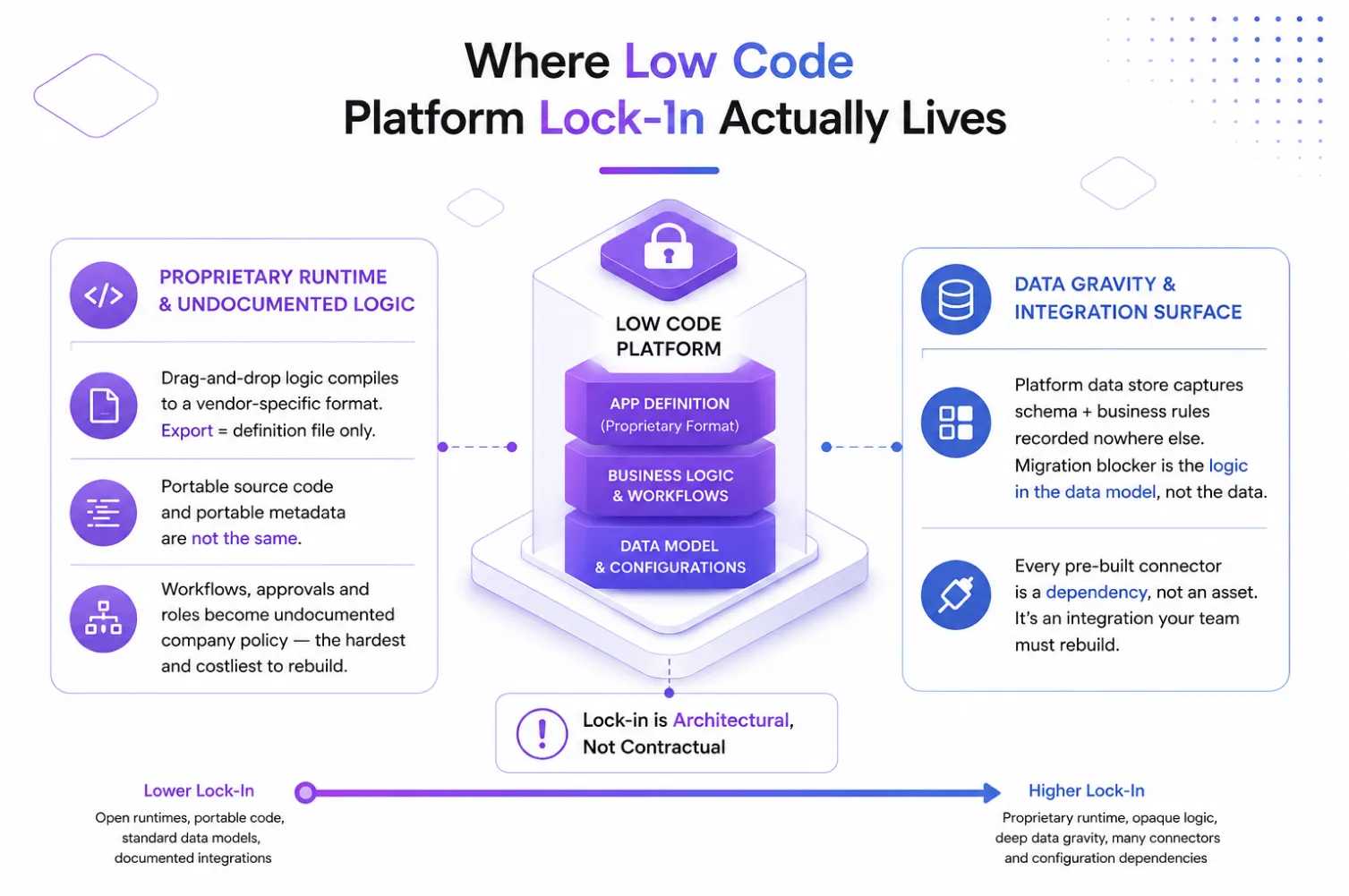
Where Low Code Platform Lock-In Actually Lives
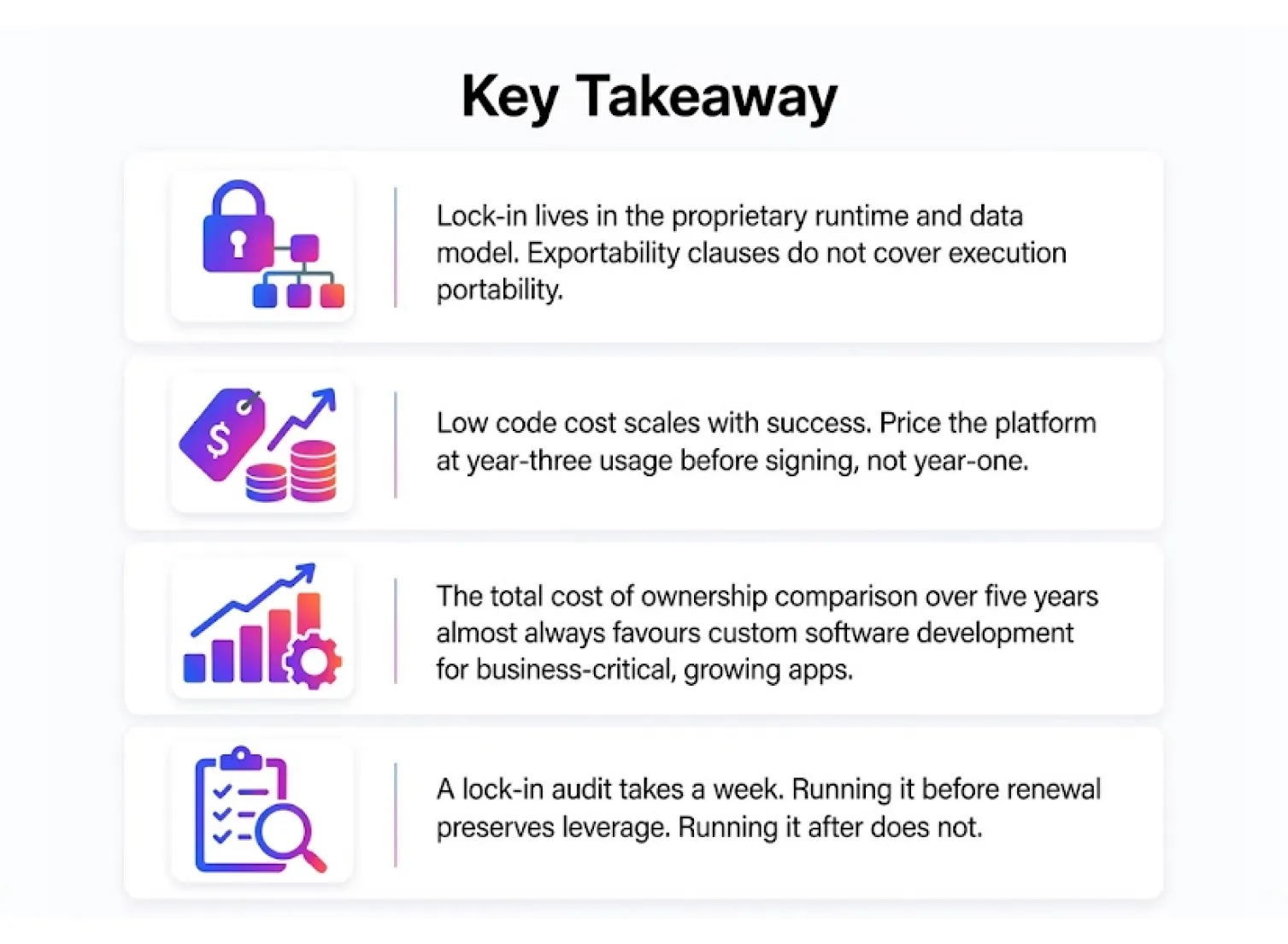
Low code platform lock-in is architectural, not contractual. Legal review never catches it. The "we can export our data" clause covers the rows, not the execution layer above them.
Most low code vendors offer export functions. What they export is a metadata definition, not portable source code.
Enterprise-grade low code vendors like OutSystems and Mendix offer more, but that still means a model file that runs only inside their runtime. IT professionals and professional developers cannot maintain it independently.
Gartner forecasts AI application development platforms will reach $9.5 billion in spending by the end of 2026, a 38.6% year-on-year rise. The commitment is architectural. The exit cost compounds with every app that goes live.
Proprietary Runtime and Undocumented Logic
The drag-and-drop interfaces that made the app fast to build compile business logic to a vendor-specific representation. "We can export our app" almost certainly means a definition file; nothing outside the vendor's workflow engine can execute.
Low code vs programming is an ownership debate as much as a skills debate. Logic built inside a visual builder using the visual development approach belongs to the platform's runtime, not your codebase.
The visual development approach creates undocumented company policy:
- Approval workflows configured in the visual builder exist nowhere else.
- Role-based access control rules and user verification steps live only inside the platform.
- Security and governance policies are embedded in a business logic engine nobody can read externally.
- Exception-handling logic is locked inside the platform's automated system.
Reconstructing this enterprise logic is the expensive part of any migration. Not writing replacement code.
Data Gravity and the Integration Surface
The migration blocker is never row volume. What blocks the move is the coding logic baked into the visual development environment: calculated fields, referential constraints, and validation rules that never made it into a portable database layer.
Every pre-built component your team relies on is a dependency, not an asset:
- User experience flows built on pre-built components must be rebuilt from scratch.
- API integrations and the low-code data integration layer are platform-specific.
- Each connector adds to exit cost, not build value.
The more integration points in production, the harder it becomes for business owners to justify the switch, even when the economics demand it.
What Low Code Costs Enterprise Software Portfolios by Year Three
The original business case compared the license fee to a custom software development quote. That comparison was wrong. In traditional app development, wider adoption does not trigger a larger platform bill. Low code platforms break that assumption entirely.
Here is what almost every initial business case leaves out:
- Per-app licensing as the portfolio grows.
- Seat expansion as citizen development spreads across teams.
- Environment tiers for production, staging, and UAT.
- Premium connectors for API integrations that matter most.
- Support escalations for issues the documentation does not cover.
Microsoft Power Platform and Power Apps make this especially visible given their per-user and per-app pricing tiers. That inverts what every Waterfall methodology business case assumes. Model the platform cost against where your usage will be in year three, not where it is on day one.
App Development Cost: Low Code Platform vs Custom Software Development
The profile we would not migrate: internal, low-traffic apps with stable requirements and no compliance complexity. Low code is the right answer for those. A table that favours migration on every row is not credible.
Our Take: The custom software development case does not rest on low code vs high code being a universal winner. It rests on the mismatch between what low code vendors charge at scale and what business owners planned to pay. For business-critical apps, scaling, or sitting inside a compliance boundary, the total cost of ownership gap nearly always outweighs what a migration actually costs. Do the cost modelling while you still have negotiating room, not once the contract is already on the table.
How to Run a Low Code Exit Readiness Audit
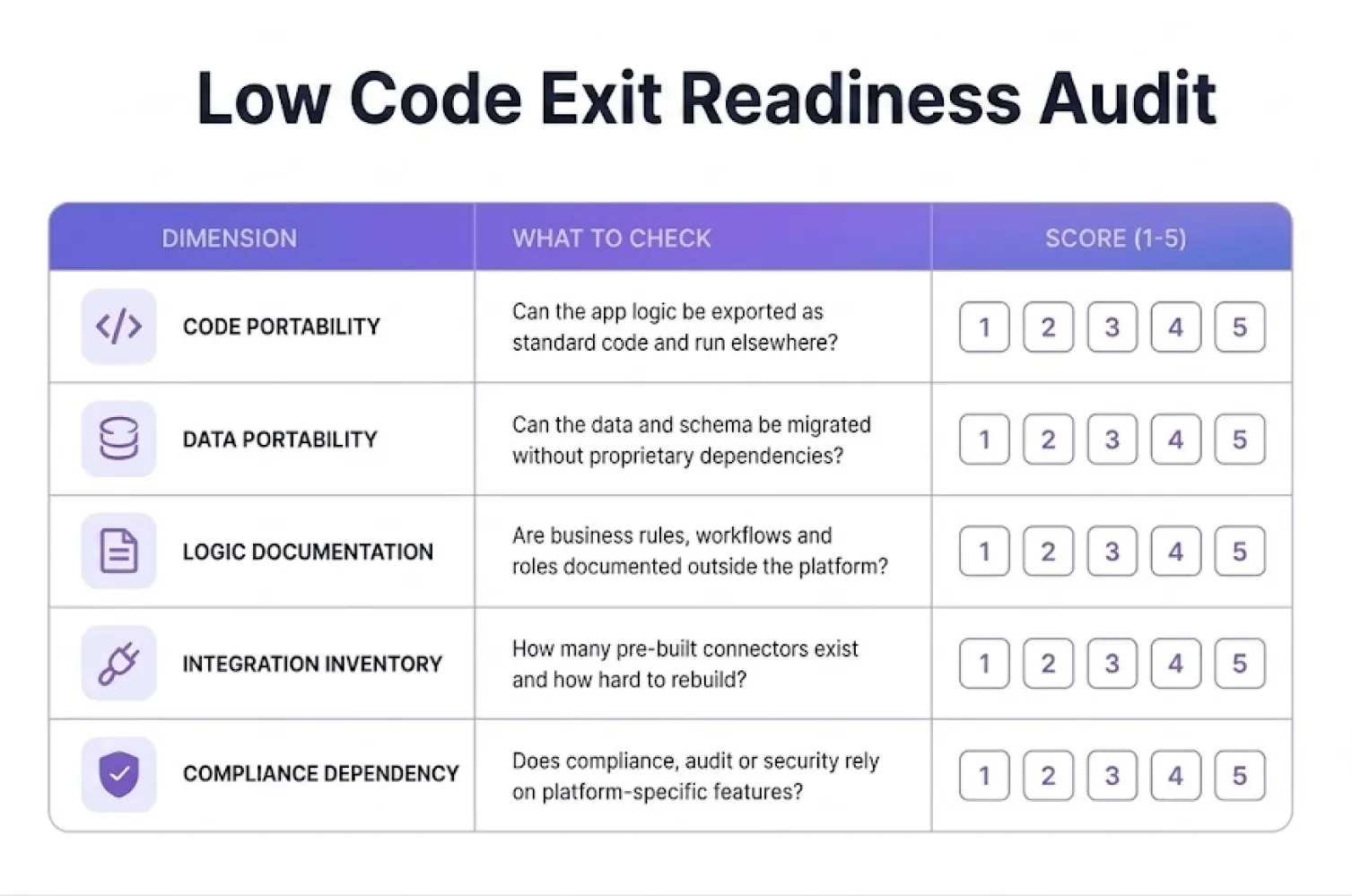
Score each application across five dimensions, not the platform as a whole:
- Code portability: Can the application development logic be expressed in a language your team owns?
- Low code data integration portability: Does the schema live in a system you control?
- Logic documentation: Has the workflow logic been documented anywhere outside the visual builder?
- Integration inventory: How many pre-built components and API integrations are load-bearing?
- Low code governance: Does the platform sit inside a regulatory or compliance boundary?
Three exit paths exist: Incremental strangler-pattern replacement, targeted rewrite of the highest-risk app, or hybrid coexistence. Start with the highest lock-in score at the lowest functional complexity.
Incremental replacement behind stable interfaces means the business never experiences a feature pause. Cutovers happen on a schedule the business controls.
The anti-pattern is trading platform lock-in for vendor lock-in. Choose a custom software development company that transfers source code and knowledge at handover. Manual coding expertise stays with your team, not just the vendor.
How BuildNexTech Rebuilds Low Code Applications as Software You Own
A manufacturing firm we worked with moved four production apps off a per-seat-priced platform ahead of a pricing-tier step-change. Run-rate platform spend dropped by over 60% in year one. The business never noticed the transition. The engineering team did, every sprint.
We take applications trapped in proprietary low-code runtimes and rebuild them as owned, source-available software. AI-powered agents and AI code-generation tools make the logic reconstruction step tractable. That is where most migrations stall, and it is where we start.
The reconstruction output is a documented specification of the existing system's behaviour. Teams discover shadow IT workarounds, undocumented access rules, and role-based permission gaps the visual builder had obscured. It functions as a security system audit and resolves years of ambiguity.
At handover: Full repository, infrastructure-as-code, documented business logic, and a runbook. No per-seat ceiling. No renewal conversation held hostage to migration cost.
What a BuildNexTech Low Code Migration Looks Like
Four phases, paced to team capacity:
- Weeks 1 to 2: Audit the platform. Extract workflow engine rules, UI/UX design flows, security check logic, and automated system behaviour into documented specifications.
- Weeks 3 to 4: Design the target architecture for web and mobile applications. Run the verification process. Agree the cutover sequence.
- Week 5 onwards: Rebuild application by application while the existing system stays live. Automated updates are managed per-app, not platform-wide.
- Per-app cutover: Each app moves when the replacement passes acceptance testing, not on a calendar deadline.
Who This Is For
Organisations running production low code apps that have become business-critical, where the platform bill grows faster than headcount, or where a compliance or integration requirement has hit the ceiling.
Three triggers we see most often across enterprise environments:
- The renewal quote arrived with a step-change increase the original business case never modelled.
- A required integration is unsupported or sits behind a premium connector tier.
- The app has more users than the pricing model ever anticipated, and low-code vs programming costs are now visible to the CFO.
These are market demands that low-code platforms were not designed to absorb at scale. Low-code governance works well for small, simple portfolios. It breaks down when business solutions become load-bearing for revenue or compliance.
If that describes your portfolio, map the exit before the renewal date sets the timeline for you.
The Ceiling Was Always There
Low code development is not a bad decision. It is a decision with a time horizon attached, and most teams never model that horizon before committing.
The digital transformation case for low code is real. So is the ceiling. When to use low code is a question about scope and time horizon, not just delivery speed.
Teams that have worked with BuildNexTech on low-code/no-code application development exits consistently report the same thing: the audit alone was the most valuable output.
People Also Ask

Is low code development bad for enterprise software?
No. Low code is the right long-term choice for internal, stable-requirement apps with no compliance complexity. The problem is unplanned commitment to a platform, not the technology itself.
How much does it cost to migrate off a low code platform?
Migration cost is driven by undocumented logic volume and integration count. Any figure quoted without a proper lock-in audit of both dimensions is unreliable and will underestimate the real cost.
Can we export our application from a low code platform?
Most low code vendors export metadata definitions, not executable source code. Ask in writing whether a third-party runtime can execute the export without the platform installed.
How long does a low code to custom software development migration take?
Per-application, not per-platform. With incremental migration, the key number is time-to-first-cutover, typically four to six weeks. The entire business stays operational and live throughout every single cutover.
What should we negotiate at low code platform renewal?
Negotiate data export guarantees, source access provisions, usage-based pricing caps, and notice periods. These terms preserve exit optionality without requiring an immediate or costly migration decision.


.webp)
.webp)
.webp)

.webp)
.webp)