

A fintech company came to us eighteen months into a migration that produced the opposite of what they wanted: A distributed monolith with extra network hops. Every service deployed independently, but three still shared one database, so a single schema change broke two others weekly.
Most microservices best practices guides treat architecture and security as two separate articles, and that split is the mistake. Your service boundaries are your security boundaries, and this takes a deep understanding of both. Teams across 30+ industries hit this wall: the business reality behind most "distributed monolith" postmortems, and why this guide treats architecture and digital security as one decision.
What Is Microservices Architecture?
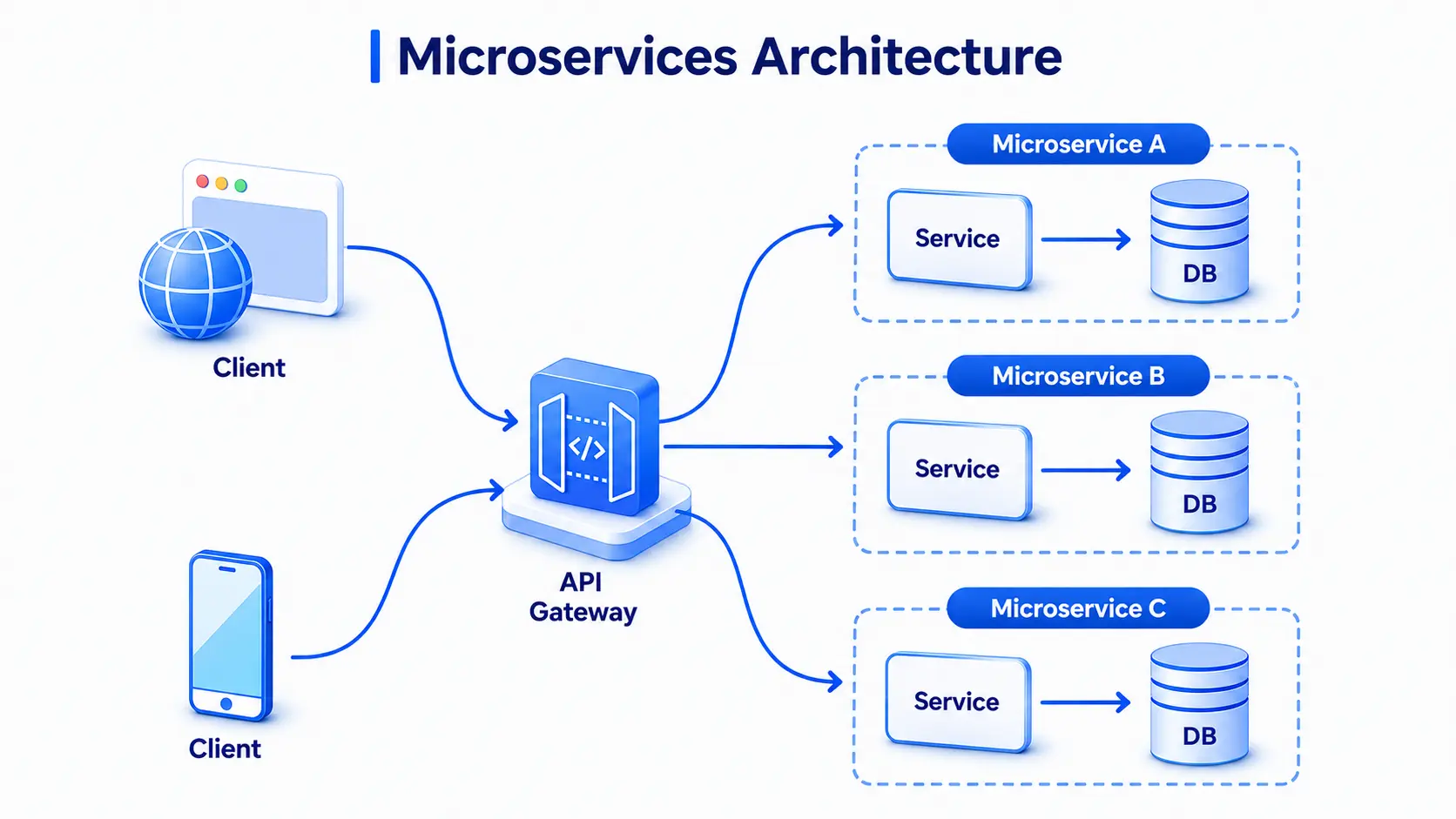
Microservices architecture means independently deployable services, each owned by one team, responsible for a single business capability. The benefits:
- Fault isolation: One service failing doesn't take the whole system down.
- Independent scaling: Scale the busy service, not everything.
- Team autonomy: A payments team ships without waiting on checkout's calendar.
The trade-off gets less airtime:
- The mechanism: A function call becomes a network call, which fails in ways function calls never do.
- The failure mode: Services deployed separately but still sharing a database, and failing together.
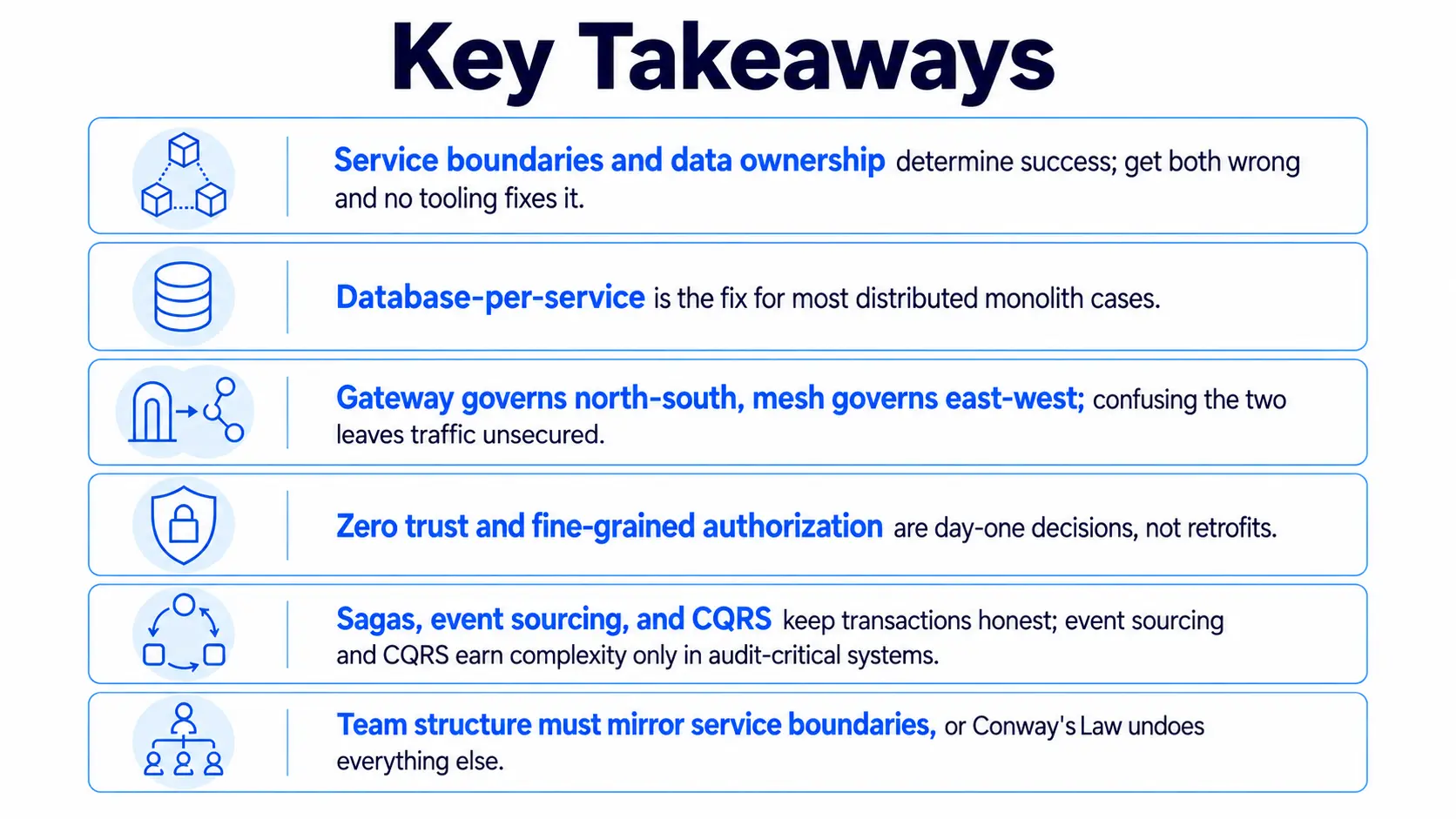
- The takeaway: Independent deployment only pays off once boundaries and data ownership are drawn correctly, the foundation behind every microservices architecture best practices list.
Microservices vs Monolithic Architecture: When to Make the Switch
Not every team needs this. A small startup on one product line gains nothing from microservices except a bigger AWS bill; complexity is earned once a growing engineering org has stable, separable domains.
That overhead row typically shrinks once orchestration and access control systems sit on one platform instead of three. That often decides whether a migration pays off inside a year or drags into a second.
Which one fits your team?
- A small team on one product line? Stay monolithic.
- A growing engineering org with separable domains? Microservices, boundaries from business capability.
- Already split but deploying in lockstep? Distributed monolith, fix boundaries first.
Core Architecture Best Practices: Service Boundaries and Data Ownership
Two decisions determine success here: Where you draw service boundaries, and who owns the data behind each one. That is the honest answer to how to create microservices that don't collapse into a distributed monolith, more than any framework choice.
Domain-Driven Design and Bounded Contexts
Bounded contexts slice services along business capabilities, not technical layers. The test: If this service disappeared tomorrow, what stops working? "Several things" means too big, and that distinction plays out in two common patterns:
- Anti-pattern: Slicing by layer, "User Service," "Data Service," "Auth Service," a monolith wearing three name tags.
- Right pattern: Slicing by domain, "Checkout," "Fulfillment," "Pricing," keeps each blast radius contained.
Database-Per-Service and Data Ownership
The rule is not negotiable: Each service owns its own database, no exceptions. Shared-database coupling is invisible on a diagram and catastrophic in production; an unnoticed change breaks a service nobody was watching, and three things follow from that rule:
- Trade-off: Eventual consistency, data once one transaction away is now spread across services, with a window where two disagree.
- Two mechanisms: Synchronous calls for current reads; asynchronous events for state changes others need eventually.
- Protecting data starts here: A service that never exposes its schema directly has one less attack surface for client data, a bug, or a bad actor.
API Gateway and Service Mesh Best Practices
These two layers get confused constantly. It starts with the question people actually type into a search bar: what is API gateway versus service mesh? Traffic direction is the short answer: Gateway governs north-south, client to service; mesh governs east-west network connectivity between services, and here is what each layer actually does:
- Gateway: Centralises authentication, rate limiting, routing, and SSL termination, so a client calls one endpoint.
- Mesh: Via sidecar proxies, automates retries, circuit breakers, mTLS, and traffic shifting without touching code.
- Mesh options: Istio service mesh dominates for feature depth; Linkerd wins on mTLS with less overhead.
The objection: "we don't have time for another infrastructure layer." Fair, but the answer isn't day-one mesh adoption. Hand-rolling retries and mTLS inside three services is manageable; inside fifteen it isn't, and every added service widens your attack surface.
Zero Trust Security and Fine-Grained Authorization for Microservices
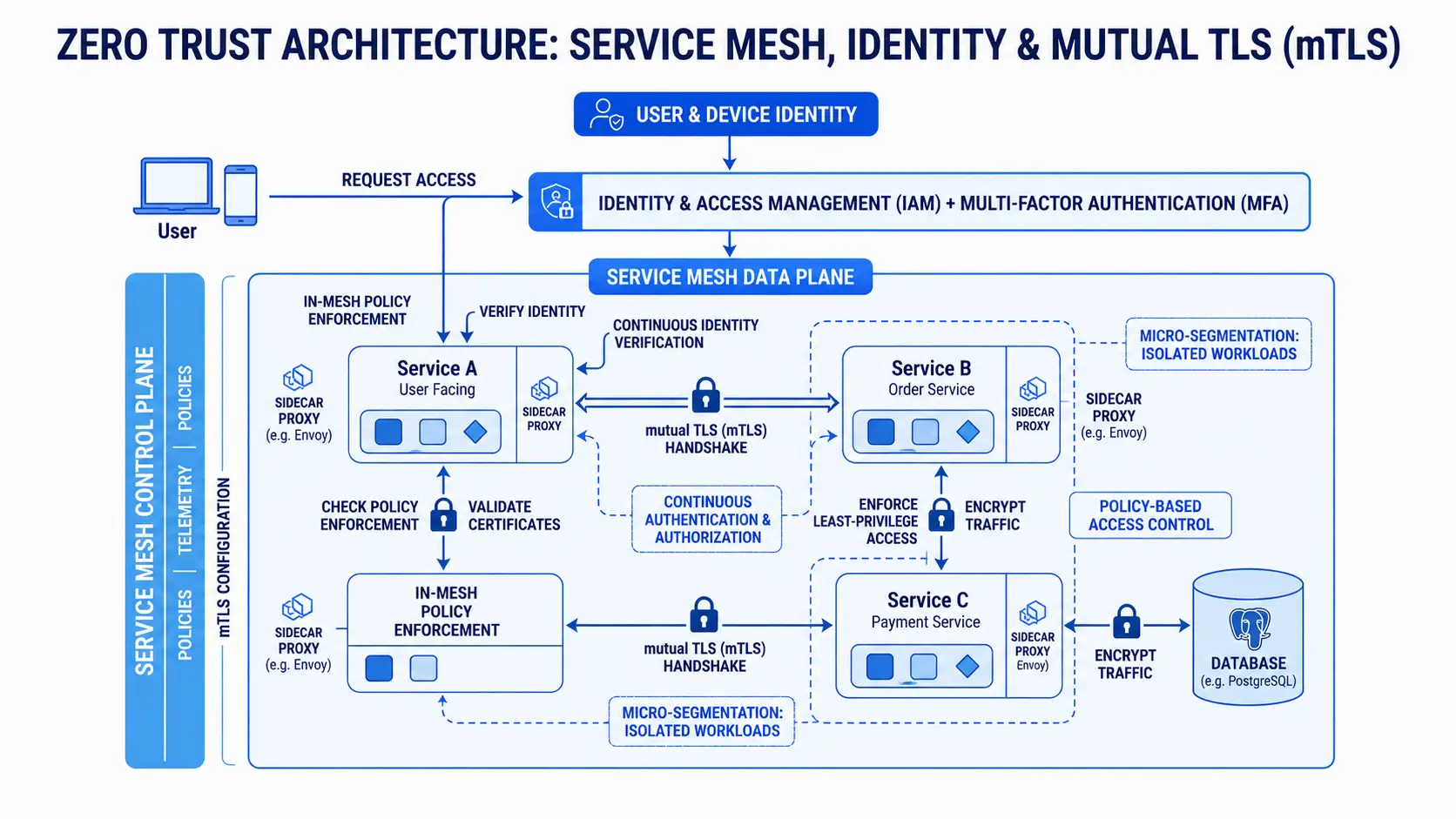
Every service call is authenticated and authorised, even inside the cluster; no internal traffic is trusted by default. Like physical security for a building: checkpoints, not one locked door, protecting every call, not just protecting devices at the perimeter, the oldest rule in computer security.
Security experts and security research back this as the default for information security in distributed systems; NIST's zero trust guidance is a solid baseline.
Four Principles That Set the Protection Level
- Authentication: Proving who's calling doesn't say what they can do; the same gap banking websites close before a transfer or product reviews close before a purchase; route decisions through dedicated auth services instead of hard-coding checks per service.
- Threat intelligence and policy: OPA enforces resource security in real time, not if-statements scattered across services.
- Two-factor authentication: Protects a login, not a service call; machine-to-machine traffic needs mTLS instead.
- Virtual private network: Not a trust boundary; zero trust assumes nothing about either side of a hop, functioning as zero trust network access for internal traffic.
This is a multi-layered defense by design, not a single edge gate, and generic zero trust solutions built for perimeter security rarely map onto service-to-service calls. That gap between identity and authorization is where most teams stall, having solved who's calling but not what they can do. Worth noting the scope: Zero trust secures machine-to-machine calls, not people; social engineering, phishing scams, and online scams, sharpened by AI-assisted phishing, need separate training.
Our Take: Zero trust is not optional infrastructure added after launch. Retrofitting identity and policy checks into forty live services costs more than building them in from service one; teams that treat it as day-one architecture ship faster, not slower.
Implementing mTLS and Service Identity for East-West Traffic
Mutual TLS makes zero trust real for east-west traffic. So what is a service mesh doing here, concretely? Both sides present a certificate, so no service can impersonate another- the service-to-service version of identity theft- and the mesh automates this instead of every team hand-rolling it.
Policy-based authorisation using OPA and Rego handles the layer above identity, context-aware decisions on role, resource, and action, not a flat allow-or-deny gate. A centralized service adds a network hop per call; most teams choose a sidecar engine instead.
Microservices Database Best Practices
Once each service owns its own database, a new problem appears: Keeping a transaction consistent across services that used to share one. The consistency a single database gave you for free is gone.
Saga Pattern for Distributed Transactions
A saga is a sequence of local transactions, each with a compensating action if a step fails. It is the standard fix once atomic cross-service transactions are off the table, and two implementation styles exist:
- Orchestration: A central coordinator, easier to reason about, the right start for most teams.
- Choreography: Services react to events without a coordinator, scales better but is harder to debug at 2 am.
Take order placement: Payment charged, inventory reserved, shipping scheduled. If the reservation fails, the saga triggers a compensating refund instead of a customer charged for nothing. Skip that step and a customer finds the gap.
Event Sourcing and CQRS for Data Consistency
Event sourcing stores every state change as an immutable event log instead of just the current state, an audit trail as a side effect. CQRS pairs naturally with it, separating the write model from the read model so each can scale and be tuned independently.
This pairing is not free. It's worth the added complexity for audit-critical systems, financial transactions, or anything needing point-in-time replay. For a straightforward CRUD-heavy service, it's over-engineering dressed up as rigour.
Deploying and Managing Microservices at Scale
Microservices deployment stops being a manual job at this scale. Every service needs its own build, test, and deploy pipeline, since coordinating fifteen releases by hand isn't viable in 2026, and three things keep that safe at scale:
- Containerisation: Package each service in a container, almost always Docker, and run it on Kubernetes, so a developer's laptop, staging, and production all behave the same way.
- Supply chain hygiene: Only pull container images from a source you trust and verify. An attacker who slips a bad image into your build pipeline can move sideways into every service that runs it.
- Observability: Combine centralised logging, distributed tracing, and unified metrics so you can follow one request's full path across services. Without that, tracking down a single failed request among seven services can take hours instead of minutes, exactly the kind of delay a Security Operations team can't afford mid-incident.
Team structure has to mirror service boundaries. Conway's Law describes what happens regardless: Split services one way, teams another, and the architecture won't deliver the autonomy promised.
How BuildNexTech Helps You Ship Microservices Faster and More Securely
Most teams stitch together a gateway, mesh, and policy engine from three vendors, hiring platform engineers to keep the seams from cracking. BuildNexTech unifies all three, backed by AI security and AI-powered protections. Centralized platforms like Google's Security Command Center or Agentic SOC aggregate alerts after the fact; Model Armor adds a policy layer for AI models. BuildNexTech enforces policy at the call. AI agents keep reading context and making routing decisions at runtime, referencing a knowledge graph of your topology instead of a static diagram.
Across 150+ engagements, the real cost has consistently been three disconnected control planes, not the architecture decisions, and one team cut provisioning from three weeks to four days after consolidating. Teams choose this over more rules or a systems integrator for three reasons: AI-native routing, built-in observability, and no vendor lock-in, a combination that matters as much as the architecture itself.
What a BuildNexTech Microservices Implementation Looks Like
- Day 1-3: Map topology to find handoffs breaking deployment.
- Day 4-7: Integrate via native connectors, nothing ripped out.
- Week 2 on: Deploy the riskiest boundary, reviewer in the loop.
- Ongoing: Observability feeds iteration.
Who This Is For
This fits a team that has outgrown ad-hoc coordination: multiple squads own separate services, domains are stable enough for real boundaries, and DevOps practices are already firmly in place. The signs repeat: Deployment coordination is the bottleneck, policy drifts, and on-call can't localise failures fast.
Conclusion
Microservices best practices in 2026 are not a checklist completed once. Architecture, zero trust security, and scalability are one continuous decision, made service by service, not a reward for running the most services. The teams getting this right drew real boundaries, gave each service its own data and identity, and built security into the architecture rather than around it.
That is the business context every engineering leader should bring here, and it rarely starts with a rewrite. It starts with fixing the boundary and trust model already running today.
People Also Ask

How long does a microservices migration typically take?
Most teams see six to twelve months for a mid-size system when they decompose services in phases rather than all at once, with the first two services taking the longest.
Can you build microservices without using Kubernetes?
Yes. Docker Compose, Nomad, or a managed container service run a small catalogue fine; Kubernetes becomes worthwhile once a team operates fifteen or more services in production.
What's the difference between microservices and serverless functions?
Microservices are long-running services a team deploys and manages independently, while serverless functions are short-lived, event-triggered code the platform provisions and scales automatically, with no service to operate.
How do you test microservices without spinning up the entire system?
Contract testing checks each service's API against what consumers expect without running every dependent service live, catching breaking changes early and replacing costly full-environment runs for routine changes.
Do microservices reduce cloud costs compared to a monolith?
Not automatically. Granular scaling lowers costs for uneven traffic, but added infrastructure and observability overhead often offsets those savings unless a team already operates at meaningful scale.


.webp)
.webp)
.webp)

.webp)
.webp)