

.webp)
Gartner expects 40% of enterprise applications to ship with task-specific AI agents by the end of 2026, most built to act on prescriptive recommendations, not predictive ones alone. Most guides describe prescriptive analytics as a static report next to a dashboard nobody opens. Your predictive model can flag revenue dipping next quarter, but not what to do.
This piece covers what prescriptive analytics is, how it differs from predictive analytics, and where the two meet across four industries, using real prescriptive analytics examples supporting data-driven decision-making. Across 150+ engagements in 30+ industries, this gap is the bottleneck we see most, and where business intelligence tools fall short alone.
What Is Prescriptive Analytics?
Prescriptive analytics is the analytics layer that recommends a specific action from a forecast, not just a probability or a trend line. It sits one step past predictive analytics in the descriptive vs predictive vs prescriptive analytics maturity model.
That gap is exactly where BuildNexTech's agentic AI development comes in. Most teams already have a working predictive model; what's missing is the layer that turns the forecast into an action a system can execute, not another report in a dashboard. Here is the ladder in full:
- Descriptive analytics tells you what happened.
- Diagnostic analytics tells you why.
- Predictive analytics tells you what is likely to happen next.
- Prescriptive analytics tells you what to do about it, the step most organisations skip.
It answers "what should we do" instead of "what will happen", the whole point of moving from predictive to prescriptive analytics. Most teams get comfortable with the first half and never build the second.
How Prescriptive Analytics Works
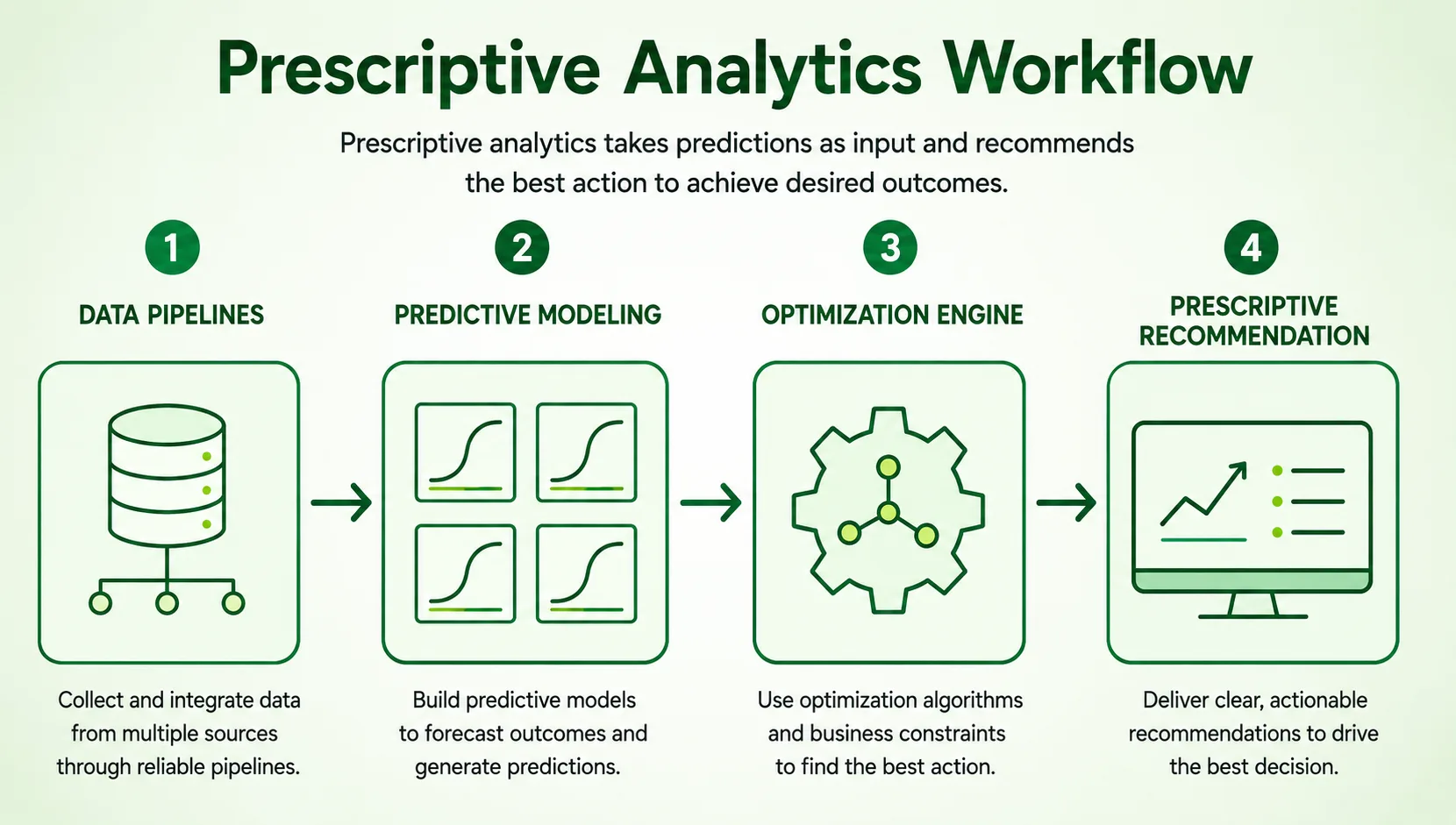
Several prescriptive analytics techniques, centred on prescriptive analytics optimization, work together inside a four-part pipeline. Each part hands off to the next, turning a single forecast into a defensible action:
- A predictive model produces a forecast: Expected demand, likely churn, probable fraud.
- That forecast feeds a scenario analysis layer, testing responses against the outcome.
- Constraint-based optimization algorithms narrow scenarios using real limits: budget, capacity, compliance, staffing.
- The system outputs a ranked recommendation with a confidence score.
Business rules do most of the quiet work. A recommendation that breaches a compliance constraint gets filtered out before a human sees it. Building a solid prescriptive model, or refining one via prescriptive modeling, means tightening constraints, not chasing a bigger algorithm. AI-driven orchestration holds this pipeline together.
Key Benefits of Prescriptive Analytics
- Faster decisions: A scenario that took a team two days manually resolves in minutes.
- Reduced bias: A recommendation engine does not favour last quarter's vendor.
- Real scale: Prescriptive systems weigh thousands of combinations a person could not hold in mind.
None of this means the recommendation is always right. It means the option surfaced first is worth testing, at a fraction of the cost, where operational efficiency gains show.
What Is Predictive Analytics?
Predictive analytics forecasts future outcomes using historical data, often through statisticalmodeling. It is the input that prescriptive analytics depends on: You cannot recommend an action without estimating what is likely. The two are often framed as competing approaches, but they are not; one feeds the other, and treating them as identical data analytics tools confuses.
How Predictive Analytics Works
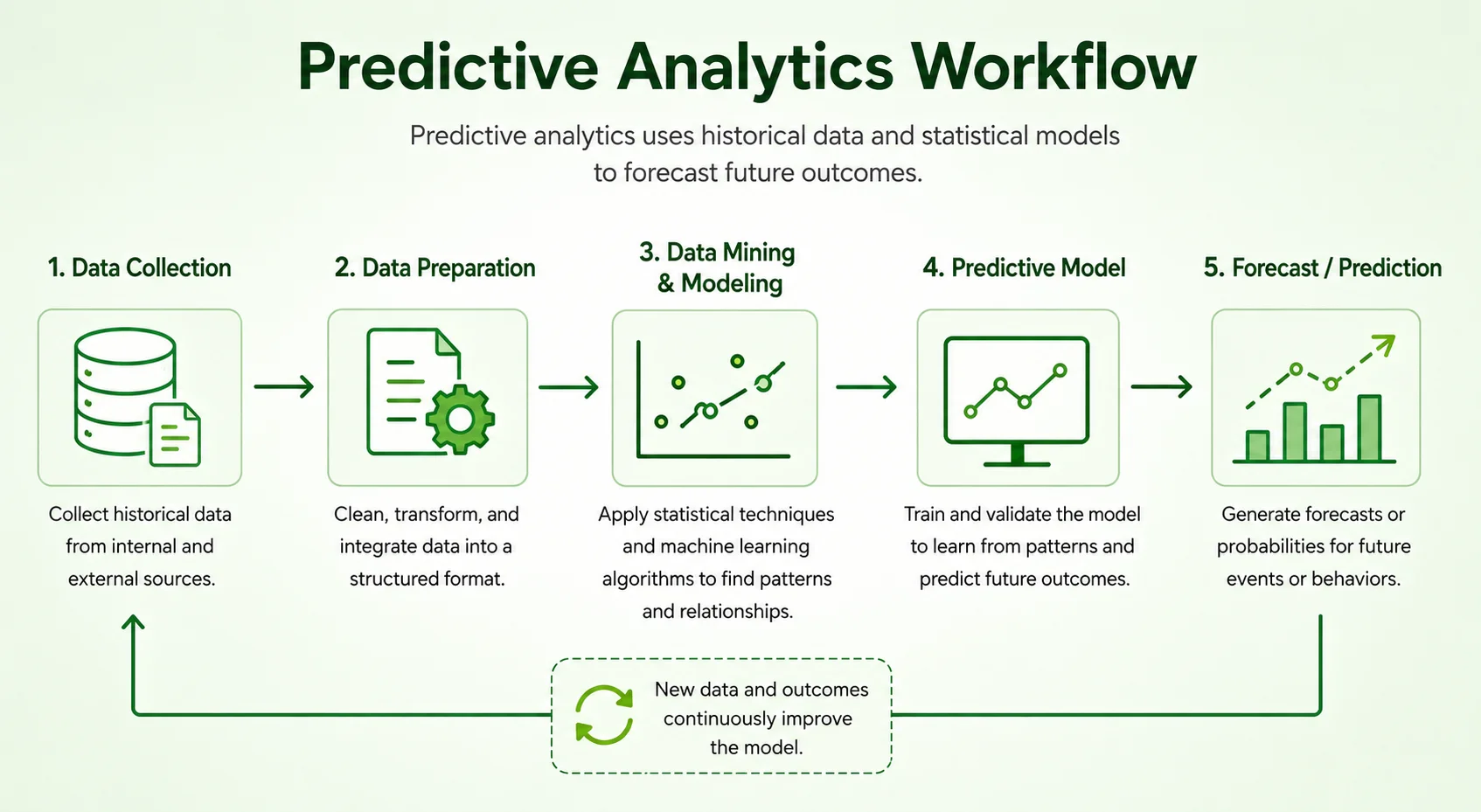
- Data aggregation pulls together transactions, sensor readings, and patient records across the business.
- That data moves through a data pipeline into Data Warehouses, via Data Integration or cloud analytics.
- Data mining techniques detect patterns inside that history.
- Regression and time-series methods generalise those patterns into a forecast.
The output is a number or classification, not an instruction. A predictive model can tell you customer churn risk jumped to 34% for a segment, with no view on whether to discount or drop the account. What is a data pipeline doing here? The unglamorous work that makes the forecast trustworthy.
Key Benefits of Predictive Analytics
- Risk mitigation: Fraud detection models flag risk before a transaction clears.
- Demand forecasting: A retailer spotting a shift six weeks early can reorder.
- Customer retention: Churn models let a team intervene before a customer leaves.
These benefits compound once a prescriptive layer sits on top, turning the forecast from informational into actionable. That combination is what standalone business intelligence software fails to deliver alone.
Predictive vs Prescriptive Analytics: Key Differences
The obvious answer is that predictive analytics forecasts and prescriptive analytics recommends. True, but it undersells how differently the two behave in production. The move from predictive to prescriptive analytics is where predictive and prescriptive analytics programmes stall. Predictive optimises for accuracy; prescriptive optimises for outcome.
Here is the point most vendor content skips: A perfect forecast with no execution path is worth less than a mediocre forecast paired with a fast, imperfect action. Speed beats precision almost every time real money is on the line.
Which one does your team need first?
- Trust forecasts but decide manually? Build the prescriptive layer.
- Forecast accuracy inconsistent? Fix the predictive model first.
- Neither exists, but a decision follows known logic? Start with a scoped pilot.
The cost objection surfaces here: Prescriptive systems sound like a bigger build than they are. If the model and rules exist, the extra engineering is an integration point, not a rebuild. Six hours weekly translating forecasts never becomes a line item next to the data analytics services invoice teams approve.
Examples of Predictive and Prescriptive Analytics
Four industries make this pattern easiest to see. "Our industry is too specific for this" is the objection we hear most, and it rarely survives the pattern below. The mechanics barely change between a hospital and a factory; only constraints do.
Retail
- Predictive: A model forecasts demand two to four weeks out, using behavioral signals.
- Prescriptive: The system recommends a pricing strategy and bundle discounts with personalized recommendations, where prescriptive analytics in retail earns its keep.
- A mid-sized retail client used this to cut markdown losses and lift customer retention.
Prescriptive Analytics Examples in Manufacturing
- Predictive: Maintenance models forecast when a machine is likely to fail.
- Prescriptive: The system recommends which supply chain partner to source a part from.
- This kind of supply chain management call is where teams rely on memory of who came through.
Healthcare
- Predictive: Models forecast patient admission volumes, letting a hospital anticipate a surge.
- Prescriptive: The system extends that into personalised treatment protocols, using prescriptive data analysis.
- Human review stays in the loop across the healthcare industry; the value is speed.
Finance
- Predictive:Models forecast market movement using pricing patterns and macro indicators.
- Prescriptive: The system recommends investment adjustments, rebalancing a portfolio against risk.
- Fraud detection paired with agentic AI now runs on real-time data, with audit trails in the orchestration layer.
How BuildNexTech Turns Prescriptive Recommendations Into Automated Action
Most teams reach this point and think: fine, the recommendation needs an execution path. This is the part we do. We connect optimisation and machine learning recommendations to orchestration frameworks like LangChain, so the top-ranked recommendation triggers a real action instead of a report. For a US digital bank, this cut manual underwriting effort by 65%, turning business analytics into something that acts, not something read weekly.
Our prescriptive AI work sits inside a broader set of prescriptive analytics services built as AI agents for business, not generic automation. People ask us how to build AI agents that survive a real workflow; the answer starts with narrow, auditable agents over flashy, general-purpose ones, roughly the agentic AI vs. AI agents question most vendors avoid.
In practice, that means:
- Some of the best AI agent examples we build are narrow and single-purpose, not the flashiest enterprise AI agents.
- Production-grade orchestration that has handled failure modes a first attempt hits.
- Human-in-the-loop controls that satisfy compliance.
- Integration with legacy systems never built for automation, usually the real blocker.
- Big data analytics and AI data analytics paired with AI-powered insight that acts, run by autonomous AI agents.
Day to day, a planning team stops manually translating forecasts and starts reviewing exceptions instead.
What a BuildNexTech Implementation Looks Like
Rollout follows a staged path rather than a single big-bang launch, so the team can validate the constraint logic before anything runs unsupervised. What the team owns at the end is an auditable action trail, not another dashboard nobody opens.
- Day 1 to 3: Data and constraint discovery, plus data aggregation and Data Integration.
- Day 4 to 7: The predictive model and rules are wired into the optimisation layer.
- Week 2 onward: Agent deployment, with review calibrated to risk.
Who This Is For
This fits teams already running a predictive or business intelligence layer who need prescriptive execution shipped without a rebuild. Usual triggers: A forecast that never turns into an action, no clear path from recommendation to execution, or manual decisions piling up faster than the team can automate.
Conclusion
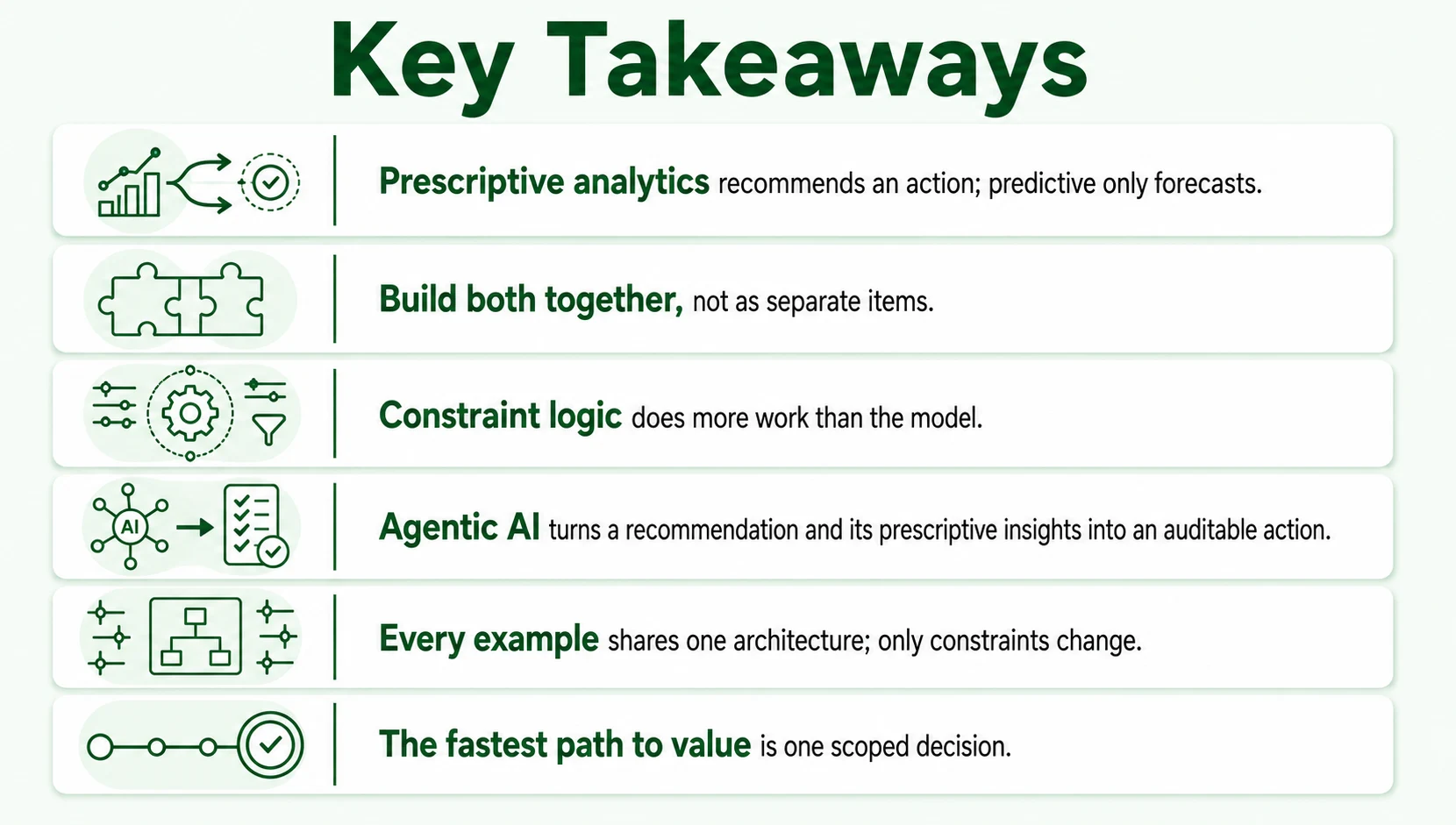
Prescriptive analytics recommends the action a predictive forecast makes possible, and neither does much alone. In 2026, the shift is not a smarter forecasting model; it is more teams pairing that forecast with an agent that acts on it, so the recommendation stops sitting in a dashboard nobody reads twice. Teams working with BuildNexTech on this transition tell us the same thing every time: The forecast was never the bottleneck, and the decision always was.
People Also Ask

How does prescriptive analytics differ from standard business intelligence reporting software?
Business intelligence reporting software shows what happened and lets you slice historical numbers. Prescriptive analytics goes further, recommending the specific next action rather than just displaying data.
Does prescriptive analytics require an in-house data science team?
Not necessarily. Many teams start with a scoped pilot using existing data analytics tools and an external partner, then build internal capability once the workflow is proven.
What data quality issues most often break a prescriptive analytics model?
Incomplete constraint documentation causes more failures than bad data itself. Missing business rules and unlogged manual overrides quietly undermine even a technically sound prescriptive model.
Is prescriptive analytics only suitable for large enterprises?
No. Smaller teams with one well-documented, repeating decision often see value faster than large enterprises juggling competing priorities, since the pilot scope stays narrow and easier to govern.
What is a realistic ROI timeline after deploying prescriptive analytics?
Most scoped pilots show measurable time savings within four to six weeks of going live. Full return on investment typically follows within one to two quarters.


.webp)
.webp)
.webp)

.webp)
.webp)