
.webp)
Your team spent three months gathering requirements. By the time the first build shipped, the stakeholders had already changed their minds. That is the problem the RAD model was designed to eliminate.
So, what is the RAD model in software engineering? Put simply, rapid application development skips exhaustive upfront planning and gets a working prototype in front of users fast. You build something, get real user feedback, improve it, and repeat until the software actually fits people's needs. The RAD software development model trades documentation thoroughness for delivery speed and continuous user involvement.
TL;DR: The RAD model uses four phases (Requirements Planning, User Design, Construction, Cutover) to deliver working software in 60-90 days. It replaces upfront documentation with iterative prototype cycles and continuous user feedback.
Across 150+ client engagements, BuildNexTech has helped engineering teams move from documentation-heavy delivery cycles to iterative, prototype-driven builds that reach production in weeks, not quarters.
What Is the RAD Model in Software Engineering?
The RAD model is a rapid application development framework that prioritises working prototypes over exhaustive documentation. James Martin introduced the rapid application development definition in 1991 as a direct alternative to the Waterfall model's rigid, sequential phases. The core idea: Treat software as a living artefact shaped through real user involvement, not a specification handed down for execution.
According to IBM's analysis of the RAD SDLC, testing and feedback are embedded across the development cycle rather than reserved for the end: A structural difference that separates the RAD software development model from every traditional approach.

RAD Model vs. Traditional SDLC Approaches
RAD predates Agile by a decade (1991 vs. the Agile Manifesto in 2001) and is best understood as a prototype-specific software development methodology, not a replacement for Agile at scale. Where the agile vs waterfall debate is about planning philosophy, RAD takes a third position: More structured than iterative Agile, far more adaptive than Waterfall, and uniquely suited to projects where early user feedback determines architectural direction.
The 4 Phases of the RAD Life Cycle
The RAD life cycle runs through four phases. Unlike Waterfall stages, the User Design phase is recursive: It loops through prototype iterations until the design is approved, then construction begins.
- Requirements Planning: User requirements, system scope, and delivery timelines get defined here through JAD sessions. Everything stays high-level. Time-boxed development cycles target 60 to 90 days. The goal is a shared direction, not a locked-down spec.
- User Design: A working prototype is built, shown for user feedback, then refined and rebuilt. This loop repeats until the design is approved. Reusable components and pre-built components keep each prototype iteration fast. UI/UX design gaps and workflow issues surface here, not after deployment.
- Construction (Rapid Construction): The approved prototype is converted into a production-ready system using the same modular codebase. With user design locked in, rapid construction moves quickly-continuous integration, automated QA testing, and performance monitoring run throughout to keep the build production-grade.
- Cutover: User acceptance testing (UAT), data migration, and go-live happen in this final phase. Because the system went through multiple prototype cycles, go-live risk is far lower than a traditional Waterfall release. Scope creep surfaces here if earlier change-control boundaries were unclear.

When to Use the RAD Model (and When Not To)
Not every project suits the rapid application development model. The decision criteria are specific.
Use RAD when:
- The system architecture is modular and decoupled.
- Stakeholders can commit to regular prototype reviews throughout the development cycle.
- The delivery timeline is under 90 days.
- The team is experienced enough to make autonomous decisions without formal blueprints.
- The project involves building a minimum viable product, internal tools, or a web rapid application development initiative.
Avoid RAD when:
- The system has tightly coupled legacy integrations where rapid prototyping introduces risk.
- The project operates in a regulated environment (HIPAA, FedRAMP) requiring exhaustive upfront documentation.
- Large multi-team coordination overhead outweighs the speed benefit of the RAD approach.
- Stakeholder availability is limited or inconsistent.
Advantages of the RAD Model
The advantages of rapid application development are most visible in projects where requirements are likely to evolve:
- Shorter time-to-first-working-build through iterative prototype cycles.
- Fewer defects from continuous testing and feedback throughout the development process.
- Higher alignment between user requirements and delivered software, since users shape the build in real time.
- Flexibility to absorb requirement changes mid-cycle without formal change-request processes.
McKinsey research finds that iterative delivery loops outperform sequential planning cycles, delivering 30% higher customer satisfaction and faster time-to-market, a pattern consistent with what RAD's prototype cycle is built to produce.
Disadvantages of the RAD Model
The RAD method has genuine trade-offs that teams should evaluate honestly:
- Scope creep risk from open-ended user feedback loops with no defined boundary.
- Architectural debt when UI flows and user interface design are prioritised over back-end structure.
- Documentation gaps that create compliance and maintenance issues downstream.
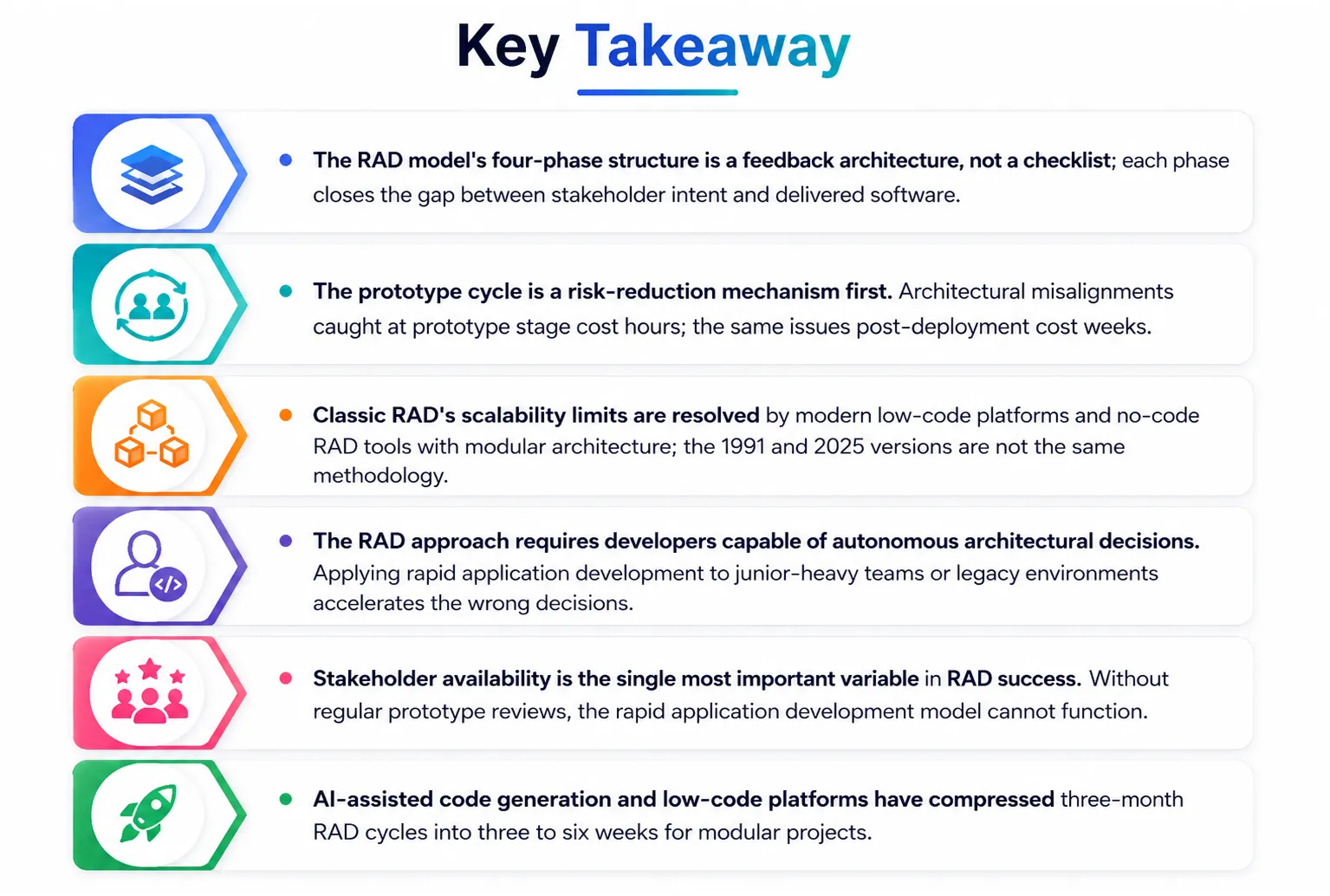
- High talent requirement: The RAD approach depends on developers who can make sound architectural decisions autonomously, without waiting for formal blueprints.
- Small teams with junior developers often struggle in RAD, not because of skill gaps, but because each prototype cycle demands confident, independent decision-making at every stage.
What the RAD Model Gets Right That Most Engineering Teams Overlook
Most RAD coverage stops at the four phases. The more important story is architectural risk reduction. When stakeholders validate a working system at each prototype iteration, structural misalignments get corrected before they reach the production codebase. That is a quality and rework-reduction story, not just a speed story.
The scalability criticism is real but misattributed. Classic rapid application development does not fail at scale because the RAD model is flawed; it fails because teams do not pair it with the right rapid application development tools. Low-code platforms and no-code platforms with modular architecture and enterprise governance have resolved what the 1991 model left open.
The Prototype Cycle as an Architectural Risk Control Mechanism
Each prototype iteration is a structured risk-reduction event. Integration failures, data model mismatches, and workflow gaps surface here, where correcting them costs hours. Caught post-deployment, the same issues cost weeks. The prototype cycle in the RAD SDLC is not a speed mechanism; it is the earliest detection layer for architectural decisions that would otherwise compound into production.

Modern RAD: Low-Code Platforms and AI-Assisted Prototyping
Low-code platforms and no-code RAD tools have removed the primary bottleneck of classic RAD: Manual construction. Visual development environments, drag-and-drop functionality, pre-built components, and integration connectors allow teams to sustain the prototype cycle with a smaller headcount. AI-assisted code generation compresses the User Design phase further: automated UI flow generation, DevSecOps pipelines, and automated QA testing make the rapid application development process faster than James Martin's original framework could anticipate.
How BNXT.ai Accelerates the RAD Life Cycle for Engineering Teams
BuildNexTech's AI-native low-code application development platform shortens both the User Design and Construction phases. Here is what the platform brings to each stage of the rapid application development life cycle:
- Pre-built components and reusable code modules that eliminate scaffolding work.
- Drag-and-drop functionality and visual development tools for rapid prototyping without manual build overhead.
- Integration connectors for third-party systems, enabling workflow automation across the full development cycle.
- DevSecOps pipelines and performance monitoring baked in, so rapid construction does not create maintenance and support debt later.
- AI-assisted code generation that accelerates each prototype iteration without compromising code quality.
Engineering teams using BuildNexTech have cut prototype-to-production cycles by up to 60% across fintech, healthcare, and logistics deployments.
What a BNXT.ai RAD Implementation Looks Like
- Day 1 to 2: Requirements mapping session: Project scope is translated into a modular component blueprint using visual development tools inside the platform.
- Day 3 to 5: Prototype cycle: visual builders generate a working prototype in a live environment, not a mockup. Stakeholders review it the same week.
- Week 2: Second and third prototype iterations incorporating user feedback. Each cycle runs within the platform without rebuilding from scratch.
- Week 3 onwards: Rapid construction begins from the approved prototype. Automated pipelines handle continuous integration, automated QA testing, and deployment.
Who This Is For
This rapid application development approach suits engineering-led organisations with active stakeholder availability, delivery timelines under 90 days, and a backlog of internal tools or mobile app development projects that traditional dev cycles cannot clear.
Our Take: Stakeholder availability is the single constraint that determines whether RAD accelerates delivery or produces fast, misaligned software. If your decision-makers commit two to three hours per week across a six-week prototype cycle, the RAD approach with the right tooling outperforms every other software development methodology for modular scope.
Conclusion
The RAD model in software engineering keeps software development close to what users actually need, not what was documented weeks before a line of code was written. Modern rapid application development software, low-code platforms, and AI-assisted prototyping have removed the overhead that once limited the RAD approach to small teams and tight scopes. The prototype cycle is what makes it work. Get that right, with the right rapid application development tools, and delivery timelines compress in ways traditional software development models simply cannot match.
People Also Ask
Can the RAD model be used for large-scale enterprise projects?
Yes, but only with the right rapid application development tools. Low-code platforms and modular architecture resolve the scalability limits that made classic RAD unsuitable for enterprise-scale software development.
How does RAD handle changing requirements mid-project?
The RAD model absorbs changing user requirements naturally. Each prototype iteration incorporates new user feedback, so changes are addressed within the development cycle, not through a formal change-request process.
What is a JAD session and why does RAD depend on it?
JAD (Joint Application Development) sessions are structured workshops for aligning user requirements and system scope. RAD depends on them to give the prototype cycle a clear direction before iteration starts.
Does the RAD model work for mobile app development?
Yes. RAD suits mobile app development well when UI/UX design needs frequent iteration. Low-code platforms and pre-built components accelerate prototype cycles for both iOS and Android builds.
How does RAD manage technical debt from fast prototype cycles?
Technical debt in RAD is managed during Construction. Reusable components and a modular codebase from the prototype cycle keep the production build clean without requiring a full rewrite later.


.webp)
.webp)
.webp)

.webp)
.webp)