

A company came to us with a stalled product. They had skipped the software requirements specification (SRS) in week one, and a month later their developers still did not know what functions it was meant to deliver. The code was never the problem. The missing stage was, and that structure is exactly what the software development life cycle (SDLC) provides.
In this guide, we break down the 7 stages of the software development process, follow one worked example from the first interview to the maintenance backlog, and show how modern AI-driven workflows remove traditional bottlenecks.
What Is the Software Development Process?
The software development process, commonly known as the software development life cycle (SDLC), is a systematic, step-by-step framework engineering teams use to design, build, test, deploy and maintain high-quality software.
The SDLC divides complex projects into manageable phases, each with specific deliverables, clear ownership and defined exit criteria, so project managers and developers can control budgets, minimise technical risk and deliver software that solves real user problems.
Stages of Software Development Process
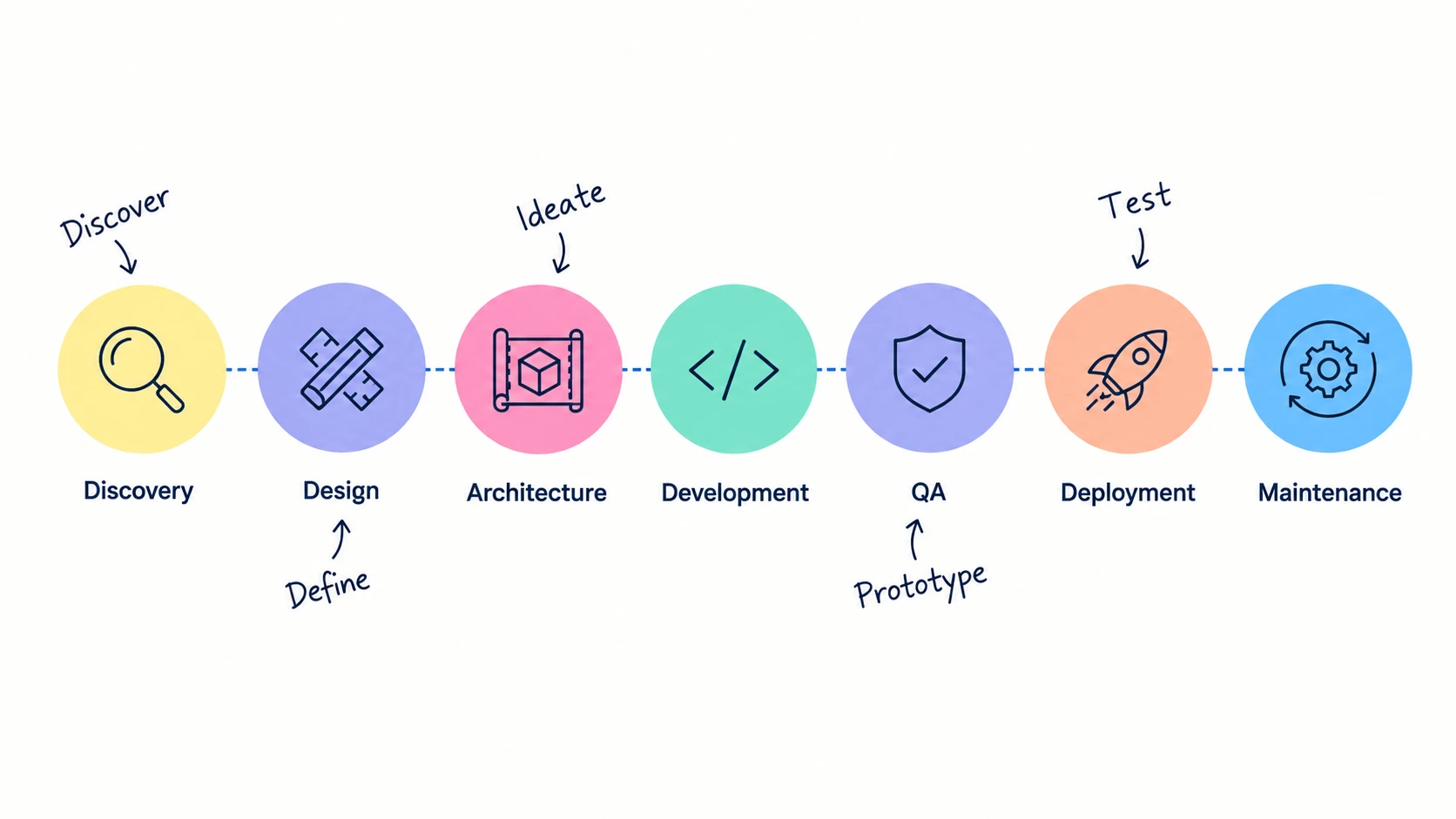
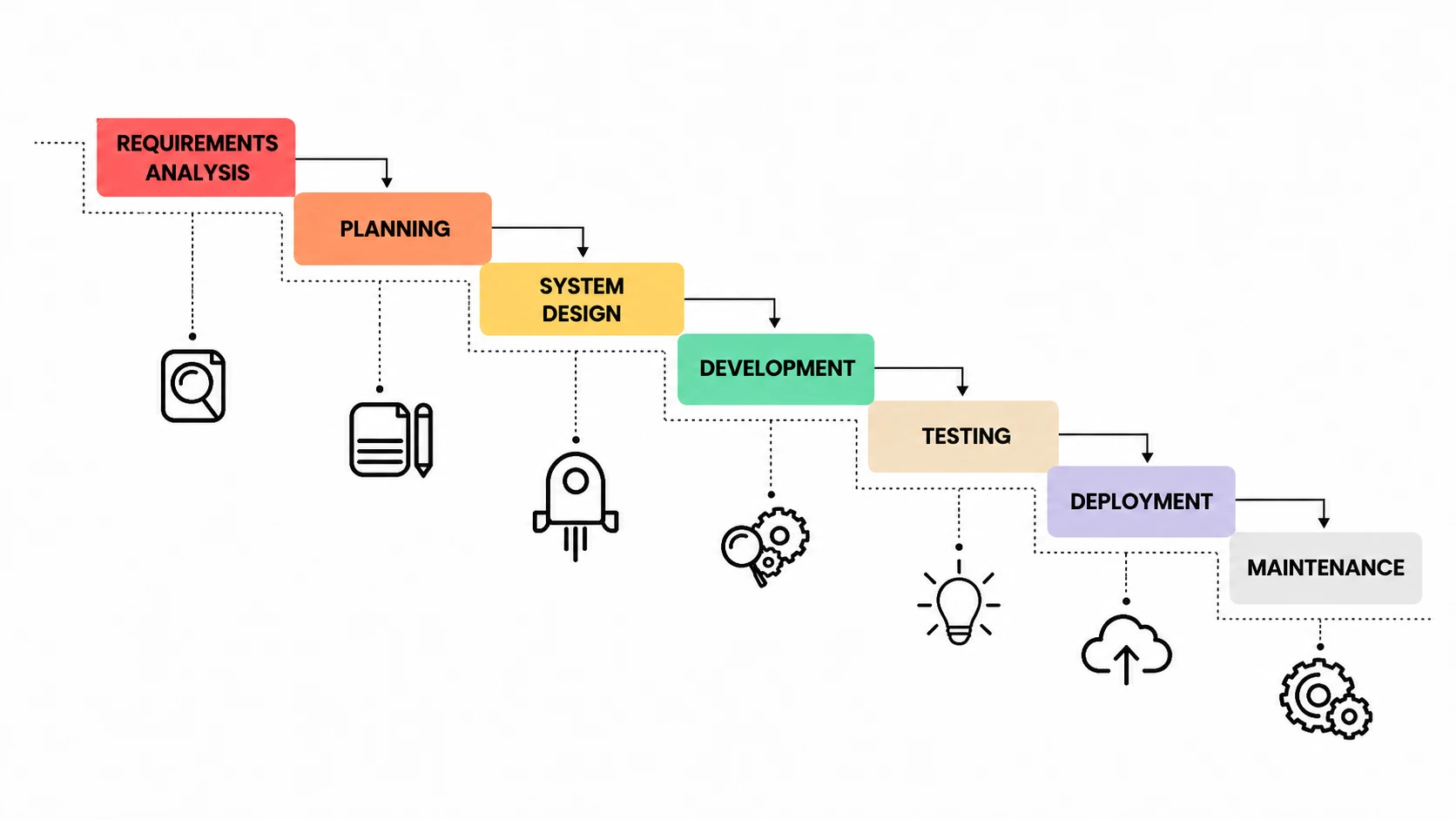
Each of the SDLC stages, also called SDLC phases, hands one named deliverable to the next:
- Requirements analysis: Capture what users need and hand over a signed software requirements specification (SRS).
- Planning phase: Set scope, cost, and risks and hand over a roadmap, budget, and risk register.
- Design phase: Shape the experience and structure and hand over wireframes and an architecture record.
- Development phase: Build the product with reviewed changes and hand over release-branch code.
- Testing phase: Check the build against the requirements and hand over a triaged test report.
- Deployment phase: Release in stages and hand over a live product with a rollback plan.
- Maintenance phase: Fix, support and improve, then hand over a prioritised backlog for Stage 1.
Types of SDLC
SDLC models, also called software development models, differ in when they accept change. The waterfall model locks scope first, while the agile model delivers in small increments. The answer to what agile methodology is is iterative delivery, with working software in small increments and feedback shaping each next step, through timed sprints in Scrum or continuous flow in Kanban.
The 7 Stages of SDLC Explained With a Real-World Example
To see how the seven phases work in practice, let's follow a real-world scenario: Building a field-service scheduling app for the anonymous logistics firm from the introduction. We explain it through Waterfall, because three conditions favour a strict, gated sequence. Each stage follows it through the mobile app development lifecycle.
- Fixed scope: The contract names the features and delivery date.
- Gated sign-off: The operations director approves each stage in writing.
- Clear boundaries: Every stage ends in a named deliverable.
Waterfall suits this project because the scope is fixed. With moving requirements, Agile or a hybrid would serve better. A hybrid keeps Waterfall for design and compliance.
Stage 1: Requirements Analysis and Discovery
Requirements & Analysis starts with interviews and market research, not a feature list. Product managers, business analysts and stakeholders define what the software must achieve, because most rework starts here.
- Key Activities: User interviews, requirements gathering for functional and non-functional needs, light business modelling to rank market opportunities, and drafting the SRS.
- Deliverable and Exit Criteria: A signed SRS, with every requirement testable and budget-approved.
Scheduling App: Requirements
- We will ensure every technician workflow is captured, with offline use as a testable requirement.
- Our team will verify each requirement with the operations director before sign-off.
Stage 2: Planning and Feasibility
Once requirements are clear, leadership evaluates whether the project is viable and how it will be delivered. This prevents impossible deadlines and overspending, and surfaces the riskiest assumptions early.
- Key Activities: Feasibility analysis, scope, budget and headcount estimates agreed with project managers, risk assessment, and choosing the SDLC model.
- Deliverable and Exit Criteria: A roadmap and risk register, approved by the budget owner.
Scheduling App: Planning
- We will evaluate offline sync against real signal gaps, prototyping it first as the riskiest assumption.
- We will ensure the budget reflects network and regulatory compliance requirements.
Stage 3: System Design and Architecture
Design turns requirements into blueprints. It locks in cost and performance before anyone writes code, across software design at two levels. Mobile app development rests on one early decision: Native clients (Kotlin, Swift) or a cross-platform codebase (Flutter, React Native), plus a backend. Native Android mobile app development still wins for deep hardware access. If you hire out, ask any Android mobile app development services or iOS app development services provider which stack they would pick. Our mobile development team makes that call per build.
- Key Activities: UX/UI design with user interface sketches for the core flows, tested with real users, then choosing the client approach, defining the REST API and systems integration, and setting database definition, database management and data management rules.
- Deliverable and Exit Criteria: A clickable prototype and an architecture decision record, signed off by the operations director.
Scheduling App: Design Decisions
- Our designers will test the three core flows with technicians on a live site.
- Our developers will check the cross-platform build shares offline logic and the REST API into dispatch and billing stays stable.
- We will verify PostgreSQL handles scheduling conflicts before coding starts.
Stage 4: Development and Implementation
Coding & Implementation is where developers turn the approved design into working software. In the coding/implementation phase, each software developer follows written coding guidelines and works in short branches under version control, with pull request review doubling as asynchronous communication.
- Key Activities: Writing modular code with mobile app development tools such as Android Studio and Xcode, bug tracking in Jira or Monday. DevOps and continuous integration for faster feedback.
- AI-assisted coding: 84% of developers use or plan to use AI tools. Developers still own the review, with checks aligned to NIST SP 800-218
- Deliverable and Exit Criteria: Reviewed code on a release branch, with tests passing.
Scheduling App: Development
- Our developers will check every pull request against the coding guidelines.
- We will ensure scheduling APIs have automated tests before merging.
Stage 5: Software Testing and Quality Assurance
Testing finds defects while they are cheap. Knowing what software testing is, and what the stages of software testing are, starts with one idea: Each level of the software testing life cycle checks a different risk. Good software testing strategies map each level to a real risk, and shift-left testing moves QA testing into Stage 3. Frugal Testing's guide to the stages of software testing goes deeper.
- Key Activities: Unit, integration, system and performance testing, then user acceptance testing (UAT).
- Software Testing Tools: Deciding what the tools are for software testing gets easier once each is matched to a test type, such as Selenium for web interfaces, Postman for API contracts and a device farm for handsets. Automate regression, keep exploratory testing manual, and agree on quality metrics before testing starts. Software testing services can add device coverage.
- Deliverable and Exit Criteria: A test report with every defect triaged and no open critical defects.
Scheduling App: Testing
- Our testers will verify route logic and app-to-API calls with unit and integration tests.
- We will evaluate real handsets in poor signal before UAT sign-off.
- We will ensure no critical defect stays open at release.
Stage 6: Deployment and Release Management
Once the software passes every quality gate, it goes live. The deployment phase follows a staged software deployment process, because app store review adds days you cannot control. DevOps automation replaces the manual release checklist, where careless mistakes happen.
- Key Activities: Configuring production servers, phased rollouts with blue-green deployment, user training for the end-user support desk, and a rollback plan.
- DevOps Best Practices: A CI/CD pipeline on GitHub Actions or Jenkins, infrastructure as code so environments are reproducible, and monitoring with alerts tied to crash rates. A DevOps engineer owns this pipeline with DevOps tools such as Terraform, or DevOps services can set it up. Faster iteration follows, and customer expectations are met.
- Deliverable and Exit Criteria: A staged release and rollback runbook, with the rollout complete and the rollback tested.
Scheduling App: Deployment
- We will release to a few technicians first and verify crash rates before rollout.
- Our team will ensure the rollback is tested before the first release.
Stage 7: Maintenance and Continuous Improvement
Once the software is live, the maintenance phase never closes. Maintenance and operations feed what is learned back into Stage 1.
- Key Activities: Bug fixes, yearly OS updates, application enhancement from feature requests, software re-architecture when the codebase slows delivery, and end-user support.
- Deliverable and Exit Criteria: A prioritised backlog, with a retrospective closing each release.
Scheduling App: Maintenance
- We will evaluate sync complaints and crash data after each release.
- Our developers will turn confirmed issues into the next SRS.
Software Development Process Best Practices
Even with a clear 7-stage framework, projects can stall when teams fall into siloed habits. Whether you build in-house or buy custom software development services from a software development company, these practices keep the SDLC running smoothly across the software development steps:
- Shift Left on Testing and Security: Do not wait until Stage 5 to think about quality. Integrate automated testing and security checks (DevSecOps) from the design and coding phases.
- Maintain Living Documentation: Keep architecture diagrams, API specs and requirement documents current, so onboarding stays quick.
- Automate Repetitive Workflows: Use CI/CD pipelines for builds, regression testing and deployments, so developers focus on complex problem-solving.
- Keep Feedback Loops Short: Involve stakeholders early through prototypes and demos. A misaligned feature caught in Stage 3 costs a fraction of the fix after Stage 6, and short loops sharpen project management.
How BuildNexTech Streamlines Your Software Development Process
Traditional software development often suffers from handoff delays, manual testing bottlenecks and fragmented workflows. As a custom software development company serving various industries, BuildNexTech bridges these gaps by embedding AI agents, agentic workflows and cloud engineering into the software development lifecycle, a direction Gartner expects to spread across enterprise applications. BuildNexTech's agents remove manual work at four of the slowest points:
- Drafting requirements from interview notes.
- Generating test cases from the SRS.
- Running release checks before every deployment.
- Triaging post-release tickets and crash data into the next backlog.
What a BuildNexTech Software Development Implementation Looks Like
Partnering with BuildNexTech changes how teams move through the SDLC:
- AI-Accelerated Discovery and Architecture: BuildNexTech aligns business goals with scalable cloud architectures (AWS, Azure, Google Cloud) and spots openings for generative and agentic AI early.
- Intelligent Full-Stack and Agentic Development: Engineers build web and mobile platforms alongside custom LLM workflows, multi-agent automation and API integrations.
- Automated Quality Engineering and Cloud Modernisation: Backed by deep roots in software testing and DevOps (alongside Frugal Testing), BuildNexTech validates every release for quality and security, then deploys it with ongoing AIOps and MLOps monitoring.
Conclusion
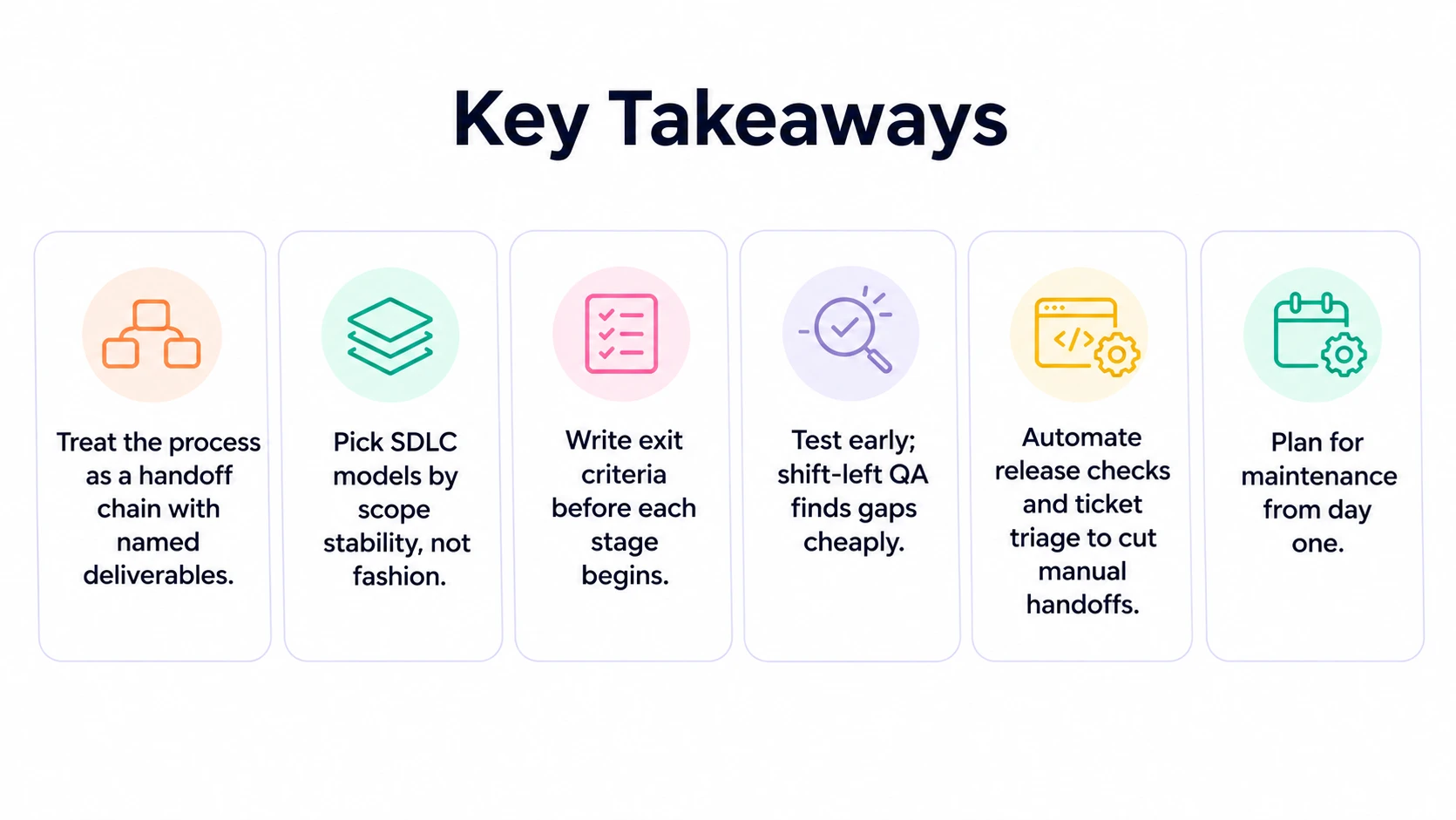
The software development process is a chain, and chains fail at the weakest link, which is rarely the code. Seven stages, a model matched to scope stability and five habits that keep gates honest will carry most builds, whatever the team size, stack or industry.
The harder question is which of your seven handoffs is already leaking, and who would notice. Pick one stage, write its exit criteria, and check what the next team actually receives. That single check often exposes more risk than another round of code review.
People Also Ask

What are the skills required for software development?
Core skills include programming, version control, data structures, testing habits and clear communication. Developers also need problem-solving ability and domain knowledge.
What is API testing in software?
API testing checks that services exchange data correctly. It verifies responses, errors, security and performance, and it runs faster than UI tests, so teams automate it first.
What does a DevOps engineer do?
A DevOps engineer builds the pipelines, environments and monitoring that carry code from commit to production. They automate release work and connect developers with operations, making releases predictable.
How do I choose a software development company?
Choosing a software development company starts with case studies in your industry, a named build team and a clear testing and release process. Begin with a paid discovery phase.
How much does custom software development cost?
Custom software development cost depends on scope, integrations, platforms and team size, so no honest figure exists without discovery. Ask for a fixed-scope estimate tied to the SRS.