

.webp)
A company came to us nine months into a multi-agent rollout, stuck on a problem their engineers had not flagged early enough. Their LLM agents called fifteen internal tools without issue: Pulling records, checking scores, drafting summaries. Handing that summary to a separate agent, built by a different team, broke every time, and each new pairing meant another integration failing quietly in production.
This is precisely the gap that Google A2A, formally the Agent2Agent (A2A) Protocol, was built to close. Instead of leaving every vendor to solve agent handoff on its own, it gave the industry a shared way for agents built on different platforms to work together. This guide explains the A2A Protocol, how it differs from the Model Context Protocol (MCP), and where enterprise AI agents are already running it.
What Is the A2A Protocol?
The A2A protocol, formally the Agent2Agent (A2A) Protocol, is an agent-to-agent protocol: An open standard that lets AI agents built on different frameworks discover one another and hand off tasks, using a structured request and response instead of a bespoke integration. Google announced it in April 2025 and donated it to the Linux Foundation two months later, and it now sits under the Agentic AI Foundation (AAIF) alongside MCP.
A few things worth knowing:
- It is one of the Open Protocols now governed neutrally under the Linux Foundation, not owned by a single vendor.
- It runs on a client-server architecture, where one agent requests and another responds as an A2A Server.
- The agentic AI vs. AI agents distinction matters here: A2A assumes autonomous AI agents that complete a task, not single-turn tools responding to one prompt.
Client Agents vs Remote Agents: The Core Model
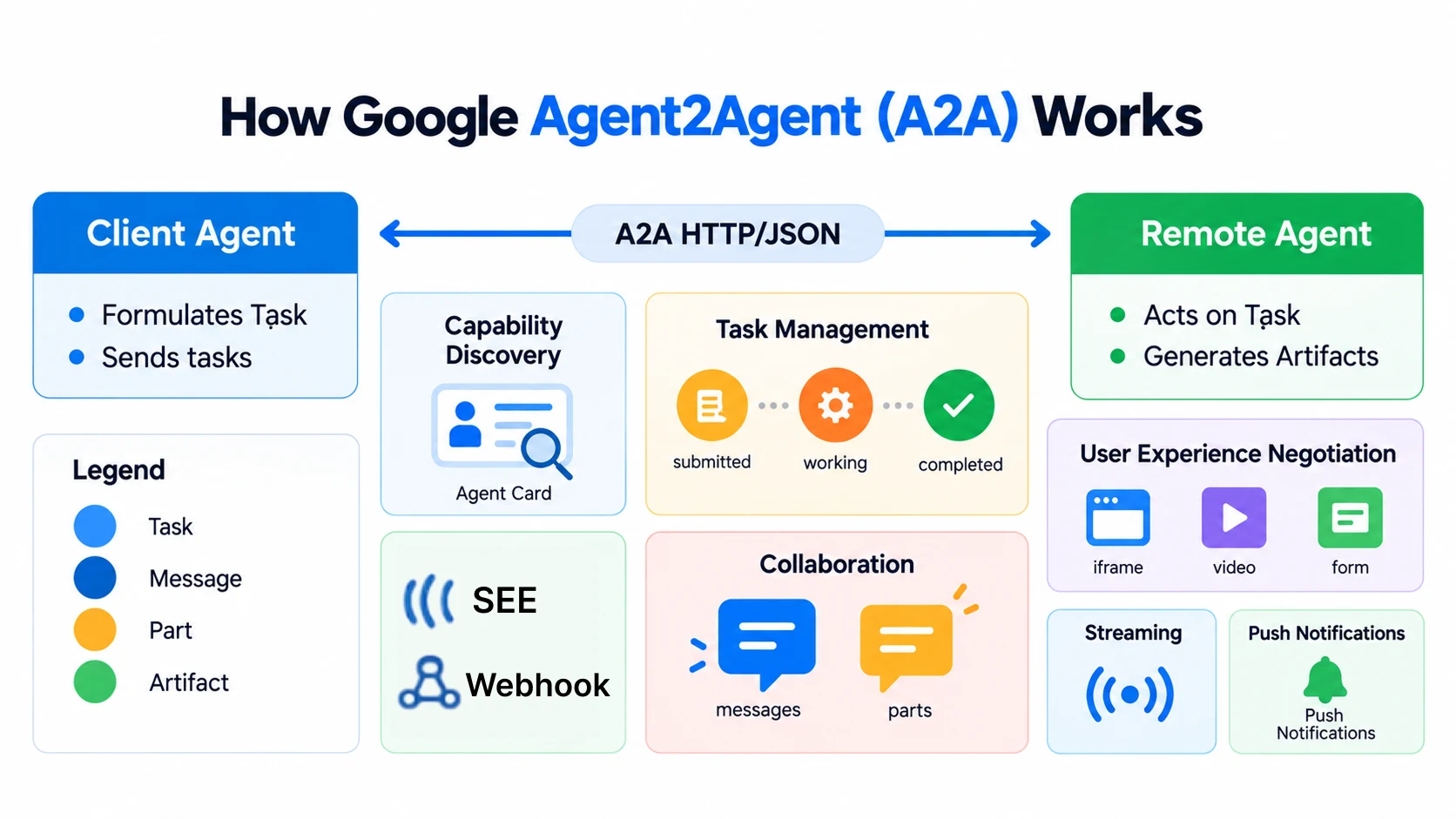
A2A defines two roles built on a client-server architecture. A client agent initiates a task, and a remote agent, exposed as an A2A Server, executes it, using a structured message in and a structured result out, with no shared memory or runtime between them.
That minimalism is what lets a LangGraph agent hand off work to a CrewAI agent without either side knowing how the other was built, which is why A2A works across vendors instead of locking teams into one stack.
How A2A Works: Agent Cards, Tasks, and Messages
A2A runs on JSON-RPC 2.0 over HTTPS, with streaming through server-sent events for long-running tasks. It is not a plain REST API with a new name; it is a defined message format built specifically for agent collaboration, using request patterns most engineering teams already know how to debug.
The mechanics, in order:
- A client agent reads a remote agent's capabilities before sending anything.
- The protocol creates and tracks a task through built-in Task Management logic.
- Agents exchange structured messages carrying both data and natural-language context, so a remote agent gets more than a raw payload.
- The task closes with a result, or a documented reason it could not be completed.
Agent Discovery Through the Agent Card
An Agent Card is a machine-readable capability declaration published at a known endpoint: What the agent does, how to reach it, and which authentication schemes it expects. It works like a directory listing that another agent reads before sending a task.
- As of A2A 1.2, Agent Cards can carry security schemes with domain-verified signatures for authentication without a prior relationship.
- Some enterprise directories now use Semantic Indexing of Agent Cards to match capabilities to the right agent as fleets scale.
- A first Agent Card typically takes half a day to publish for a team with a documented API already.
Task Lifecycle and Structured Messaging
Every task moves through a defined state machine, tracked from creation to close. That lifecycle is what turns A2A into an actual protocol for coordinating agents that do not trust each other by default.
- Submitted, working: The task is received and actively being processed by the remote agent.
- Completed, failed, canceled: The task closes with a result or a documented reason it could not finish.
- Input-required: The remote agent pauses mid-task to ask a clarifying question instead of failing outright.
A2A Protocol vs MCP: Complementary, Not Competing
A2A did not replace MCP. Both sit under the same Linux Foundation umbrella, with MCP joining the Agentic AI Foundation in December 2025 and A2A following in August 2026, and neither project changed its own specification to accommodate the other. They solve genuinely different problems, not competing versions of the same one.
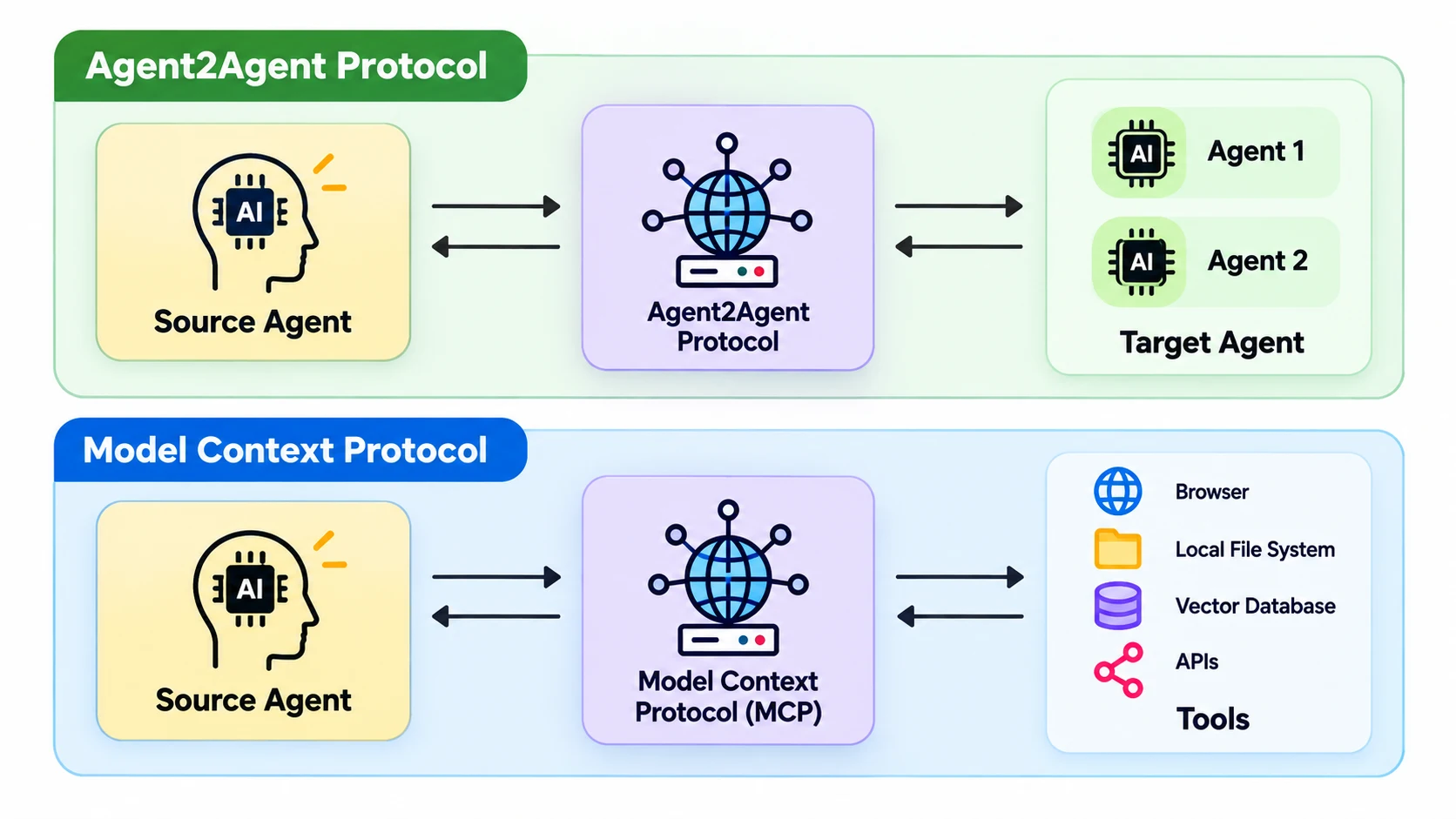
The one-line model: MCP is model-to-tool, A2A is agent-to-agent. Anthropic's Model Context Protocol governs how a single model reaches a database, a file system, or an API, while A2A governs how that whole agent, tools included, hands work to a different agent built by a separate team entirely.
Which one does your team actually need?
- Agent needs to call a tool or read a data source? MCP.
- Agent needs to hand a task to another agent outside its own codebase? A2A protocol.
- Building a multi-agent system with both? Most production stacks use MCP inside each agent and A2A between them.
In practice, most production stacks run both layers at once: MCP wired into each agent for tool access, and A2A wired between agents for task handoff across the wider system.
Why A2A Protocol Matters for Enterprise AI Agents
Each unique agent-to-agent link created without a common protocol is custom-made, and custom-made makes scaling increasingly difficult as more agents come into play, which is exactly the integration burden AI agents for business are already feeling firsthand. As per the statistics of Gartner, task-based agents are expected to be part of 40% of enterprise applications by 2026, while in 2025, only 5% of enterprise apps were expected to use task-based agents.
Cross-Vendor Interoperability at Scale
The integration burden without a shared protocol scales roughly with the square of the agent count, not with it. Five agents talking directly is manageable; fifty is not.
- A Scalable Architecture for distributed AI systems needs one shared handoff layer, not fifty bespoke point-to-point connections.
- Each new framework added to the stack, LangGraph, CrewAI, or AutoGen, plugs into the same protocol instead of a new custom adapter.
- Vendor lock-in drops once agents can move between frameworks without breaking connections other teams depend on.
Security, Governance, and Enterprise Security Standards
Neutral governance buys something concrete:
- No single vendor can unilaterally change the specification underneath a system already in production.
- Signed Agent Cards with domain-verified security schemes let one organisation's agent authenticate another's without the two teams ever speaking.
- A protocol-level security service layer reduces the surface area for online attacks compared with dozens of hand-rolled auth flows.
Enterprise security matters more once agents cross company boundaries: supplier to buyer, insurer to claimant, bank to fintech partner.
Real-World A2A Use Cases Across Industries
A2A is already running in production. A few concrete AI agent examples from live deployments:
- Supply chain: Procurement agents coordinate across supplier systems that were never built to talk to each other.
- Financial services: Claims and underwriting tasks route between agents owned by different business units.
- Insurance: Intake agents hand document review to specialised assessment agents without a human relaying context.
- IT operations: Triage agents chain to remediation agents, closing tickets that used to wait for a shift change.
- Sales operations: AI sales agents hand qualified leads to fulfilment or onboarding agents without a rep re-entering context by hand.
On all enterprise platforms, the teams who operate the fastest no longer attempt to create one large agent but have small specialized agents communicate their work via a common protocol. This is true irrespective of the exchange being within the same corporation or between corporations.
A2A Protocol Adoption and Ecosystem Support in 2026
More than 150 organisations now support A2A, with native cloud integration across Google, Microsoft, and AWS. On the framework side, Google ADK, LangGraph, CrewAI, LlamaIndex Agents, Semantic Kernel, and AutoGen all ship native support, so a reader can check their own stack against that list directly.
IBM's Agent Communication Protocol merged into A2A during 2025, one fewer competing standard for a platform team to evaluate before committing. Salesforce has followed the same pattern, building A2A support directly into its own agent tooling instead of maintaining a separate, parallel protocol.
How BNXT.ai Helps You Build A2A-Ready Agent Systems
Our agent orchestration layer speaks A2A natively, so agents built on different frameworks hand off tasks without custom glue code holding the connection together. It ships as a low-code agent builder with Agent Card publishing and Task Management built in already, so your team is not hand-rolling the custom AI agents integration work other teams have already debugged the hard way.
In our own deployments, clients have cut cross-framework agent collaboration time from weeks of custom API work down to days of configuration work. The real choice is not whether to support A2A; it is whether to build it in-house or bring in AI integration consulting for a scalable setup with observability and no model lock-in included from day one.
What a BNXT.ai A2A Implementation Looks Like
- Day 1 to 3: We map your existing agents and connect them into the orchestration layer.
- Day 4 to 7: We publish Agent Cards for each agent and map the task handoffs between them.
- Week 2 onward: We deploy to production and monitor, iterating on the highest-volume handoffs first.
- Ongoing: You own the agent-to-agent layer outright and can extend it without us touching it again.
Conclusion
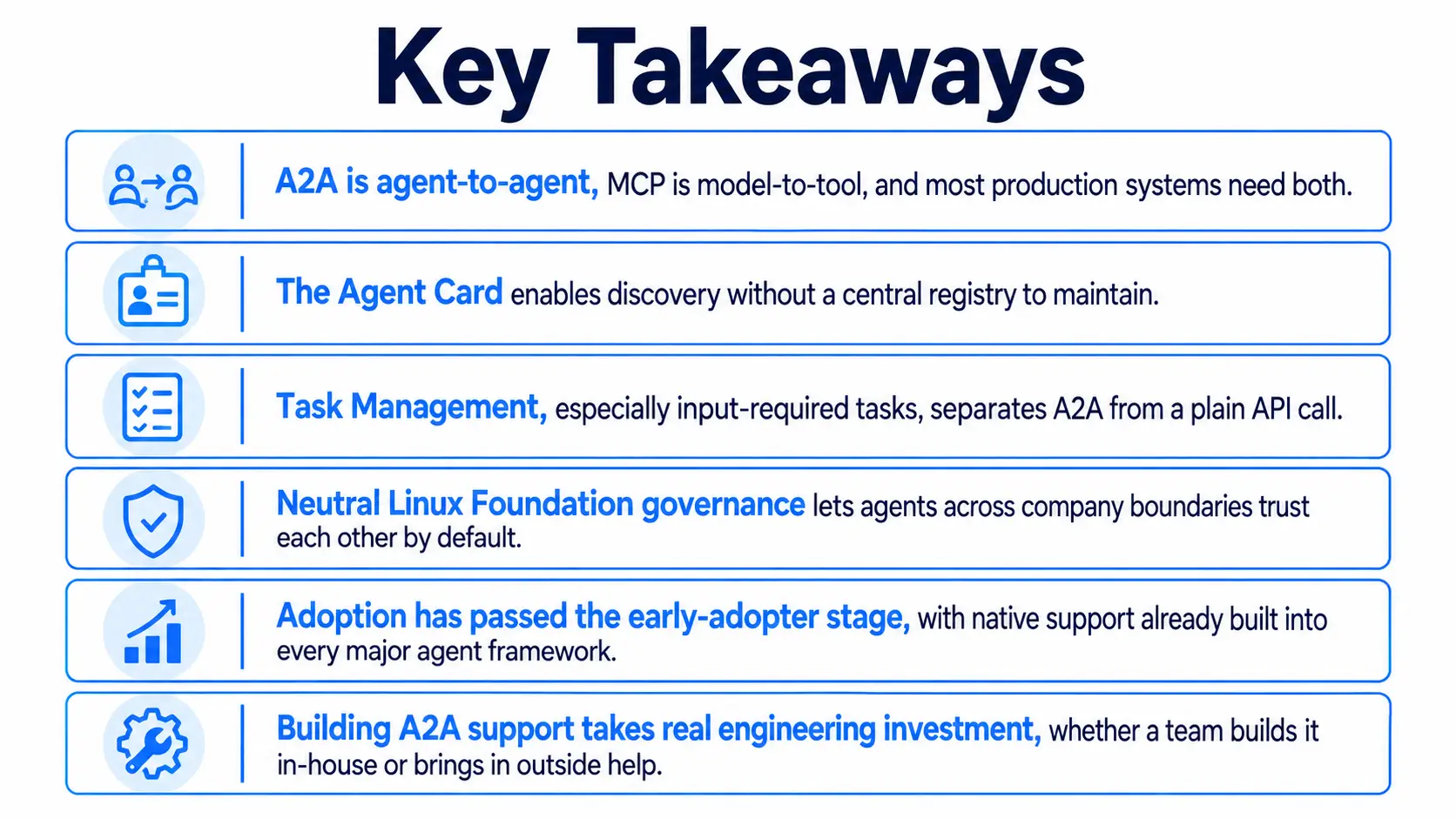
A2A protocol is production-ready infrastructure, not a speculative standard, and the adoption numbers make that hard to argue with. It does not compete with MCP; it completes it, handling the layer MCP was never designed to cover: What happens when one agent needs another to finish a task.
Teams still treating agent collaboration as a problem for later will rebuild it under deadline pressure once a partner integration demands it. The teams building on the a2a protocol now are simply doing that work before it becomes urgent instead of after.
People Also Ask

Does the A2A protocol support agents running fully on-premises, or only in the cloud?
Yes. A2A is transport-level, using HTTPS and JSON-RPC, so agents can run on-premises or in any cloud, provided endpoints are reachable and Agent Cards are published correctly.
What happens if a remote A2A agent times out or fails mid-task?
The task lifecycle marks it failed rather than leaving it open indefinitely, and the client agent can then retry, escalate to a human, or reroute it.
Is there a conformance test or certification for A2A implementations?
The Linux Foundation maintains a reference test suite so vendors can validate their A2A Server against the specification, though formal certification is not yet mandatory for production adoption.
Can A2A agents work across regulatory boundaries, such as GDPR or data residency rules?
A2A itself is transport-agnostic on data residency. Compliance depends on where each A2A Server is hosted and how its Agent Card declares data handling, not on the protocol layer itself.
Does using A2A require paying a licence fee to Google or the Linux Foundation?
No. A2A is released under the Apache 2.0 open-source licence, so any team can implement or run an A2A Server without paying licensing costs to either organisation.


.webp)
.webp)
.webp)

.webp)
.webp)