

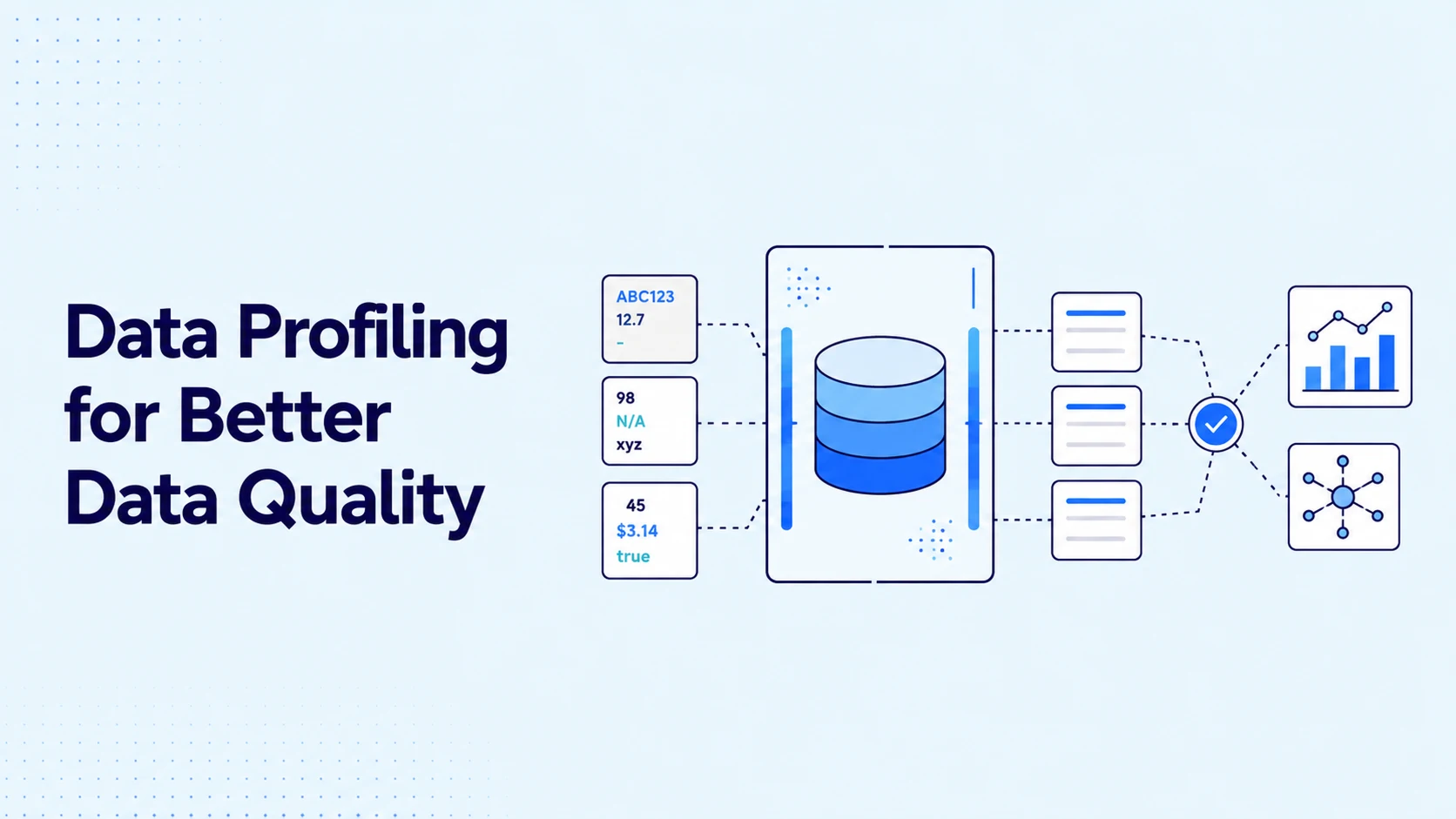
A retail company came to us four months into building a demand-forecasting model, stuck tuning the architecture twice before anyone asked a more basic question: What was actually in the training data? Buried inside were duplicate SKUs, three date formats across regional feeds, and a "customer_id" column that was unique in theory. Nobody had run data profiling before the numbers touched the pipeline, and the resulting data quality issues did not surface until the forecast was wrong.
Across 150+ client engagements spanning 30+ industries, that is the single most common root cause behind a machine learning model or dashboard quietly handing back the wrong answer: Nobody profiled the training data first. That is the gap this guide closes: The core techniques, process, and tooling to catch bad data before it reaches a model, plus how BuildNexTech wires continuous checks directly into your pipeline for faster, more confident data-driven decisions.
What Is Data Profiling?
Data profiling is the practice of examining a data structure, its content, and relationships before anyone trusts it for a model or business decision. It is a diagnostic step, not a cleanup step, and treating it as an afterthought is where data quality programmes lose ground.
A profiling pass typically checks:
- Completeness: What is missing.
- Correctness: What is wrong.
- Consistency: What contradicts itself.
- Conformity: What is duplicated.
- Coherence: What does not match its own column.
Some frameworks group these under the 5 C's of data quality. Run the checks against a customer table, and you will find at least one surprise; run them against a training set feeding a live model, and that surprise becomes a production incident.
A data audit is a point-in-time report someone runs once and forgets. Data profiling, sometimes marketed as database profiling, is a repeatable checkpoint feeding a data catalog and data inventory, tracing data lineage, with metadata profiling and metadata analysis run each time new data arrives.
Data Profiling vs. Data Quality vs. Data Cleansing
Data profiling vs data quality is a common point of confusion, and data cleansing often gets pulled into the same conversation. All three are connected, but each does a different job:
- Data profiling examines a dataset and diagnoses what's actually there: Missing, duplicated, or inconsistent data.
- Data quality is the outcome, the score a dataset gets against a standard set by data governance.
- Data cleansing is the fix: Corrections applied once profiling has shown what is broken.
Data engineer, guided by Master Data Management and data governance frameworks
Standardised, corrected data
Teams that skip cleansing straight past profiling fix the wrong problems: They standardise a country field that was never the issue, missing the orphaned keys that broke last week's dashboard. A data governance framework without profiling feeding it produces policy documents nobody can act on.
On data mining vs data profiling: Profiling summarises and validates existing data; mining extracts new patterns, risking noise if unprofiled first. That connects to the core data quality dimensions most data governance programmes measure against, and to the data cleansing process that should start once profiling has told you what needs fixing.
The 3 Core Data Profiling Techniques
The three main types of data profiling, or Quality profiling, are structure discovery, content discovery, and relationship discovery. Skip one and the picture stays incomplete until production fails. More checks are not automatically better: Running all three on the columns that feed a model beats a shallow pass across the Data Warehouse.
Structure Discovery
Structure discovery, or data structure analysis, examines:
- Data types and data type distribution.
- Field length and naming conventions.
- Missing-value patterns and schema drift.
- Pattern recognition across columns.
A price column stored as text is a classic finding, along with three source systems that format dates differently. Structure problems are easiest to catch and most damaging to ignore, since downstream transformation assumes the structure is correct.
Content Discovery
Content discovery, sometimes called content profiling, validates the values inside each field against defined Data Quality Rules and business rules:
- Data Standardization and standardization rule checks ("USA," "US," and "United States" as one value, not three).
- Outlier detection and statistical anomalies.
- Data Anomalies and duplicate records.
- Data Validation against expected ranges.
Content issues rarely throw an error. A model trained on this inconsistency will not crash; it will learn a distorted reality and produce confident, wrong output.
Relationship Discovery
Relationship discovery, or cross-column profiling, checks cross-column data dependencies, referential integrity, and key integrity across orphaned records spanning multiple tables. An order referencing a customer ID that no longer exists is the textbook example, more common than most teams assume after two or three migrations.
- Data integrity checks confirm keys still resolve correctly.
- Cross-table joins get caught before they reach a report.
Structure catches what is malformed, content catches what is wrong, and relationship catches what is missing entirely. A model only needs one of those gaps to produce output nobody can trust.
.webp)
The Data Profiling Process, Step by Step
A reliable data profiling process follows the same data profiling steps each time, a core part of data profiling best practices:
- Understand the data sources: Map every data source feeding the pipeline and each one's data lifecycle before writing a single check, so profiling targets fields that actually matter downstream.
- Run structure, content, and relationship checks: Cover all three techniques on the columns that feed a model or report, not just the easiest ones to test.
- Document findings in Data Reports: Every flagged issue gets a record of what was found, which column it lives in, and how severe it is, so nothing gets lost before the fix.
- Set up Data Monitoring and reprofile continuously: A one-time pass goes stale the moment a source system changes; continuous monitoring catches that drift automatically.
Automating ingestion, metadata analysis, and rule-based validation scripts suits automated tooling. Deciding which fixes to apply still needs business interpretation: A flagged outlier might be dirty data, or a genuine sales spike.
A Data Profiling Example
Take a customer table with 40,000 rows. Statistical profiling confirms every field matches its expected type. A content pass surfaces 1,200 malformed emails. A cardinality analysis finds the real issue: A customer_id column, assumed unique, contains 340 duplicate values from a botched migration.
That data profile finds routes into a cleansing task with a clear scope: Deduplicate, reconcile against timestamps, and re-run the relationship check. Without that scope, the task would have started as "clean up the customer table," with no clear finish line.
What Is Data Profiling in ETL?
Data profiling sits at the front of the ETL sequence, run against source data before Data Transformation, not after it lands in the target Data Warehouse or Data Lake.
- Profile after transformation, and you check data already reshaped by Data Pipelines.
- Profile before it, and bad records get flagged before reaching a model's training set.
- This holds across cloud platforms, hybrid architectures, AWS Glue, and Azure Data Factory alike.
Schema changes in source applications are the most common trigger for a broken data pipeline. Profiling catches those before Migration Accelerators move the problem downstream, making an AI-ready data pipeline reliable: Fewer 2 a.m. incidents tracing a bad forecast to one field, and cheaper fixes than debugging afterward.
Data Profiling Tools and Software Compared
Choosing data profiling software usually comes down to scale. Enterprise Data Quality Providers like Ataccama, SAS, and IBM cover governance and audit requirements at heavier implementation cost.
Profiling rarely sits in isolation. Once a team has clean data, the evaluation usually widens to broader governance and cleansing tooling that enforces the rules profiling surfaced, and larger organisations often pair it with a master data management layer that decides who owns each rule.
Which one fits your team?
- Regulated industry with compliance requirements? Enterprise platform.
- Already running workloads on cloud platforms?AWS Glue or Azure Data Factory.
- Want profiling running continuously inside an agentic AI pipeline rather than as a separate tool? BuildNexTech.
How BuildNexTech Builds Continuous Data Profiling Into Your AI Pipeline
Among agentic data profiling solutions, BuildNexTech runs automated data profiling (or automated profiling) inline in the pipeline, powered by AI Agents and Autonomous AI Agents, not a manual pass someone remembers before a launch:
- A Data insights agent checks structure, content, and relationships before data reaches any machine learning models.
- Flagged records route to a review queue instead of entering production silently.
- Continuous Data insights and data observability replace the quarterly report nobody reads.
A logistics client we worked with was tracing forecast errors back to source data weeks after each incident; continuous profiling in their ingestion layer cut that time significantly. Engineering teams choose this over custom scripts because the architecture is Generative AI-native, the low-code builder ships new rules in hours, and there is no model lock-in: AI Governance and AI Consulting applied to the data layer, catching this morning's problem, not last quarter's.
What a BuildNexTech Data Profiling Rollout Looks Like
Getting profiling live is a phased process, not a big-bang deployment that stalls other work. It runs in three stages, each building on the last:
- Days 1-3: Connect source systems, map schemas.
- Days 4-7: Configure Data Quality Rules and thresholds.
- Week 2+: Continuous monitoring flags anomalies as they appear.
By the end, a team owns a live profiling dashboard wired into its pipeline, not a stale one-time report.
Who This Is For
This fits data or platform teams running AI Initiatives and feeding business intelligence tools from multiple sources, particularly where nobody owns ongoing data quality. Two triggers: A model failure traced to bad training data, or a migration stalling because nobody can confirm the data.
Conclusion
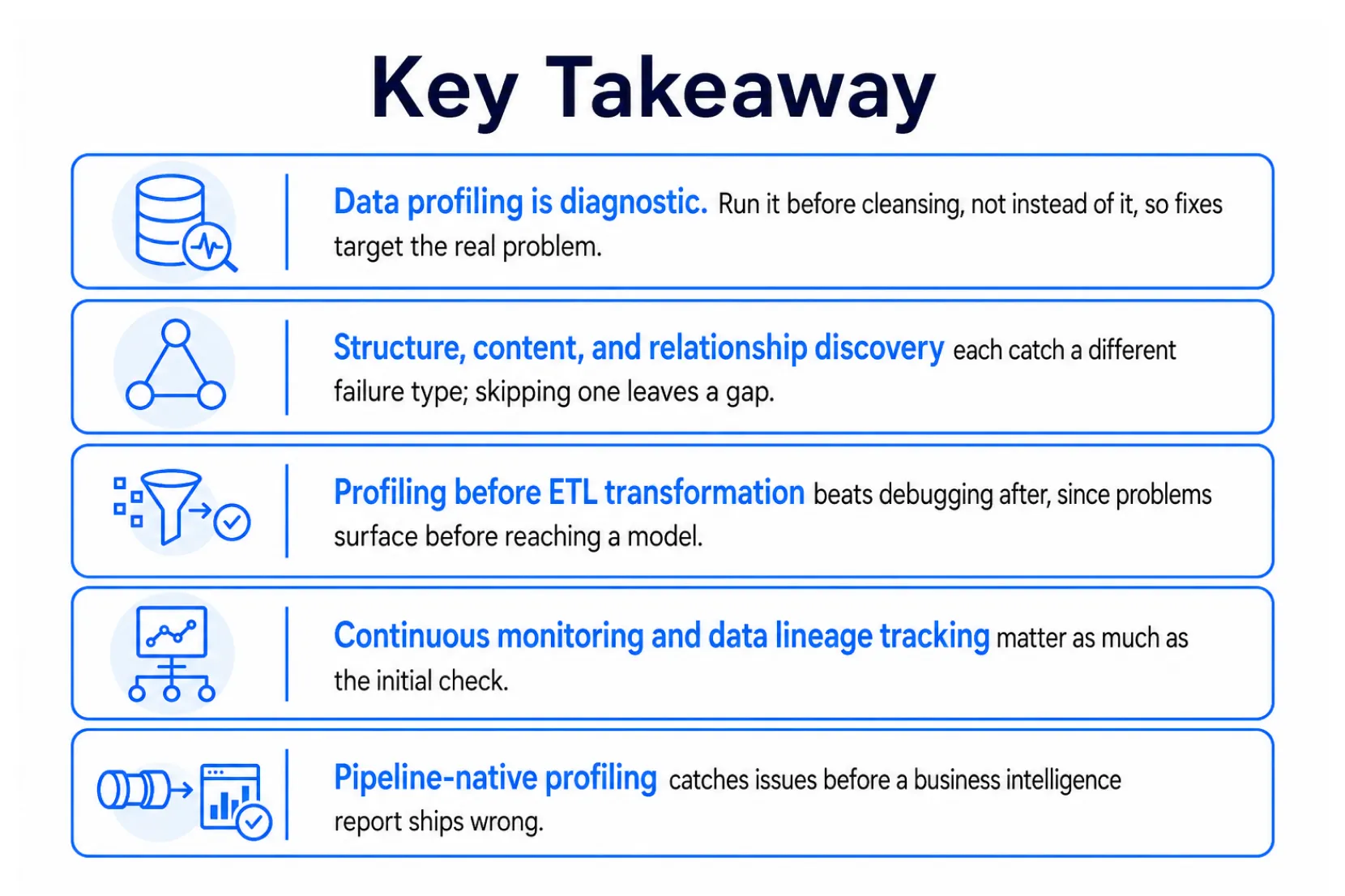
Data quality problems rarely announce themselves. They show up as a model that quietly drifts, a dashboard number nobody trusts, or a migration that stalls for reasons nobody can name, and profiling is the checkpoint that catches these before a client does. Structure, content, and relationship discovery are not a one-time audit; they are the diagnostic layer every AI-ready pipeline depends on.
The organisations getting this right are not the ones with the biggest budgets. They are the ones treating profiling as infrastructure that runs continuously, not a checklist item revisited after something breaks.
People Also Ask

Can data profiling run without disrupting production systems?
Yes, most profiling runs against read replicas or snapshots rather than live tables, so checks execute without adding load or risking downtime during business hours.
Who should own data profiling, data engineering or data governance?
Data engineering typically runs the checks; data governance sets the standard those checks measure against. Splitting ownership without a clear handoff is where most profiling programmes stall.
How does profiling differ for structured versus unstructured data?
Structured data relies on schema and column-level checks. Unstructured data, like documents or logs, needs pattern extraction and sampling first, since there is no fixed schema to check against.
What happens if profiling surfaces more issues than the team can fix at once?
Prioritise by downstream impact, not volume. Fix fields feeding live models or reports first, then work backward, rather than trying to clear every flagged issue at once.
Can small teams profile data without enterprise-grade tools?
Yes. Open-source libraries and spreadsheet-based checks cover basic profiling for small datasets. Enterprise tools become worthwhile once source systems, data volume, or compliance needs scale up.


.webp)
.webp)
.webp)

.webp)
.webp)