

.webp)
The framework with the best benchmark chart is rarely the one your platform team is still happy running three years in. Backend development guides rank frameworks by GitHub stars or synthetic throughput, then move on. Neither number tells you what happens when a compliance audit lands or traffic triples in a quarter. JavaScript and Python anchor most popular backend frameworks today, but adoption share alone won't tell you which one survives the web applications your team ships next year.
BuildNexTech has watched this play out across 150-plus web development teams in 30-plus industries: The framework topping a "most used backend frameworks" list rarely tops the roadmap two years later. This comparison grounds the 2026 shortlist in criteria that predict long-term fit, walks through each framework in plain terms, and covers one factor almost every other guide skips: How easily your framework lets you add AI features later.
What Is a Backend Framework?
A backend framework is the toolkit behind backend development: Routing, database access, authentication, and business logic, so a team isn't rebuilding the same server-side systems every project. Frameworks in this category are sometimes called backend web frameworks or server-side web frameworks, and many also handle server-side rendering for web applications needing a fast first paint. What separates a working definition from a useful one is how "best" changes once a framework has to survive real conditions instead of a demo.
What Enterprise Backend Development Actually Demands
"Best" changes once compliance, scale, and a rotating team enter the picture. The question stops being "does it work" and becomes "does it still work in five years, under audit, at ten times the traffic." Enterprise backend development comes down to five criteria, none of which show up on a benchmark chart:
- Support commitment and patch cadence: How reliably a framework ships security patches and maintenance updates, and how far ahead of end-of-life its release cycle sits.
- Security defaults: Whether a framework is secure out of the box, since dependency vulnerabilities remain a top production concern, per the Stack Overflow Developer Survey.
- Horizontal scalability: How cleanly a framework spreads load across many small instances, instead of relying on one bigger, more expensive machine.
- Talent pool: The size of the hiring market for a given framework and language, which decides how fast a team can grow.
- Ecosystem maturity: The libraries and tooling already built around a framework, which save a team from solving the same problems from scratch.
What Makes a Backend Framework "Best" in 2026
These criteria matter most once REST or GraphQL APIs carry real production load, not a demo dataset. Query design, caching, and network topology decide response times far more than which framework serves the request, which is why raw throughput benchmarks rarely predict what breaks first at scale. Teams often worry there's no time to re-evaluate their stack, but nobody needs a rebuild: Most simply tighten how they deploy, secure, and scale around the framework they already have.
The Backend Frameworks Worth Evaluating
Grouping the shortlist by ecosystem beats a flat ranking of popular backend frameworks, since it lets a team filter to what it already runs. Each entry below covers what the framework does well, and where it tends to cause pain later.
Python-First Options
FastAPI
FastAPI is a popular Python backend framework known for async-native, type-safe design. It suits API-first and AI-adjacent services well.
- Pros: Handles async requests natively, a good fit for real-time data and AI workloads, and every route comes with automatic API documentation.
- Cons: A smaller plugin ecosystem than Django means some features need custom code, and being a newer framework, the talent pool is still growing in places.
Django
Django Python ships batteries-included: Admin panel, ORM, and authentication all built in. It suits data-driven, admin-heavy platforms best.
- Pros: The admin panel and ORM save weeks of setup on data-heavy platforms, backed by a mature ecosystem and a large talent pool that makes hiring easier.
- Cons: A synchronous core by default is not ideal for AI-adjacent services, and the framework can feel heavy for small, single-purpose APIs.
TypeScript and JavaScript Options
NestJS
NestJS is a JavaScript backend framework that enforces structure and dependency injection borrowed from Angular. That structure pays off once a team passes ten engineers on one codebase.
- Pros: Enforced structure keeps large codebases consistent across contributors, and it's a strong fit for real-time data and WebSocket-heavy applications.
- Cons: The learning curve is steeper than Express for smaller teams, and simple, single-endpoint services end up with more boilerplate.
Express.js
Express.js takes the opposite bet: A minimal, unopinionated HTTP router. It remains one of the most used backend frameworks in the Node ecosystem.
- Pros: Minimal setup lets small teams ship a working API quickly, backed by a huge middleware ecosystem and a large talent pool of Node developers.
- Cons: Less enforced discipline means structure erodes past three engineers on one service, and there's no built-in dependency injection, so larger apps need extra tooling.
JVM Options
Spring Boot
Spring Boot is built on the broader Spring Framework. It keeps unmatched ecosystem depth for regulated, integration-heavy systems like banking, insurance, and large B2B platforms.
- Pros: Minimal setup lets small teams ship a working API quickly, backed by a huge middleware ecosystem and a large talent pool of Node developers.
- Cons: Less enforced discipline means structure erodes past three engineers on one service, and there's no built-in dependency injection, so larger apps need extra tooling.
Quarkus and Micronaut
Quarkus and Micronaut answer a different demand: Cloud-native architectures with fast cold-start performance, built for Kubernetes-native microservices and edge computing deployments. As the leading Kubernetes container orchestration platform, Kubernetes rewards frameworks that start fast.
- Pros: Fast cold starts keep cloud costs down on Kubernetes orchestration platforms, with built-in distributed tracing for cloud-native applications.
- Cons: The community is smaller than Spring Boot's, so tutorials and integrations are harder to find, and some Spring libraries need adapters or don't work at all.
.NET, PHP, and Ruby on Rails Options
ASP.NET Core
ASP.NET Core is the default backend web framework for teams standardised on Microsoft or Azure infrastructure. It plays well with an existing .NET toolchain, from tooling to hosting.
- Pros: Entity Framework Core, Visual Studio, and NuGet packages cover ORM, tooling, and dependency management, and Razor Pages fit server-rendered admin screens without extra frameworks.
- Cons: Most of the value is tied to Microsoft or Azure infrastructure choices, and the open-source ecosystem is smaller outside the Microsoft world.
Laravel and Ruby on Rails
Laravel and Ruby on Rails close the list for teams prioritising delivery speed over infrastructure complexity. Laravel Forge simplifies deployment for teams that would rather not manage servers by hand.
- Pros: Convention-over-configuration gets a web application shipped fast, backed by large, mature package ecosystems for common features.
- Cons: Both are a weaker fit for high-concurrency, API-heavy systems, and neither is a natural fit for AI-adjacent, async-first services.
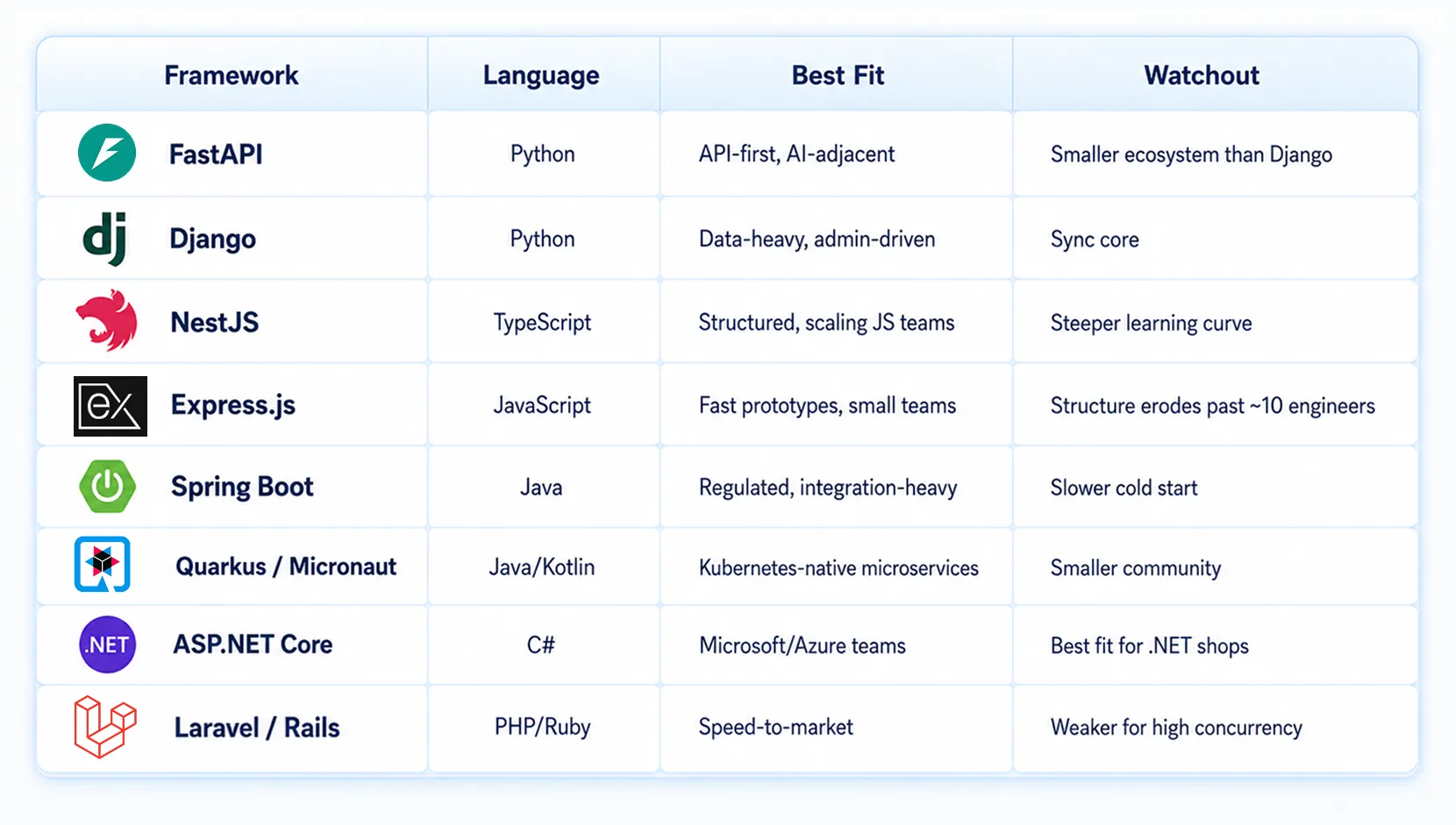
Backend Frameworks Comparison Table
The table below covers the realistic 2026 shortlist across the most used backend frameworks in each ecosystem. Use it to compare best fit and watchouts at a glance before reading the full breakdown above.
Which Backend Framework Is Best for Your Team
There is no universal winner, only the best backend platform for a team's actual constraints. The list below narrows things down fast.
Which one fits your team?
- API-first and performance-critical: FastAPI.
- Data-heavy or ML-adjacent with admin needs: Django.
- One TypeScript stack end to end: NestJS.
- Already on Java with broad integration needs: Spring Boot.
- Kubernetes-native and cost-sensitive at scale: Quarkus or Micronaut.
- Standardised on Microsoft or Azure: ASP.NET Core.
Our Take: Most teams overthink this decision by treating it as permanent. It rarely is. The framework a five-person startup picks is rarely the one running the company with 200 engineers, and that's fine. The mistake is refusing to revisit it once constraints change. The industry-specific objection shows up here too: "our compliance requirements make this different." They rarely do; BuildNexTech has applied this same matching across fintech, healthcare, logistics, and retail.
The Fastest-Growing Backend Framework in 2026
FastAPI continues gaining share among Python web developers, driven by async performance and type safety. NestJS tells a similar story in Node, gaining ground among teams that want structure over Express's flexibility. Two newer entrants are worth watching, though growth isn't the same claim as best:
- Rust frameworks (Axum, Actix) lean on the language's standard library and offer real greenfield flexibility for performance-critical services, though the talent pool remains small.
- The Bun framework pairs a fast runtime with a built-in HTTP router, appealing to teams chasing speed over ecosystem maturity.
What Framework Comparisons Don't Tell You
Most comparisons stop at five criteria and call it complete. There is a sixth criterion- almost nothing on the current SERP scores for: How easily a chosen framework lets a team wire in an agent orchestration layer later, without a rewrite.
Async-first frameworks such as FastAPI and NestJS integrate more cleanly with AI agents than older synchronous stacks, since the request lifecycle already assumes non-blocking calls to external services. The real question is whether you can build AI-native architectures without rebuilding the service underneath it. Add this as a sixth evaluation criterion now.
How BuildNexTech Fits On Top of Any Backend Framework
BuildNexTech's orchestration layer connects to whatever backend framework a team already runs: FastAPI, Spring Boot, NestJS, or something older. It's a low-code agent builder with model routing, distributed tracing, and observability, deployed alongside existing REST or GraphQL APIs instead of custom orchestration. Here's what wiring an agent into a route looks like:
@app.post("/support/route")
async def route_ticket(payload: TicketPayload):
    result = await agent_client.run(
        workflow="triage_v2",
        input=payload.dict(),
    )
    return {"assigned_team": result.team, "confidence": result.score}
That one route replaces a custom queue, a model client, and retry logic. Teams shipping AI-powered software this way typically cut deployment time by up to 10x. A US digital bank we worked with cut manual underwriting review time by 65% using AI agents wired into their existing backend.
What a BuildNexTech Rollout Looks Like on Your Stack
The rollout runs four steps on a fixed timeline:
- Discovery (days 1-3): Mapping the existing framework and the best AI opportunity.
- Model routing and integration (days 4-7): Wiring the model routing layer into the existing API.
- Deployment: The agent pipeline goes live alongside the current stack.
- Iteration (week two on): Tuning based on real usage.
At close of rollout, the team owns a live agent pipeline wired into the API layer it already had.
Who This Is For
This fits teams already running a production backend framework who need AI features shipped without a rebuild. Usual triggers: An AI pilot stuck in prototype, no clear model-routing strategy, or manual workflows piling up faster than the team can automate.
%20(1).webp)
Conclusion
Framework fit comes down to support commitment, security defaults, horizontal scalability, talent pool, and ecosystem maturity, not hype. AI readiness is the sixth factor most comparisons miss, and it costs nothing to weigh today. The backend frameworks worth evaluating in 2026 narrow fast once those constraints are named honestly. What separates a defensible choice from a lucky one is whether a team can explain, in one sentence, why its framework fits its actual traffic, team, and roadmap.
People Also Ask

What Is Kubernetes, and How Does It Compare to Docker?
Kubernetes is a container orchestration platform managing how containers run, scale, and recover across machines. In a Kubernetes vs Docker comparison, Docker packages one app; Kubernetes coordinates many in production.
What Is GraphQL, and Why Do Some Frameworks Favour It Over REST?
GraphQL is a query language that lets clients request exactly the fields they need in one call, instead of separate REST endpoints. Frameworks like NestJS support it natively.
What Is an API Gateway, and Do Small Teams Need One?
An API gateway sits in front of backend services, handling routing, authentication, and rate limiting, similar to AWS API Gateway. Small teams often skip it until they run several services.
Is There a Good Node.js Tutorial for Someone New to Backend Development?
Yes. The official Node.js documentation offers a solid Node js tutorial covering the runtime, modules, and the event loop, a good starting point before picking Express or NestJS.
Is Django Python the Same as the Django REST Framework?
No. Django Python is the base web framework handling routing, admin, and ORM. Django REST Framework is a separate add-on built on top of it, specifically for building REST APIs.


.webp)
.webp)
.webp)

.webp)
.webp)