

Picture a company that lets an AI agent pay its supplier invoices. The agent reads each invoice, checks it, and sends the money, all without a person clicking pay. Then one payment goes out that nobody expected, and nobody can say who set the limits, who owns the agent, or why it paid.
That scenario is what agentic payments are about. Software is moving from suggesting payments to making them, and that changes who is accountable. In this guide, we explain how agentic payments work, where they are used, and how to keep them safe, in plain language, so finance and engineering teams can work from the same picture.
What Are Agentic Payments?
Agentic payments are payments that an AI agent starts, makes, and completes on its own, on behalf of a person or a business. Nobody has to click pay or type in card details at checkout, because the agent has already been given permission and limits to work within.
Autopay and scheduled bills follow a rule you set once, such as pay this bill when it arrives or on the first of the month. The agent goes further: it decides if, when, how much, and to whom to pay, within limits a person set beforehand. You may also hear the term agentic commerce. So what is agentic commerce? It covers the buying side, where an agent picks what to purchase, while agentic payments cover the money side.
Key Traits of Agentic Payments
- Autonomous decision-making: The agent decides when and how much to pay based on live conditions.
- Bounded financial authority: Fixed spending limits on amount, payee, and time.
- Rules-based or ML-driven logic: Strict business rules, machine learning, or both.
- Real-time execution: Autonomous payments fire the moment an event happens.
- Human in the loop: People set policy and handle exceptions instead of approving every step, which is the human in the loop vs. human on the loop distinction.
How Agentic Payments Work
Every agentic payment follows five stages, from setup to audit. Each stage has one control point, a place where you can check or stop the agent, so the process stays safe and easy to review.
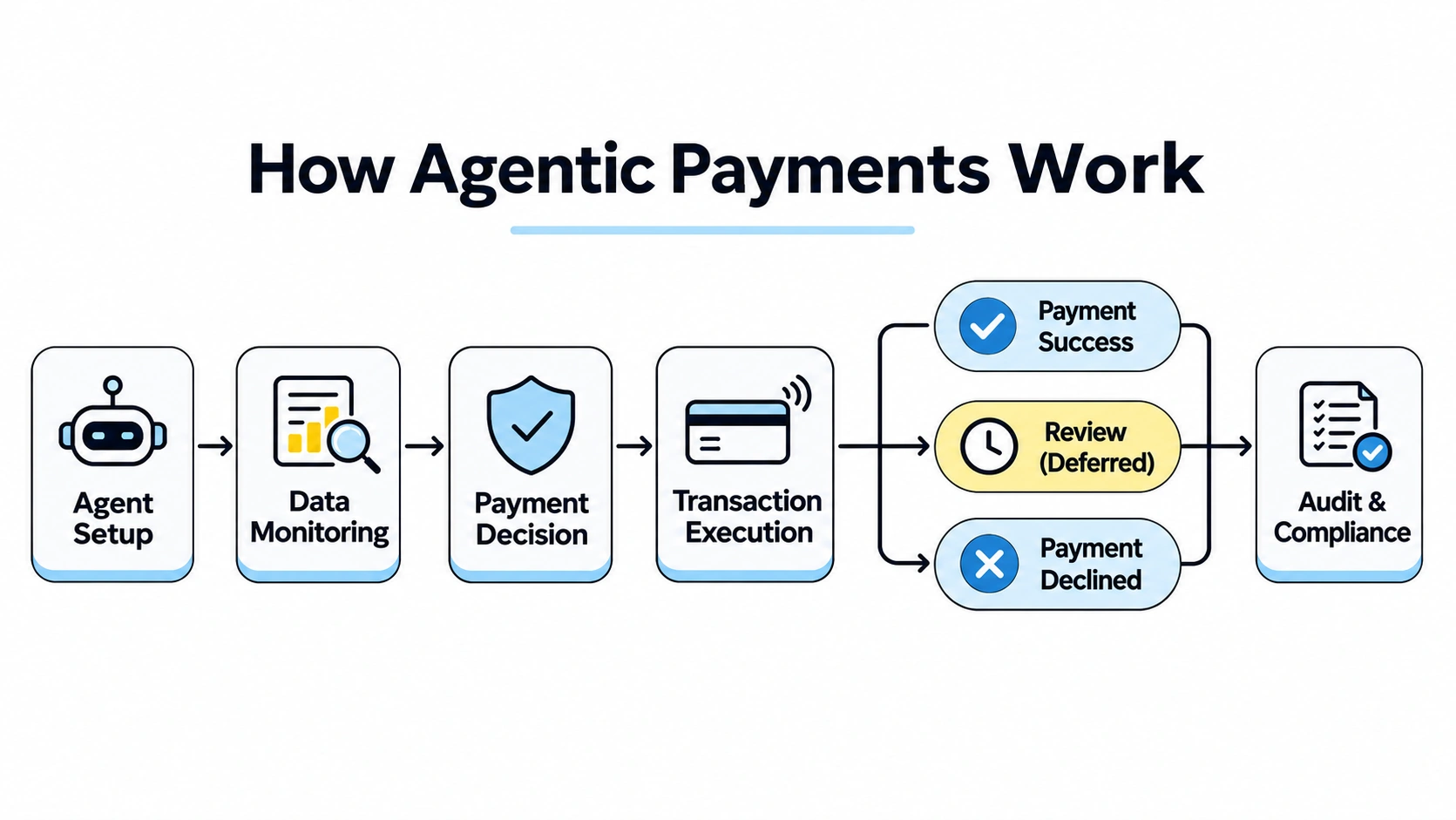
Agent Setup
The AI agent is created with a clear job, a funding source, and hard limits. Nothing is paid until all three are in place.
- Set one goal, such as paying supplier invoices.
- Link a bank account or wallet, and add spending limits.
- What is tokenization? The agent gets a stand-in token, never the real card number.
- Control point: Scoped credentials, so a leaked token exposes only what the job needs.
Data Monitoring
The agent watches for signals that a payment may be due. It gathers the facts it needs before it acts.
- Triggers include invoices, delivery confirmations, contract milestones, and low stock.
- It pulls ERP, purchase order, and balance data, for example, through an MCP server.
- Control point: Data freshness checks, which block a payment when the data is too old to trust.
Payment Decision
The agent checks the rules and the risk, then chooses what to do. The model makes the decision, but it does not get the final word.
- It picks one outcome: Pay now, pay later, or ask a human.
- Control point: A veto outside the model, so a payment stops when it breaks policy, even if the AI approved it or a clever prompt pushed it through.
Transaction Execution
Once approved, the agent sends the money through a payment rail. The decision may need judgment, but the payment itself should be predictable.
- Rails include card, ACH, RTP, and FedNow, plus stablecoin where it fits.
- It handles one-time, recurring, and multi-party payments, plus receipts and errors.
- Control point: Single-use tokens, so each payment uses a credential that is worthless once spent.
Audit and Compliance
Every action is recorded for later review. Compliance checks run in the same flow, so nothing is bolted on afterwards.
- KYC and AML checks run before money moves, and people can override the agent.
- The log supports the accountability goals in the NIST AI Risk Management Framework.
- Control point: A log of the time, inputs, decision, and rule used, which an auditor can replay to trace any payment.
Agentic Payments Use Cases and Examples
Here are three examples of where agents pay today. Some are live, and some are still early, so design them as agentic AI systems with limits from day one.
Businesses: Autonomous B2B Payments and Invoice Automation
B2B payments are the most mature of the agentic AI examples, and one of the clearest AI agent examples for finance teams.
These agents can:
- Check each invoice against its purchase order and receipt.
- Pay once delivery is confirmed and limits are met.
- Choose the best day to pay.
- Hold or escalate payments that do not match.
- Route approvals by amount and payee.
Example: A supplier invoices 20% above the purchase order. The agent logs the gap and sends the buyer a short note, so the overpayment never leaves the account. The routine-versus-exception split is the core of most AI agentic workflows.
Consumers: Smart AI Assistants for Personal Finance
Agentic payments are enabling personal finance assistants that act on your behalf instead of only sending reminders.
These agents can:
- Buy one-time online items within a set budget.
- Pay utility bills once funds are available.
- Cancel or renegotiate subscriptions that go unused.
- Shift money between savings and debt repayment.
- Adjust budget categories as spending changes.
Example: An agent notices a gym membership nobody has used for three months, cancels it, and moves the monthly fee into savings, all within limits the owner set.
APIs and Machines: Micropayments Between Software
Software agents and connected devices can pay each other for what they use, a few cents at a time. When several agents share one budget, AI agent orchestration decides which one may spend. Most agentic AI tools for this are still early, so standards may keep changing.
These agents can:
- Pay per request for data, compute, or APIs.
- Settle tiny usage-based charges as they happen.
- Top up a prepaid balance within set limits.
- Use early-stage approaches such as x402, which builds on the HTTP 402 status code.
- Stop paying the moment a limit is reached.
Example: A research agent pays a data provider a small fee for each query and stops when its daily budget runs out.
Key Benefits of Agentic Payments
Agentic payments help most where payments are frequent, rule-based, and easy to verify. The main benefits are:
- Speed: Payments run the moment conditions are met, with no approval queue.
- Round-the-clock operation: Agents work nights, weekends, and across time zones.
- Fewer errors: Matching and checks follow rules instead of tired eyes.
- Lower processing cost: Fewer manual touches and smarter choice of payment rail.
- Better cash timing: Agents can pay on the best day, for example, to catch early-payment discounts.
- Consistent policy: The same rules apply to every payment.
- Audit-ready records: Each payment keeps its own evidence.
Some teams worry that agents cost too much to set up. Manual payments cost staff time and late fees too, and the benefits only hold when data is clean.
Agentic Payment Risks and Fraud Prevention
Giving an agent the power to pay brings new security risks. Four matter most:
- Hijacked agents: Prompt injection steers the agent off task.
- Payee-redirect fraud: Fake bank-detail changes.
- Runaway spend: A loop drains the budget.
- Unclear liability: No clear rule says who is at fault, and chargebacks often land on the merchant.
Payment fraud prevention starts with spending limits and scoped credentials. Four more controls help:
- Spend caps: Limits per payment and per day, enforced outside the model.
- Approved payees: New payees or changed bank details go to a human.
- Single-use tokens: Each payment gets a credential that cannot be reused.
- Escalation rules: Large or unusual payments pause for review.
Fraud detection software must understand agents too. Good AI fraud detection learns each agent's normal pattern, while AI for fraud detection on your own agents matters as much as ai in fraud detection on the payee side.
How BuildNexTech Helps You Build Secure Agentic Workflows
BuildNexTech builds payment agents on one rule: The agent proposes, a policy engine approves, and every step is logged. Our AI agent development services for enterprise AI agents include a policy layer, scoped tool permissions, and full observability, so each decision can be audited. Nothing moves money without passing that check.
You do not have to choose between speed and control. We use a low-code agent builder with no model lock-in, so you can change models or payment rails without rebuilding the controls around them. The result is a governed agent your team owns, with written policy rules.
What a BuildNexTech Agentic Development Looks Like
- Day 1 to 3 (Discovery): Map payment flows, limits, and approvers.
- Day 4 to 7 (Integration): Connect ERP, payment rails, and tokenisation.
- Week 2 onward (Deployment): Run in shadow mode first, where the agent proposes and humans pay, then go live on low limits.
- Ongoing (Iteration): Monitor decisions, tune policy, and widen scope.
Conclusion
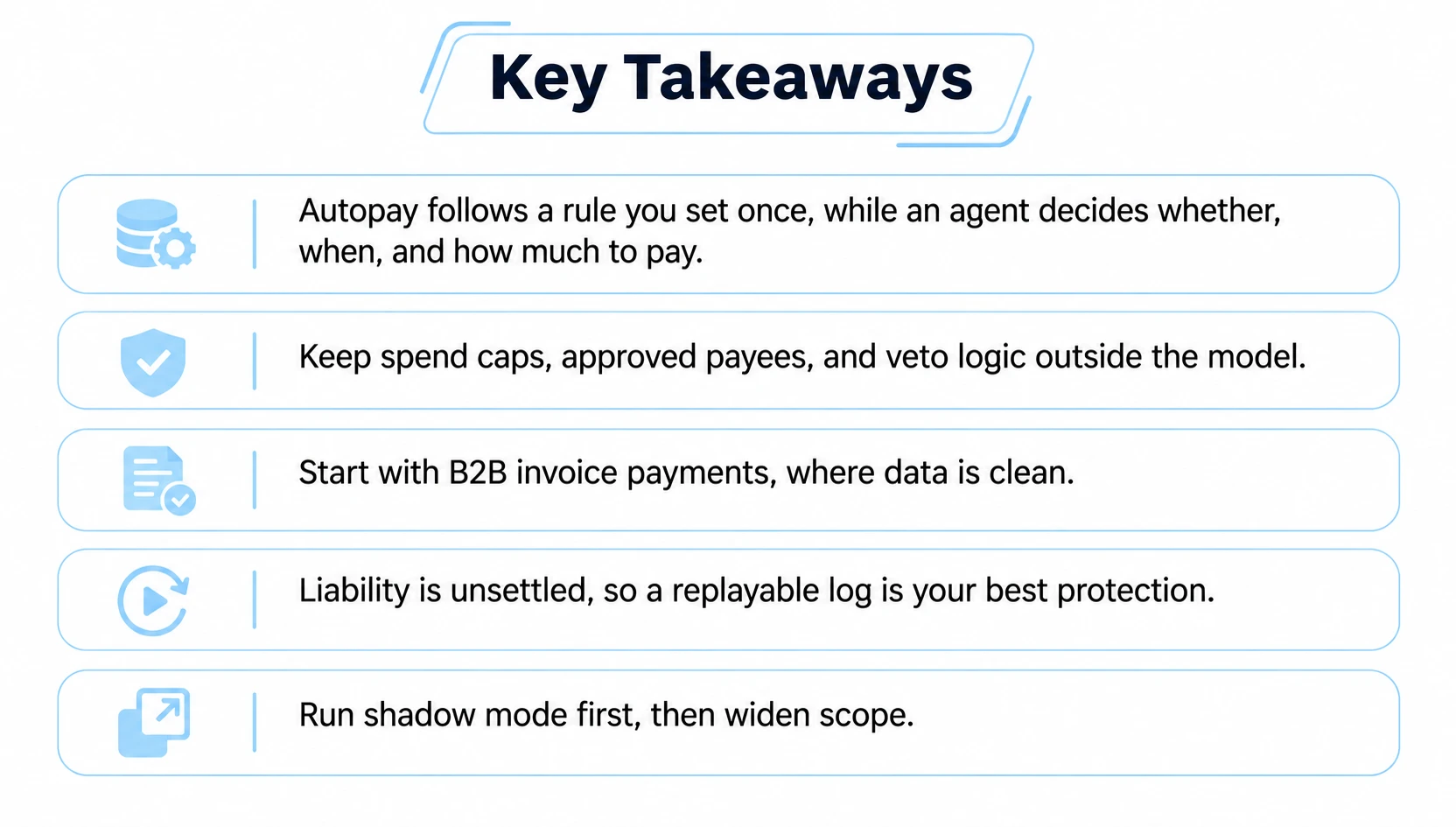
Agentic payments become real when an AI agent decides, not just when it clicks pay. The value is clear: Faster payments, fewer manual steps, consistent rules, and cleaner records. The open problems are control and liability, and a better model does not fix either.
Teams that treat AI agent payments as a governance project first are more likely to reach production safely. Start small, set tight limits, run in shadow mode, and log everything. Then ask one question: Who owns your agent's next decision, and could you explain it?
People Also Ask

Agentic AI vs generative AI: What is the difference?
Generative AI creates content such as text, while agentic AI takes actions towards a goal, such as paying an invoice. That ability to act is why payment agents need limits.
How are agentic payments affected by PCI DSS?
Card data still falls under PCI DSS rules. Tokens keep raw card numbers away from the agent, which may shrink the systems in scope. Confirm the effect with your assessor.
Who should own a payment agent inside the business?
Finance should own the policy and limits, and engineering should own the build. Name one accountable owner across both, because an agent with no owner is where incidents begin.
How are payments across currencies and countries handled?
Rails that support them are used, but each market adds its own KYC, AML, and foreign exchange rules. Set limits per currency and send unfamiliar countries to a human.
What happens if an agent crashes or times out mid-payment?
A well-built agent attaches a unique idempotency key to every payment, so a retry cannot pay twice. Unclear states go to human review instead of being retried blindly.