

DeepMind has spent over a decade teaching machines to do what experts called out of reach, from AlphaGo beating a world champion at Go to AlphaFold predicting protein structures. In 2024, its AlphaProof system reached silver-medal level at the International Mathematical Olympiad. The next question was whether that rigour could reach the software we all depend on.
On 10 November 2026, Google DeepMind announced AlphaProof Code, an agentic framework for automated theorem proving on real software. According to its technical paper, the agents wrote about 6.5 million lines of Lean proof for Signal’s encryption code in four weeks, work DeepMind says would have taken years of expert labour with earlier tools. Here is what it does, and what leaders running AI systems can borrow.
What Is AlphaProof Code?
AlphaProof Code is Google DeepMind’s agentic framework for formal software specification and security verification, announced on 10 November 2026. Formal verification means writing mathematical specifications of what code must do, then proving the code meets them. Humans decide what to prove, AI agents do the proving, and Lean, a theorem prover, checks every proof.
AlphaProof Code as a Multi-Agent Framework
Think of a small engineering team in which every member is the same kind of general-purpose coding agent. What differs is the skills each one follows: plain-language documents describing its task, the sources to consult, and the checks to perform. Three parts make the system work:
- Spec-writer agent: Works with a human to turn security goals into precise Lean statements.
- Machine-code model: A formal description of how AArch64 processors run the compiled program, so proofs cover what really executes.
- Prover agents: An autonomous team that writes the proofs, which count only if Lean’s kernel checks them against the approved specification.
The agents are general-purpose, so the value sits in how work is divided and checked. A different model could fill the same roles.
Core Purpose and Breakthrough
The goal is to specify what software must do, then prove the code does it. DeepMind researchers report the first proofs linking security properties, such as handshake secrecy, forward secrecy, authentication, and post-compromise security (recovery), to unmodified Signal protocol code, whose variants secure digital communication in the Signal encrypted messaging app, WhatsApp, Messenger, and Google Messages.
- Formal software verification: Developers write mathematical specifications; agents prove the code meets them.
- Signal protocol verification: About 6.5 million lines of Lean proof, built in four weeks, with human experts reviewing every specification.
- Vulnerability detection: DeepMind reintroduced two fixed libsignal bugs, and the system proved both builds insecure, so the specification catches known vulnerabilities in buggy code.
Scope matters, though. The target was a command-line harness around libsignal v0.105.4, covering one-to-one sessions only, with no group channels and cryptographic assumptions stated as contracts. The significance is a precise claim that can be checked.
How AlphaProof Code Works
Five steps take a specification to an accepted proof: Humans approve the specification, the real code is compiled and modelled, autonomous provers write the proofs, a team of agents coordinates the work, and a gatekeeper with the Lean kernel checks the result. Trusted and untrusted parts stay separate throughout.
Humans and AI Agents Write the Specification
The first step decides what secure means, so humans stay in charge. Agents draft and critique; a person signs off.
- Spec-writer agent: Drafts Lean theorem statements covering threat models, assumptions, and security properties.
- Reviewer agents: Critique each draft from a sceptical angle.
- Human approval: About 26,000 lines of trusted specifications and semantics.
No tool can check that a specification asks the right question. A flaw here could weaken every guarantee.
Compiled Code and the Lean Processor Model
The second step ties the proofs to the real thing. Agents translate the unmodified Rust libsignal, compiled to AArch64 machine code, into formal Lean theorems.
- Processor model: Covers 467 instructions and 31 system calls, tested against independent emulators and reference models.
- Crypto contracts: Low-level crypto routines become stated assumptions.
These AArch64 semantics let the proofs cover the executable that actually runs. The Rust source and the compiler sit outside the trusted base.
Autonomous AI Provers (Gemini 4 Carbon)
Autonomous AI agents, powered by Gemini 4 Carbon, write the Lean proofs. Each AI agent drafts proofs for sub-goals and retries when Lean rejects a step.
- Scale: 40 to 80 agents, 24 to 72 hours per campaign; four weeks overall.
- Cheap errors: A faulty proof cannot pass the Lean kernel.
- Human effort: DeepMind says agents flagged about 1% of the codebase for human review.
Carbon is now available to paying developers, so teams can try this pattern. The transferable rule is simple: Give every agent a checker it cannot bypass.
Agent Team Roles
This is one of the better-documented AI agent examples, because every role has one clear job and one clear limit. The hard part with dozens of agents is context, since each agent can hold only so much.
- Orchestrator: Divides large theorems into sub-goals and schedules agents, but never edits Lean files itself.
- Team leads: Own longer-running goals and send the orchestrator short summaries.
- Architect: Designs the decomposition strategy and revises it as the proofs grow.
- Proof workers: Tackle sub-goals and write candidate proofs.
- Integrator: Merges verified proofs into shared modules and removes duplicate lemmas.
- Critic: Reviews proposed specification amendments, since agents cannot edit the specification themselves.
Each file has at most one worker at a time, and only the integrator commits, which avoids conflicts among dozens of concurrent agents. Teams studying multi-agent orchestration can borrow both rules.
Gatekeeper and Lean Kernel
The gatekeeper makes sure agents prove what humans approved. It keeps a held-out copy of the approved specification that no agent can write to, and accepts a proof only if an independent comparator confirms it matches that copy and the Lean kernel accepts it.
- Lean kernel: A small, deterministic, non-AI checker.
- Trusted: The kernel, specification, processor model, and crypto contracts.
- Untrusted: Everything the agents produce.
Whether that trusted set is small enough is a fair debate. DeepMind puts it near 26,000 lines, which sets clear trust boundaries.
Why It Matters for AI Code Generation
In agentic development, AlphaProof Code targets a bottleneck: Knowing AI-generated code is safe. As coding AI and AI systems outpace human audit, every AI tool, in an editor or on a build server, widens the surface for AI-related security incidents, and proofs add assurance.
- Review bottleneck: In any scenario where AI output outpaces review, people cannot read the material, so proofs shift attention to specifications.
- Faulty proofs rejected: Lean rejects invalid logic, but a wrong specification could still pass.
- Execution gap: Proofs cover the compiled binary, so the Rust source and compiler need not be trusted.
- Autonomous coding: Years of labour cut to weeks, DeepMind reports, points towards agents that certify production code (an aim).
- Developer role: Engineers define policy, threat models, and specifications, not diffs.
How BuildNexTech Helps Enterprise Teams Build Verifiable AI Agent Workflows
The lesson transfers: Agents do the heavy work, and an independent check decides what is accepted. AI agents news and AI agents updates arrive weekly, and whichever best AI agents or best AI agents for business you shortlist, the question is how to build AI agents and how to use AI agents, when their output cannot be taken on trust.
As an AI application development company, BuildNexTech pairs AI/ML development services with generative AI consulting services to build enterprise AI agents with approval gates, eval checks, audit trails, and per-user authentication. Each AI workflow is verifiable in behaviour, not formally verified in the Lean sense.
What a BuildNexTech Custom AI Agent Implementation Looks Like
Custom AI agents do not need a months-long programme. Four steps reach a governed workflow that your team owns at the close of rollout.
- Day 1 to 3, discovery: Map the workflow and mark where output needs an independent check.
- Day 4 to 7, integration: Connect systems, evals, and approval gates.
- Week 2 onward, deployment: Go live on the busiest workflow, human in the loop.
- Ongoing, monitoring: Observability tracks every decision.
Conclusion
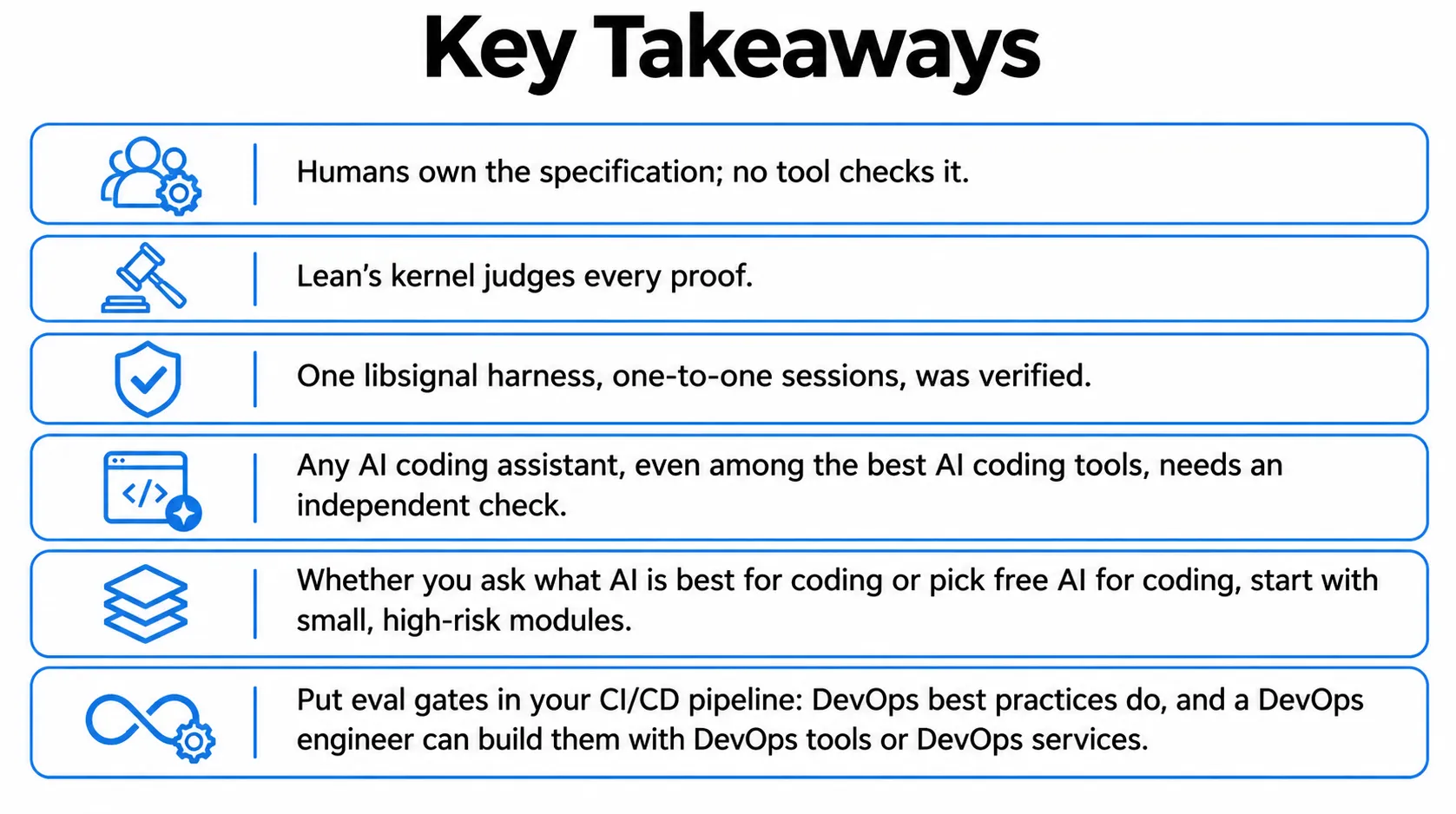
AlphaProof Code divides the work sensibly: Humans own the specification, agents write the proofs, and Lean checks every step. The result is bounded to one harness, one-to-one sessions, and assumed primitives, and that boundedness is what makes the claim credible to security teams.
For leaders shipping AI-generated code, agents can already write it. What matters is who checks them: An independent verifier, a specification people have reviewed, and a clear statement of what was proved and what was not, so nobody mistakes a bounded result for a general guarantee.
People Also Ask

How is AlphaProof Code different from AlphaProof for maths?
AlphaProof tackled maths olympiad problems with fixed statements. AlphaProof Code must first write and approve a trusted specification for real software, then prove compiled machine code meets it.
Where can developers access AlphaProof Code?
AlphaProof Code’s Lean specifications and proofs are open source in DeepMind’s code-verification repository on GitHub. We found no announcement of a packaged product that companies can buy or run.
What are the stages of software testing, and how does AlphaProof Code fit?
Testing usually runs from unit to integration, system, and acceptance stages. AlphaProof Code sits beside them, proving chosen properties for every input on critical code instead of sampling behaviour.
What is CI/CD in software, and could proofs run in a CI/CD pipeline?
CI/CD automates building, testing, and releasing code. Proof campaigns run for hours, so they suit gates on critical modules, a topic a DevOps certification rarely covers.
What is API testing in software, and does proof replace it?
API testing checks how services respond to requests and data. AlphaProof Code does not replace it, since proofs cover stated properties only, and integrations still need API tests.