

TL;DR
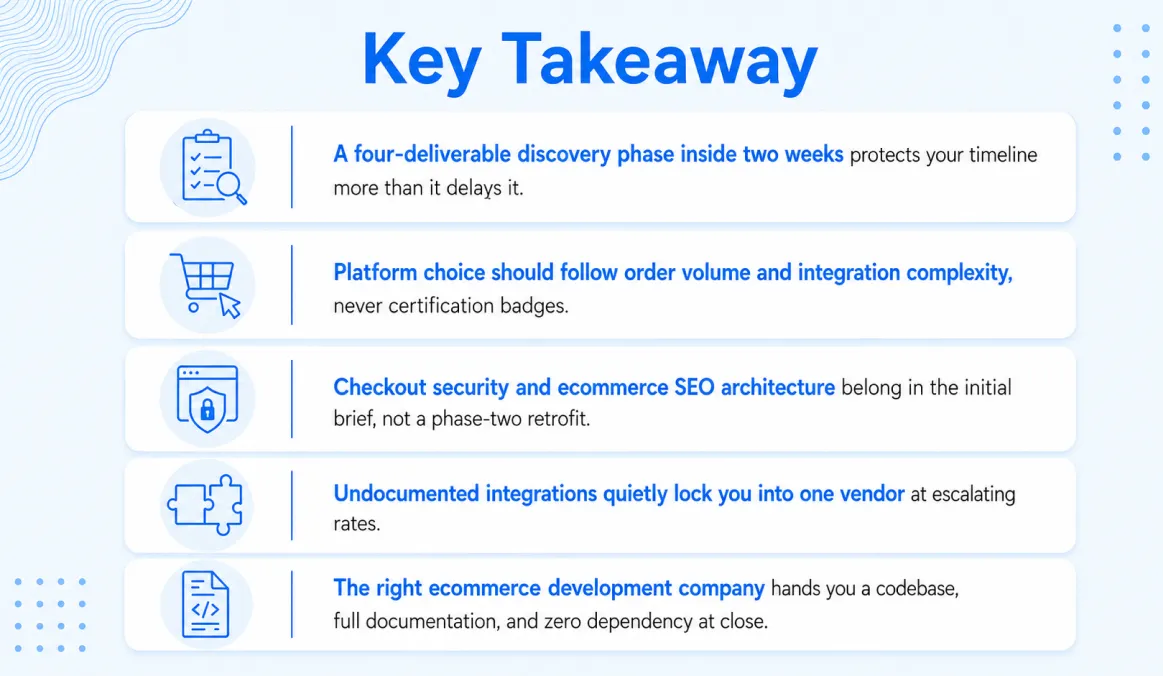
- Ecommerce development is a sequence of ten decisions, not one build phase, and the earliest ones (discovery, platform choice) carry the most risk.
- Most over-budget projects trace back to vague scoping, not technical complexity.
- Security, SEO, and scalability have to be built into the brief from day one, not patched on after launch.
- This guide covers what to demand from any ecommerce development company or agency at each of the ten stages.
What is ecommerce website development? It is the process of designing, building, securing, and launching an online store, covering platform selection, payment integration, backend architecture, security, and SEO. Whether you already run a store or are just learning to create one, the same ten stages apply; they just carry different stakes depending on where you start.
Over 70% of ecommerce projects blow past their original budget, and the reason is rarely technical complexity. It is scope that was never nailed down, and a partner picked for cost rather than fit. This guide walks through the ten stages of a professional ecommerce development process, so you know exactly what to demand from a partner before signing anything.
Step 1: Discovery and Business Requirements Scoping
A credible ecommerce development company never opens with wireframes or a platform pitch. It opens with discovery: Business model, SKU complexity, integration dependencies, peak traffic projections, and the revenue target the build has to support. Founders researching how to build an online store often assume this stage is optional. Skip it, and you are not saving time; you are deferring the cost to month four, when the platform choice turns out wrong for the catalogue you actually run.
What a Proper Discovery Deliverable Looks Like
Discovery typically takes five to seven working days for a mid-market build. Teams that skip it to save time usually lose far more later, when integration gaps surface mid-build. Roughly 70% of over-budget ecommerce website development process failures trace back to this exact scoping gap, which is why any ecommerce strategy consulting engagement worth paying for starts here, not at the wireframe stage.
Step 2: Platform Selection, Shopify, Custom, or Headless
A professional ecommerce web development agency chooses a platform against order volume, checkout complexity, integration count, and three-year growth projections, not against what the agency happens to be certified on. Three architecture tiers cover most brands:
Which one fits your team?
- Standard catalogue, checkout within template limits? Shopify or Shopify Plus.
- Multi-channel selling or custom checkout logic? Headless or composable.
- Proprietary pricing rules or ERP-integrated B2B workflows? Custom ecommerce website development.
An online store builder can get a basic storefront live fast, but it is not the same category as custom ecommerce website development built for order volume growth, and treating them as interchangeable is where most build-vs-buy decisions go wrong. Shopify ecommerce website development is the right call for most D2C brands under $20M in revenue, since it answers how to set up an online store fast without sacrificing the checkout logic that matters. Headless only earns its complexity budget with genuine multi-channel commerce or a checkout flow no template supports.
This is also where the "too expensive" objection surfaces. Custom ecommerce portal development costs more upfront than a SaaS build, but for a brand that has already hit Shopify's ceiling, the ongoing cost of workarounds usually exceeds the build premium within eighteen months. A vendor-agnostic ecommerce web application development partner explains these trade-offs before recommending a stack, rather than defaulting to whatever they specialise in.
Step 3: Ecommerce Website Design and Development for Conversion
Ecommerce website design and development is a conversion engineering problem before it is a visual one. Anyone creating an online store for the first time tends to focus on how it looks, but the decisions that separate a 1.8% conversion rate from a 3.5% one happen elsewhere, in CTA placement, checkout step count, mobile-first layout, and how the product page hierarchy guides a buyer toward "add to cart."
Average cart abandonment sits around 70% industry-wide, and most of it traces back to checkout friction and forced account creation, both of which are online store development decisions, not marketing ones. What separates a strategic retail website development partner from a design studio is simple to check: do they show wireframes tied to specific conversion goals, or just polished mockups with no rationale attached? The former means someone is actually thinking about your funnel, and the latter usually means a pretty ecommerce store development project that does not convert.
Step 4: Payment Gateway Integration and Checkout Security
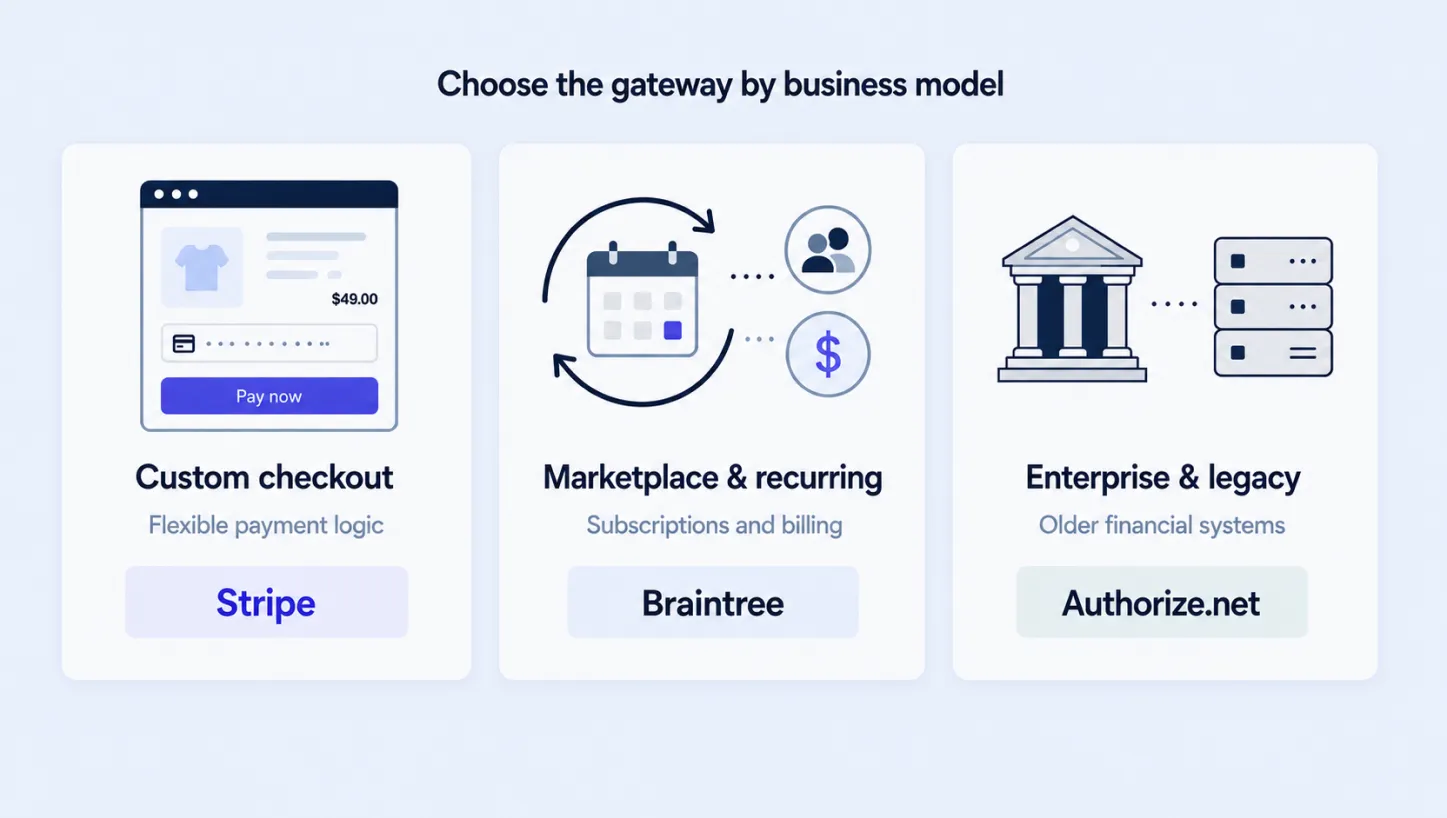
Payment gateway selection is a commercial decision and a security one at the same time. The right choice depends on transaction volume, average order value, currency mix, and whether you run B2B, B2C, or both. For most US ecommerce stores, three payment gateway providers cover the real options:
- Stripe, developer-first, best for custom checkout logic.
- Braintree, built for marketplaces and recurring billing.
- Authorize.net, common in enterprise builds tied to legacy financial systems.
An agency that defaults to one of these online payment gateway service providers without asking about your transaction profile is oversold and not advising. Every secure payment gateway integration needs PCI DSS compliance, tokenisation, and 3D Secure fraud checks built into the checkout layer from day one, not bolted on after launch. A secure online payment gateway that treats these as phase-two work is shipping a store with a known gap already built in.
Step 5: Scalable Backend Architecture and Online Store Development
"Scalable" in online store development has a concrete meaning, and it is the part of building an online store that founders underestimate most: stateless application servers, auto-scaling cloud infrastructure on AWS or GCP, read-replica databases for catalogue queries, a caching layer such as Redis, and a CDN-backed media pipeline. This is where cheap ecommerce web development agency shortcuts show up fastest, and where brands end up paying three to five times more later to retrofit infrastructure that should have been specced upfront.
A logistics-adjacent client came to us mid-replatform after their previous build choked at three times normal traffic during one promotional weekend. Rebuilding the caching and database layer properly, instead of patching the symptom, cut peak-load response time from 4.2 seconds to under 600 milliseconds, and it held through two full peak seasons afterward. If your build-vs-buy question already includes custom order management, subscription billing, or multi-warehouse inventory allocation, you have outgrown SaaS platforms, and online store development services built around a plugin stack will not close that gap.
Step 6: Third-Party Integrations via API-First Architecture
The integration layer separates a functional ecommerce web application development project from a production-ready commerce system. CRM, ERP, fulfilment, and marketing automation tools need versioned API contracts, not point-to-point database links that break the moment one vendor updates a schema. A basic order-sync contract looks like this in production:
{
  "event": "order.created",
  "version": "1.2",
  "order_id": "ord_8841",
  "fulfilment_status": "pending",
  "webhook_url": "https://client-erp.example.com/hooks/orders",
  "retry_policy": { "max_attempts": 5, "backoff": "exponential" }
}
This configuration means the ERP receives a versioned, retry-safe event rather than a direct database write, so a schema change does not silently break order sync overnight. Brands relying on point-to-point integrations instead typically spend 40 to 60% of post-launch engineering budget on integration maintenance, and that dependency quietly locks them into the same agency or escalating rates. For Shopify brands, a Shopify upsell app can help simplify upselling and cross-selling without requiring complex custom development.
Step 7: Web Security and Web Application Security Hardening
Web security best practices for ecommerce are a liability issue before they are a checklist item. A single breach costs the average US ecommerce brand $4.99 million in remediation, legal exposure, and lost trust, according to IBM's Cost of a Data Breach report. The baseline every professional ecommerce web development engagement should deliver includes:
- WAF configuration across every input surface.
- OWASP Top 10 web application security risks hardening.
- PCI DSS compliance for payment data.
- CCPA coverage for California-resident data.
- TLS as the minimum transport layer, never the ceiling.
This is also where "they won't understand our industry" tends to surface as an objection. Security requirements shift by vertical, but the hardening checklist does not, and an agency shipping across 30-plus industries has already handled your compliance edge case. Skipping a pre-launch web application security testing pass, a DAST scan plus dependency audit inside CI/CD, means shipping a store that is already vulnerable on day one.
Step 8: Ecommerce SEO Architecture Built into the Build
There is a real difference between post-launch ecommerce seo tips and ecommerce SEO decisions engineered into the build itself. Canonical URL structure for faceted catalogue navigation, server-side rendering for JavaScript-heavy storefronts, structured data such as Product and FAQPage schema, and Core Web Vitals as a performance budget all belong in the architecture phase, not a marketing checklist added later.
Here is the mistake behind most post-replatform traffic drops: Brands migrating to a React or single-page-app storefront without server-side rendering lose indexed pages, because Googlebot cannot reliably render client-side JavaScript at scale, and that takes six to twelve months to recover from. If a partner's proposal does not mention Core Web Vitals, canonical handling, or schema markup by name, they are not thinking about seo for ecommerce at the level that protects rankings through a rebuild. The best ecommerce seo company for your situation treats these as build requirements, not seo services for ecommerce websites bolted on later, and any real ecommerce seo strategy starts at this stage.
Step 9 : How BNXT.ai Delivers Ecommerce Development That Scales and Converts
Eight steps in, the natural question is who actually does all of this properly. Our ecommerce web development practice is built for D2C and B2B brands that need production-grade architecture, scoped with payment milestones tied to deliverables, not a lump-sum quote hiding scope creep.
Our scalable ecommerce platform for a D2C gifting brand is the clearest proof point. The brand needed custom order management, gift personalisation logic, and infrastructure capable of absorbing seasonal traffic spikes several times normal volume, without a post-launch emergency rebuild, and it scaled through peak season with no replatform and no emergency calls.
What a BNXT.ai Ecommerce Development Engagement Looks Like

If you are wondering how to make an online store that will still work at ten times your current order volume, the engagement model looks the same regardless of where you start:
Requirements scoping, platform rationale, and a signed technical brief.
Start with clear requirements, decision logic, and documentation before development begins.
Clients own their codebase, API contracts, and infrastructure at the end, with no dependency on us for routine updates.
Who This Is For
This is worth a conversation if you have outgrown Shopify or WooCommerce and need custom checkout logic, if you are replatforming and cannot afford to lose six months of organic traffic, if you are asking how to create my own online store without hiring a full internal team, or if you simply want to start an online store with scalable architecture from day one instead of a rebuild at month eighteen.
Step 10: Post-Launch Monitoring, Optimisation, and Ongoing Support
Post-launch support from a proper ecommerce development company includes performance monitoring (Datadog, New Relic), Real User Monitoring for Core Web Vitals, error tracking on checkout and payment flows, and a quarterly architecture review as order volume grows.
Run this test on any agency you are evaluating: ask what their post-launch SLA actually looks like, including response time for critical checkout errors and whether monitoring access transfers to your team at project close. Core Web Vitals degradation in production has a direct line to Google rankings, which makes post-launch monitoring both an operations function and an SEO function, and your partner should own it for at least 90 days rather than handing you a dashboard and disappearing.
"The biggest risk in ecommerce development isn't choosing the wrong platform. It's choosing the right platform for the wrong reason."
Conclusion
Ecommerce development is a series of partner decisions, and a wrong call at step one compounds through every stage that follows. Scalability, security, and SEO have to be engineered from the first brief, not retrofitted after the store is already losing revenue.
The brands that get this right treat ecommerce development as a business-critical engineering engagement, not a website project with a launch date attached. Most brands reading this sit at one of three decision points, evaluating a partner, mid-replatform, or planning a first build, and the next move for all three is the same 30-minute conversation.
People Also Ask

Is a custom ecommerce website development project always more expensive than an online store builder?
Not always. An online store builder costs less upfront, but custom ecommerce website development often costs less over three years, once workaround and re-platforming costs are factored in.
Can retail website development and ecommerce web application development share the same platform?
Yes, if the platform supports headless or API-first architecture. Retail-specific features like in-store pickup usually need custom logic layered on top of standard ecommerce web application development.
How is web application security testing different from a one-time security audit?
Testing is continuous and built into CI/CD pipelines, catching vulnerabilities before each deploy. A one-time audit only reflects the security posture at a single point in time.
What's the difference between ecommerce strategy consulting and full ecommerce development services?
Consulting advises on platform and roadmap decisions without writing code. Full ecommerce development services execute the build, integrations, and security work the consulting phase recommends.
Do I need dedicated online store development services if I'm already using Shopify?
Often yes. Once you need custom checkout logic, ERP integration, or performance tuning, generic Shopify store development services and Shopify's default theme cannot handle it without dedicated support.


.webp)
.webp)
.webp)

.webp)
.webp)