Scripted RPA
Rule-based tasks

Learn how robotic process automation in healthcare streamlines revenue cycle management, prior auth, and clinical ops, and how to choose the right platform.

.webp)
TL;DR: Robotic process automation in healthcare uses software bots to handle repetitive administrative tasks like claims processing, prior authorization, and insurance eligibility checks. The highest ROI shows up in revenue cycle management, patient scheduling, and eligibility verification. As workflows grow more complex, healthcare organizations are moving from scripted RPA toward intelligent automation and agentic AI. CMS-0057-F, whose prior auth response rules took effect January 2026 with the FHIR API mandate due January 2027, makes prior auth automation a compliance requirement, not just an efficiency upgrade.
Robotic process automation in healthcare refers to software robots (bots) that mimic human clicks across Electronic Health Record (EHR) systems, payer portals, and billing platforms, handling data entry, claims processing, and prior authorization without replacing the underlying systems. That is “what is RPA in healthcare”, in plain terms.
What most guides skip is why pilots stall before production, or why a bot that runs flawlessly in a demo breaks the moment a payer portal changes its login screen. Across 150+ engagements in 30+ industries, we have seen healthcare organizations underestimate one thing: The difference between automating a workflow and automating a broken one faster.
Healthcare RPA, or robotic automation, works at the User Interface layer without touching the underlying system architecture, which is why healthcare providers adopt RPA in healthcare faster than most IT projects. It is one of the clearest examples of process automation in healthcare, sitting inside the wider category of business process automation most hospitals already use for scheduling and billing. Common business process automation examples include invoice approvals and HR onboarding, delivered through a business process automation platform, business process automation software, or standalone business process automation tools.
The category spans three tiers, each suited to a different kind of task:
Healthcare is close to an ideal environment for automation tools: High transaction volume, explicit rules (CPT and ICD-10 codes), and legacy digital systems and EMR systems that cannot be swapped out overnight. That is why intelligent automation solutions and robotic process automation solutions keep landing on the roadmap.
RPA bots typically authenticate into EHR portals such as Epic, Cerner, and Meditech, along with payer portals and practice management software, using UI-layer automation. No API is required for this first layer, which is one reason robotic process automation tools spread faster than most integration projects. FHIR API integration becomes valuable for a deeper exchange of patient data between payer and provider systems, particularly for prior authorization and insurance eligibility verification, since the CMS-0057-F prior auth rules were introduced in January 2026 and the FHIR API deadline follows in January 2027.
.webp)
Not every process is worth automating. The ones that are share three traits: High volume, deterministic rules, and a measurable cycle-time impact on revenue or care delivery.
Revenue cycle management healthcare teams may call this healthcare revenue cycle management, hospital revenue cycle management, medical revenue cycle management, or RCM revenue cycle management. The label does not matter: Revenue cycle management for healthcare providers and revenue cycle management in medical billing both describe the same discipline, and healthcare revenue cycle management solutions track one thing: The path from scheduling to payment, which is also the simplest answer to what is revenue cycle in healthcare.
Claims processing and claims management sit at the centre of that discipline, and this is where automation earns its budget line. RPA bots:
Automated claim scrubbing can push clean claim rates above 95%, and organizations running AI in medical billing expect operational cost savings above 20%, according to Deloitte Insights. A single claims administration workflow reaches production after months of rigorous compliance testing.
According to the 2025 AMA Prior Authorization Physician Survey, physicians complete an average of 40 prior authorization requests per week, consuming 13 hours of physician and staff time, a burden that has not eased even after major insurers pledged reform in 2025. Bots handle submission and documentation retrieval, insurance verification and claim processing tracking, and escalation of exceptions to medical professionals.
Since January 2026, CMS-0057-F has required payers to respond to prior authorization requests within 72 hours for urgent cases, or seven days for standard ones. The FHIR API requirements that carry those decisions follow on 1 January 2027, which mirrors recent Medicare Payment turnaround rules and makes automation the default.
Bots automate patient scheduling, appointment scheduling, and scheduling appointments across departments, along with data entry, then cross-check insurance eligibility against payer databases in real time, flagging coverage gaps before the patient reaches the point of care. Eligibility errors at registration are the root cause behind most insurance claims denials, and the CAQH Index puts preventable US administrative spend tied to this rework at $20 billion annually. Fixing it upstream strengthens the patient care cycle and improves patient experience.
Beyond the revenue cycle, these healthcare automations also extend into enterprise RPA, and fixing revenue cycle, prior auth, and eligibility verification in sequence is exactly how revenue cycle management solutions pay for themselves. That broader reach covers:
More automation is not automatically better automation, and not every artificial intelligence deployment beats the workflow it replaces. A smaller fleet of reliable bots beats a sprawling one that needs babysitting every time a portal updates its layout.
Our Take: Scripted RPA is the right starting point for claims and eligibility work, full stop. Intelligent automation earns its place once you are dealing with unstructured medical records or scanned forms. Agentic AI belongs where a workflow genuinely needs judgment, like assembling a prior auth packet. Deploying agentic AI for a task scripted RPA already handles is over-engineering with better marketing.
Scripted bots break the moment an EHR vendor pushes a UI update, and they cannot handle unstructured data: A clinical note, a scanned PDF, or a lab report all defeat a rules-based bot. The upgrade path is intelligent document processing, agentic orchestration across systems, and Large Language Models or LLM-based automation, the practical meeting point of RPA and AI in healthcare.
The real question is not whether to move beyond scripted RPA, but which workflows in the robotic process automation in healthcare ecosystem have already outgrown it, usually the one with the most manual exception handling today. Call it robotic process automation healthcare, RPA for healthcare, or the wider RPA in healthcare industry: RPA use cases in healthcare keep expanding, and the benefits of RPA in healthcare show up wherever rules meet volume, which is the application of RPA in healthcare in one line.
BuildNexTech's platform is built for healthcare organizations that have outgrown scripted bots, handling structured RPA tasks and multi-step agentic AI workflows without model lock-in or added infrastructure costs, unlike most robotic process automation service providers selling a single scripted-bot product. It delivers a low-code agent builder across healthcare workflows, multi-LLM orchestration by cost and quality, and real-time observability for HIPAA-traceable regulatory compliance across medical institutions.
"You will not understand our industry" is a fair objection, but ours has worked across fintech, logistics, retail, and healthcare, which is where the exception-handling and customer experience instincts come from. Healthcare organizations using our AI automation services have cut manual reporting time by up to 80%.
By the end of rollout, your team owns a production-ready automation layer, a documented exception playbook, risk matrices and audit checklists for governance, and a measurable baseline for cost-per-claim reduction.
This fits US-based healthcare providers, payers, or health tech organizations with 50+ staff running manual or partially automated revenue cycle, prior auth, or patient data management operations. Three signals say it is time to move: a denial rate above 5%, a prior auth backlog past 48 hours, or billing staff spending more than 30% of their time on data entry and status checks. If that describes your team, the next step is a workflow audit, not another evaluation.
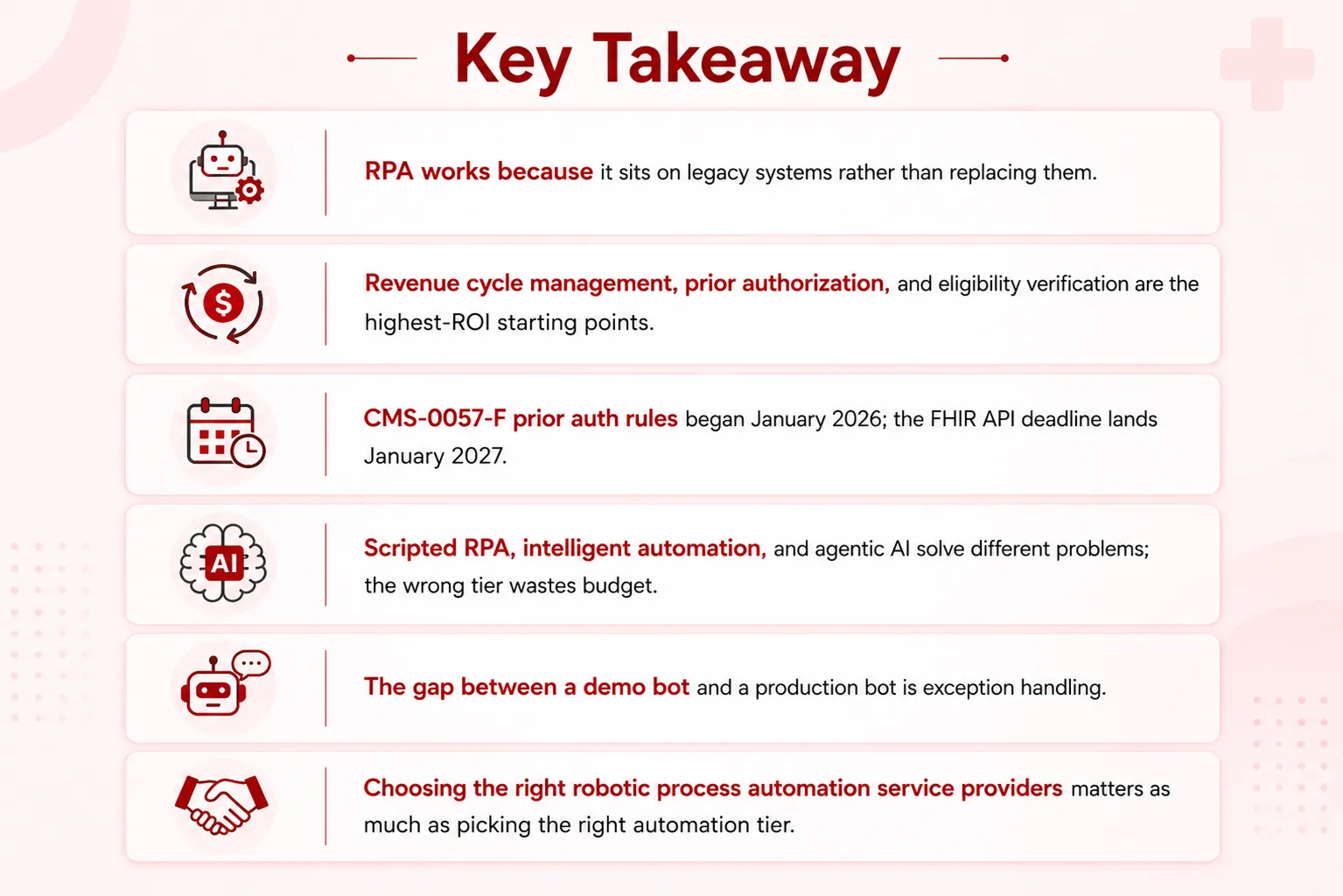
Robotic process automation in healthcare is not one decision. It is three: what to automate first, how far up the intelligent-to-agentic spectrum a workflow needs to go, and which platform stays flexible as healthcare technology and the healthcare market keep shifting. Organisations treating this as a one-time purchase tend to stall between a pilot and a system nobody trusts enough to scale. Treating it as an operating model change gets teams past that point faster, since CMS-0057-F will not wait.

It covers every step from patient scheduling and insurance verification through claims processing, payment posting, and denial management, tracking the full financial journey of one patient encounter.
Business process automation coordinates entire workflows across systems and teams, while robotic process automation focuses narrowly on repetitive, rule-based tasks within one application, like data entry.
Examples include automated insurance eligibility checks, claims processing bots, appointment reminder systems, medical record data entry, and prior authorization submissions, each replacing manual administrative work.
Look for robotic process automation service providers offering healthcare-specific RPA consulting services, genuine healthcare digital transformation consulting experience, and a record among top RPA consulting companies.
Healthcare RPA follows fixed scripts for repetitive tasks, while AI automation in healthcare, including agentic AI, makes context-aware decisions on unstructured data and handles genuine exceptions.


.webp)
.webp)
.webp)

BuildNexTech empowers businesses with expert web development, app development, and cloud migration services.


.webp)
.webp)
