

.webp)
A fast-growing fintech company came to us with three dashboards and one board deck, each reporting a different number for "active users." Finance read a warehouse column one way, product read it another, and nobody could say which was right. No shared semantic model defined what "active user" meant, so three defensible answers reached the board.
This is your semantic model guide to the decisions that matter: What a semantic model is, how it's structured, and why it's now foundational to trustworthy AI. Microsoft Power BI semantic models already support ad hoc analysis for tens of millions of users; AI agents are next in line to query them.
What Is a Semantic Model?
A semantic model defines what your data means, not just how it's stored. Think of it as a translation layer: A column labelled amt becomes "net revenue, after refunds, in USD," a definition every team and every tool can rely on. It turns raw tables into shared business language, so a number means the same thing everywhere it appears.
How a Semantic Model Differs from a Traditional Data Model
A data model and a semantic model solve different problems, and confusing them is where projects stall.
- A data model is built for a database engine: Tables, columns, keys, and joins, optimised for storage and speed.
- A semantic model is built for people and tools: Entities, metrics, and relationships that carry business meaning.
- One describes structure; the other describes meaning.
Both are necessary, and neither replaces the other. The semantic model reads from the data model, adding context a database was never designed to hold. Skip the data model, and there is nothing to query. Skip the semantic model and every query means something slightly different depending on who wrote it.
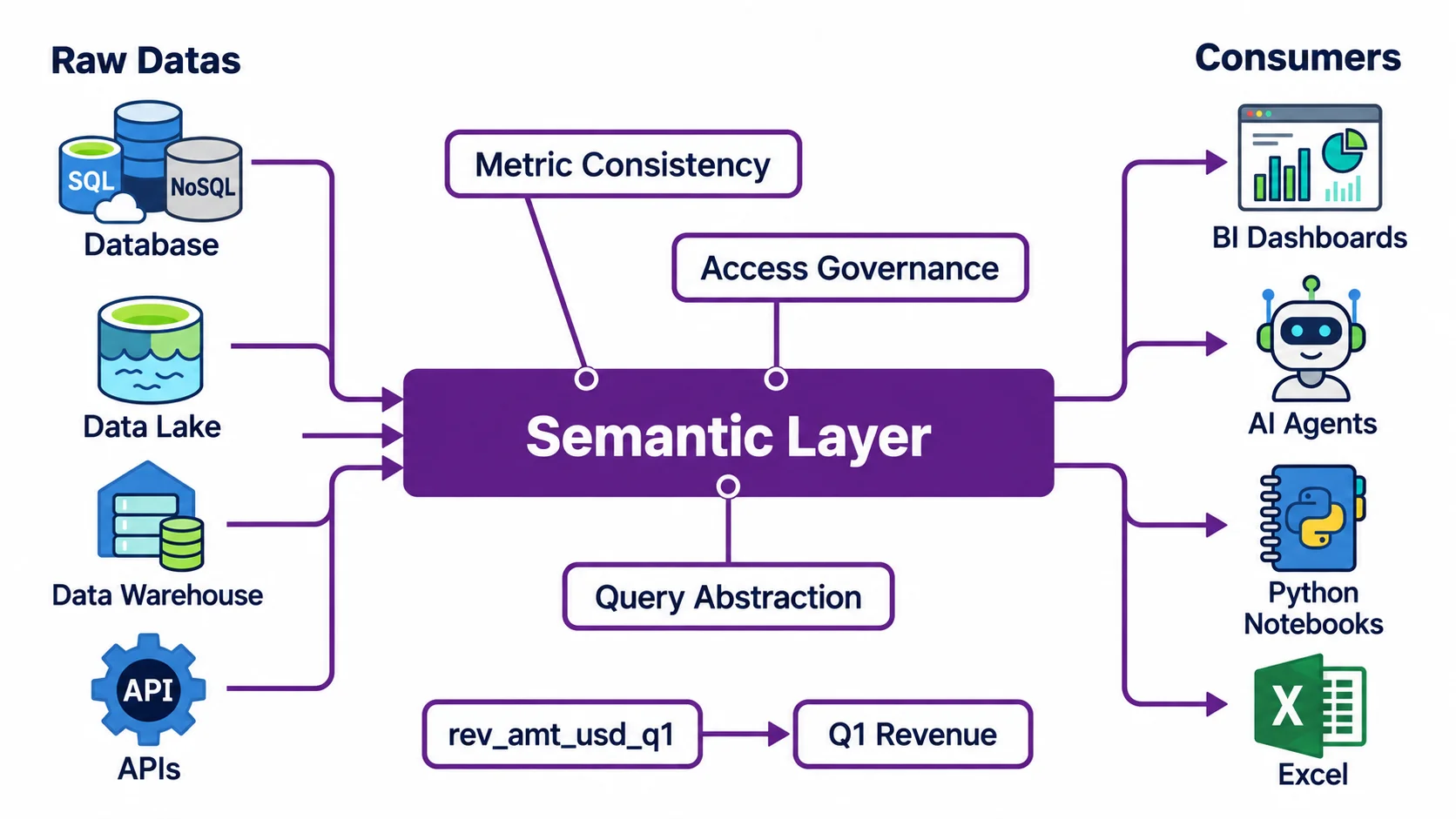
The Core Architecture of a Semantic Model
Most enterprise semantic models are built across three layers, and each one serves a different audience.
Physical Layer
The physical layer is the foundation, mapping directly to the warehouse.
- Source tables, columns, and joins live here, usually organised around a star schema.
- This layer mirrors what already exists in the database, nothing more.
- Engineers and data architects work at this level, connecting the model to real tables.
Nothing about business meaning happens yet; the physical layer tells the model where raw data physically sits.
Logical Layer
The logical layer is where the model earns its name.
- Business logic, calculations, and hierarchies get defined once, instead of being rebuilt inside every report.
- A metric like "net revenue" is calculated once and reused everywhere.
- Relationships between entities, like customer to order, are also defined here.
This is the layer most teams underinvest in. Skipping it does not remove the calculations; it scatters them across dozens of reports, each drifting further apart.
Presentation Layer
The presentation layer is what end users actually see.
- Named subject areas and friendly labels replace cryptic table and column names.
- A field called dim_active_flag becomes "Active Customer" here, nothing technical.
- This is the only layer most business users ever interact with directly.
Get this layer right, and self-service analytics genuinely works, because people find what they need without understanding how the warehouse is built.
Vocabulary overlaps here: Semantic modelling, semantic data modeling, and a semantic data platform describe the same discipline of semantic modeling, defining data semantics once, the basis of semantic analytics rather than an inert semantic database.
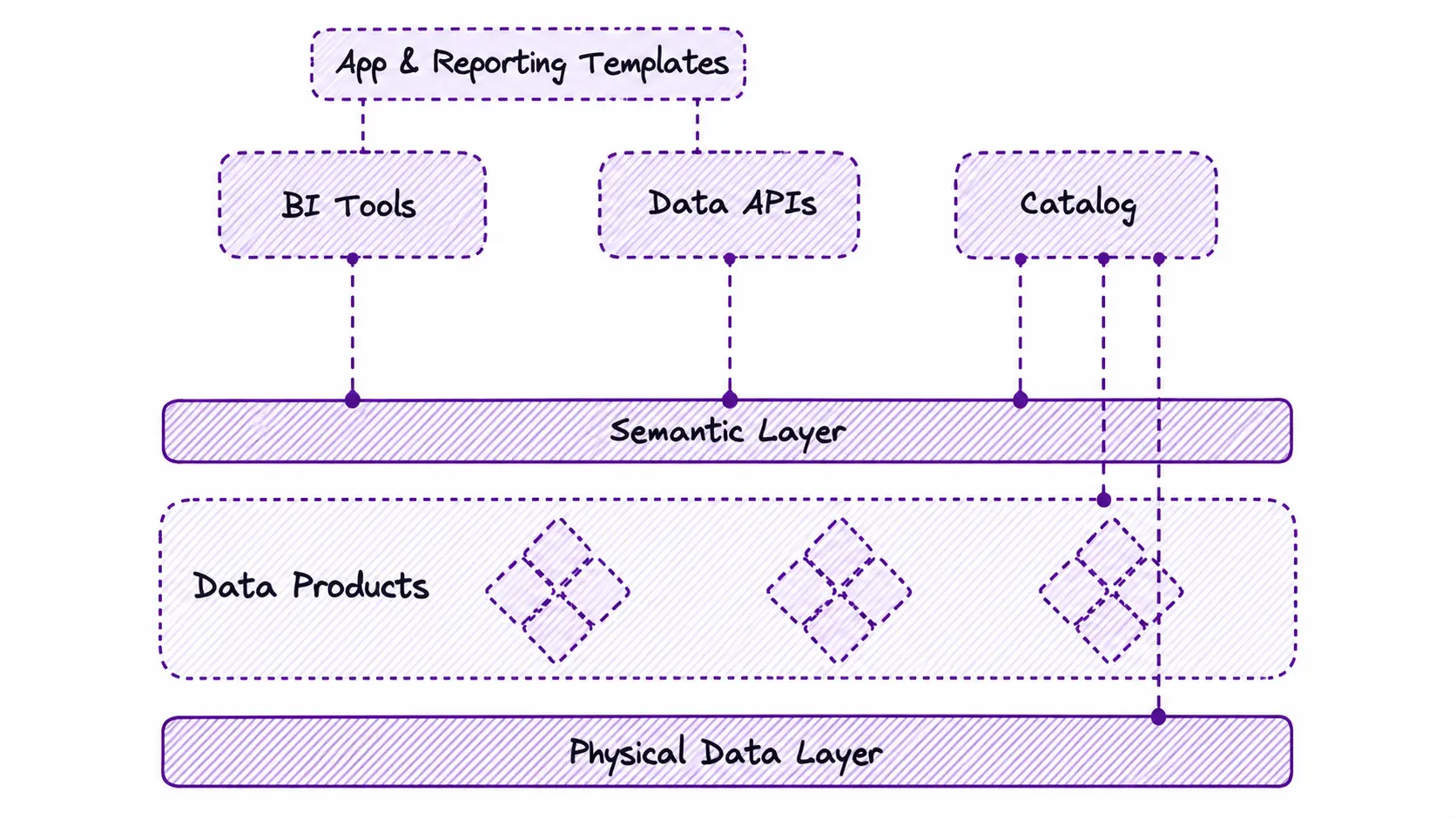
Key Components: Tables, Relationships, and Measures
Every semantic model is built from five components, and understanding them makes the rest of this guide easier to follow.
- Entities: The core business objects, like customer, order, or subscription.
- Measures: The numbers people actually ask for, like revenue, churn rate, or Customer Lifetime Value.
- Dimensions: How those measures get sliced, by region, product, or month.
- Relationships: The join paths connecting entities, and the most common source of a broken model.
- Access rules: Who is allowed to see what, including row-level security.
Relationships deserve extra attention. A join modelled as many-to-many instead of one-to-many can silently double a revenue figure, and it can go unnoticed for months before anyone questions the number.
These components sit on real infrastructure: Data sources spanning operational databases, data warehouses, and data lakes, catalogued through data catalogs, often in formats like Apache Iceberg via AWS Glue, with data marts and Data Vault handling departmental and historised data, plus data source systems feeding it upstream.
Semantic Model vs. Semantic Layer vs. Dataset
A semantic model, a semantic layer, and a dataset are used interchangeably, which is where confusion starts: In Power BI specifically, "dataset" was simply the old name; Microsoft renamed it "semantic model" in 2023, so the semantic model vs dataset question, or the Power BI semantic model vs dataset question, is really a naming change, not two different things.
- Semantic model: The governed artifact, definitions, and metrics.
- Semantic layer: The delivery system, tools like the dbt Semantic Layer or Cube, often layered on dbt Cloud and existing dbt transformations.
- Dataset: The legacy Power BI term, pre-2023.
Which one fits your situation?
- Building definitions for the first time? Start with the semantic model.
- Definitions exist but need serving across several tools? You need a semantic layer.
- Working purely inside Power BI? The model, on its own, is enough.
Semantic Models in Power BI and Microsoft Fabric
A Power BI semantic model sits between raw sources and every report built on top of it, so one governed definition powers dashboards across a team. Microsoft Fabric extends this further, turning the model into a shared, governed asset across an entire organisation rather than one workspace.
Three modes decide how that model connects to data:
- Import mode caches data in memory for speed.
- DirectQuery queries the warehouse live, trading speed for real-time freshness.
- Composite models blend both, importing fast-moving tables while querying larger ones live.
Underneath, this runs through SQL Server Analysis Services, with calculations written in DAX and models increasingly defined as code, in YAML or other machine-readable formats, with a scheduled data refresh keeping figures current.
Business Use Cases for Semantic Models
Three concrete jobs justify the investment in a semantic model, and most companies only get around to the first one.
Self-Service Analytics and a Single Source of Truth
One governed model lets multiple teams build reports without re-deriving the same logic. A metric certified once, centrally, means two analysts working from the same warehouse stop producing two different "correct" answers. Business analysts and data science teams query the same definitions instead of maintaining shadow copies, which is what self-service analytics actually looks like: Everyone building from one trusted, single source of truth.
AI-Ready Data for Copilot and LLM-Powered Consumption
An AI agent pointed at raw tables has to guess what a column means on every prompt, and a wrong guess does not look like an error. It looks like a confident, wrong answer. A semantic model changes that: An agent selects a certified metric by name, "net revenue after refunds," instead of inventing a join and hoping, which is what makes its answer explainable and consistent.
Generative AI, AI assistants, and RAG applications depend on this knowledge layer, encoding concept hierarchies and ontology design into a Metadata Plane that keeps answers traceable, part of the AI democratization semantic content makes possible.
Centralized Governance and Consistent Metrics Across Teams
Without one governed model, marketing and finance will report two different revenue numbers off the same tables. It's also a Data mesh building block, each domain owning its slice, which is what real data democratization requires, and ties into broader data governance practice.
Best Practices for Designing a Semantic Model
A handful of practices separate semantic models that stay trustworthy from ones that quietly decay within a year.
- Define models as code, in version control, reviewed like any other production change.
- Name metrics the way the business actually talks, not the way engineers think about the schema.
- Enforce access rules, including row-level security, at the model layer, before a query runs.
- Assign a named owner and a regular review cadence.
- Document relationships explicitly, since an undocumented join is what a schema change silently breaks.
Skipping data quality checks, metadata management, or semantic governance raises security risks and data consistency problems that ripple through the business processes built on top. None of this is complicated; it's just easy to skip under deadline pressure, which is exactly how a well-built model decays.
How BNXT.ai Helps Teams Build AI-Ready Semantic Models
BuildNexTech connects governed semantic definitions to the AI agents that query them, so an agent answers from a certified metric instead of guessing at a join. Rather than letting an agent improvise against raw tables, we route every data question through a defined model layer first, for the AI-native architecture, observability, and freedom from model lock-in it brings.
The engagement might start as a Power BI consulting need or a data governance question, but the work ends up the same: Turning tribal knowledge into a governed model the business trusts. Past engagements cut ambiguous-metric incidents by removing guesswork from agent-generated queries.
What a BNXT.ai Semantic Model Implementation Looks Like
- Day 1 to 3: Map the process and find where judgment calls currently break automated reporting.
- Day 4 to 7: Integrate with the existing warehouse and BI layer through API and app connectors.
- Week 2 onward: Roll out the governed model on the highest-value metrics first, with a human reviewer in the loop.
At the end of rollout, the team owns one governed, agent-readable model, not a prototype.
Who This Is For
This fits mid-to-large teams already running Power BI or a modern warehouse, now starting to expose data to AI agents or Copilot-style tools. The clearest signs: Inconsistent metrics across dashboards, an AI initiative stalling on data trust, or several BI tools reading the same warehouse differently.
Conclusion
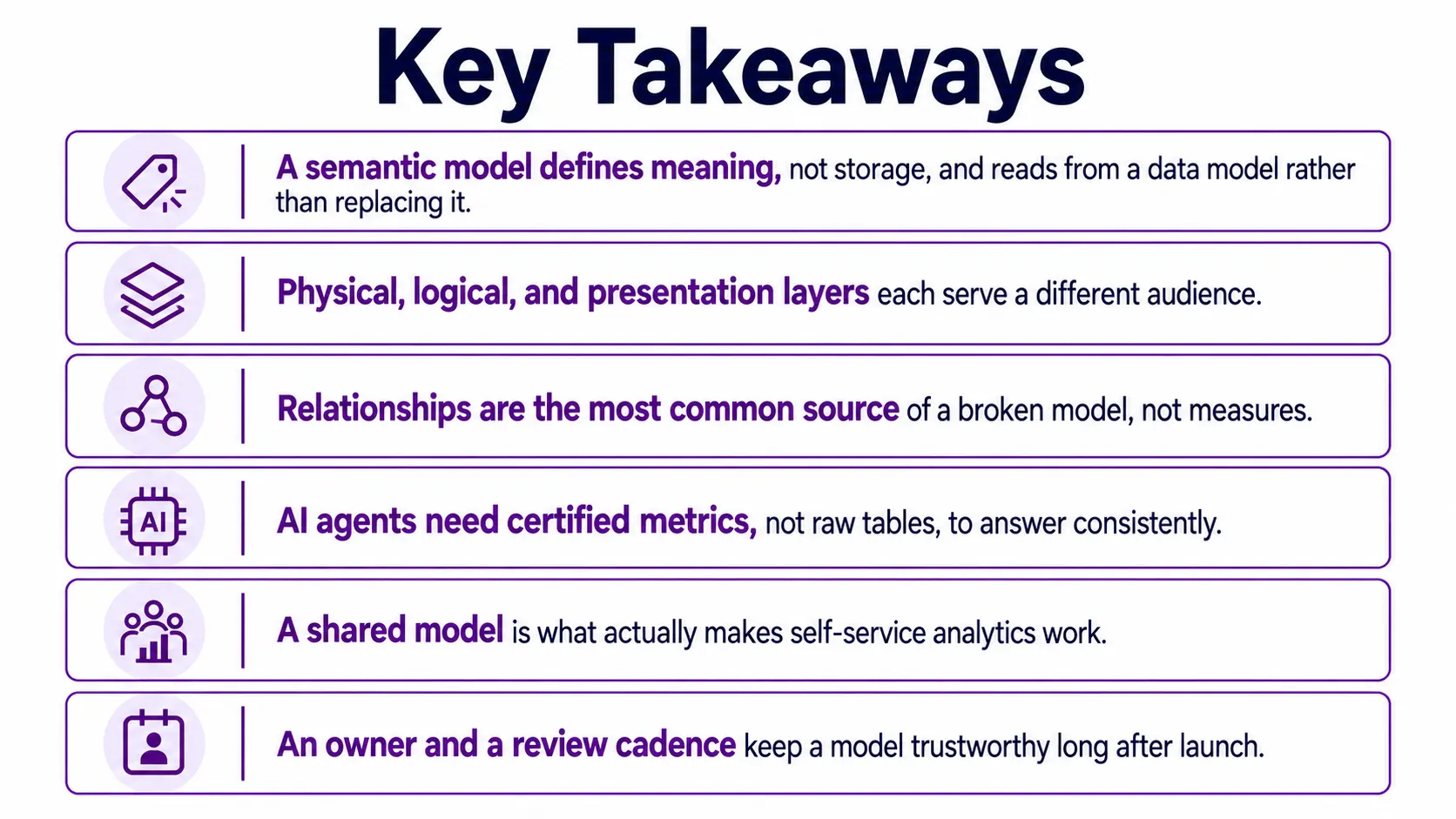
A semantic model is not a nice-to-have for teams that have already solved everything else. It decides whether a number reaching a board deck, or an answer an AI agent gives a customer, actually means what everyone assumes it means. The architecture itself is not complicated: Physical, logical, and presentation, each layer doing exactly one job well, nothing more.
The harder part was never the modelling. It is getting a business to agree, once, on what its own numbers mean, and holding that agreement in place as the warehouse keeps changing underneath it. Get that right, and every dashboard, every AI agent, and every board deck finally reads from the same page.
People Also Ask

What is data governance?
Data governance is the set of policies and processes that decide who owns data, who can access it, and how definitions stay consistent across systems.
Data governance vs data management: What's the difference?
People lump these together, but they differ. Management handles storage and movement. Governance sets the access rules that keep a model's definitions from drifting apart.
What is data modeling vs a semantic model?
Data modeling structures data for storage: Tables, keys, indexes. A semantic model sits above it, translating that structure into meaning people and AI agents can query by name.
Data governance tools or frameworks: Do you need both?
Frameworks set policy; tools and software enforce it through access control and lineage tracking. Most teams outgrow frameworks alone within a year and need a platform too.
What does a semantic model cost to build?
Cost tracks scope, not company size. A model covering a few disputed metrics takes one to two weeks; a full rollout runs six to twelve weeks, priced by definitions reconciled.


.webp)
.webp)
.webp)

.webp)
.webp)